A forklift does not need to be traveling fast to cause a serious incident. In most warehouses and plants, the greater risk is often limited sightlines – at intersections, around racking, near loading bays, and anywhere pedestrians and vehicles share space. If you are evaluating how to improve forklift visibility, the right answer is rarely a single device. It is a combination of truck condition, site layout, operator behavior, and layered safety controls.
Poor visibility is not just a driver problem. It is an operational design problem. When operators strain to see around loads, reverse through tight aisles, or approach corners with blocked views, the likelihood of collisions, near misses, pallet damage, and rack impact increases. Visibility improvements should therefore be treated as a core part of traffic risk reduction, not a minor equipment upgrade.
Why forklift visibility problems happen
Forklift blind spots are built into the job. The mast obstructs forward view, the load can block sightlines even further, and the overhead guard creates additional visual limits. Reverse travel may help in some cases, but it introduces a different set of risks, especially in pedestrian areas or when operators rely only on mirrors.
The work environment makes the problem worse. Warehouses rarely offer perfect lines of sight. High racking, stacked goods, uneven lighting, narrow aisles, dock areas, doorways, and crossing traffic all create moments where the operator sees too little, too late. In busy facilities, visibility is also affected by pressure. Operators may be moving quickly to maintain throughput, while pedestrians may assume they have been seen when they have not.
That is why improving visibility is not only about making the operator see better. It is also about making the forklift more visible to others and designing the workplace so both can react earlier.
How to improve forklift visibility with layered controls
The most effective approach starts with basic conditions and then adds engineered controls where risk remains high. This matters because not every blind spot needs advanced technology, but high-traffic conflict zones usually need more than mirrors and operator caution.
Start with the forklift itself
A poorly maintained forklift reduces visibility before it even enters the aisle. Dirty windshields, scratched panels, damaged mirrors, dim work lights, and misaligned seats all limit what the operator can detect. Regular inspections should include visibility-specific checks, not just mechanical condition.
Operator seating position also matters. If the seat is not adjusted correctly, the operator may have a restricted view of fork tips, floor conditions, or pedestrians entering from the side. On some trucks, selecting a model or mast configuration with better sightlines can make a noticeable difference, particularly in facilities where operators handle loads at varying heights or work in dense storage areas.
Lighting is another basic factor that is often underestimated. Forklift-mounted lights help, but they cannot compensate for dark aisles, glare near dock doors, or shadows in transition zones. Good facility lighting improves detection time for both operators and pedestrians.
Control load-related blind spots
Loads are often the biggest visibility obstacle. Large, tall, or unstable loads can completely block the forward view. When that happens, operators may reverse to regain sight, but reverse travel is not automatically safer. It depends on aisle width, floor condition, pedestrian activity, and whether the route has been designed for that maneuver.
If certain load types repeatedly obstruct vision, the question should shift from operator technique to process redesign. Can pallet height be standardized? Can staging rules reduce overstacking? Can travel routes be separated so loaded and unloaded movement follows different paths? Small changes in material handling rules can remove a recurring blind-spot hazard.
In some operations, camera systems provide practical support where direct sight is consistently restricted. They are especially useful when operators need better visibility of fork positioning or rear travel conditions. The trade-off is that cameras assist judgment, but they do not replace clear traffic rules or physical separation.
Improve visibility at intersections and shared zones
Most serious near misses happen in predictable places. Aisle crossings, rack ends, doorways, corners, and loading bay approaches are common conflict points because they compress movement and reduce reaction time.
Use visual warning and projection systems
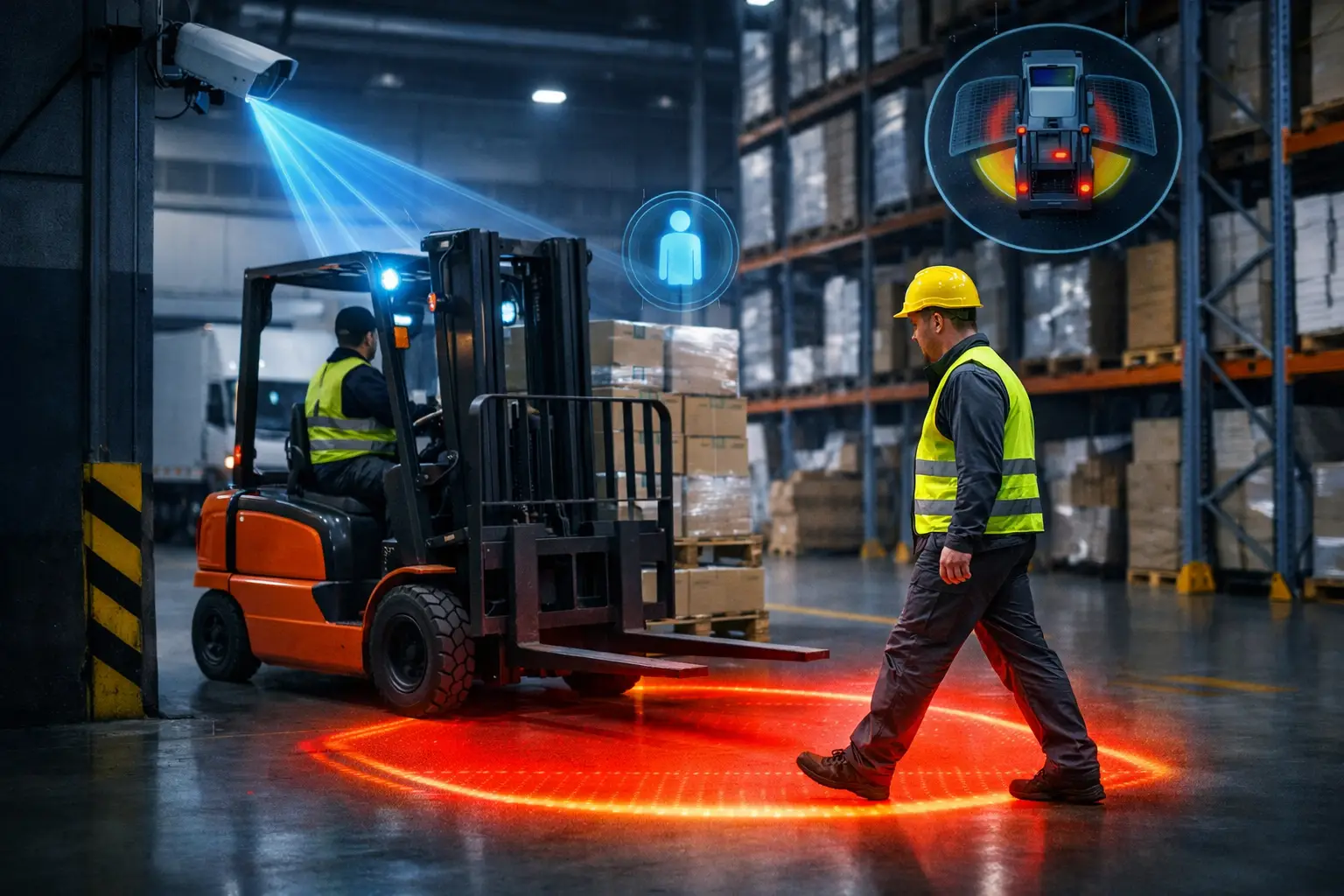
In areas where forklift and pedestrian paths intersect, projected warning lights and visual zone indicators can give earlier notice that a vehicle is approaching. Blue or red safety lights, floor projection signs, and crossing alerts help make forklift movement visible before the truck itself enters view.
These systems are useful because they address a real limitation of line-of-sight environments. A pedestrian cannot react to a forklift hidden behind racking, but a projected warning on the floor can provide advance notice. The same principle applies at blind corners and exit points from storage aisles.
Still, warning lights should not be treated as a standalone fix. In noisy, fast-moving operations, alerts are most effective when combined with disciplined traffic flow and clearly marked pedestrian routes.
Install mirrors, but know their limits
Convex mirrors remain a practical control at blind intersections and corners. They are relatively simple to deploy and can improve awareness in lower-speed zones. But they are not a complete answer. Mirrors can distort depth, become dirty, or be ignored during busy periods. In high-risk areas, they should support other controls rather than carry the entire safety burden.
A common mistake is placing mirrors without reviewing actual approach angles. If operators or pedestrians cannot see the mirror early enough, its value drops sharply. Placement should be based on movement patterns, not convenience.
Separate people and forklifts wherever possible
If your team is asking how to improve forklift visibility, it is worth asking a better question: where can you reduce the need for visual negotiation altogether?
Physical separation is often more reliable than expecting constant awareness from both operators and pedestrians. Dedicated walkways, barriers, controlled crossing points, and access restrictions reduce exposure in ways that visibility aids alone cannot. This is especially important near picking zones, staging lanes, production entrances, and loading bay areas where foot traffic is frequent.
When full separation is not possible, controlled interaction is the next best option. Marked crossings, stop points, warning beacons, and right-of-way rules help create predictable behavior. Predictability matters because even good visibility does not help much if movement is erratic.
Use smart detection in higher-risk operations
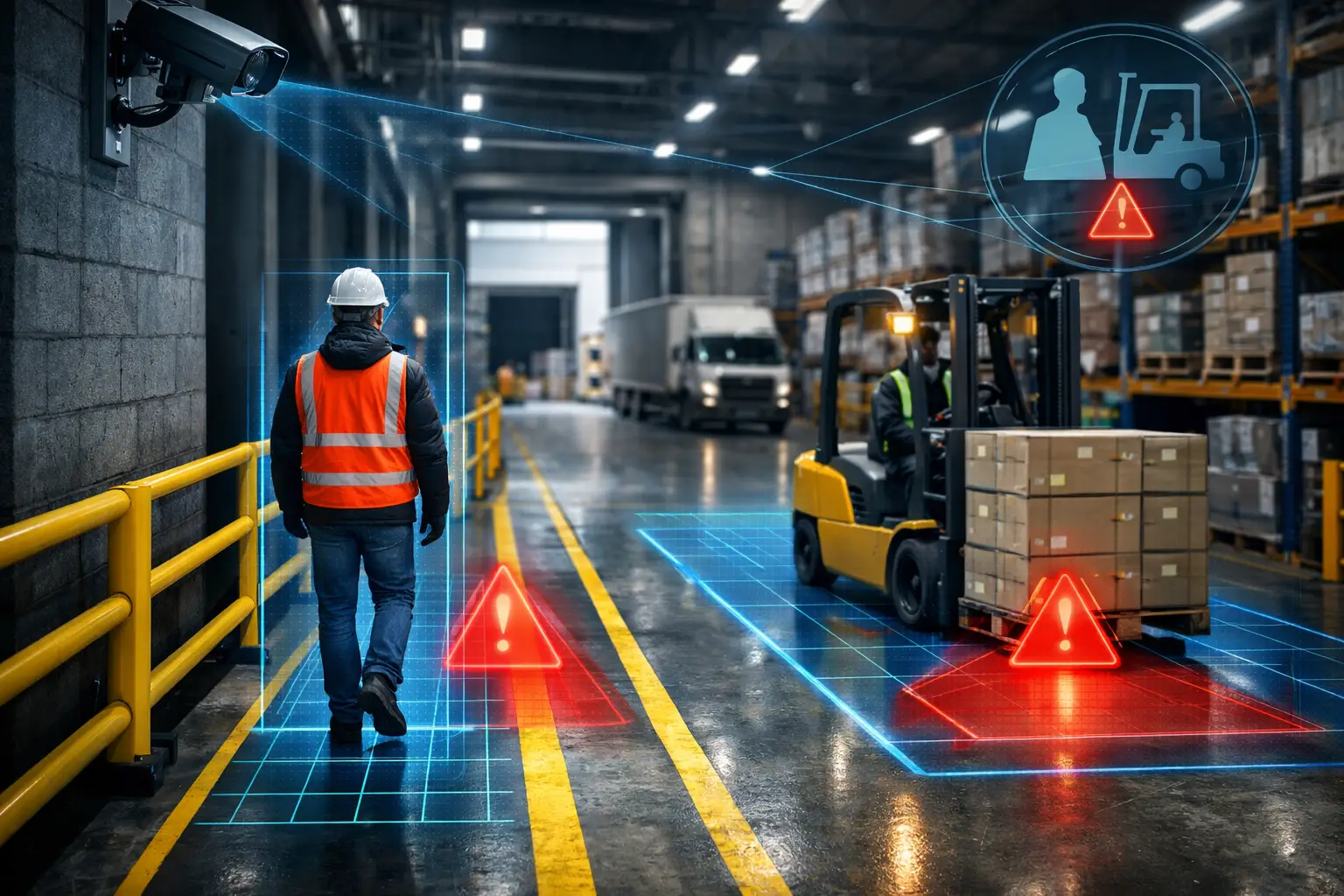
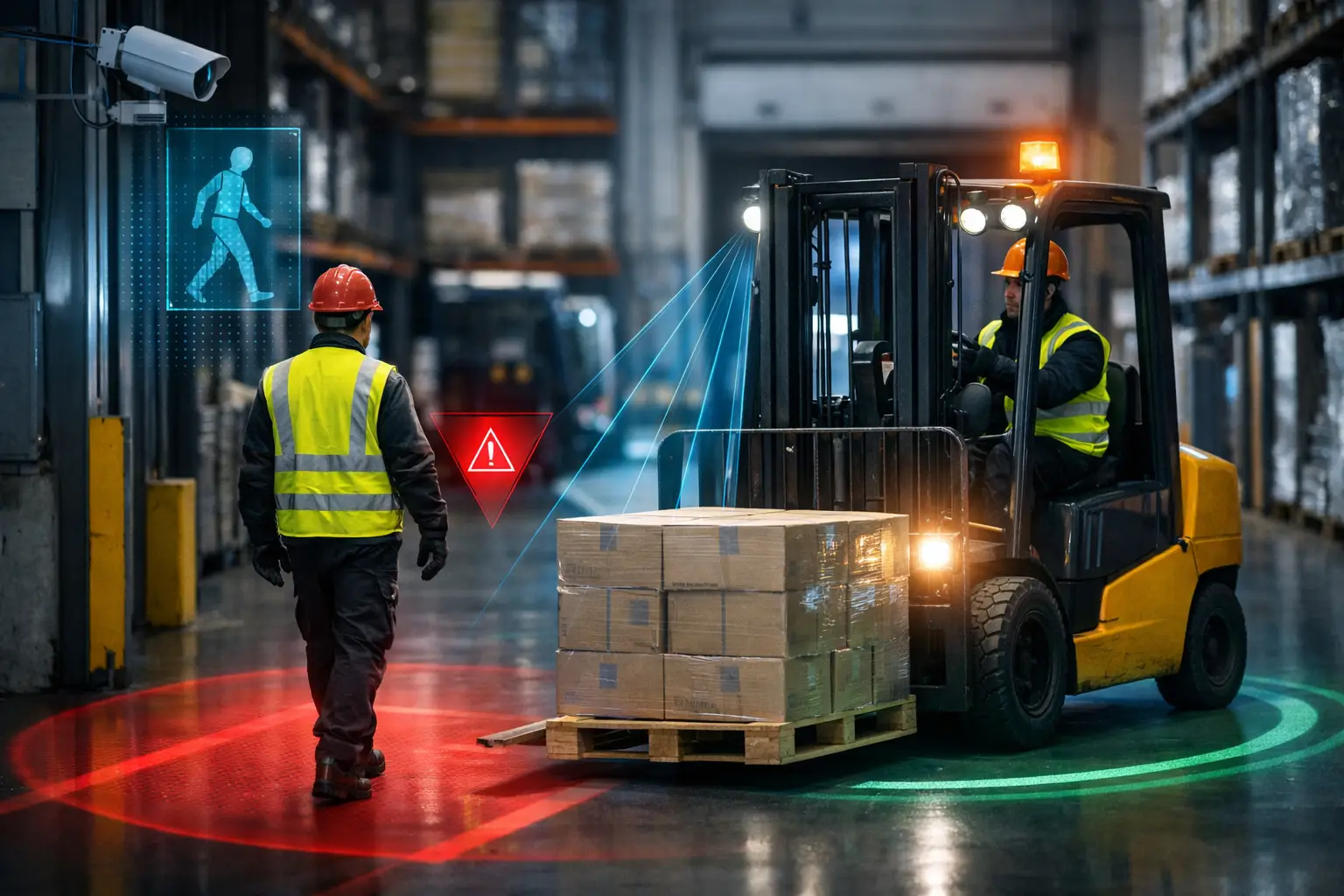
In facilities with dense traffic, multiple shifts, or recurring near misses, intelligent safety systems can strengthen visibility management. Proximity warning systems, audible and visual alerts, and Vision AI monitoring can detect risk conditions that are easy to miss in real time.
This is where a layered strategy becomes more valuable. A forklift may have lights, mirrors, and trained operators, yet risk remains high because pedestrian traffic is dynamic and sightlines change by the minute. Technology can help identify encroachment, trigger alerts, and provide a more consistent response in areas where manual controls are less dependable.
The key is matching the technology to the problem. If the issue is blind corners, projected warnings may be enough. If the issue is repeated forklift-pedestrian interaction in congested zones, detection and alert systems may be justified. More technology is not always better. Better fit is what reduces risk.
Training matters, but it cannot carry the system alone
Operator training remains essential, especially for reversing practices, horn use, intersection approach, speed control, and load handling. Pedestrians also need training so they understand exclusion zones, crossing rules, and the limits of forklift sightlines.
But training has limits. People adapt, take shortcuts, and normalize risk over time. That is why facilities with strong safety performance usually combine training with engineered controls and site design changes. They do not rely on memory and caution alone.
A practical site review often reveals the gap. If a location depends on operators honking at every blind corner because there is no better control in place, the system is asking people to compensate for a design weakness.
Measure visibility risk like an operational issue
Visibility problems leave evidence long before a serious accident. Near misses at intersections, frequent sudden stops, rack scrapes, damaged pallets, horn overuse, and repeated pedestrian complaints all indicate that drivers are operating with limited visual confidence.
Treat these signals as data. Walk the routes. Observe different shifts. Review where operators reverse most often and where pedestrians hesitate or cut across travel paths. The goal is to identify where sightlines break down and which controls will make the greatest difference.
For many organizations, the best results come from a phased plan: fix lighting and housekeeping, improve markings and mirrors, address load-related blind spots, then add intelligent warning or detection systems at high-risk points. That sequence keeps investment practical while targeting the places where visibility failure creates the greatest exposure.
Every worker deserves to return home safely every day. Better forklift visibility helps make that possible, but only when it is treated as part of a wider traffic safety strategy built around real operating conditions, not assumptions.