
A warehouse rarely gives you much warning before a safety problem becomes an operational problem. A near miss at a blind corner, a damaged rack upright, or a trailer shifting at the dock can look minor in the moment. Then production slows, equipment is sidelined, and people are put at risk. That is why a warehouse safety audit checklist matters – not as paperwork, but as a practical tool for finding weak points before they turn into incidents.
For warehouse managers, EHS leaders, and operations teams, the value of an audit is simple. It helps you see whether your safety controls actually match the way work gets done on the floor. The best audits do not just confirm compliance boxes. They reveal traffic conflicts, equipment exposure, housekeeping breakdowns, and loading bay hazards that can interrupt operations and harm people.
What a warehouse safety audit checklist should actually do
A good warehouse safety audit checklist should help you answer three questions. Where are people exposed to preventable risk? Which controls are weak, missing, or no longer effective? And what needs immediate correction versus longer-term engineering improvement?
That distinction matters. Some issues can be fixed quickly through layout changes, clearer markings, or better work practices. Others point to deeper exposure that calls for physical separation, warning systems, rack protection, dock safety controls, or monitoring technology. If your checklist only captures obvious housekeeping issues, it is too narrow.
An effective audit also reflects how the site operates at different times. A warehouse at 10 a.m. may look controlled. The same warehouse during shift change, peak outbound activity, or trailer loading may reveal very different risks. Audit timing, route, and observation points all affect what you find.
Core areas to include in a warehouse safety audit checklist
Traffic management and pedestrian interaction
In many facilities, the highest exposure sits where forklifts, reach trucks, pallet jacks, and pedestrians share space. Your audit should examine whether vehicle routes are clearly defined, pedestrian walkways are visible and protected, and intersections are controlled where sightlines are poor.
Do not stop at painted floor lines. Check whether workers actually follow the intended routes and whether drivers have enough time and distance to react. If foot traffic regularly crosses active forklift lanes, the issue is not worker behavior alone. It may be a layout problem.
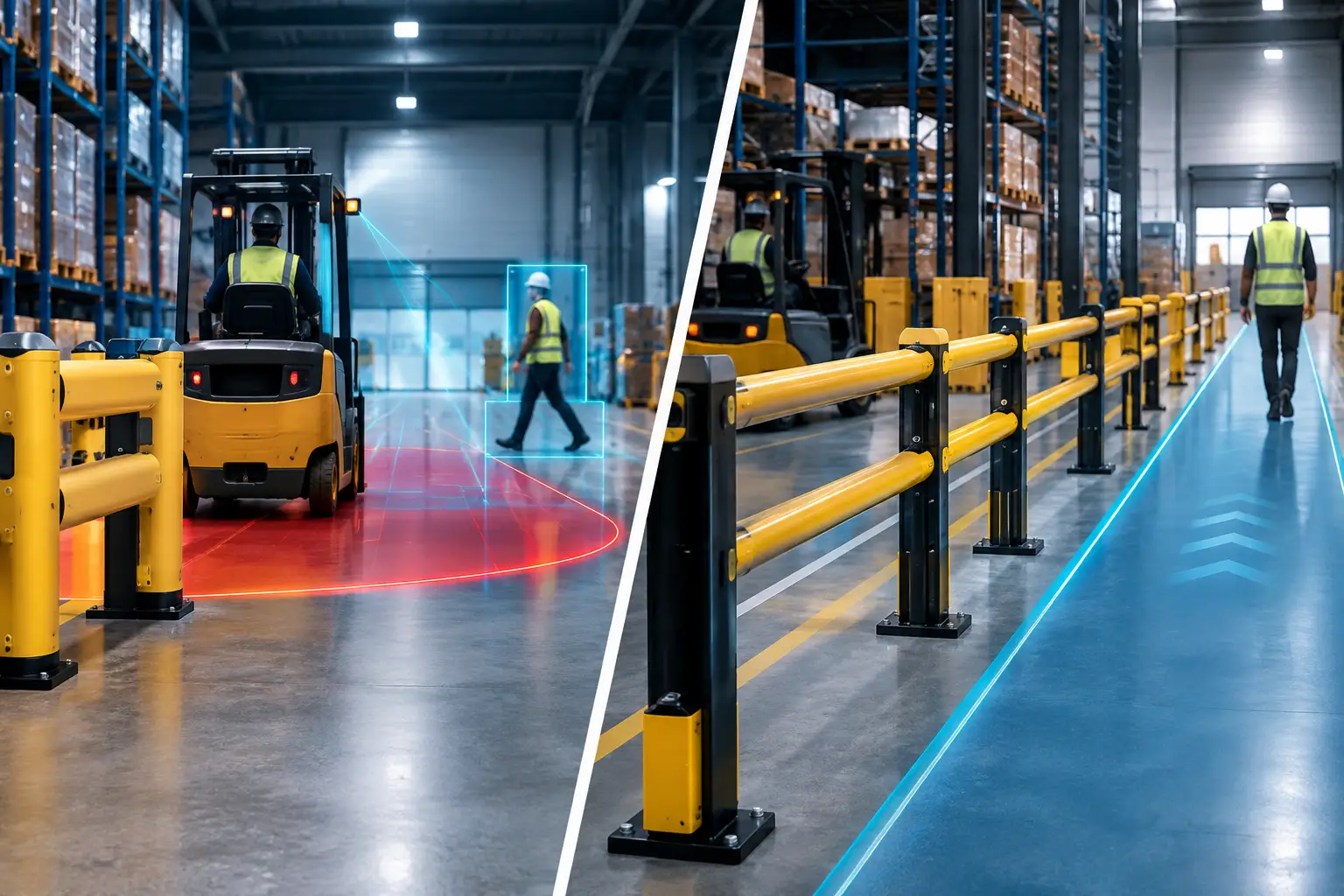
This is also where technology can make a measurable difference. In high-traffic areas, visual alerts, proximity warnings, safety floor projection, and AI-based monitoring can strengthen awareness where mirrors and signage are not enough. The right control depends on traffic density, line of sight, speed, and the consequences of a collision.
Forklift operating zones and equipment condition
A checklist should review more than whether forklifts appear functional. Look at how they are used, where they travel, and what environmental conditions affect safe operation. Damaged flooring, congested staging zones, overloaded routes, and charging areas with poor organization all increase exposure.
Observe speed behavior in practice. If operators consistently move too fast in a given aisle or corner, that often signals unrealistic workflows or poor route design rather than an isolated discipline issue. The same applies to horn use, reverse travel, and parking habits.
Equipment damage trends deserve attention as well. Repeated impacts on doors, barriers, columns, or rack legs usually point to a control gap. Audits should document these patterns, because they help justify engineering changes before damage escalates into downtime or injury risk.
Racking, storage discipline, and impact exposure
Storage systems are easy to take for granted until damage accumulates. During an audit, inspect uprights, beam connections, load conditions, aisle clearance, and the presence of rack protection in high-impact zones. Even minor visible deformation should trigger closer review.
Storage discipline is just as important. Overhanging pallets, unstable stacking, blocked access, and inconsistent load placement all increase the chance of product fall, impact, or operator error. In fast-moving warehouses, these conditions often develop gradually. That is why regular audits work better than occasional reactive inspections.
If a particular rack end, column, or structure sees repeated strikes, protective barriers may be warranted. There is a trade-off, of course. Overprotecting every surface can waste budget. The smarter approach is to focus physical protection on verified impact zones and high-value assets.
Loading bay and dock safety
The dock is one of the most dynamic and hazardous parts of a facility. A warehouse safety audit checklist should examine whether trailers are properly restrained, dock areas are clearly marked, and vehicle movement is controlled during loading and unloading.
Look for gaps between process and reality. For example, a dock may have procedures in place, but if workers routinely enter trailers before proper restraint or visual confirmation, the exposure remains. The same applies to communication between forklift operators, dock teams, and truck drivers.
Check dock leveler condition, edge visibility, lighting, and the separation of people from moving vehicles. In busier facilities, warning lights, restraints, and interlocked safety processes often provide stronger control than administrative rules alone. Where turnaround pressure is high, engineered safeguards become even more important.
Floor conditions, visibility, and housekeeping
Housekeeping is often treated as basic, but it has direct impact on vehicle stability, slip exposure, and emergency access. Audits should review spills, shrink wrap debris, pallet fragments, discarded strapping, and obstructions in travel paths. A clean-looking facility can still hide localized hazards in corners, charging stations, and staging areas.
Visibility is another critical factor. Poor lighting, obstructed views at aisle ends, faded markings, and clutter near intersections all reduce reaction time. In some cases, adding mirrors or repainting lines helps. In others, active visual warnings are more effective because they respond to moving traffic rather than relying on passive awareness.
Safety controls, alerts, and real-world effectiveness
Many warehouses already have signs, mirrors, sirens, and marked lanes. The audit question is whether those controls still work under current operating conditions. Growth, layout changes, new equipment, and higher throughput can quickly make older controls inadequate.
Assess where fixed safety measures are ignored, blocked, damaged, or simply no longer visible in a busy environment. Then consider whether the site needs stronger interventions such as barriers, gate systems, intelligent alerts, proximity detection, or Vision AI monitoring to identify recurring unsafe interactions.
Not every site needs advanced technology in every zone. But high-risk areas with repeat near misses, limited sightlines, or mixed traffic often benefit from controls that do more than remind people to be careful.
How to run the audit so it finds real risk
A checklist is only as useful as the audit process behind it. Walk the warehouse during active operations, not just during quiet periods. Speak with supervisors and operators to understand where they feel pressure, where visibility is poor, and where they have seen close calls. Those conversations often reveal more than a static inspection.
It also helps to score findings by severity, frequency, and exposure. A cracked floor in a low-traffic corner may matter less than a daily pedestrian crossing at a forklift blind spot. When you rank issues this way, your action plan becomes easier to defend internally.
Photo documentation, repeat observations, and trend tracking make the audit more credible over time. If the same issue appears month after month, the message is clear. Training alone is not solving it.
Common audit mistakes that weaken results
One common mistake is treating all findings as equal. When every item looks urgent, teams struggle to act. Another is focusing too heavily on worker behavior while overlooking layout, traffic design, and equipment-related causes.
There is also a tendency to audit for appearance rather than exposure. Fresh paint and tidy aisles can create a sense of control, but they do not eliminate blind intersections, unstable docks, or repeated impact points. The audit should test whether controls perform under pressure, not whether the facility photographs well.
Finally, avoid making the checklist too generic. A distribution center with intense forklift traffic has different priorities than a warehouse with frequent dock turnover or high-density racking. The checklist should reflect the operation you actually run.
Turning audit findings into safer operations
The real value of an audit comes after the walkthrough. Findings should lead to specific actions with owners, deadlines, and a clear rationale. Some actions will be immediate, such as isolating a damaged rack area or clearing blocked walkways. Others may require investment, such as installing vehicle restraints, impact barriers, pedestrian segregation, or intelligent warning systems.
This is where an engineering mindset helps. Instead of asking only how to remind people, ask how to redesign the environment so the safer action is also the easier action. That shift usually delivers better long-term results, especially in fast-moving operations where fatigue, time pressure, and routine can erode awareness.
For many warehouses, the strongest improvements come from combining operational discipline with engineered controls. That might mean reworking traffic flow, protecting key structures, improving dock control, and using monitoring technology to identify patterns that manual observation misses. SysGuard supports this kind of practical risk reduction by helping facilities connect everyday hazards to safety systems that are built for real industrial conditions.
Every audit is a chance to catch the next preventable incident while it is still just a warning sign. If your checklist helps you see the warehouse as it truly operates, it is doing its job.