A forklift can travel safely down a straight aisle for hours, then encounter its highest-risk moment in a few seconds at a corner. To optimize forklift turning zones, facilities must account for vehicle sweep, load visibility, pedestrian movement, traffic volume, and the condition of the surrounding infrastructure. A painted line alone rarely controls these risks.
Turning zones are where forklifts slow, steer, reverse, and often cross paths with people or other vehicles. These movements create blind spots and place loads, racks, walls, doors, and workers within the forklift’s operating envelope. The result can be a rack strike, product damage, pedestrian near miss, or a collision that stops an active work area.
Why Forklift Turning Zones Create Disproportionate Risk
Forklifts do not turn like passenger vehicles. The rear of the truck swings outward as the front wheels follow the curve, and the required turning space changes with truck type, load dimensions, attachment use, and travel direction. A zone that appears wide enough when empty may become restrictive when a long pallet is carried or when an operator needs to reverse to maintain visibility.
Visibility is another major factor. At intersections, operators may be looking around a load, checking for cross-traffic, monitoring overhead clearance, and responding to radio instructions or warehouse activity. Pedestrians approaching from behind racking, staging areas, or access doors can remain hidden until the last moment.
Operational pressure can make the risk worse. Peak shipping periods encourage tighter staging, temporary pallet placement, and faster vehicle cycles. These changes can quietly reduce the usable turning radius or obscure an established sightline. A well-designed zone must work under normal operating conditions and remain controlled when the facility is busy.
Start With the Actual Forklift Movement
The right design begins with observation, not assumptions. Review each turn using the largest forklift, widest load, and most demanding attachment expected in that area. Watch the complete maneuver: approach, steering input, rear-end swing, load movement, straightening, and exit. The real path is often wider than the layout drawing suggests.
Measure the vehicle’s turning specification, but do not treat the manufacturer figure as the final answer. That specification may not reflect load overhang, uneven driving behavior, or the practical clearance operators need to maneuver without clipping a rack upright or barrier. Build in a realistic margin so safe operation does not depend on perfect steering every time.
Account for Dynamic Clearance
Clearance should be assessed in three dimensions. Floor space is the obvious concern, but load height and elevated forks may create risks near doors, conveyors, low structures, or suspended services. Consider whether a driver needs room to stop and correct a turn without entering a pedestrian route or reversing into an active aisle.
The turning path should also remain clear. Pallets placed at corners are a common source of blind spots and restricted maneuvering. Even short-term staging can become permanent if no one owns the space. Assign each turning zone a clear operational purpose and prevent it from becoming overflow storage.
Separate People From Vehicle Paths
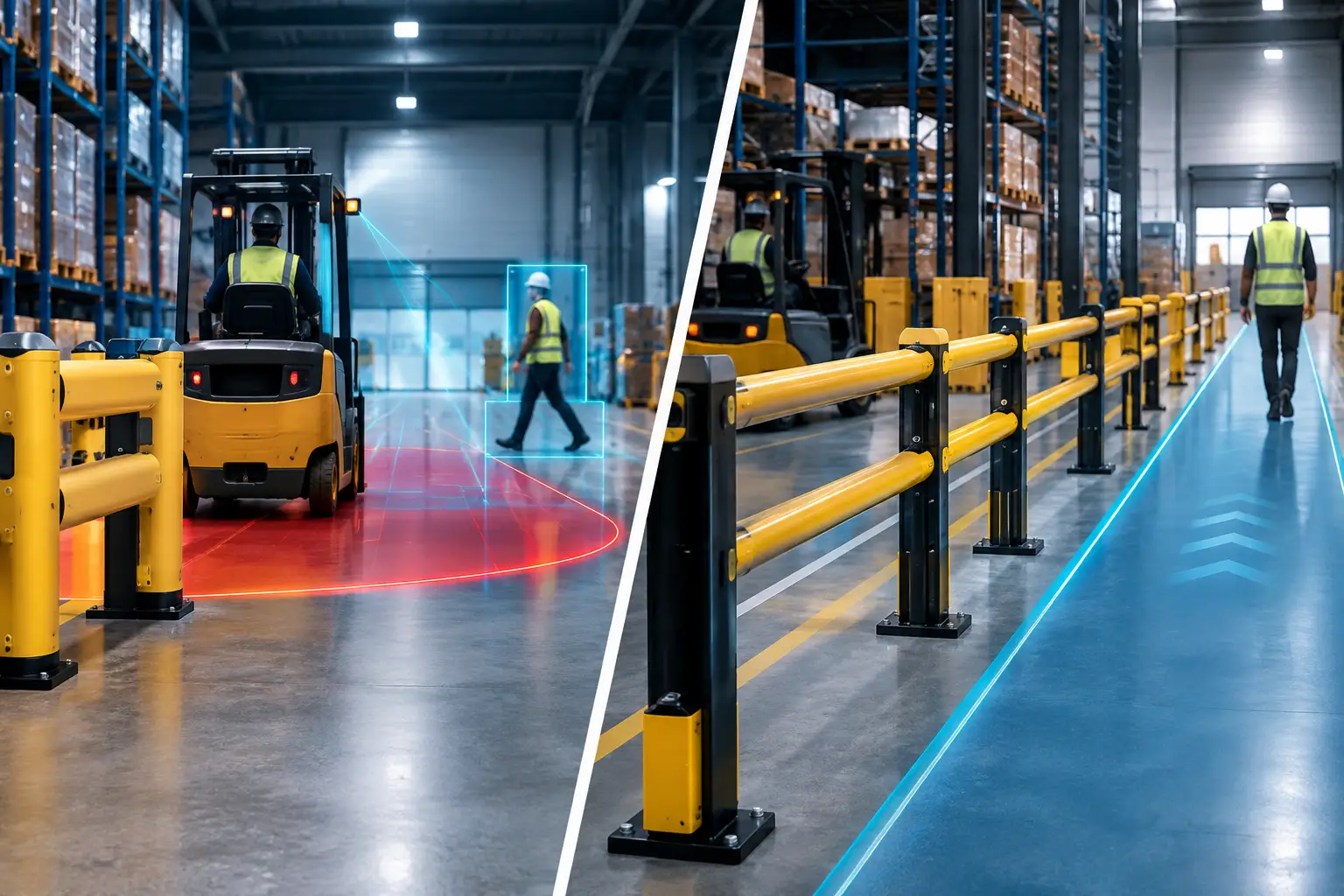
The most effective control is to prevent pedestrians and forklifts from occupying the same space at the same time. Where a pedestrian route crosses a turning zone, assess whether the route can be relocated, protected, or controlled. A walkway that cuts across the inside of a forklift turn may be convenient, but it exposes people to a vehicle’s blind side and rear swing.
Physical separation is generally more dependable than relying on awareness. Safety barriers, guardrails, and properly positioned rack-end protection can define vehicle paths while shielding pedestrian areas and vulnerable infrastructure. The design must preserve adequate turning clearance. Installing barriers too close to the path may simply exchange pedestrian risk for repeated vehicle impacts.
Where full separation is not feasible, use controlled crossing points with clear right-of-way rules, visible markings, and warning devices that suit the environment. The chosen approach depends on the frequency of crossing, line of sight, forklift speed, and whether workers routinely handle materials nearby. High-frequency mixed traffic calls for stronger controls than an occasional crossing in a low-activity area.
Improve Sightlines Before Adding Warnings
Warning technology can support a safer turn, but it cannot compensate for a poorly planned layout. First, remove avoidable obstructions. Keep corners free of staged pallets, waste containers, promotional displays, and parked equipment. Review rack-end signage, door frames, and stacked materials that may block an operator’s view of approaching traffic.
Convex mirrors can help at selected blind corners, especially where a driver needs early visibility of an intersecting aisle. However, mirrors require careful placement, regular cleaning, and realistic expectations. They can distort distance and may not be effective where operators travel quickly or lighting conditions change sharply.
Lighting also matters. A dark aisle opening, glare from a loading door, or strong contrast between indoor and outdoor areas can delay hazard recognition. Ensure turning zones are adequately illuminated and that visual floor markings remain legible after routine cleaning and vehicle traffic.
Use Active Alerts Where They Add Control
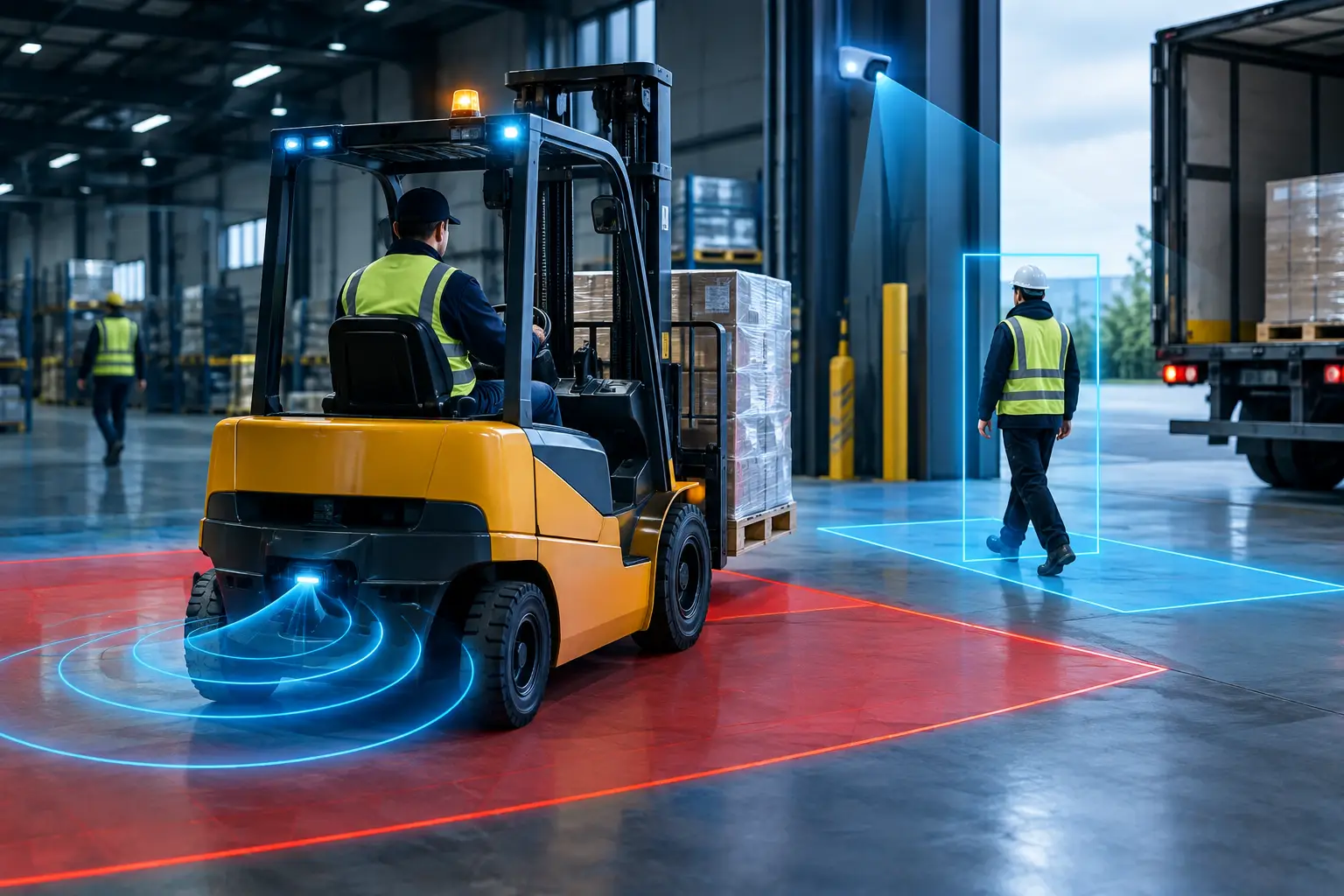
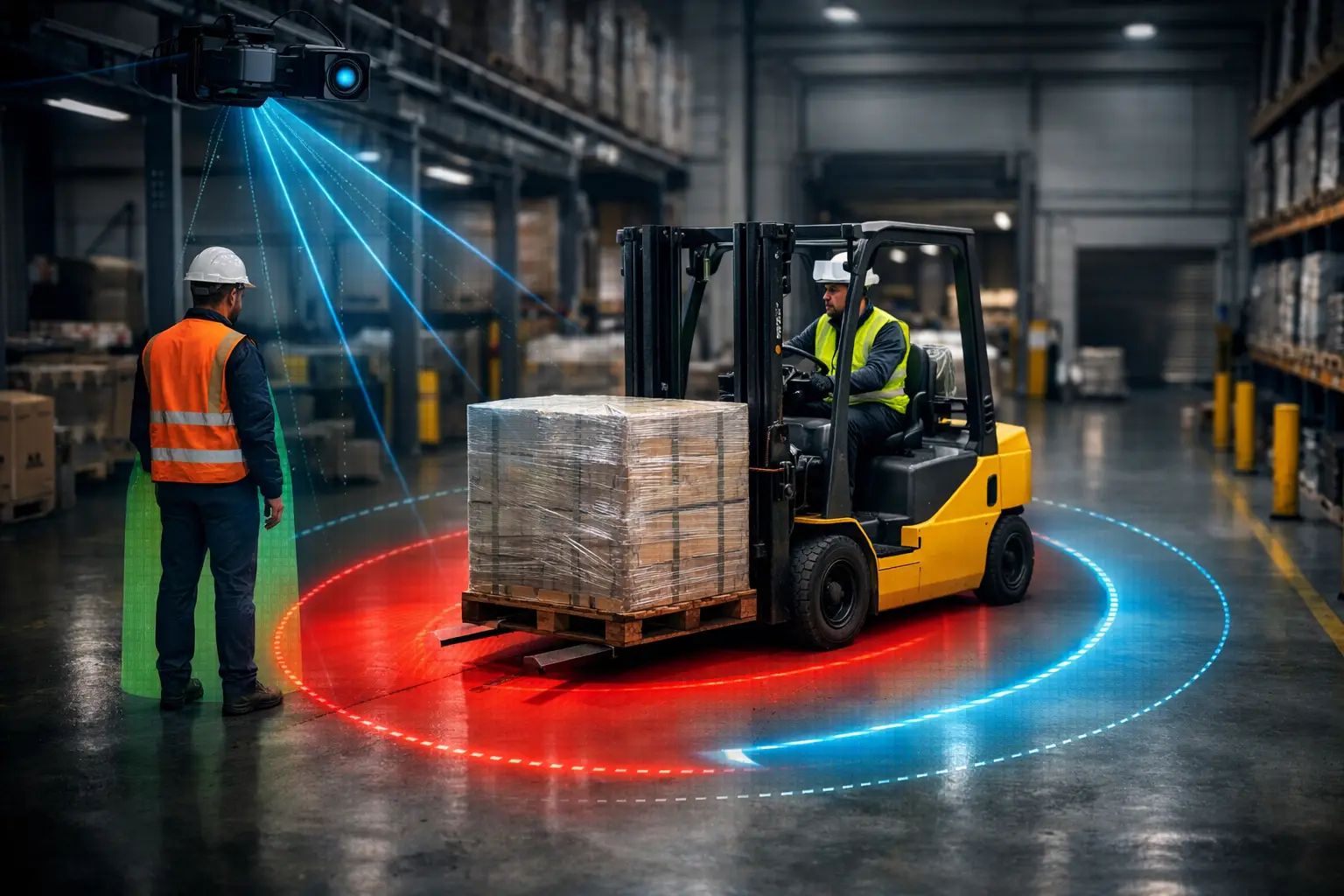
At high-risk intersections, active warning systems can provide an additional layer of protection. Blue or red safety floor projections can alert pedestrians to an approaching forklift before the vehicle enters their line of sight. Audible and visual alerts can call attention to movement at blind corners, while proximity warning systems can identify potential interactions between vehicles and people.
These technologies work best when they are matched to a defined hazard. An alert at every corner can create noise fatigue, causing workers to ignore signals that matter. Focus investment on locations with repeated near misses, restricted visibility, dense vehicle traffic, or pedestrian access that cannot be fully separated.
Vision AI safety monitoring can also help facility teams identify recurring unsafe behaviors and congestion patterns. For example, monitoring may show that drivers consistently cut a corner because staging has narrowed the route, or that pedestrians use an unplanned shortcut at shift changes. This information turns anecdotal concerns into evidence for layout or process improvements.
Build Turning Zones Into Traffic Management
A turning zone cannot be optimized in isolation. It is part of the facility’s wider traffic plan, including aisle direction, speed expectations, receiving activity, battery charging access, loading bay movement, and pedestrian routes. A one-way aisle system may reduce opposing traffic at a tight corner, while a revised staging process may prevent pallets from encroaching on the turning area.
Use clear floor markings to communicate the operating boundary. Mark vehicle lanes, pedestrian paths, no-storage areas, and crossing points in a consistent visual system. Markings should reinforce physical controls and operating rules, not replace them. If a no-storage box is repeatedly occupied, investigate the upstream cause rather than repainting the box.
Consider whether the zone needs a stop control, yield control, or reduced-speed approach. The answer depends on available sight distance and traffic volume. Requiring every forklift to stop at every minor turn may reduce productivity without improving attention, while a blind high-traffic intersection may justify a formal stop point and active warning system.
Protect the Assets Around the Turn
Rack ends, building columns, door frames, conveyors, and safety barriers are frequently damaged in poorly designed turns. These impacts are more than maintenance problems. A damaged rack upright can affect storage integrity, and a bent barrier may no longer provide its intended separation.
Place rack protection and impact barriers where they protect critical assets without narrowing the operating path. Choose protection that can withstand the likely impact energy for the vehicle type and speed in that area. Frequent minor strikes are also useful risk data. They may indicate inadequate clearance, poor visibility, insufficient training, or an operational flow that forces difficult maneuvers.
Inspect turning-zone protections routinely. A barrier that has absorbed an impact, loose floor markings, or a damaged mirror should trigger review before the next shift continues through the same area. Maintenance is part of the control strategy, not an afterthought.
Validate the Design With Operators
Operators understand where a route feels constrained, where loads block vision, and when traffic patterns change during the day. Include them in the assessment and test proposed changes under realistic operating conditions. Run the largest expected vehicle and load through the redesigned turn, including the approaches used during peak activity.
Track leading indicators after changes are made: near-miss reports, barrier strikes, rack damage, blocked no-storage zones, and observations of pedestrian behavior. If the same issue returns, the control may be poorly positioned or the underlying workflow may need adjustment.
A safer turning zone should not rely on extraordinary caution from skilled drivers. It should guide ordinary daily behavior toward safer outcomes, protect workers when visibility is limited, and keep equipment moving without unnecessary corrections. Every well-managed corner removes one more opportunity for an accident that was preventable.