A near miss at a warehouse cross aisle usually lasts two seconds. The investigation, downtime, and loss of confidence can last much longer. If you are evaluating how to improve forklift pedestrian safety, the real issue is not just operator behavior. It is whether your site is designed to keep people and vehicles apart, warn them early, and reduce risk when conditions change.
Forklift pedestrian incidents rarely come from a single failure. They happen when traffic routes are unclear, blind spots are accepted as normal, warning devices are too easy to ignore, and safety controls depend too heavily on workers reacting perfectly every time. That is why effective prevention starts with system design, not reminders alone.
How to improve forklift pedestrian safety at the source
The strongest control is separation. When pedestrians and forklifts share the same space, even a skilled operator with good visibility can lose sight of a person at a corner, behind a rack end, or near a loading zone. The more often people and lift trucks cross paths, the more exposure your operation carries.
Start by mapping actual movement, not just planned routes on a floor drawing. In many facilities, forklifts cut through informal shortcuts, pedestrians step into travel lanes to save time, and staging areas expand beyond their intended boundaries during peak periods. Those real operating patterns show where collision risk actually lives.
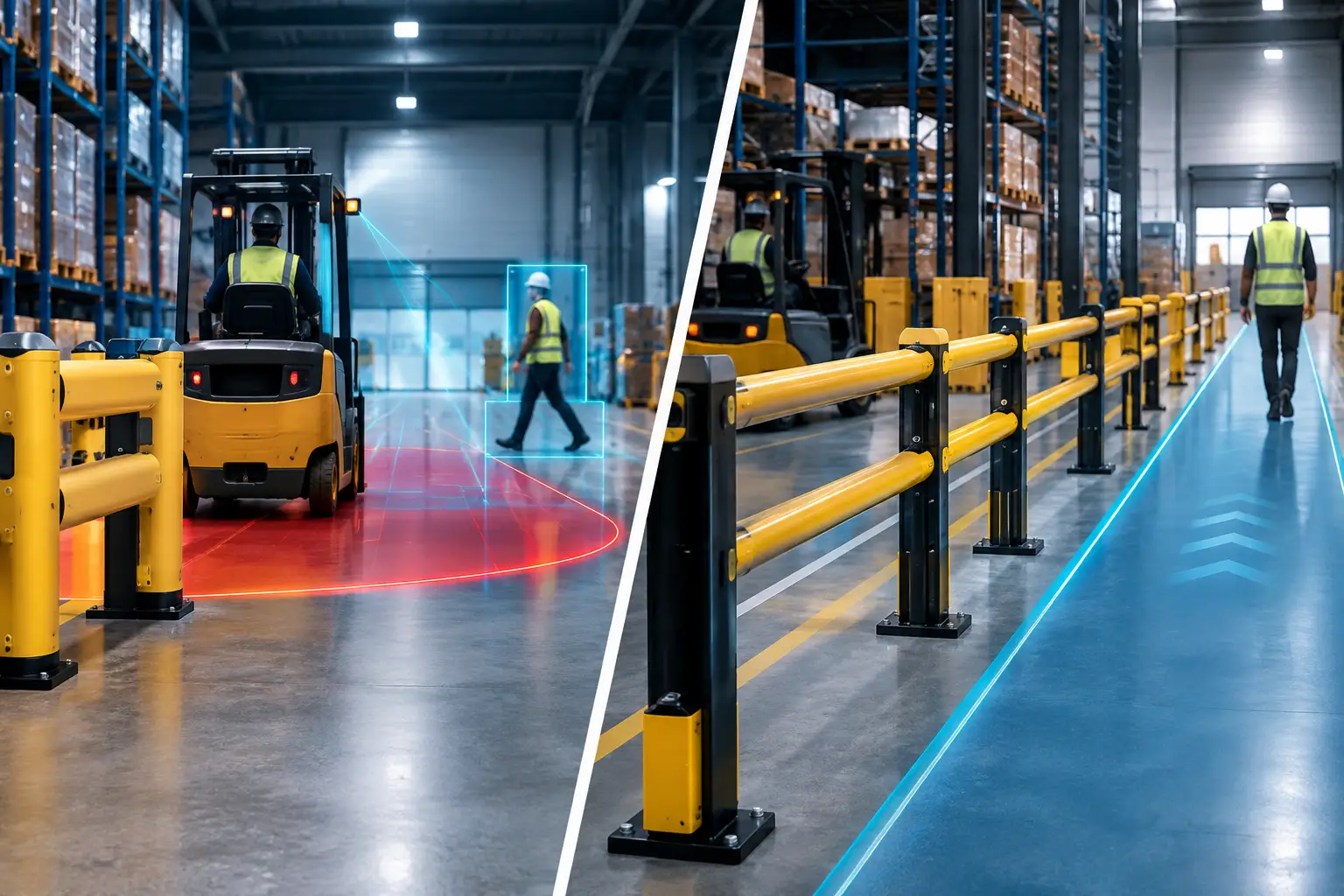
Physical segregation is usually the first improvement worth making. Barriers, guardrails, gated walkways, and protected crossing points create a clear boundary between people and mobile equipment. This matters because painted floor lines alone are often treated as guidance rather than control, especially in high-throughput environments. Visual markings still have value, but they work best when backed by a physical measure that changes behavior.
That does not mean every site needs a full rebuild. In some warehouses, selective barrier placement at rack ends, production exits, charging areas, and cross aisles can significantly reduce exposure. In tighter facilities, the trade-off is that barriers may affect maneuvering space or picking efficiency, so route design needs input from operations, engineering, and safety teams together.
Build traffic flow people can follow under pressure
Most facilities do not become unsafe because nobody thought about traffic. They become unsafe because the traffic plan does not match production reality. A route that works during light activity may fail during shift changes, replenishment peaks, trailer loading, or urgent order turnaround.
A practical traffic plan defines one-way vehicle lanes where possible, designated pedestrian walkways, controlled intersections, and crossing rules that are easy to understand during busy shifts. It should also account for temporary conditions such as overflow pallets, maintenance work, and dock congestion. If the traffic system only works when the floor is perfectly clear, it is not a real control.
Forklift speed management belongs in this discussion as well. Lower speed limits near intersections, doorways, corners, and mixed-use zones reduce stopping distance and buying even a fraction of a second can prevent contact. But posted speed limits alone are not enough. The area has to be designed to support lower speeds through lane width, visibility, warning systems, and supervision.
This is also where site-specific zoning helps. Not every area needs the same level of control. A bulk storage aisle, a pedestrian entrance, and a loading bay have different exposure profiles. Matching controls to risk makes implementation more effective and easier for teams to accept.
Treat blind spots as a design problem
Blind spots are one of the most persistent causes of forklift pedestrian risk. Corners, rack ends, trailer entrances, high stacked loads, and door transitions all reduce reaction time. Many operations accept these areas as unavoidable, but that mindset leaves too much to chance.
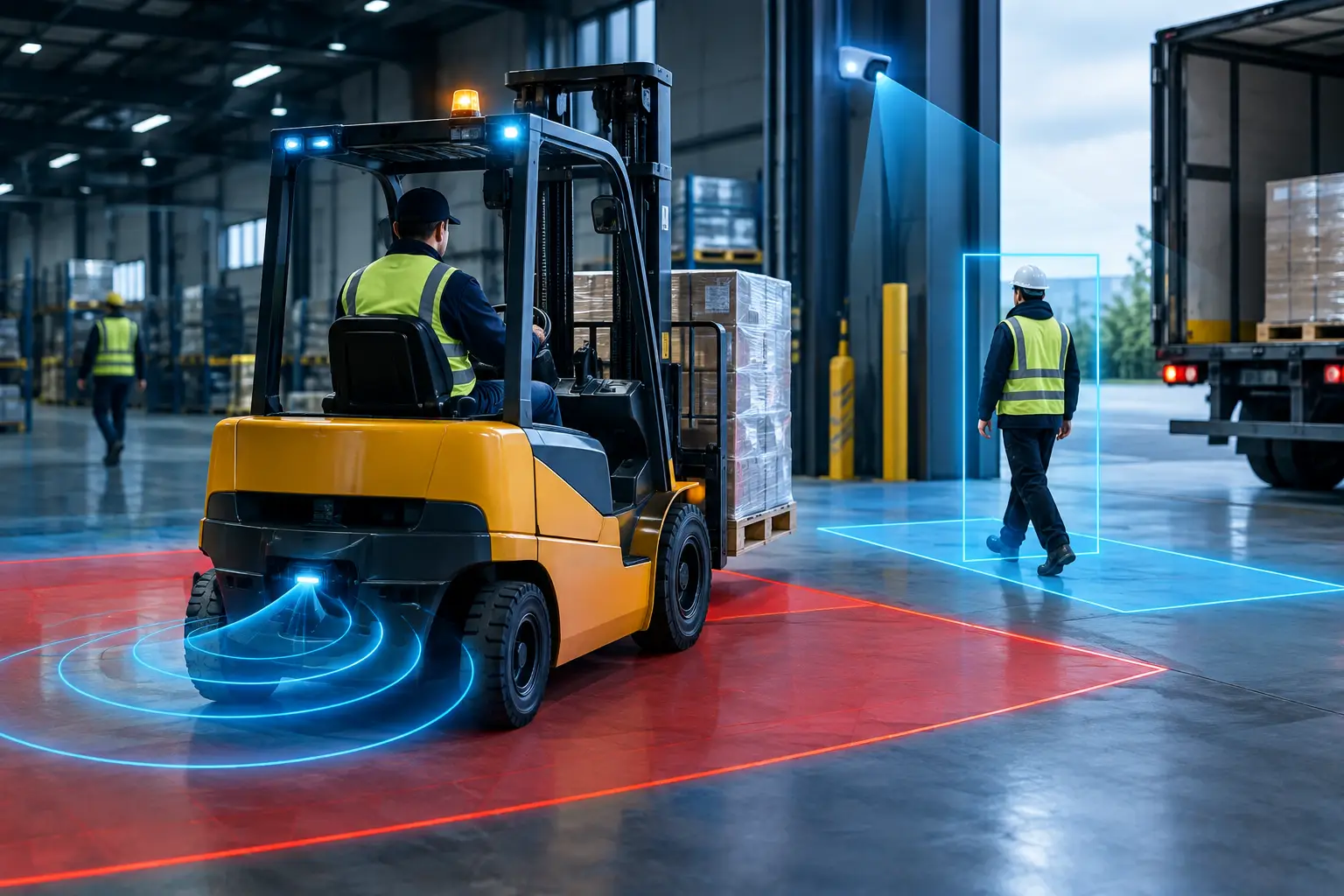
A better approach is to identify where visibility breaks down and add layered controls. Convex mirrors can help in some locations, but they depend on workers looking at the right moment. Audible and visual warning devices at intersections improve awareness, especially where forklift and pedestrian paths must cross. Safety floor projection can also reinforce caution by marking active vehicle zones or projected warning areas in a way that is more visible than worn floor tape.
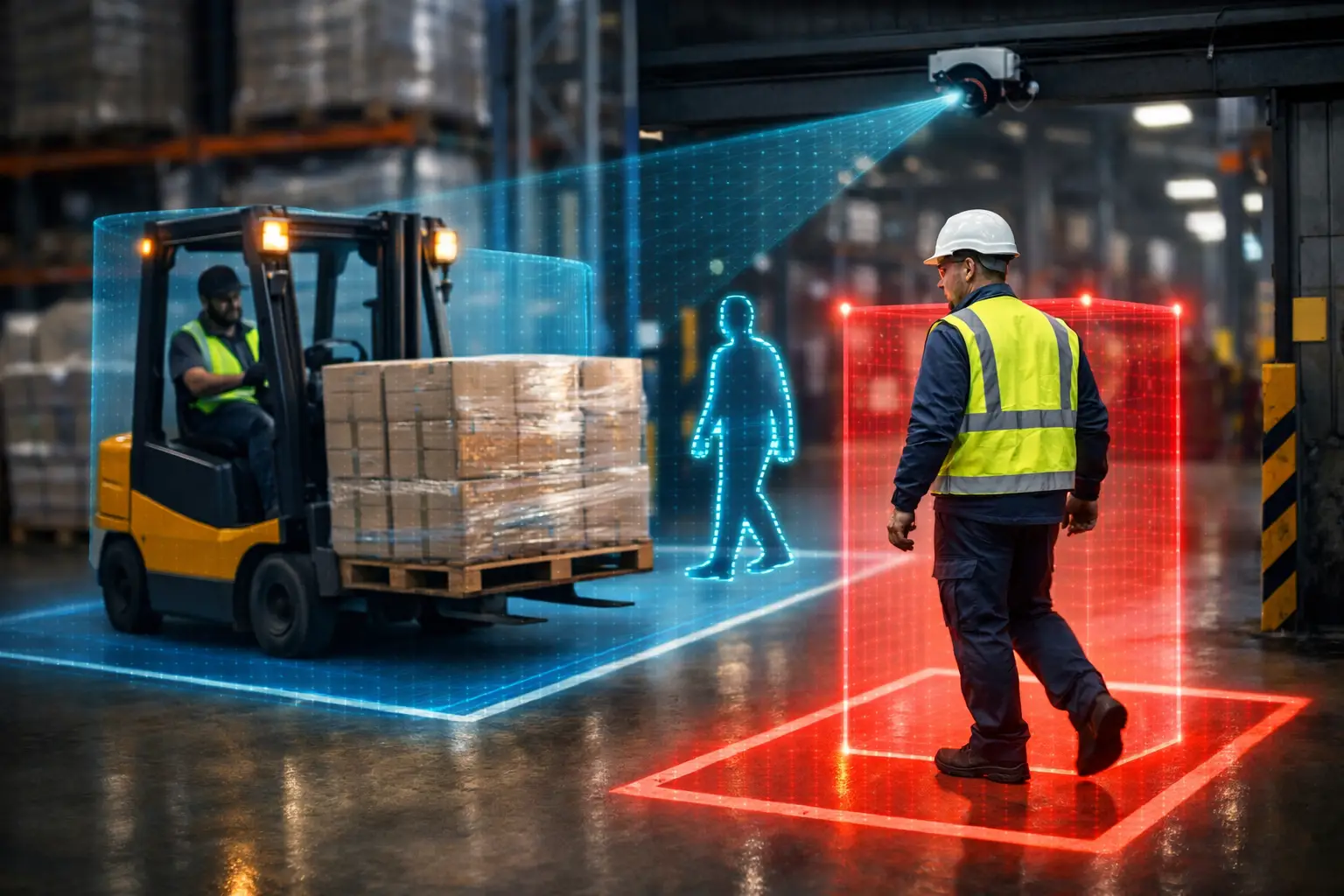
Technology becomes more valuable as traffic complexity increases. Proximity warning systems, pedestrian detection solutions, and intelligent alert systems can provide earlier notice than human observation alone. In facilities with frequent crossings or obstructed views, those added seconds matter. They do not replace disciplined driving and walking practices, but they reduce reliance on perfect attention in imperfect environments.
Training matters, but behavior follows the environment
Most sites already provide forklift training and safety briefings. The gap is that training often explains what workers should do without addressing why the environment makes safe behavior difficult. If operators are expected to sound horns constantly in noisy areas or pedestrians must cross active lanes to reach workstations, training will have limited effect.
Good training is specific to the site. It should reflect actual routes, actual hazards, and actual near-miss patterns. Operators need clear rules on speed, horn use, intersection approach, traveling with loads, and stopping at crossings. Pedestrians need equally clear rules on designated walkways, restricted areas, and how to behave near docks, corners, and active forklift lanes.
Just as important, supervisors need to reinforce the system consistently. Mixed messages undermine safety fast. If production pressure routinely overrides route discipline, workers will follow the real priority they see on the floor.
Short refreshers are often more effective than infrequent classroom sessions. A focused review after route changes, seasonal volume increases, or a near miss helps teams connect the rule to a real operating risk. That kind of reinforcement supports both safety and operational continuity.
Use technology where human attention has limits
Warehouses and plants are dynamic. Noise, congestion, fatigue, stacked inventory, and time pressure all affect awareness. That is why many organizations looking at how to improve forklift pedestrian safety are moving beyond passive controls and adding active safety technologies.
Audible and visual alert systems can warn pedestrians when a forklift enters a shared zone or approaches an intersection. Proximity detection can trigger alerts when people and vehicles get too close. In higher-risk environments, Vision AI safety monitoring can help identify unsafe interactions, repeated route violations, or high-exposure hotspots that are hard to capture through manual observation alone.
The benefit is not only accident prevention. Better visibility into traffic patterns supports better decisions on lane redesign, barrier placement, and workforce movement. It also helps managers address recurring risk before an injury occurs.
That said, technology should fit the operating environment. An alert-heavy system in a noisy, high-traffic facility may create alarm fatigue if not configured carefully. A more selective setup, focused on critical intersections or exclusion zones, may deliver better results. The right answer depends on traffic density, site layout, and how much environmental complexity your teams face.
Measure exposure, not just incidents
If you only track recorded accidents, you are learning too late. Forklift pedestrian safety improves faster when teams monitor leading indicators such as near misses, unauthorized crossings, speeding in controlled zones, repeated congestion points, and temporary storage encroaching into walkways.
These indicators show whether controls are holding under daily pressure. They also reveal whether a good safety design is being weakened by operational drift. For example, a crossing may be well marked, but if pallet staging keeps blocking sightlines, the control is already failing.
Regular walkthroughs with operations, safety, and maintenance teams can uncover these issues quickly. The goal is not to create more paperwork. It is to confirm that routes remain visible, barriers remain intact, warning devices are functioning, and traffic rules still match the way work is actually being done.
This is where an engineering-led approach makes a difference. The strongest forklift pedestrian safety programs do not treat incidents as isolated behavior problems. They evaluate layout, movement, controls, and technology as one operating system. That is the thinking behind many modern warehouse safety programs, including the approach used by SysGuard in industrial environments where accident prevention has to work in real-world conditions.
Make improvement practical enough to sustain
A common mistake is trying to fix every risk at once. Large-scale changes can stall if they disrupt throughput or require major layout changes without a clear sequence. A phased plan is usually more effective.
Start with the highest-exposure zones such as blind intersections, dock approaches, packing exits, and shared access routes. Add physical separation where possible, improve visibility where separation is not yet feasible, and support both with active warning systems where risk remains high. Then review how workers use the space after the changes. If people still bypass the intended route, the design needs adjustment.
The best safety improvements are the ones your operation can maintain. Clear routes, durable barriers, functioning alerts, and targeted monitoring outperform complicated rules that fade under production pressure. Every worker deserves to return home safely every day, and that starts with a workplace designed to make the safe path the easiest path.