A loading dock can shift from routine to high-risk in seconds. A trailer moves before loading is complete, a forklift crosses a wet dock plate, or a pedestrian steps into a blind corner at the wrong moment. That is why choosing the best loading dock safety equipment is not about adding hardware for the sake of it. It is about controlling the specific failure points that lead to injuries, product loss, vehicle damage, and costly downtime.
For most facilities, the right answer is not one device. It is a layered system built around trailer restraint, vehicle communication, pedestrian protection, impact protection, and real-time warning. The best-performing docks are designed so people, forklifts, and trucks can operate with clear signals, controlled movement, and fewer assumptions.
What makes the best loading dock safety equipment effective
The best loading dock safety equipment addresses the hazards that occur most often during live loading operations. These usually include premature truck departure, trailer creep, forklift-drive off incidents, falls from open dock doors, collisions at bay entrances, and damage to doors, frames, and building structure.
Effective equipment does more than meet a checklist. It has to fit the traffic pattern, trailer mix, loading method, and site discipline of the facility. A high-volume distribution center with constant trailer turnover needs stronger control and clearer signaling than a low-frequency dock used a few times a day. A site handling mixed fleets may also need more flexible restraint and detection systems than one using standardized trailers.
That is where many buying decisions go wrong. Teams often compare products by unit cost alone, when the real question is how well the equipment reduces exposure to the hazards already identified on site.
10 best loading dock safety equipment options to prioritize
1. Vehicle restraint systems
If one category deserves to be first on the list, it is vehicle restraint systems. These are among the most critical controls for preventing unexpected trailer movement during loading and unloading. When a trailer creeps forward or departs early, the gap between trailer and dock can become a direct fall and forklift hazard.
A good restraint system secures the trailer in position and provides a visible, controlled process for dock use. The benefit is not just accident prevention. It also improves loading discipline and reduces the chance of equipment damage caused by unstable trailer positioning.
The trade-off is that not every restraint type fits every fleet. Hook-based systems, wheel chocks, and more advanced powered solutions each have limitations depending on trailer geometry, yard conditions, and driver behavior. The best choice depends on how predictable your vehicle mix really is.
2. Dock traffic lights and communication systems
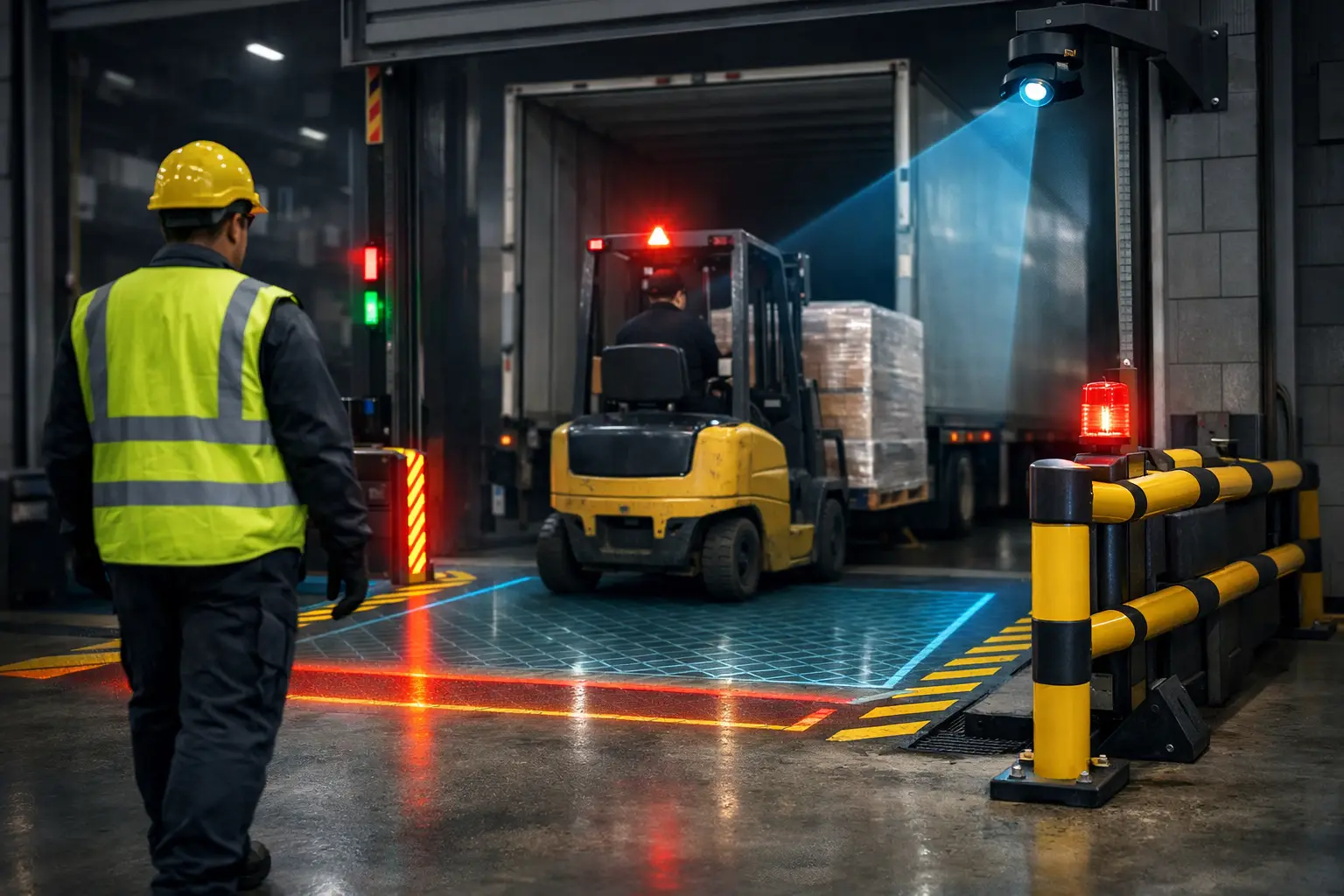
Miscommunication between truck drivers and dock teams is still one of the most common loading bay risks. External and internal traffic lights create a clear visual instruction system – when to stay, when to wait, and when movement is permitted.
This seems simple, but simple controls are often the most effective. A red-green signal system reduces guesswork, especially in noisy environments where hand signals or verbal communication can fail. When connected to restraints or dock door interlocks, it becomes even more reliable because the signal reflects actual dock status rather than human memory.
3. Dock levelers and dock plates with proper safety features
The transition point between trailer and facility is where forklifts carry heavy loads over a changing surface. Dock levelers and plates help bridge that gap, but the safety value comes from stability, load suitability, and maintenance condition.
A worn or poorly matched leveler can create impact, slippage, or imbalance. The right equipment should support the actual forklift and load profile being used, not the theoretical minimum. In practice, this means engineering review matters. Capacity, lip length, operating frequency, and trailer height variation all affect whether the dock interface remains safe under real operating conditions.
4. Dock door safety barriers
Open dock doors create a serious fall hazard when no trailer is present. Safety barriers provide a physical control that helps prevent pedestrians, pallet jacks, or forklifts from reaching the edge unintentionally.
These barriers are especially valuable in facilities where doors are opened before trailer arrival or where internal traffic passes near inactive bays. They are not a replacement for safe procedures, but they provide an important fail-safe when routine breaks down.
5. Warehouse safety barriers around dock zones
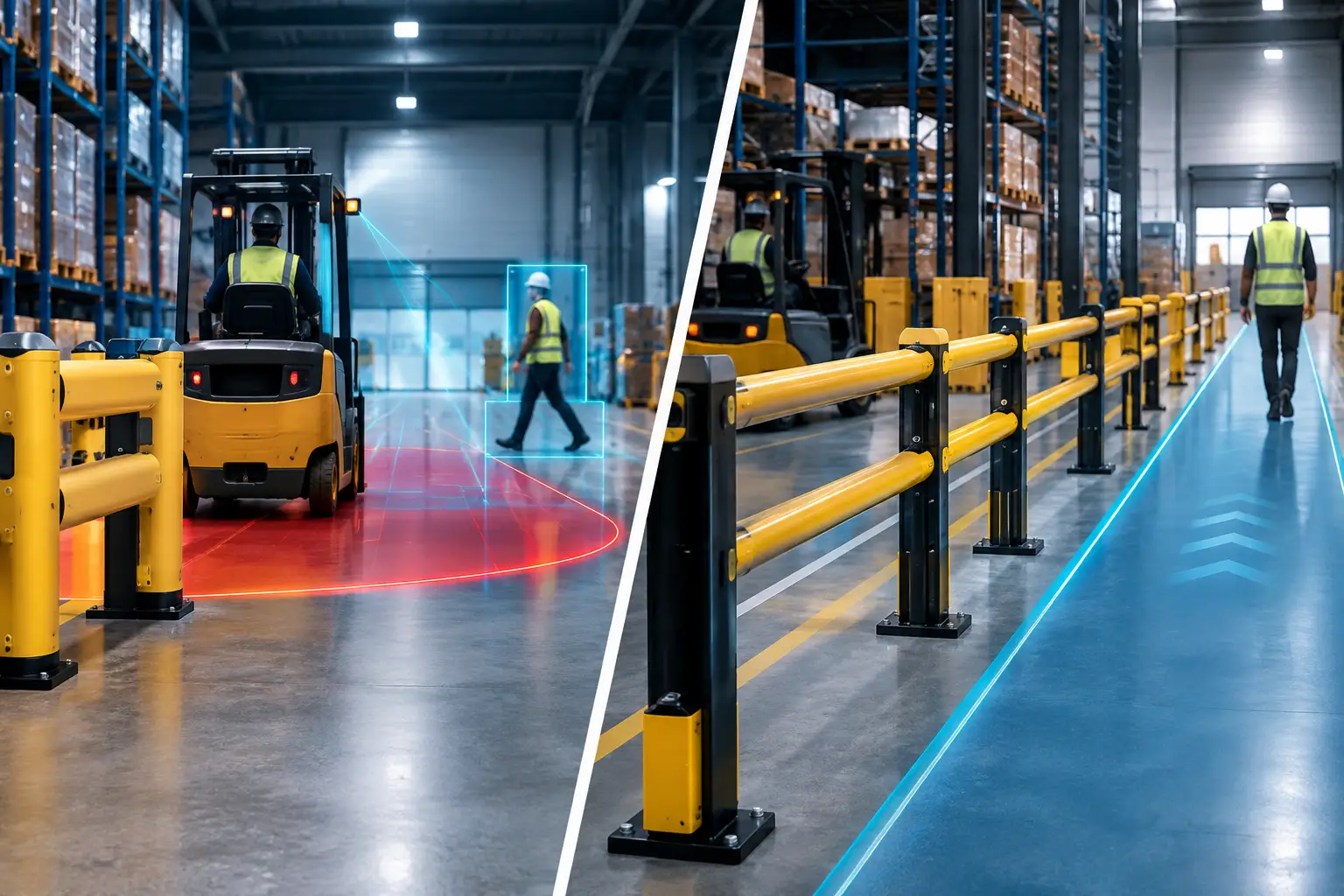
Not all loading dock risks happen at the edge. Many happen in the approach area, where forklifts, pedestrians, and mobile equipment converge. Industrial safety barriers help separate traffic, protect structural elements, and reduce the severity of impacts.
The strongest applications are usually around door frames, dock equipment, control panels, and pedestrian walkways leading to the bay area. If a forklift clips a door track or bay structure repeatedly, the issue is not only maintenance cost. It is evidence that the traffic environment needs stronger protection and better guidance.
6. Audible and visual warning systems
A dock is a high-noise, high-distraction environment. Flashing beacons, warning lights, and audible alerts help draw attention to moving vehicles, active dock operations, or unsafe entry into restricted zones.
These systems are especially useful where sightlines are poor or where multiple teams share the same work area. Still, they need to be used carefully. If every event triggers the same alert, people start to ignore it. The best setups match the warning type to the risk event so alerts remain meaningful instead of becoming background noise.
7. Safety floor projection and pedestrian zone marking
Painted floor lines help, but in dynamic warehouse environments they fade, get blocked, or fail to command attention. Safety floor projection offers a more visible way to mark pedestrian lanes, no-go zones, and active hazard areas near loading bays.
This is particularly useful where dock traffic patterns change by shift or by lane use. Projected warnings can reinforce safe movement paths and improve awareness near crossing points. On their own, they are not enough to stop a collision. Combined with barriers and warning systems, they become much more effective.
8. Proximity warning systems for forklifts and dock approaches
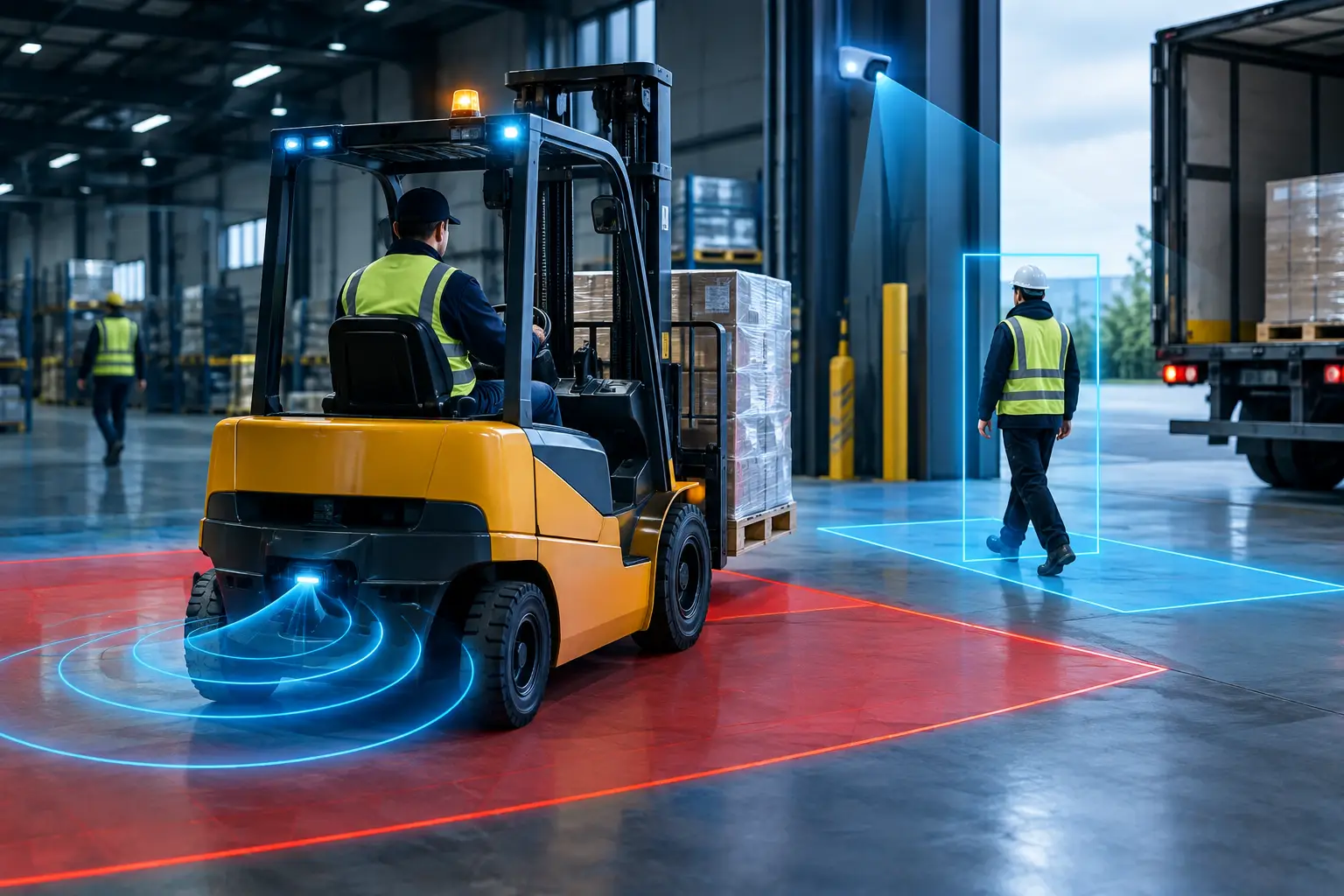
Where forklifts and pedestrians operate near dock entrances, proximity warning technology adds another layer of control. These systems can detect approaching vehicles or people and trigger alerts before a crossing conflict becomes an incident.
This is one of the better examples of safety technology supporting behavior, not replacing it. Facilities with blind intersections, racking near dock approaches, or fast-moving forklift traffic often benefit from these systems because they address the exact moment when visibility and reaction time are limited.
9. Vision AI safety monitoring for loading dock risk zones
For facilities with recurring near misses or complex dock traffic, Vision AI safety monitoring can provide more advanced hazard detection and visibility. It helps identify patterns such as unauthorized pedestrian entry, unsafe forklift movement, congestion, or repeated conflict points near loading bays.
The value here is not just live warning. It is also insight. If one dock consistently generates unsafe behavior, managers can use actual event data to improve layout, training, signaling, or equipment placement. That makes safety improvement more targeted and easier to justify operationally.
10. Wheel guides and impact protection equipment
Trailers do not always approach perfectly. Wheel guides help align vehicles more consistently, reducing the chance of misalignment damage to dock structures and improving positioning accuracy. Added impact protection for doors, frames, and building corners helps contain the cost when contact does happen.
This category is sometimes treated as secondary, but it directly affects dock stability, turnaround efficiency, and asset protection. Repeated minor impacts are often an early warning sign of a larger dock safety problem.
How to choose the best loading dock safety equipment for your site
The best loading dock safety equipment for one site may be incomplete for another. A facility with frequent trailer movement and multiple carriers should start with trailer restraint and communication controls. A site with heavy pedestrian presence near the bays may need barriers, projected walkways, and proximity alerts as a higher priority. A facility dealing with recurring blind-spot incidents may benefit more from warning systems and Vision AI monitoring.
The practical starting point is a dock-specific risk review. Look at trailer movement, forklift travel paths, pedestrian exposure, sightline limitations, structural damage history, and near-miss patterns. Then match controls to those failure points.
It also helps to think in layers. Physical controls prevent movement or access. Visual controls guide behavior. Intelligent systems detect what people can miss. The strongest loading dock safety strategy uses all three where needed.
Best loading dock safety equipment works best as a system
Facilities rarely solve dock risk with a single upgrade. A restraint without clear signal lights still leaves room for confusion. Floor markings without barriers may not protect pedestrians from drift or impact. Warning alarms without traffic design can create noise without control.
That is why engineering fit matters as much as product selection. The goal is a dock environment where equipment, process, and operator behavior support each other. For companies evaluating improvements across warehouses, factories, and logistics sites, this systems approach often delivers better accident reduction and less operational disruption than isolated product purchases.
Accidents happen. But many loading dock incidents follow a pattern long before they cause harm. The right equipment helps break that pattern early, so the dock stays productive and every worker has a better chance of going home safe at the end of the shift.