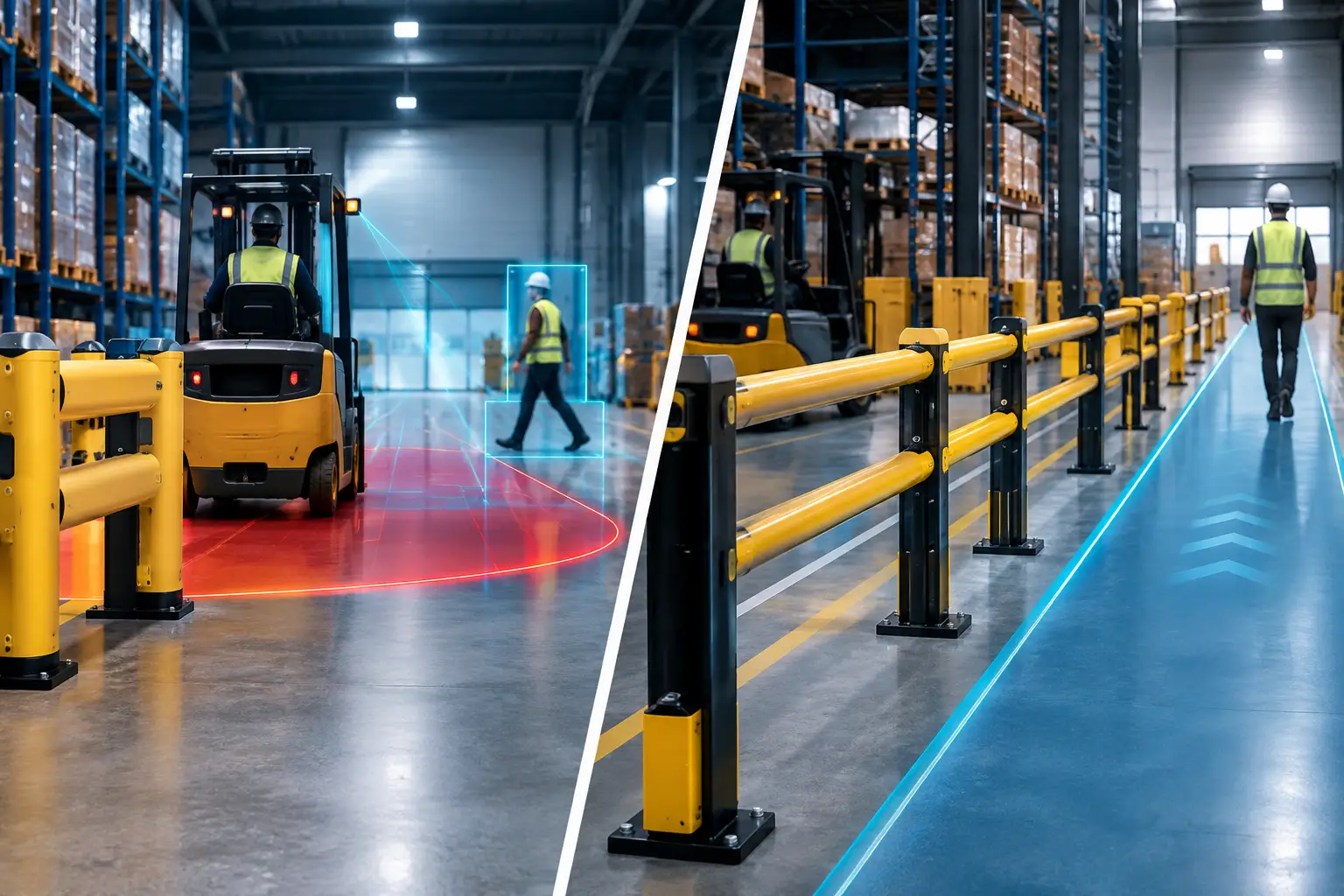

A painted line on the floor does not mean people and forklifts are truly separated. In many warehouses and plants, pedestrian routes pass loading zones, rack aisles, staging areas, and blind corners where vehicle traffic changes by the hour. If you are evaluating how to separate pedestrian walkways, the real question is not where to draw a line. It is how to build a traffic system that workers will actually follow under daily operating pressure.
Why pedestrian walkway separation fails in real operations
Most facilities do not struggle because they lack intent. They struggle because the layout, work pace, and traffic patterns evolved faster than the safety controls. A walkway may have been suitable when traffic volume was lower, but once additional forklifts, pallet jacks, or temporary staging enter the area, that same path becomes exposed.
Separation also fails when controls rely too heavily on worker attention alone. Drivers are watching loads, rack clearances, and travel direction. Pedestrians are focused on picking, scanning, inspection, or talking with coworkers. In mixed-traffic environments, human awareness matters, but it should not be the only barrier preventing an incident.
That is why effective separation needs layers. Floor markings help define intent. Physical barriers create real protection. Warning systems address intersections and blind spots. Traffic rules and site discipline keep the design functioning over time.
How to separate pedestrian walkways with a risk-based layout
The strongest starting point is a site-specific traffic risk assessment. Before choosing barriers or marking paint, map where pedestrians actually walk, not just where they are supposed to walk. Then compare that movement with forklift routes, reversing zones, charging areas, dock approaches, access doors, and workstations.
Look closely at conflict points. Crossings near dock doors, aisle exits, and end-of-rack corners usually present higher risk than long straight routes. So do areas where pedestrians stop to scan labels, inspect goods, or wait for access. A route that looks safe on a drawing can become hazardous if workers pause inside a turning radius or near a staging lane.
Good walkway separation starts by reducing unnecessary interaction. If pedestrians can be rerouted away from forklift-intensive zones, that is usually better than trying to protect a walkway that runs through them. The most effective layout is often the one that eliminates crossing points rather than trying to manage too many of them.
Start with traffic flow, not just barriers
One-way vehicle traffic, designated crossing points, reduced reversing, and controlled access doors can do as much for pedestrian safety as any hardware. In some facilities, changing the direction of travel or relocating a picking station creates more risk reduction than adding more paint or signs.
This is where trade-offs matter. A shorter pedestrian route may be less safe if it passes active forklift lanes. A longer route may improve protection but lose worker compliance if it adds too much walking time. The right answer depends on how often the path is used, what vehicles operate nearby, and whether the route remains practical during peak shifts.
Physical separation is the most reliable control
If pedestrians and vehicles operate in the same general area, physical segregation should be the default wherever feasible. This is the clearest answer to how to separate pedestrian walkways in working industrial environments.
Industrial safety barriers create a real boundary between people and moving equipment. They are especially valuable along main pedestrian corridors, beside workstations near traffic lanes, and around building columns, doorways, and high-exposure aisle edges. Unlike floor tape or painted lines, barriers do not depend on constant attention or perfect behavior.
The barrier type should match the risk. In low-speed foot traffic areas, lighter-duty pedestrian barriers may be enough to guide movement and discourage shortcuts. In forklift travel zones, impact-rated barriers are a better fit because they can help absorb vehicle strikes and protect both workers and infrastructure. The goal is not simply to mark the walkway. It is to prevent vehicle encroachment into it.
That said, barriers are not always suitable everywhere. If a route requires frequent material transfer, maintenance access, or emergency egress flexibility, fixed separation may create operational friction. In those cases, use controlled openings, swing gates, or designated crossing zones rather than leaving the walkway exposed for convenience.
Floor markings still matter, but they are not enough on their own
Painted walkways, color-coded lanes, directional arrows, and crossing boxes are useful because they make the traffic plan visible. They help new workers understand the intended movement pattern and support consistent site discipline. In lower-risk zones, they may be appropriate as part of the control strategy.
But markings should never be treated as equivalent to physical protection. Paint fades. Tape lifts. Pallets get staged on marked paths. Temporary congestion changes behavior. If a walkway sits next to active forklift movement, relying on visual markings alone leaves too much room for failure.
The better approach is to use markings to reinforce a system that already includes stronger controls. Mark the pedestrian corridor clearly. Mark stop lines at crossings. Highlight no-storage zones so materials do not creep into the path. Make the walkway wide enough for expected foot traffic, especially in areas where workers carry tools, scanners, or paperwork.
Protect crossings, intersections, and blind spots
Even a well-separated walkway usually has some points where pedestrian and vehicle paths must interact. These transition points often carry the highest risk because they combine movement, limited visibility, and assumptions about who will yield.
Crossings should be limited in number and made highly visible. Where possible, place them at predictable, well-lit locations instead of allowing informal crossing anywhere along a route. Use guardrails or channelization barriers to guide pedestrians toward the approved crossing point rather than cutting across open floor space.
At blind corners and aisle exits, add active warning controls. Safety floor projection, audible and visual alerts, and proximity warning systems can help warn both drivers and pedestrians before they enter the same space. In more complex or high-traffic sites, Vision AI safety monitoring can help identify repeated near misses, unauthorized walkway encroachment, or unsafe crossing behavior that a basic inspection might miss.
These technologies work best when they support the traffic plan, not replace it. If the layout is poor, alerts will trigger constantly and workers may start ignoring them. The system needs to be engineered so that warnings appear where a meaningful decision can still be made.
Keep walkways usable or people will ignore them
A separated walkway only works if pedestrians choose it consistently. That sounds obvious, but many facilities undermine their own design by allowing the route to become blocked, poorly lit, too narrow, or slower than the unsafe shortcut.
Walkways should remain free from pallets, waste bins, parked equipment, and temporary stock. Doors along the route should open safely without forcing workers into traffic lanes. At shift change or peak dispatch periods, check whether foot traffic volume exceeds the walkway width. If workers are spilling out of the path, the route may be correctly marked but operationally inadequate.
This is also where supervision and local ownership matter. If teams repeatedly bypass the designated route, treat that as a design signal, not only a behavior problem. Sometimes the issue is training. Often, the route no longer matches how the work is actually done.
Make separation part of traffic management, not a one-time project
Facilities change. Inventory profiles shift. Temporary staging becomes permanent. Additional forklifts are added to meet demand. A walkway that was separated effectively last year may be exposed today.
That is why pedestrian segregation should be reviewed whenever there is a layout change, process change, or traffic increase. Incident reports, near misses, congestion complaints, and barrier strike data can all show where the original design is weakening. Engineering reviews and routine walkthroughs are far more useful than assuming the controls still work because they are still physically present.
For many operations, the strongest results come from combining fixed barriers, clear floor markings, designated crossings, smart warning systems, and disciplined housekeeping into one traffic management approach. That layered model reduces dependence on a single control and is far more resilient under real operating conditions.
If you are deciding how to separate pedestrian walkways, think beyond visible lines on the floor. Build routes that match the work, protect the high-risk points, and hold up when the site gets busy. Every worker deserves a path that is clearly defined, physically protected where needed, and designed for the reality of the operation, not the ideal version of it.