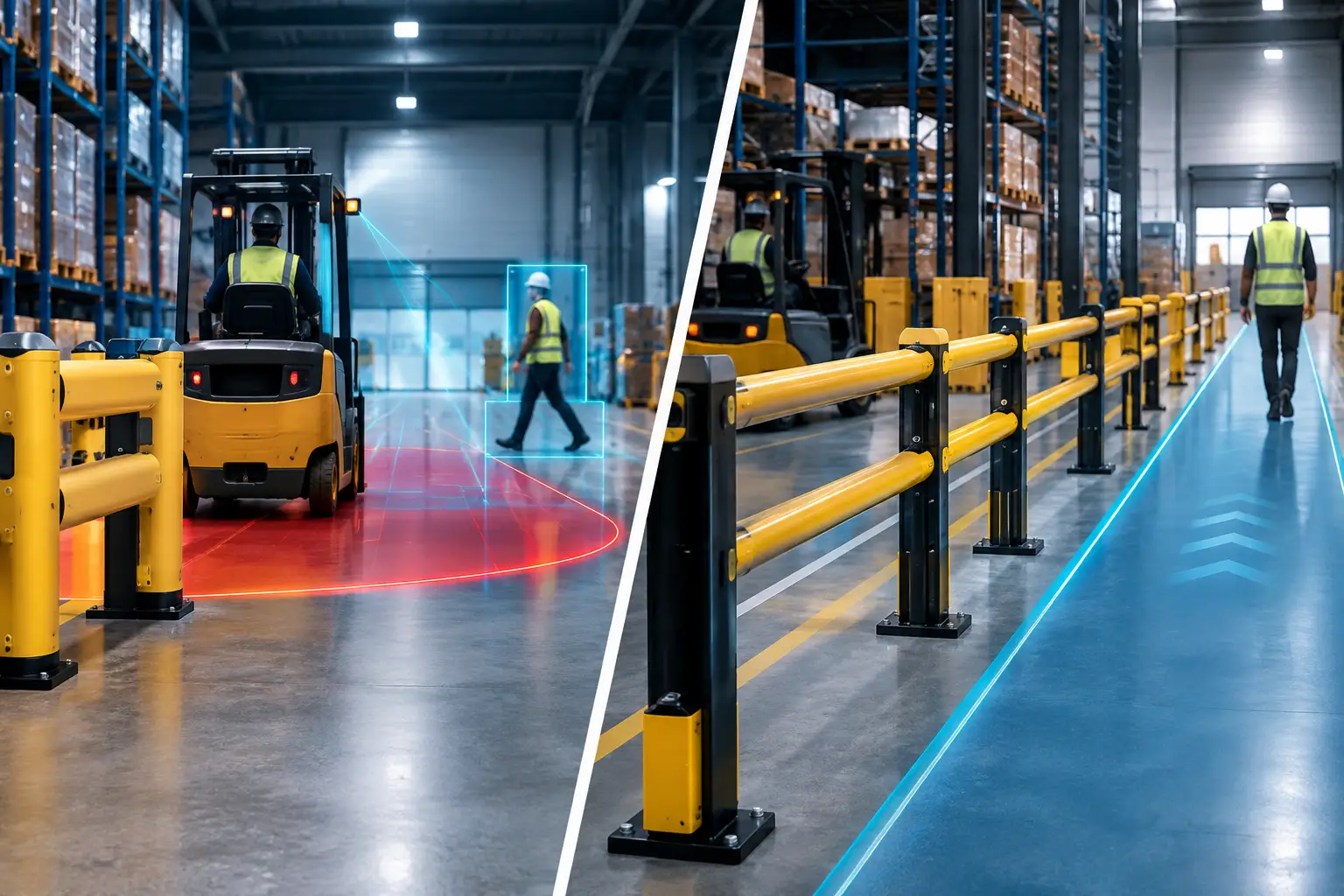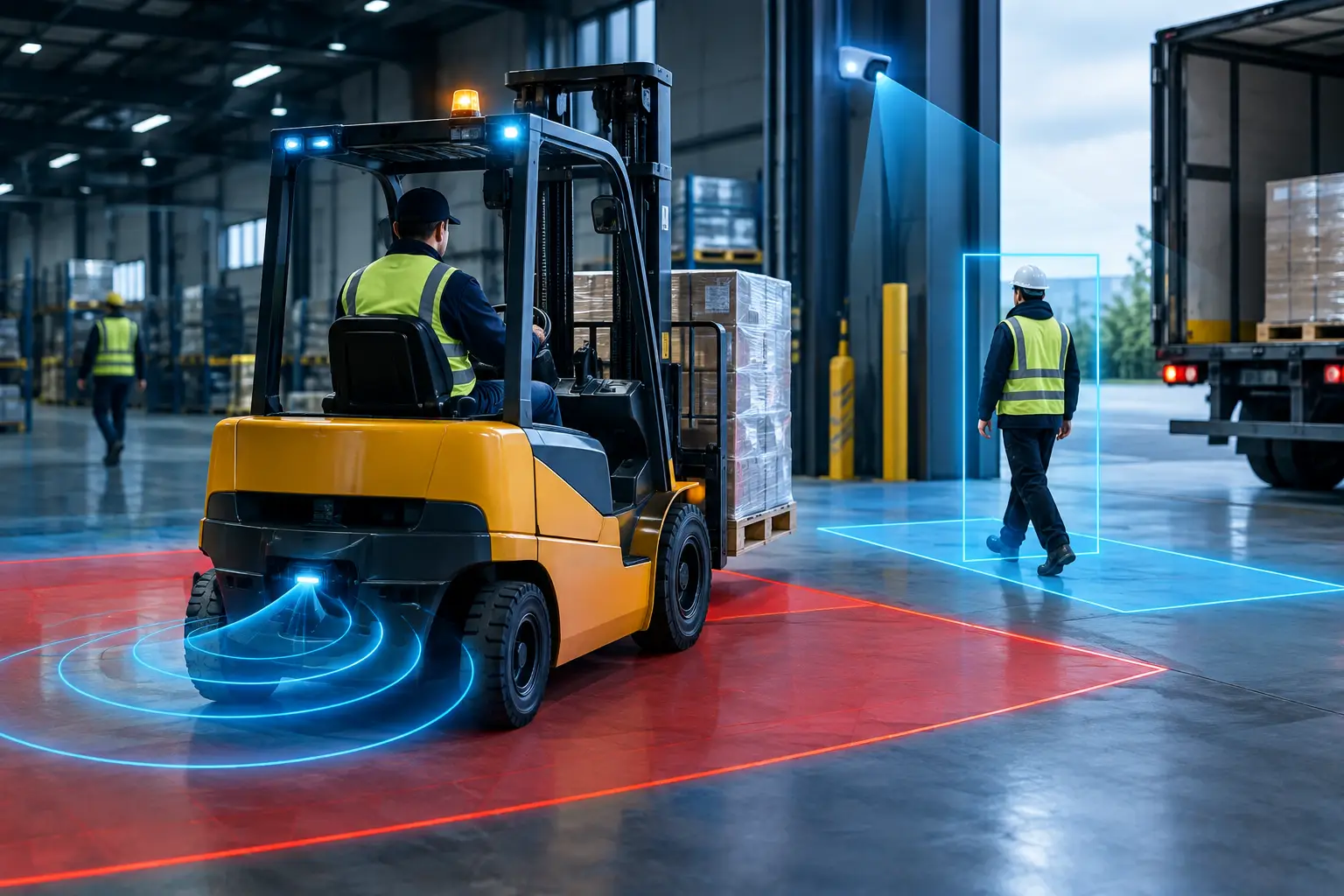
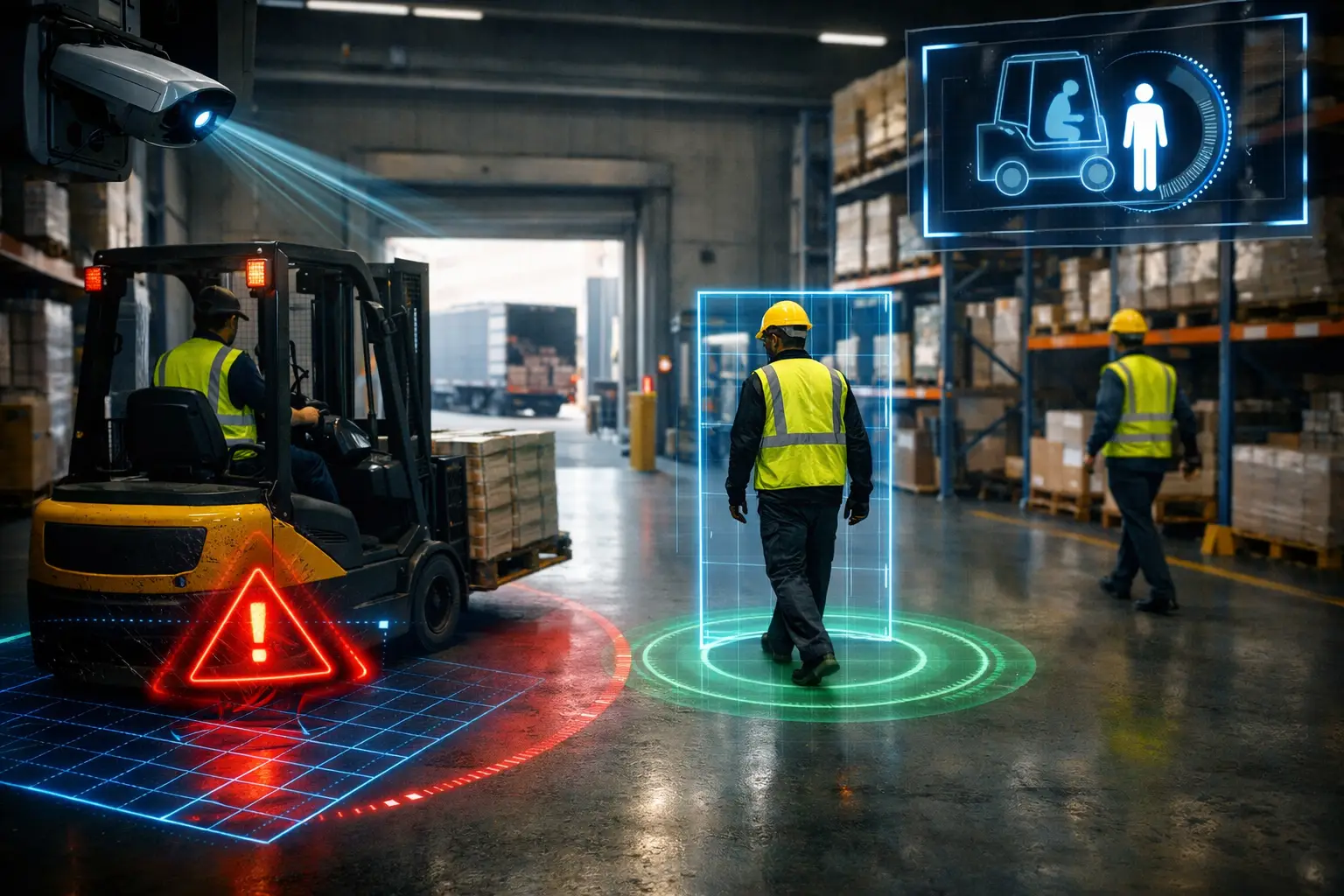
A forklift rounds a rack end as a picker steps from a pedestrian aisle toward a staging area. Neither person intends to take a risk, yet changing sightlines, noise, production pressure, and blind corners can turn ordinary movement into a serious incident within seconds. AI safety deployment gives operations teams a practical way to identify these high-risk interactions early and trigger the right warning or control before contact occurs.
For warehouses, factories, and logistics facilities, the value of AI is not simply that it can record activity. Its value is the ability to recognize safety-relevant conditions in real time: a pedestrian entering an exclusion zone, a vehicle approaching a crossing too quickly, congestion building at a loading bay, or an operator working near an unprotected edge of vehicle travel. Used well, AI monitoring supports better decisions on the floor and better risk controls across the site.
Why Conventional Safety Controls Can Miss Changing Risk
Physical barriers, marked walkways, mirrors, signs, training, and traffic rules remain essential. They establish the safe operating framework. But facilities are dynamic. Temporary storage appears in travel paths, dock doors become busy at different times, contractors enter unfamiliar areas, and vehicle routes change as order profiles change.
Conventional controls can struggle when the risk depends on what is happening at that exact moment. A convex mirror cannot warn a pedestrian that a forklift is reversing around a blind corner. Floor markings cannot distinguish between a person safely behind a barrier and a person stepping into the vehicle lane. Incident reviews may reveal recurring patterns, but they happen after a near miss, damage event, or injury has already exposed the weakness.
Vision AI safety monitoring adds a responsive layer. It can detect defined people, vehicles, zones, directions of travel, and unsafe proximity conditions, then activate visual or audible alerts. The purpose is not to replace supervisors, operators, or established safety procedures. It is to make critical hazards more visible when human attention is divided.
What AI Safety Deployment Should Solve
An effective system begins with a site-specific risk, not a camera specification. The question is not, “Where can we install AI?” It is, “Which recurring interaction has the highest potential for harm or disruption, and what intervention will reduce it?”
In a warehouse, that may be forklift-pedestrian conflict at cross aisles. In a manufacturing plant, it could be vehicle movement near work cells or dispatch lanes. At loading bays, the priority may be unsafe movement around open dock positions, trailer interfaces, or vehicle restraint areas. Each environment has different lighting, traffic density, line-of-sight constraints, and operating rules.
The most useful AI safety deployments usually focus on a small number of clearly defined scenarios. These may include detecting pedestrians in forklift operating zones, identifying vehicle entry into restricted areas, monitoring unauthorized access to hazardous travel paths, or recognizing prolonged congestion at a high-risk intersection. Clear scenarios make it possible to configure alerts appropriately and measure whether the control is working.
Alert design matters as much as detection accuracy. If every movement produces an alarm, workers quickly tune it out. If alerts arrive too late, the system has limited preventive value. The best approach matches the warning method to the risk: a projected floor warning at a crossing, an illuminated sign at a blind corner, a localized audible alert for an immediate conflict, or a supervisor notification when a repeated behavior requires intervention.
Start With Traffic Risk, Not Technology
Before installation, map how people, forklifts, reach trucks, pallet jacks, delivery vehicles, and visitors actually move through the facility. The formal traffic plan is useful, but direct observation often reveals a different reality. Workers may take shortcuts during peak periods. Operators may need to reverse frequently because of staging layouts. A pedestrian walkway may be marked but poorly positioned for the work being performed.
A practical assessment should examine high-consequence areas such as intersections, rack ends, dock approaches, battery charging routes, marshalling zones, and pedestrian transition points. It should also consider when exposure changes. Shift handovers, inbound receiving peaks, end-of-day dispatch activity, and temporary overflow storage can all create conditions that do not exist during a quiet walkthrough.
This assessment should lead to a control strategy, not a technology-only recommendation. Sometimes the first answer is to separate routes with barriers or gates. Sometimes it is to redesign a crossing, improve sightlines, or relocate a staging area. AI becomes particularly valuable where separation is not fully achievable and where live detection can reduce the remaining risk.
Building an AI Safety Deployment That Workers Trust
Workers are more likely to accept a safety system when its purpose, scope, and operation are clear. Position the technology as an accident-prevention control that supports safer decisions, rather than as a tool for routine individual surveillance. Explain where it operates, what conditions trigger alerts, how information will be reviewed, and who is responsible for acting on recurring findings.
The installation process must account for the realities of industrial environments. Camera positioning affects detection quality. Backlighting from dock doors, dust, rack shadows, reflective high-visibility garments, vehicle vibration, and changes in lane geometry can all influence system performance. A site survey and controlled testing period are necessary to validate coverage under real operating conditions, not just ideal conditions.
Configuration should reflect the facility’s own safety rules. A pedestrian should not trigger the same response in a protected walkway as in an active forklift lane. Likewise, a forklift moving slowly through a controlled crossing may require a different alert threshold than a forklift entering a blind corner at speed. Fine-tuning zones, dwell times, direction rules, and alert escalation helps reduce nuisance alarms without weakening protection.
Training is equally important. Forklift operators, pedestrians, supervisors, and maintenance teams should understand what each alert means and the action expected. A flashing warning is useful only if people know whether to stop, give way, check for approaching traffic, or report a recurring issue. Supervisors need a defined process for reviewing trends and correcting layout, behavior, or workflow problems.
Measure Prevention, Not Just System Activity
A high number of detections does not automatically mean a system is successful. It may indicate that a risky area has been identified, but it can also show that the layout or workflow is generating constant exposure. The goal is to reduce unsafe interactions over time while maintaining workable operations.
Useful performance measures include pedestrian entries into vehicle zones, vehicle-pedestrian proximity events, repeated alerts at specific locations, near-miss reports, rack or equipment damage, and downtime connected to traffic incidents. Compare these measures by shift, activity period, and location. This helps distinguish an isolated event from a design issue that needs engineering attention.
For example, repeated AI alerts at one crossing may point to an inadequate pedestrian route, poor visibility from a rack configuration, or a dispatch schedule that concentrates too much movement in one period. The corrective action may be a barrier, a revised one-way system, a safety floor projection, or a change in staging practice. AI provides evidence that helps teams choose the control with the strongest operational effect.
It is also reasonable to expect a period of adjustment. A newly installed system can surface risks that have become normalized over years of operation. Early data should be reviewed constructively, with input from the people who work in the area. Treating every alert as a disciplinary issue can discourage reporting and hide the root cause. Treating patterns as opportunities to improve the system creates stronger safety ownership.
Where AI Delivers the Greatest Value
AI monitoring is most effective in areas where people and vehicles must share space, visibility is limited, and activity changes throughout the day. Warehouse intersections, rack-end crossings, loading bay approaches, receiving zones, and production transfer points are common examples. These are places where fixed controls provide a foundation but may not fully address real-time exposure.
It is less useful to deploy AI broadly without a defined hazard, response plan, or maintenance process. Technology that is not aligned with traffic management, physical protection, and supervisor follow-up can generate data without reducing risk. The right deployment is proportionate to the hazard and integrated into the facility’s existing safety management practices.
SysGuard approaches these projects as engineering and operational safety improvements, combining site assessment, technology implementation, installation, training, and ongoing support. The objective is practical: reduce the opportunities for a person and a vehicle to meet in the wrong place at the wrong time.
Every worker deserves to return home safely every day. When a facility uses AI to see risk earlier, act faster, and improve the conditions behind repeated near misses, safety becomes part of how the operation runs – not something reviewed only after an incident.