A forklift reverses from an aisle as a picker steps around a palletized load. A truck begins to move while a dock worker is still inside the trailer. A rack upright absorbs another minor impact that no one reports. These workplace hazards are familiar because they are built into the movement, speed, and pressure of industrial operations. Left unmanaged, they can injure people, damage assets, interrupt throughput, and expose weaknesses in a facility’s safety program.
For warehouse, manufacturing, and logistics leaders, the objective is not simply to react after an incident. It is to identify where people, vehicles, equipment, and loads can conflict, then redesign the conditions that make those conflicts likely. Effective hazard control combines operational discipline with physical protection, visible warnings, and reliable data.
Why Workplace Hazards Persist in Busy Facilities
Most serious industrial incidents are not caused by one dramatic failure. They result from ordinary tasks performed in changing conditions: a temporary storage area narrows a pedestrian route, a new shift pattern increases congestion, a contractor is unfamiliar with site traffic rules, or a driver’s view is blocked by a high load.
Warehouses are especially exposed because multiple activities compete for the same space. Forklifts move materials quickly. Pedestrians pick, pack, inspect, and stage orders. Trucks arrive and depart on schedules that can create loading bay pressure. As volumes rise, informal shortcuts can become accepted practice.
A risk assessment should look beyond whether a hazard exists. It should examine when and where exposure rises. A crosswalk may be safe during a quiet shift but become a high-risk crossing point during dispatch peaks. A loading bay may appear controlled until an unfamiliar carrier arrives with a different trailer configuration. Context determines the right control.
The Highest-Risk Areas to Assess First
Forklift and pedestrian interaction
Forklift-pedestrian contact remains one of the most severe risks in industrial environments. Blind corners, aisle intersections, doorways, battery charging areas, and staging zones can all bring people into a vehicle’s travel path. Mirrors and painted lines can help awareness, but they depend heavily on people seeing, interpreting, and following them every time.
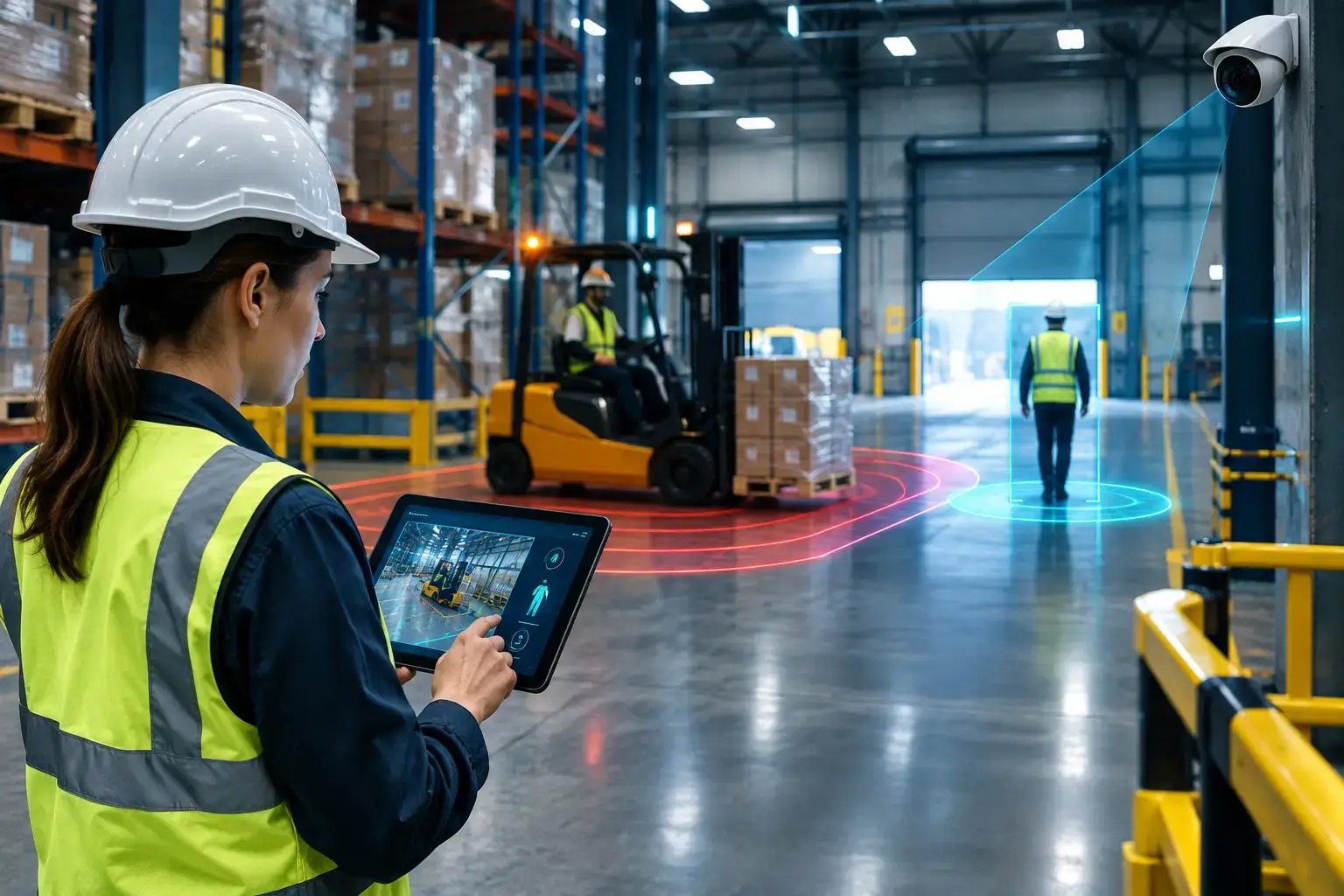
The stronger approach is to reduce reliance on judgment alone. Separate pedestrian and vehicle routes wherever layout permits. Use physical barriers at exposed walkways, controlled crossing points where separation is impossible, and audible or visual warnings at intersections and blind spots. Proximity warning systems and safety floor projection can add another layer of awareness where moving equipment operates near people.
The trade-off is that segregation can alter travel routes and may initially affect productivity. In practice, clearly defined movement routes often reduce hesitation, near misses, and congestion. The design should support the actual workflow, not force workers to work around it.
Loading bay activity
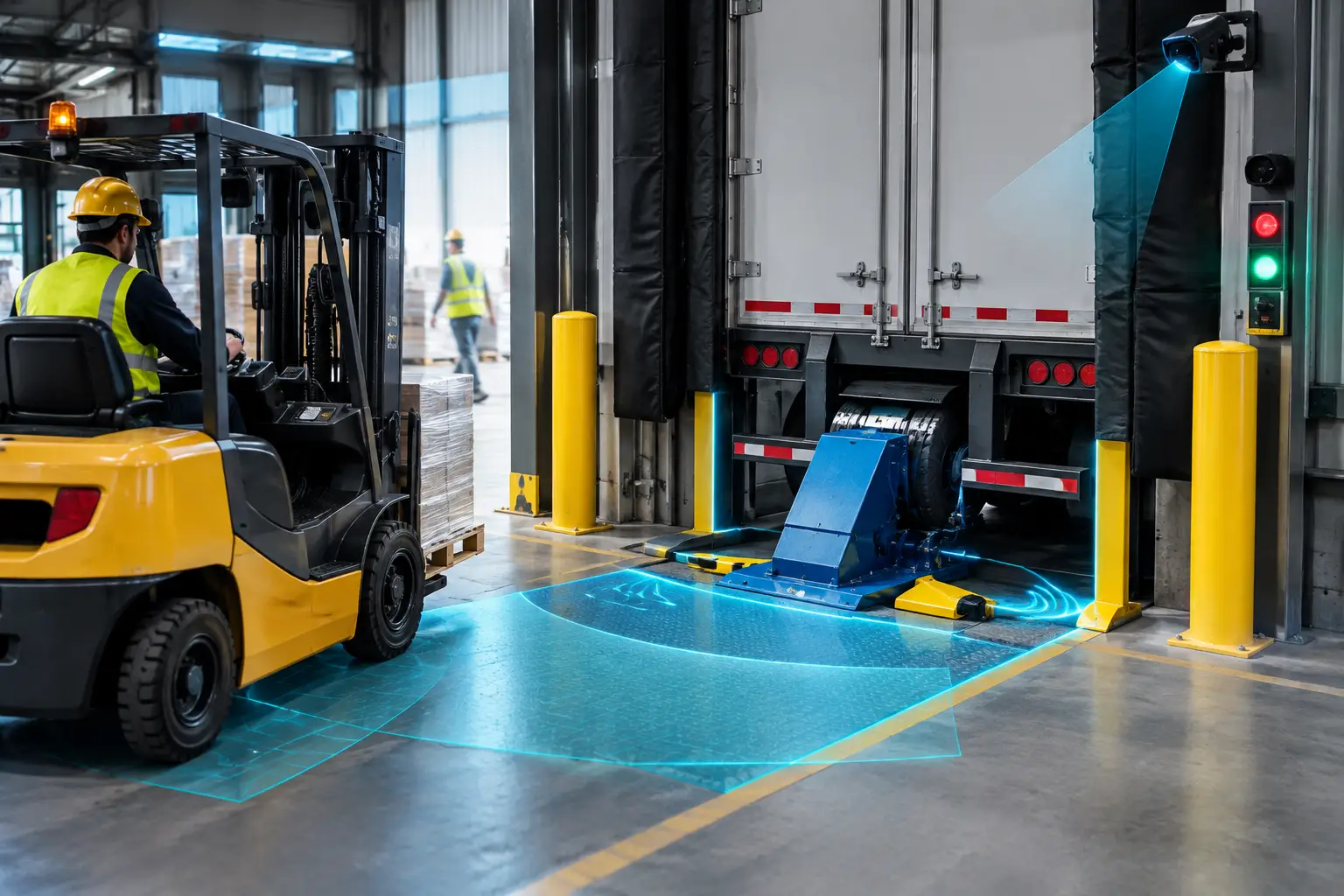
Loading bays combine vehicle movement, uneven surfaces, changing trailer conditions, and time-sensitive dispatch work. A vehicle pulling away too early, a trailer shifting during loading, or a worker stepping into an unprotected dock edge can have serious consequences.
Bay safety starts with a consistent sequence. The vehicle should be secured before loading begins, communication between driver and dock team should be clear, and visual status indicators should show whether the bay is safe to enter or exit. Vehicle restraint systems, dock warning lights, wheel chocks where appropriate, and physical dock-edge protection address different points in that sequence.
No single device solves every loading bay hazard. The best arrangement depends on trailer types, dock geometry, traffic frequency, operating procedures, and the degree of driver interaction. A site handling high volumes with multiple carriers may need more automated interlocks and status visibility than a low-volume dedicated fleet operation.
Racking, storage, and falling-object risks
Warehouse racking is designed to carry planned loads, not repeated forklift impacts or improvised storage practices. Damaged uprights, overloaded beams, poorly positioned pallets, and inadequate clearance at aisle ends can turn a minor strike into a costly shutdown or a more serious event.
Rack protection is a practical first line of defense at vulnerable uprights, corners, and aisle ends. It should be supported by clear reporting procedures so that impacts are inspected rather than ignored. Managers also need to consider how changes in pallet dimensions, lift equipment, or storage density affect the clearance originally available.
This is where asset protection and worker protection overlap. Preventing rack damage reduces repair costs and inventory loss, but it also helps preserve the structural reliability of the storage system during daily operations.
Blind spots and uncontrolled intersections
Not every hazard is visible from a fixed position. Forklift operators can lose sight of pedestrians behind loads, around racking, or when reversing. Pedestrians may not hear approaching vehicles in noisy areas. At intersections, both parties may assume the other has seen them.
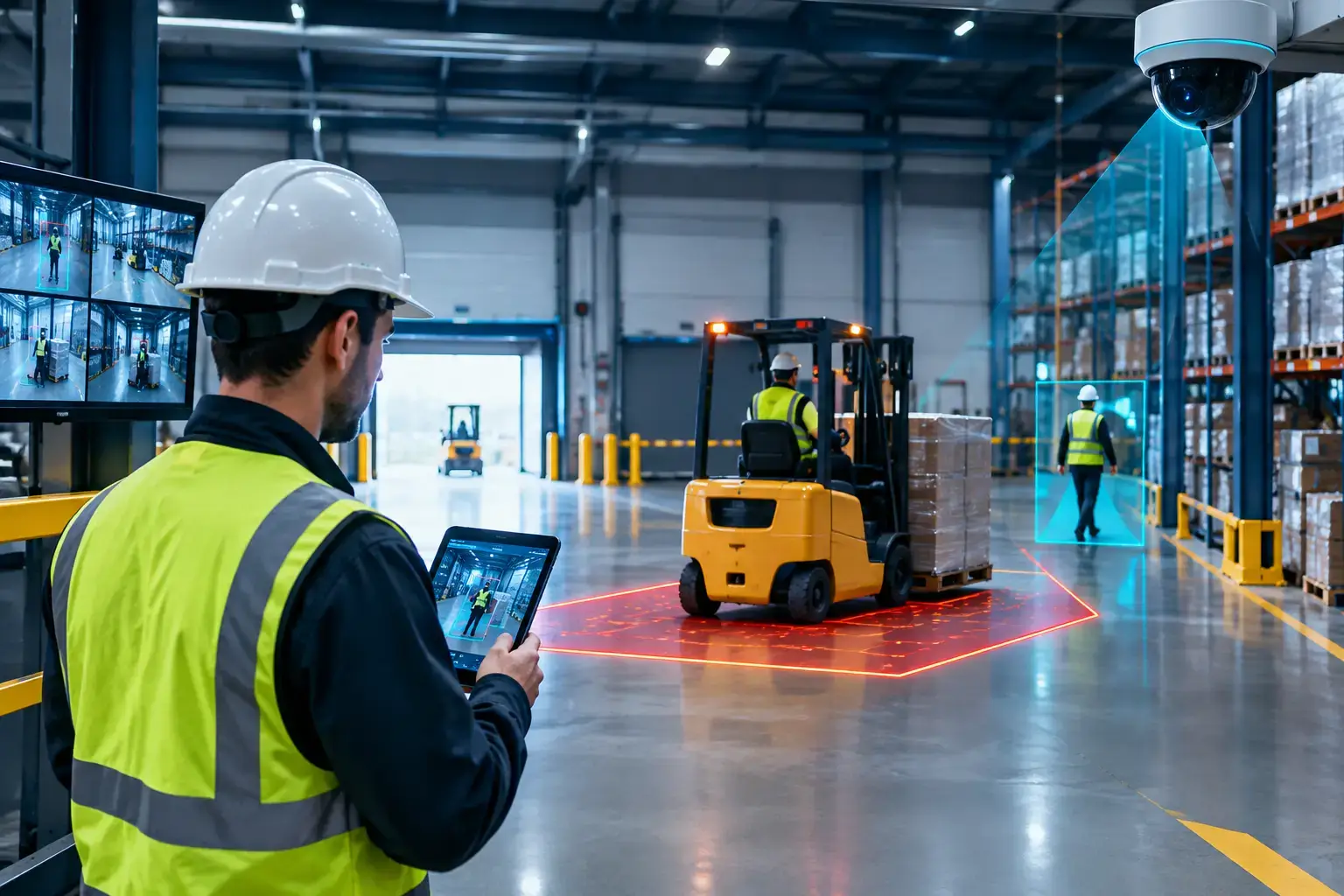
Warning systems should be selected for the environment. Audible alerts can be useful in areas with clear lines of travel, while projected warning zones or visual alerts may be more effective where noise is high. Vision AI safety monitoring can provide another level of insight by identifying unsafe interactions, restricted-zone incursions, or recurring behaviors that are difficult to capture through manual observation alone.
Technology is most useful when it leads to action. If a system shows repeated pedestrian exposure at one aisle intersection, the response may be to change the route, add barriers, adjust staging locations, or introduce a controlled crossing. Data should guide engineering improvements, not simply create more incident records.
Use the Hierarchy of Controls in Real Operations
Training, signs, and procedures matter, but they are administrative controls. They require consistent human attention in environments where workloads change quickly. They should not be the only safeguards standing between a worker and a moving forklift.
A practical control strategy moves from eliminating exposure where possible to reducing it through engineering. For example, moving a packing station away from a forklift aisle removes a conflict. Installing barriers between the station and the aisle reduces exposure when relocation is not feasible. Warning lights, marked routes, and operating procedures then reinforce the physical controls.
This layered approach is particularly valuable where a facility cannot be rebuilt. Many operations work within existing buildings, narrow aisles, or fixed dock positions. Targeted improvements can still make a meaningful difference when they focus on the highest-consequence interactions first.
Turn Near Misses Into Design Improvements
Near misses are often treated as isolated behavior issues: someone walked outside a designated path, a forklift operator took a corner too quickly, or a pallet was staged in the wrong place. While individual accountability has a role, repeated near misses usually point to a system problem.
Look for patterns. Do incidents cluster at shift handovers? Does congestion increase near a particular dispatch door? Are workers leaving marked routes because the shortest route is blocked by temporary storage? Are equipment impacts occurring in the same rack aisles? These questions shift the conversation from blame to prevention.
Facility leaders should review incident reports, equipment damage records, traffic observations, and monitoring data together. A damaged barrier, a rack impact, and a pedestrian near miss may all indicate the same underlying issue: a travel path that no longer matches how the operation actually functions.
Make Safety Controls Part of Daily Performance
Safety improvements fail when they are installed and forgotten. Barriers need inspection after impact. Warning devices need testing. Vehicle restraint systems need maintenance. Traffic routes need review when layouts, order profiles, or equipment fleets change.
Ownership should be clear across operations, maintenance, and safety teams. Operators and supervisors should know what normal safe operation looks like and how to report defects without delay. Engineering teams should verify that safeguards are positioned, maintained, and performing as intended.
The most effective sites treat hazard prevention as an operating standard, not a separate project. SysGuard supports this approach through safety consultation, engineering-led implementation, training, and maintenance across forklift, pedestrian, and loading bay environments.
Every worker deserves to return home safely every day. Start with the places where movement, visibility, and time pressure collide, then make the safer choice the easier choice to follow.