A warehouse can become more hazardous when equipment moves faster, works longer hours, and follows routes people assume they understand. Warehouse automation safety is therefore not a matter of adding a warning light to a robot or putting tape around a conveyor. It requires a planned system that considers how people, vehicles, automated equipment, loads, and workflows interact under normal and abnormal conditions.
Automation can reduce manual handling, improve throughput, and make operations more predictable. Yet it can also introduce unfamiliar movement patterns, blind spots at transfer points, and new interfaces between forklifts, autonomous mobile robots, conveyors, and employees on foot. Accidents happen. But with the right controls in place, many are preventable.
Why Warehouse Automation Changes the Risk Profile
Traditional warehouse traffic risks are often easier for experienced workers to anticipate. A forklift has an operator who can make eye contact, sound a horn, and react to a pedestrian stepping into an aisle. Automated equipment follows programmed logic, sensor inputs, and operating parameters. It may stop safely when it detects an obstruction, but a stop itself can create a bottleneck or place a load in an unexpected position.
The critical question is not whether automated equipment is safe in isolation. It is whether the complete operating environment is safe when people are picking orders, clearing jams, replenishing stock, maintaining machines, or responding to an exception.
Risk is commonly concentrated at transition points: where automated systems meet manual processes, where vehicles cross pedestrian routes, where loads transfer between conveyors and forklifts, and where maintenance teams access equipment. These areas deserve more than generic signage. They need physical separation, visible warnings, defined access rules, and a layout that supports safe decisions under pressure.
Start With the Actual Flow of People and Equipment
Effective warehouse automation safety begins with observing work as it is actually performed. Process maps and equipment specifications are useful, but they rarely capture every shortcut, temporary staging area, or congestion point created during peak demand.
A practical assessment should follow a pallet, tote, or order from receiving through storage, picking, packing, and dispatch. At each stage, identify who enters the area, what equipment moves there, how loads are transferred, and what happens when the process stops. This approach exposes risks that may be missed when automated systems are assessed separately from the wider facility.
For example, an autonomous mobile robot may operate safely on its designated route until a pallet is staged outside a rack location. A pedestrian then steps around the pallet, narrowing the travel path. The robot may detect and stop for the person, but repeated stops can encourage workers to bypass the intended route or place more materials in the same area. The initial issue is not simply robot detection performance. It is traffic management, space discipline, and operational behavior.
Build Layers of Control, Not a Single Barrier
No individual technology can guarantee safety across a live warehouse. A safer design uses layers so that one control supports another when conditions change. The strongest programs typically combine four elements:
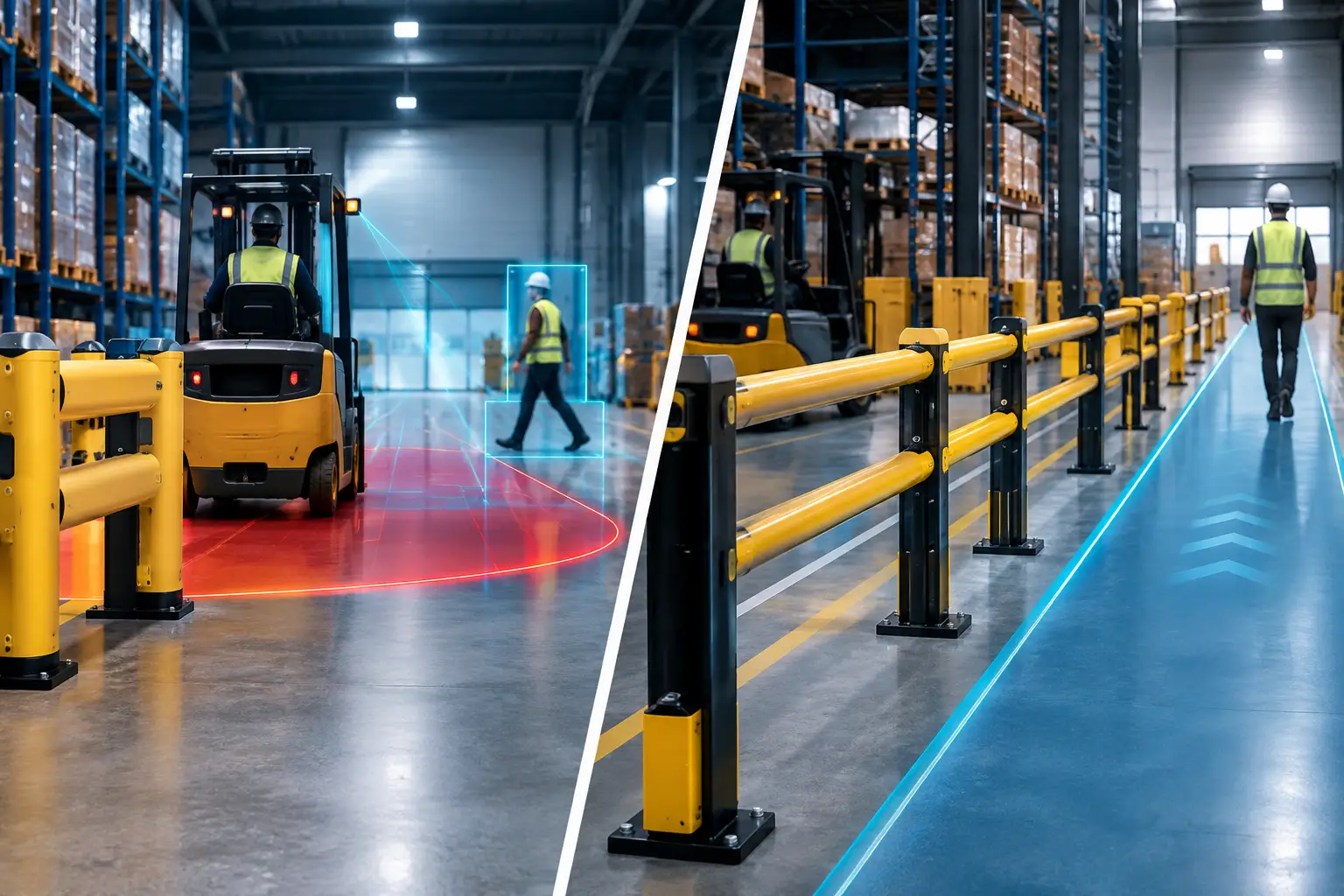
- Separation, using barriers, guardrails, protected walkways, controlled crossings, and clear exclusion zones to keep people away from moving equipment and hazardous transfer points.
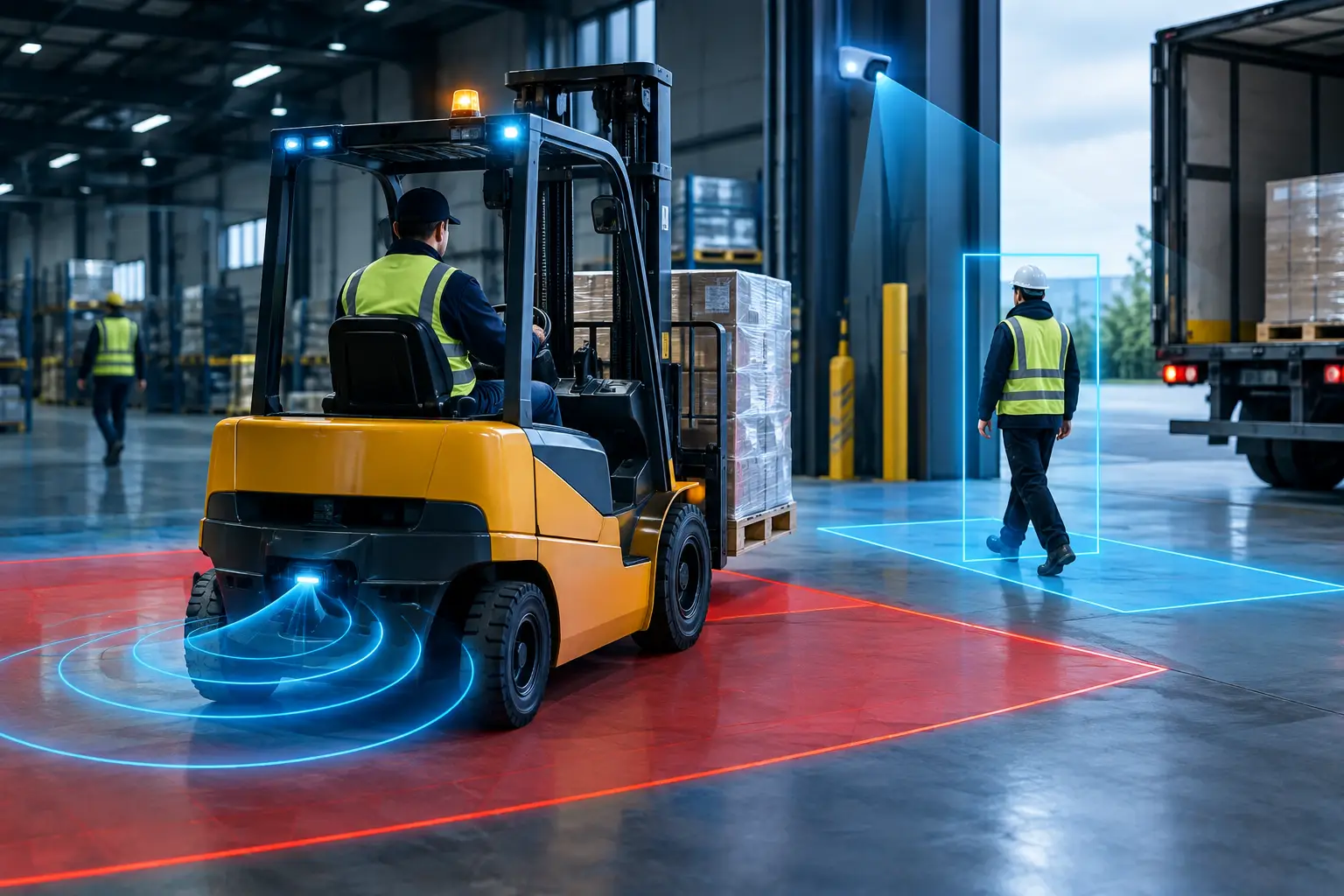
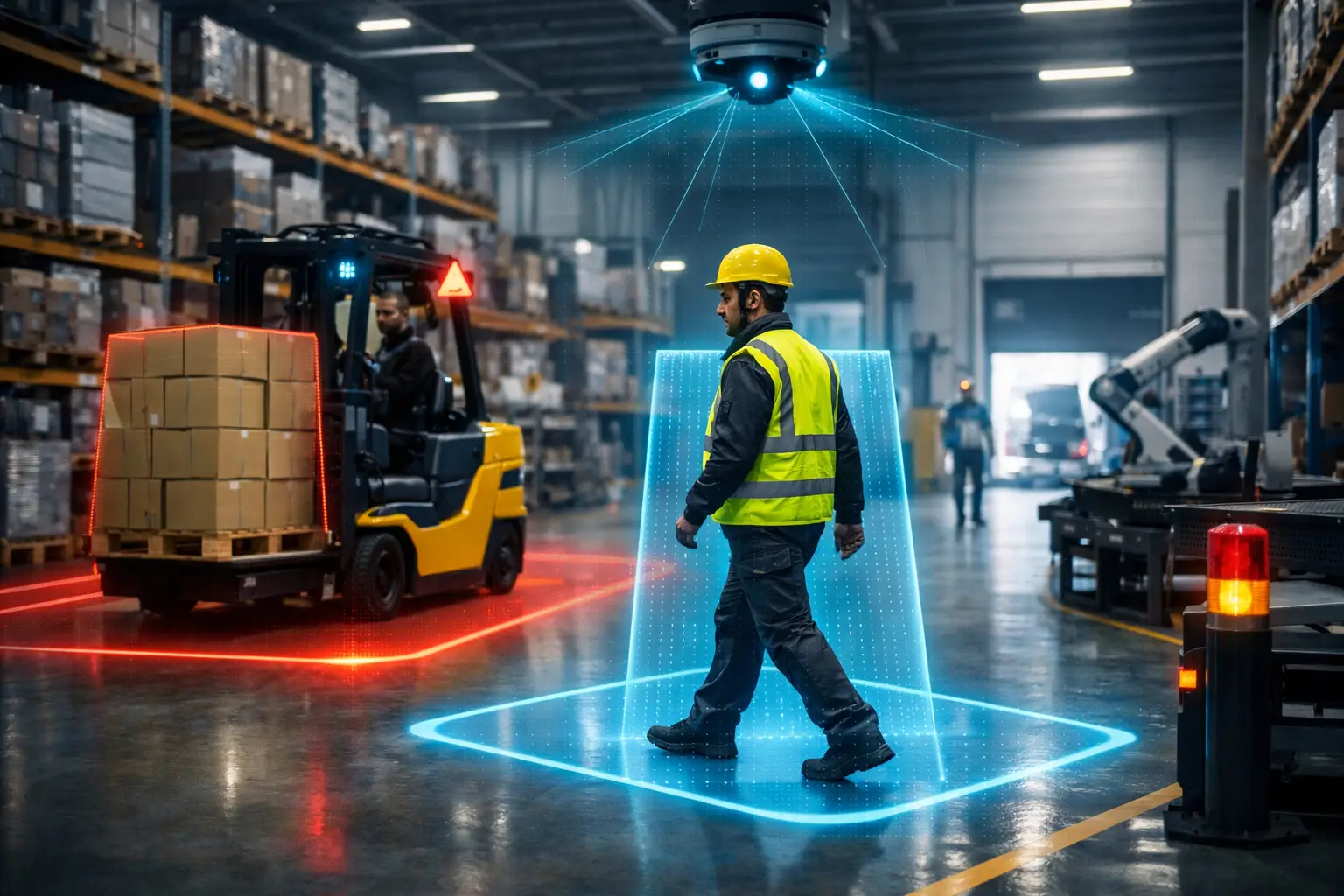
- Detection and warning, using proximity systems, safety scanners, projected floor warnings, audible alerts, visual indicators, and Vision AI monitoring where they address a defined risk.
- Traffic discipline, using planned routes, speed controls, right-of-way rules, staging locations, and procedures for intersections and loading areas.
- Response and maintenance, using inspection routines, fault reporting, access controls, and clear procedures for jams, system recovery, and equipment servicing.
Physical separation remains one of the most dependable controls because it does not rely on a worker noticing a warning at the right moment. Warehouse safety barriers, rack protection, and protected pedestrian walkways can reduce exposure before an alert is even needed. Warning technologies add another level of protection, especially where complete separation is impractical.
The right combination depends on the layout and process. A high-speed conveyor transfer point may need fixed guarding and controlled access. A mixed-traffic aisle may require pedestrian segregation, forklift speed management, and active proximity warnings. A loading bay may need vehicle restraint, dock status indicators, and clear communication between drivers and warehouse personnel.
Design for Predictable Movement
People work more safely when equipment behavior is consistent and easy to read. Automated vehicles should have clear operating zones, defined crossing locations, visible status indicators, and movement logic that employees can understand. If a worker cannot tell whether an automated vehicle is waiting, charging, rerouting, or about to move, they may make unsafe assumptions.
This is particularly relevant where autonomous mobile robots and forklifts share space. A robot can be programmed to yield, while a forklift operator may expect the robot to continue. If neither movement rule is obvious, both parties may hesitate or move at the same time. The solution is not to rely on human judgment alone. It is to establish route priorities, manage intersection design, and reinforce the rules with visual and audible alerts.
Floor projection can be useful in noisy or visually complex environments because it places a warning in the worker’s line of sight. However, projected warnings should not substitute for a protected walkway or barrier where pedestrian exposure is frequent. Technology works best when it supports a safe layout rather than compensating for an unsafe one.
Pay Special Attention to Exceptions
Automated systems are often evaluated during normal production. Many incidents, however, occur during exceptions: a carton jams, a sensor is blocked, a load is misaligned, a battery needs attention, or an employee enters a restricted zone to recover a product.
These events should be designed into the safety plan. Teams need safe access points, controlled isolation procedures, and practical methods for removing obstructions without reaching through guarding or entering an active travel path. If recovery procedures are too slow or difficult, workarounds will appear.
Maintenance access deserves the same attention. Technicians may work near stored energy, moving conveyors, elevated loads, or automated storage systems. The facility should clearly define who can enter restricted areas, how equipment is placed in a safe state, and how operators know that maintenance activity is underway. Good safety design accounts for the people who keep automation running, not only those who work around it.
Use Data to Find Exposure Before an Incident
Near misses, emergency stops, repeated obstruction events, and equipment damage are valuable signals. They can reveal where automated equipment is encountering unpredictable behavior or where workers are being forced into unsafe routes.
Vision AI safety monitoring can help identify recurring conditions such as pedestrians entering vehicle zones, forklift activity near restricted areas, blocked walkways, or unsafe behavior around loading operations. Its value is not simply visibility. Used well, it helps safety and operations teams prioritize improvements based on patterns rather than assumptions.
Data should lead to practical questions. Is a warning zone triggered repeatedly because the aisle is too narrow? Are emergency stops concentrated at one crosswalk? Is rack damage occurring because turning space is inadequate? The aim is to remove the underlying exposure, not merely document it.
Make Safety Part of Automation Change Management
Every change to routes, storage density, software behavior, shift patterns, or equipment mix can affect risk. A new picking process may create more pedestrian crossings. A higher throughput target may increase congestion at automated induction points. Even a minor layout adjustment can reduce sightlines for forklift operators.
Before changes go live, review the impact on people and traffic flow. Involve supervisors, operators, maintenance personnel, and safety leaders because each group sees different failure points. Then validate the design during live operation, when real volumes and human behavior reveal what a drawing cannot.
Training also needs to be specific. Employees do not need vague reminders to be careful around automation. They need to know where they may walk, what each signal means, how automated equipment behaves, where they must not enter, and what to do when something does not look right. Refresher training should follow significant operational changes, not wait for an incident.
Safety That Supports Throughput
Warehouse automation should make operations safer and more reliable, not create a choice between productivity and protection. When routes are controlled, pedestrian exposure is reduced, alerts are meaningful, and exceptions are managed, teams spend less time responding to disruptions and damage.
The most effective approach treats safety as an engineering requirement from the start. Assess the real workflow, separate people from hazards where possible, use intelligent warnings where they add value, and keep reviewing how the system performs in live conditions. Every worker deserves to return home safely every day, and a well-designed automated warehouse gives operations the structure to make that expectation practical.