A forklift reverses from an aisle just as a picker steps around a rack end. The driver brakes in time. No one is injured, no product is damaged, and the shift continues. That event is still a warning. Knowing how to reduce near miss incidents means treating that warning as useful operational data, not as a lucky escape.
Near misses reveal where the workplace is relying on attention, timing, or good fortune instead of reliable controls. In warehouses, factories, distribution centers, and loading bays, they often occur where people and moving equipment share space, sightlines are poor, traffic rules are unclear, or the pace of work changes faster than the safety controls.
Why Near Misses Deserve Immediate Attention
A near miss is an unplanned event that could have caused injury, vehicle damage, rack impact, dropped loads, or disruption, but did not. It is not a minor incident simply because the outcome was minor. The same conditions can produce a serious accident on the next shift, with a different operator, a heavier load, or a pedestrian who is one step closer.
For operations leaders, near misses also point to hidden costs. Repeated forklift braking events, rack strikes, and loading bay conflicts can damage equipment gradually, create unplanned maintenance, slow material flow, and increase pressure on supervisors. Addressing the underlying hazard protects people while improving operational continuity.
The goal is not to collect more reports for their own sake. The goal is to identify recurring exposure, apply controls that work in real conditions, and verify that the risk has actually been reduced.
Build a Reporting Culture That Finds Hazards Early
Workers will only report near misses when they believe reporting leads to improvement rather than blame. If every report becomes an investigation into who made a mistake, events will go unreported until an injury or major damage forces attention.
Make reporting quick and practical. A supervisor should be able to capture what happened, where it happened, the equipment involved, the time of day, and what conditions contributed to the event. A short report submitted immediately is generally more useful than a detailed account reconstructed days later.
Just as important, close the loop. Tell teams what was found and what changed. For example, if repeated reports show pedestrians crossing behind parked forklifts at a packing area, communicate the revised pedestrian route, any floor markings, and the reason for the change. Visible action builds confidence that reporting is worthwhile.
Near-miss reporting should not replace supervisor observation. Some workers may normalize frequent hazards or assume they are part of the job. Regular floor walks, shift handovers, and review of equipment damage can identify risks that never enter the reporting system.
How to Reduce Near Miss Incidents in Shared Traffic Areas
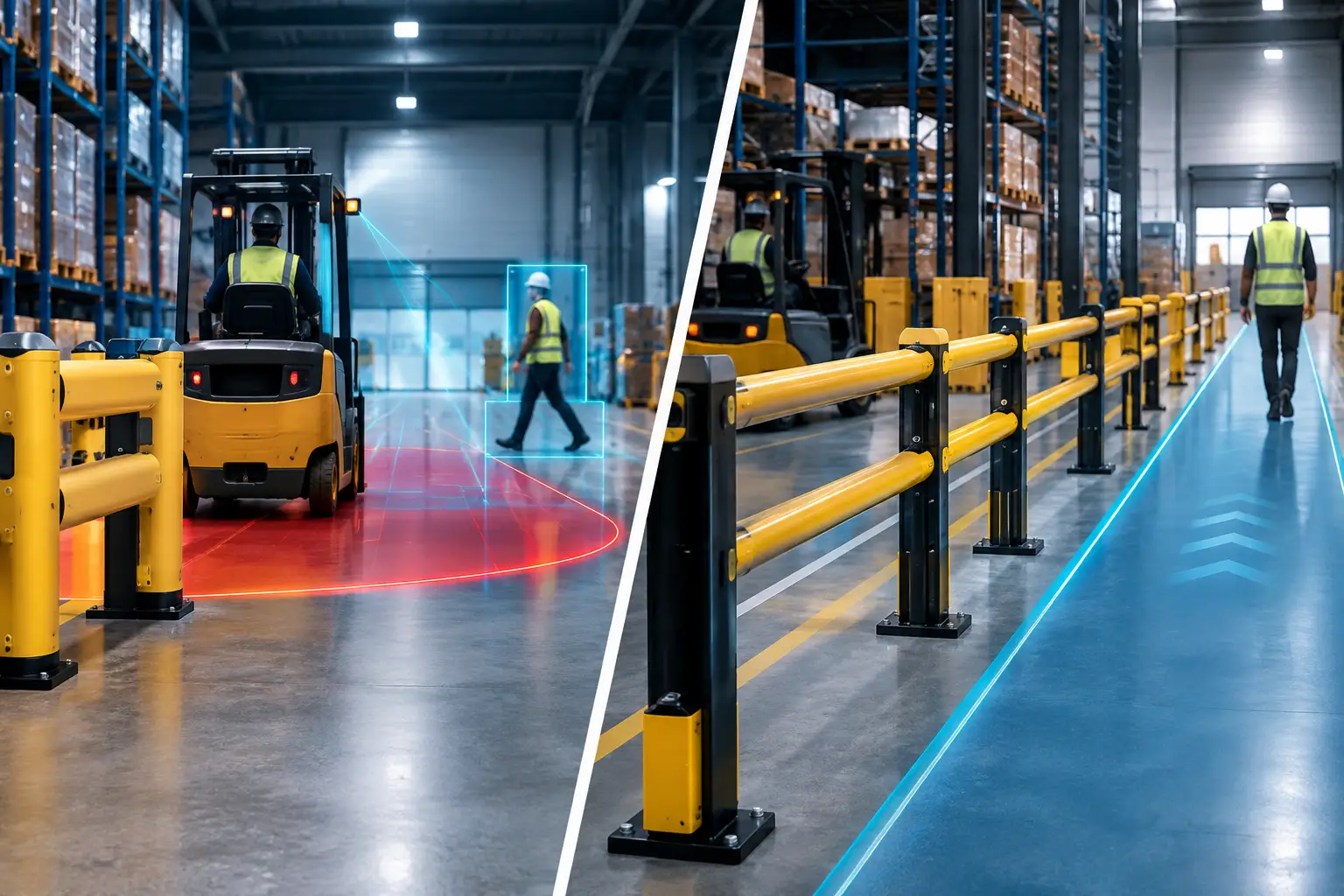
Forklift-pedestrian interaction is one of the most serious sources of near misses in industrial environments. Separation is the preferred control wherever the layout allows it. A painted line alone can help guide behavior, but it does not physically prevent a person from entering a vehicle route, especially during busy periods or when someone is carrying materials.
Start by mapping actual movement, not intended movement. Observe where forklifts travel, reverse, stage loads, turn, and queue. Then compare this with where pedestrians walk to workstations, printers, rest areas, exits, and loading zones. The most dangerous conflict points are often created by shortcuts, temporary storage, congestion, or changes in order volume.
Use a combination of controls based on the risk at each location:
- Physical barriers and guardrails can separate pedestrian walkways from vehicle routes and protect vulnerable rack ends.
- Clearly defined crossings can concentrate pedestrian movement at points with better visibility and warning controls.
- One-way traffic systems can reduce reversing and conflicting vehicle paths in narrow aisles.
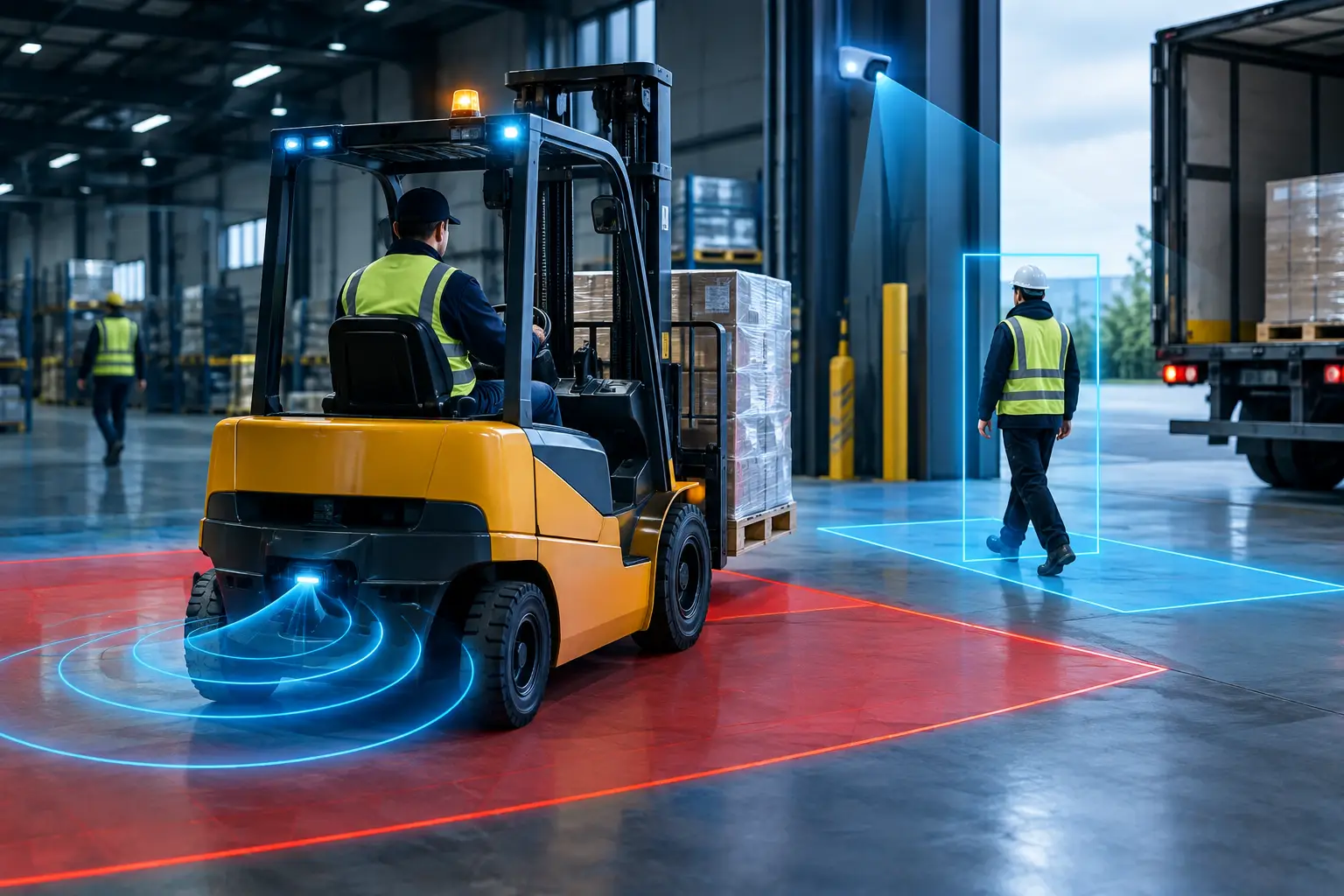
- Floor projection, audible warnings, and visual alerts can increase awareness at blind corners, doorways, and intersections.
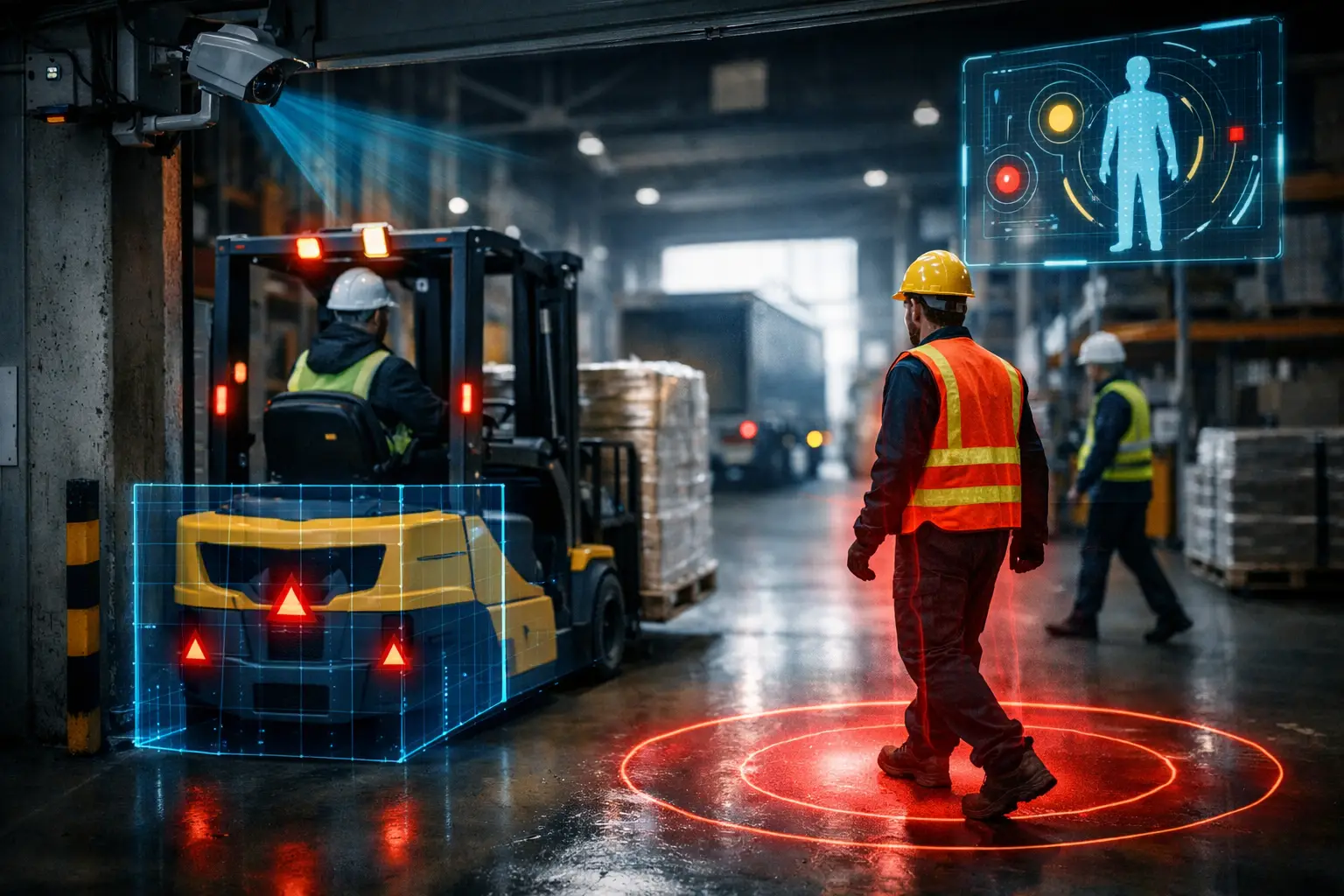
- Proximity warning systems or Vision AI monitoring can provide an additional layer of detection where vehicle and pedestrian exposure cannot be fully eliminated.
Technology should support a safe traffic design, not compensate for a poor one. A warning device may alert an operator to a pedestrian, but it cannot create stopping distance where a route is too narrow or restore visibility blocked by unstable staging practices. The right approach is to reduce exposure first, then use intelligent warnings to manage the remaining risk.
Control Blind Corners and Reversing Risks
Blind corners deserve their own review because they combine limited visibility with routine movement. Mirrors, warning lights, projected signs, and intersection alerts can improve awareness, but their effectiveness depends on placement, maintenance, and the behavior expected from both drivers and pedestrians.
Reversing creates a different challenge. Drivers may be focused on load stability, aisle clearance, or dock activity, while pedestrians may assume they have been seen. Reduce the need to reverse by designing travel routes that allow forward movement where feasible. Where reversing remains necessary, establish exclusion zones, clear stopping rules, and warning systems suited to the environment.
Investigate Conditions, Not Just Actions
A useful near-miss review asks more than, “Why did the employee not see the forklift?” It asks why the employee and forklift were able to occupy the same risk area at the same time.
Look for conditions such as obstructed sightlines, poor lighting, excessive noise, unclear right-of-way rules, worn floor markings, damaged barriers, inadequate staging space, and schedule pressure. Review whether the work process changed recently. A new product line, temporary layout, peak-season volume, or contractor activity can quickly invalidate an otherwise safe traffic plan.
Involve the people doing the work. Forklift operators, pickers, dock crews, and maintenance teams understand the practical compromises made during a shift. Their input can distinguish a one-off mistake from a control that fails under normal production conditions.
Assign an owner and due date to every corrective action. “Remind staff to be careful” is rarely an adequate corrective action because it depends entirely on individual vigilance. A stronger action might move a staging location, install rack-end protection, redesign a crossing, repair a damaged barrier, or add an alert at a recurring blind corner.
Give Loading Bays the Same Level of Control
Loading bays create concentrated risk because forklifts, trucks, pedestrians, dock equipment, and changing weather conditions meet in a confined area. Near misses can occur when a trailer moves unexpectedly, a driver enters the loading zone at the wrong time, or a forklift approaches a dock before it is safe to do so.
Clear bay procedures need physical support. Vehicle restraint systems, dock status lights, barriers, and audible or visual alerts can make the safe state of the bay easy to understand. The objective is to prevent conflicting actions, not to depend on verbal communication across a noisy dock.
Review transition points carefully. The moment a truck arrives, the point at which it is secured, the start of loading, and release from the bay are all moments when responsibilities can become unclear. Standardizing these handoffs reduces ambiguity, particularly across shifts or when carriers change.
Use Data to Prioritize the Right Fixes
A single near miss may require a local correction. A pattern requires a broader response. Track incidents by location, type of interaction, shift, equipment, and contributing condition. Combine those reports with forklift impact damage, barrier repairs, rack inspections, and observations from supervisors.
Do not judge success only by a drop in reported near misses. A sudden decline may mean reporting has weakened. Look instead for evidence that exposure has reduced: fewer pedestrians in vehicle routes, fewer hard-braking events, fewer rack impacts, improved compliance with designated crossings, and fewer repeated observations at known hotspots.
Technology can make this review more precise. Vision AI safety monitoring and intelligent warning systems can identify high-risk interactions, recurring pedestrian encroachment, or unsafe vehicle behavior that may not be reported consistently. However, collected data must lead to action. Monitoring without a defined review process becomes another source of information that does not change the floor.
Make Safety Controls Work Through Daily Operations
The most effective controls are maintained, understood, and usable during a busy shift. Include traffic routes, crossings, barriers, alerts, and loading bay equipment in routine inspections. When a barrier is damaged, a warning device is silent, or a staging area spills into a walkway, address it before the condition becomes normal.
Training should explain the reason behind each control, not only the rule. Operators and pedestrians are more likely to follow a route or exclusion zone when they understand the blind spot, turning path, or stopping-distance risk it manages. Refresher training is particularly valuable after layout changes, new equipment installation, or recurring near-miss trends.
Every near miss is a chance to strengthen the system before someone is hurt. When leaders respond quickly, workers report openly, and controls are designed for the reality of the operation, safety becomes part of how work moves forward – not a separate task that only matters after an accident.