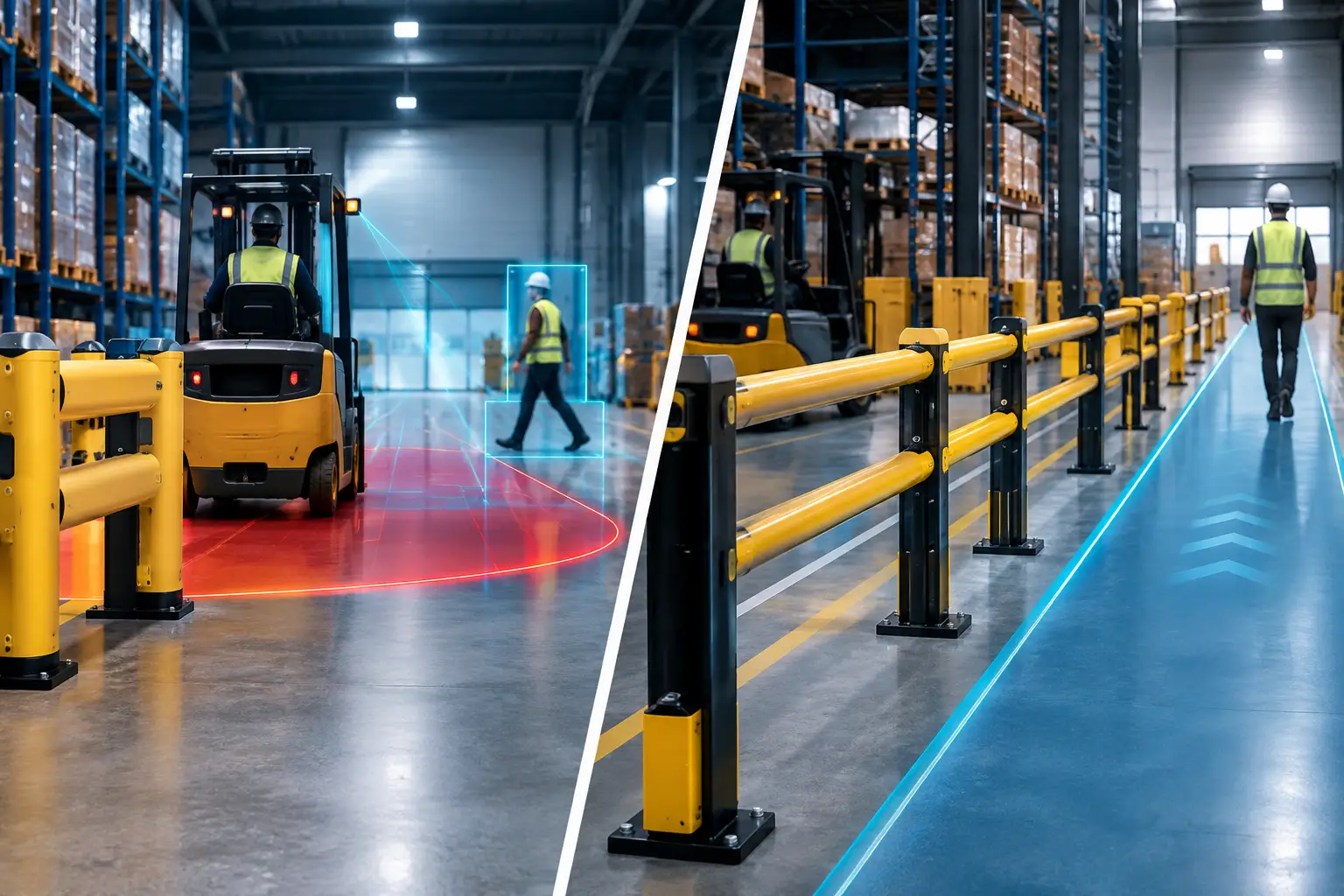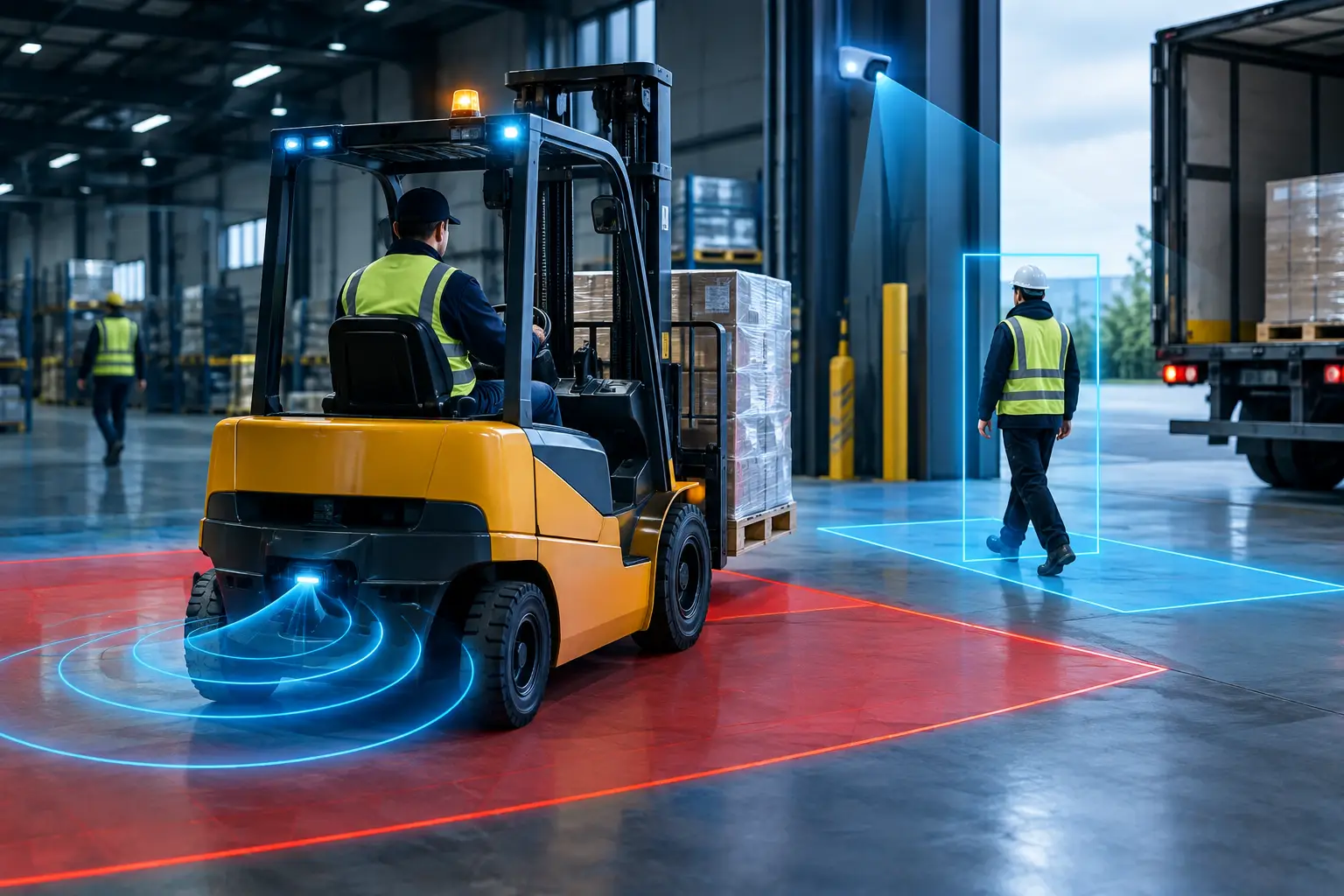
A forklift turning out of a rack aisle may have only seconds to detect a pedestrian, slow down, and avoid a serious incident. That is where the choice between vision AI vs safety sensors becomes operationally significant. Both technologies can help reduce forklift-pedestrian risk, protect assets, and strengthen traffic controls. But they do not see hazards in the same way, and neither should be treated as a universal replacement for the other.
For warehouse, manufacturing, and logistics leaders, the right question is not simply which technology is more advanced. It is which control can address the specific exposure at a particular location: a blind intersection, an active loading bay, a pedestrian crossing, a packing area, or a shared travel aisle.
Vision AI vs Safety Sensors: The Core Difference
Safety sensors are designed to detect a predefined condition within a defined detection zone. Depending on the technology, they may detect motion, presence, distance, or an object entering an area. In industrial environments, these systems are commonly used to trigger warning lights, audible alarms, floor projections, access controls, or vehicle slow-down actions.
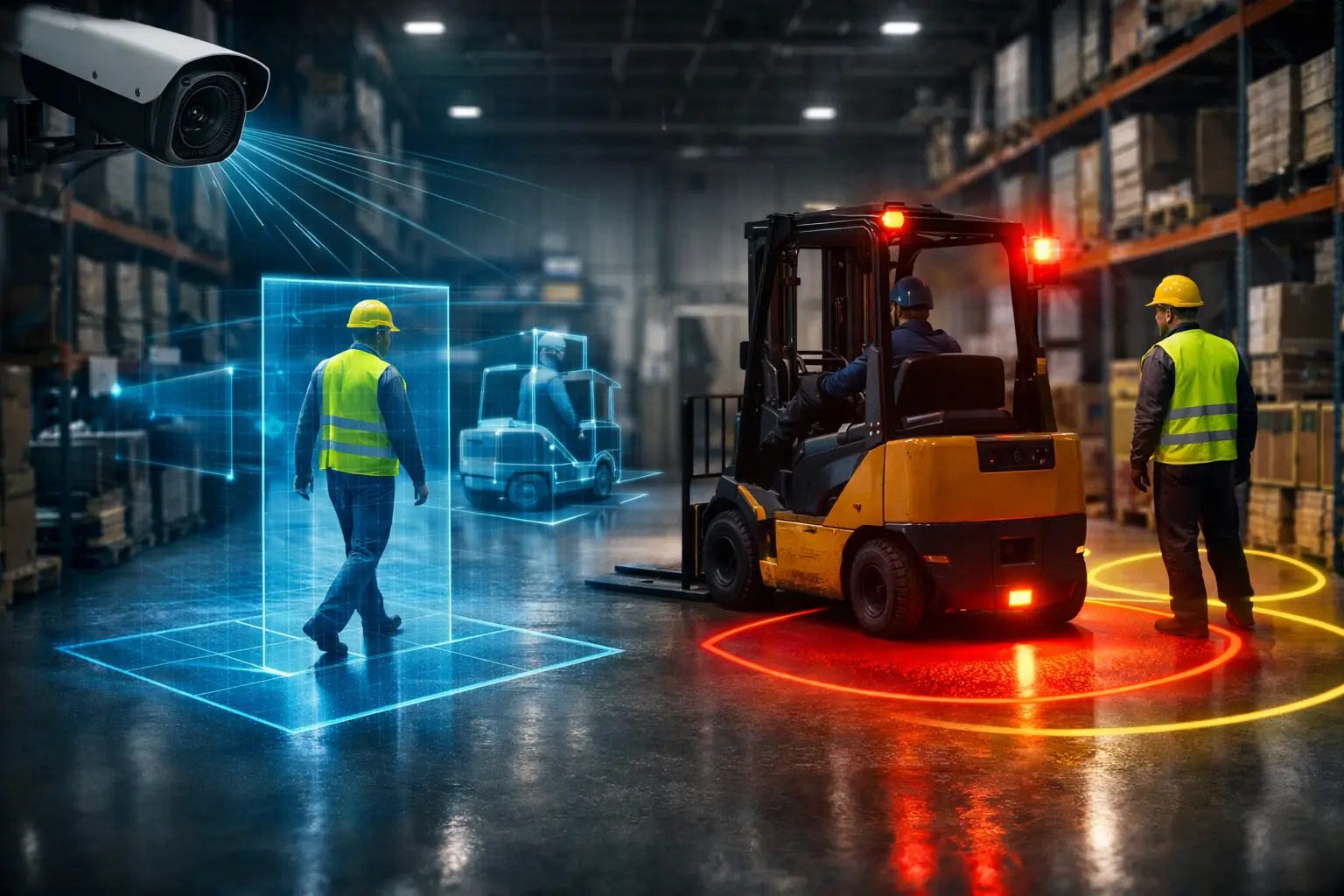
Vision AI uses cameras and trained algorithms to interpret what is happening in a scene. Rather than only recognizing that something has entered a zone, a Vision AI system may be able to distinguish a pedestrian from a forklift, identify whether a person is in a restricted area, recognize unsafe proximity, or detect behavior such as a person walking into a vehicle route.
This distinction matters. A sensor answers a focused question: is something present here? Vision AI can answer a broader question: what is present, where is it moving, and does the situation create a safety concern?
That added context can make Vision AI valuable in complex, high-traffic environments. However, it also requires appropriate camera positioning, scene assessment, configuration, testing, and ongoing maintenance. A well-selected sensor may remain the more practical and dependable control for a straightforward hazard.
Where Safety Sensors Perform Best
Safety sensors are highly effective when the hazard is predictable and the required response is clear. Consider a blind forklift intersection where two vehicle routes cross. A motion or presence detection system can activate a visual warning before the vehicles enter the conflict point. The system does not need to identify every object in the aisle. It needs to warn operators that another movement is approaching.
Sensors are also well suited to defined zones such as doorways, rack aisle exits, pedestrian gates, vehicle approach lanes, and loading bay thresholds. In these locations, a clear detection field and immediate alert can improve awareness without introducing unnecessary complexity.
Their strengths include fast response, a focused operating purpose, and relatively simple integration with audible and visual warning systems. For example, an activated sensor can trigger an intersection warning light, project a pedestrian symbol onto the floor, or alert an approaching forklift operator to slow down.
The trade-off is limited context. A sensor may detect a pallet, shrink wrap, a vehicle, or a person, depending on the sensing method and installation. If the operational need is to distinguish between those objects or identify a specific unsafe behavior, a conventional sensor may create unnecessary alerts or fail to provide the information needed for targeted corrective action.
Where Vision AI Adds Greater Value
Vision AI is most useful where the operating environment is dynamic and the safety risk depends on context. A busy dispatch area, for example, may include pedestrians, pallet jacks, forklifts, delivery vehicles, staging pallets, and changing traffic flows. A basic presence sensor may recognize movement, but it cannot always determine whether that movement represents a meaningful collision risk.
With correct configuration, Vision AI can support more intelligent monitoring of forklift-pedestrian interactions. It can identify people entering vehicle-only zones, detect unsafe proximity between workers and moving equipment, and provide event data that helps managers understand where risks are recurring.
This ability to generate operational insight is a major advantage. Instead of only hearing that an alarm was activated, an EHS or operations team may be able to review patterns: repeated pedestrian entry into a travel lane, congestion during shift changes, poor adherence to a designated walkway, or frequent conflict at a staging zone. Those findings can guide changes to layout, traffic management, training, scheduling, and physical separation.
Vision AI can also be a strong fit for locations where detection zones need to adapt to actual activity. In a loading bay, for instance, the risk changes as trucks arrive, dock doors open, forklifts transfer loads, and workers move between staging areas. The technology can help monitor these changing conditions more effectively than a single fixed-point sensor.
The Practical Limits of Each Technology
Neither solution eliminates the need for sound warehouse design and disciplined operations. A warning system cannot compensate for unclear pedestrian routes, poor visibility, excessive vehicle speed, or inadequate separation between people and mobile equipment.
Safety sensors may be affected by incorrect placement, blocked detection paths, reflective surfaces, dust, vibration, or conditions that were not considered during installation. The solution must match the environment and be tested under real operating conditions, not only during commissioning.
Vision AI also has limitations. Camera views can be compromised by poor lighting, obstructions, changing layouts, glare, or equipment positioned outside the intended field of view. Performance depends on camera coverage, algorithm configuration, network and power reliability, and the quality of the escalation process after an event is detected.
False alerts are another practical concern for both approaches. If warnings occur too frequently without a clear reason, workers may begin to ignore them. If detection is too narrowly configured, genuine hazards may be missed. The objective is not to install the most alarms. It is to create alerts that are timely, relevant, and connected to a clear action.
Choosing the Right Control for the Risk
A risk assessment should begin with the movement patterns at the site, not with a product specification. Observe where forklifts travel, where pedestrians cross, which tasks create congestion, and where sightlines are limited. Review near misses, equipment damage, and repeated unsafe behaviors. These are often the clearest indicators of where technology can make a measurable difference.
Safety sensors are generally a strong choice when the area is fixed, the hazard is straightforward, and a simple warning or activation is sufficient. Examples include blind corners, aisle intersections, access points, and pedestrian crossing approaches.
Vision AI is generally better suited to areas where several activities overlap, where the system must distinguish people from vehicles or objects, or where management needs data to identify behavioral and traffic patterns. This can include high-volume dispatch zones, shared work areas, complex loading bays, and warehouse locations with recurring pedestrian encroachment.
In many facilities, the strongest answer is a layered approach. Physical barriers and marked walkways provide separation. Safety sensors deliver immediate warnings at predictable conflict points. Vision AI monitors more complex interactions and produces evidence for continuous improvement. Vehicle-mounted warning systems, speed controls, floor projections, and site rules can reinforce the overall safety strategy.
Implementation Determines Results
Technology selection is only one part of accident prevention. Installation quality, worker communication, response procedures, and maintenance determine whether the control performs as intended.
Before deployment, define the safety objective in plain terms. For example: alert forklift operators when pedestrians approach a blind crossing; detect people entering a restricted loading lane; or identify repeated close-proximity events between forklifts and pedestrians. A precise objective makes it easier to select the right technology, configure detection zones, and measure results.
The workforce should also understand what the system does and what action is expected when it activates. An alert is useful only when operators and pedestrians can respond consistently. Teams should not view detection technology as a substitute for safe driving practices, designated walkways, or situational awareness.
After installation, review performance using real site conditions. Check alert frequency, missed detections, near-miss trends, user feedback, and changes in traffic patterns. Warehouses evolve as storage layouts, product flows, and staffing levels change. Safety controls need periodic review to remain relevant.
Build Safety Around Real Workflows
The choice between vision AI and safety sensors is not a contest between old and new technology. It is a decision about control effectiveness. A simple sensor can be the right answer at a blind corner. Vision AI may be the better answer when the risk involves people, vehicles, movement patterns, and changing conditions.
Every worker deserves to return home safely every day. Start with the moments when people and mobile equipment come too close, then apply the level of detection, warning, and separation that the risk truly requires.