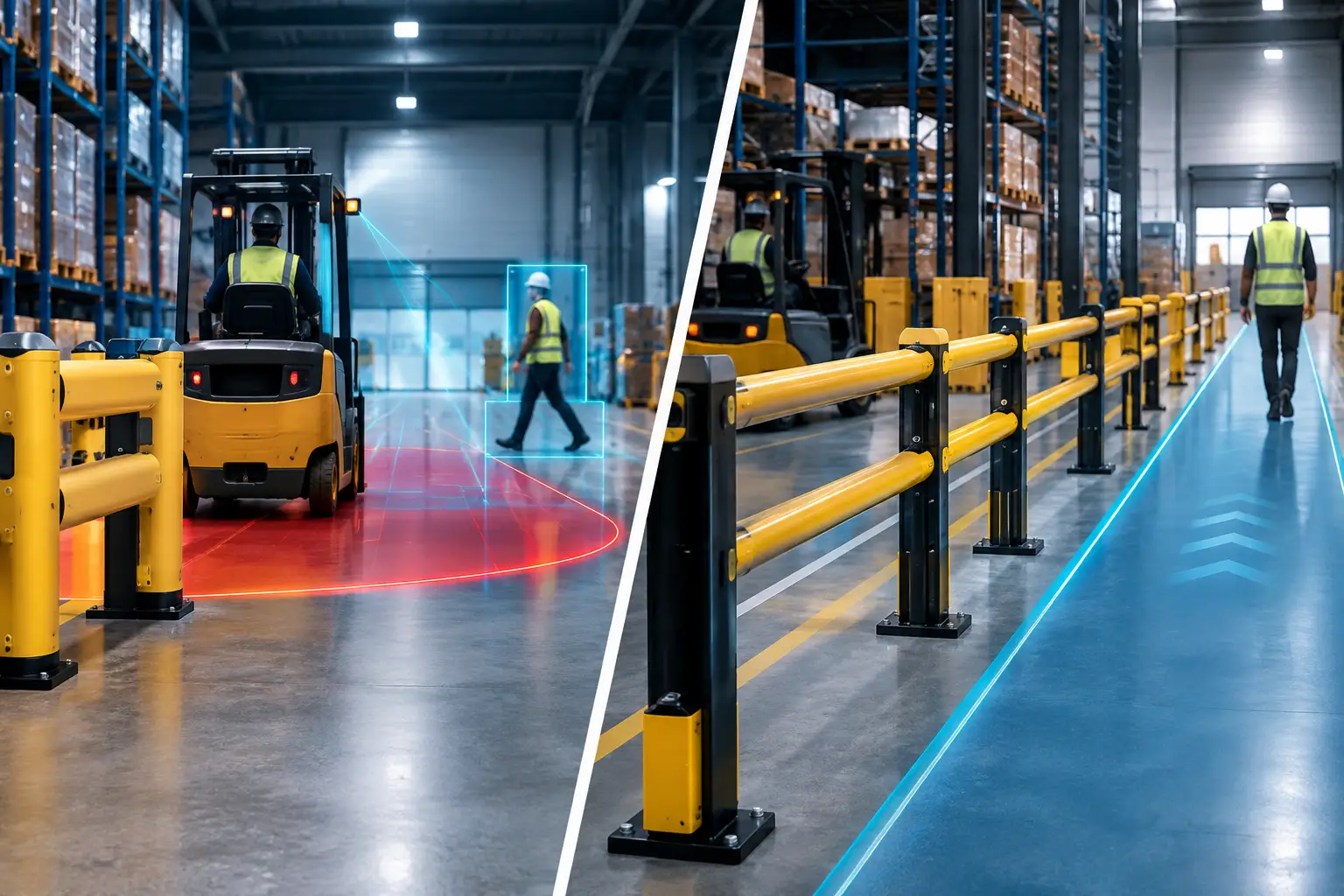

A forklift can travel the same route hundreds of times without incident, then meet a pedestrian at a blind corner during a rushed shift change. A loading bay can operate reliably for months, then become hazardous when a vehicle departs before unloading is complete. An industrial safety assessment checklist gives operations teams a disciplined way to find these conditions before they cause an injury, damaged stock, or costly downtime.
The objective is not to create another document that sits in a compliance folder. A useful assessment connects observed risks to clear controls, accountable owners, and practical follow-up. Every worker deserves to return home safely every day. That outcome depends on identifying how work is actually performed, not how it is assumed to be performed.
What an Industrial Safety Assessment Checklist Should Do
A checklist should help a facility assess exposure across people, vehicles, equipment, and the physical environment. It must be detailed enough to identify meaningful hazards, but focused enough that supervisors can use it consistently across shifts and work areas.
Start with the work process. Observe where people walk, where forklifts reverse, how trucks enter and leave, where materials wait, and what happens when production pressure increases. A hazard that only appears during peak dispatch, night operations, or maintenance activity can be missed by an assessment conducted in quiet conditions.
For each finding, record the location, activity, exposed people, likely consequence, existing control, and required action. Prioritize items according to both severity and likelihood. A low-frequency forklift-pedestrian collision may still require immediate attention because the potential consequence is severe.
Industrial Safety Assessment Checklist for Key Risk Areas
1. Forklift and pedestrian separation
Forklifts are essential to warehouse productivity, but shared traffic areas create one of the most serious operational risks. Assess whether pedestrian routes are clearly defined, physically separated where possible, and maintained free of pallets, staging materials, and temporary obstructions.
Check crossings, doorways, rack aisle ends, battery charging approaches, and blind corners. Ask whether a pedestrian can enter a vehicle route without being seen, and whether a driver has enough time and distance to react. Painted lines may help direct movement, but they are not always sufficient in high-traffic zones. Guardrails, impact barriers, controlled crossing points, projected warnings, or proximity alerts may be necessary depending on traffic volume, speed, visibility, and site layout.
Also review reversing activity. Reversing forklifts near pick faces, dispatch lanes, or compact aisles deserve particular scrutiny. Audible alarms have value, but their effectiveness can decline in noisy environments or where workers become accustomed to constant alerts. Layered controls, including visual warnings and intelligent detection systems, can provide a more dependable response.
2. Warehouse traffic flow and visibility
Traffic management should be assessed as an operating system, not a floor-marking exercise. Confirm that vehicle routes have a logical direction of travel, speed expectations, adequate turning space, and visibility at intersections. Identify places where forklifts, pallet jacks, delivery vehicles, and pedestrians are forced into the same narrow area.
Pay close attention to temporary changes. Overflow storage, seasonal inventory, damaged racking, maintenance work, and a parked trailer can all alter sightlines and create unofficial routes. A checklist should prompt teams to inspect whether safety controls still function when the layout changes.
Lighting also matters. Poor visibility at dock entrances, rack aisles, outdoor yards, and transition areas can delay recognition of a person or vehicle. The appropriate solution depends on the location. Additional lighting may address one area, while a visual alert or Vision AI safety monitoring may be more suitable where interactions are complex or patterns are difficult to observe manually.
3. Loading bay and vehicle restraint controls
Loading bays combine moving vehicles, elevated dock edges, changing floor levels, and time pressure. Assess whether drivers, dock workers, and forklift operators have a clear process for vehicle arrival, positioning, unloading, and departure.
The checklist should verify that trailers are correctly aligned, dock areas remain clear, and movement is controlled before a forklift enters the trailer. Review whether vehicle restraint systems, dock communication signals, and warning devices are used consistently and understood by both warehouse personnel and drivers.
Look for gaps between procedure and practice. For example, a designated waiting area is ineffective if drivers routinely stand near the loading zone to speed up paperwork. Similarly, a warning light is only useful if its status is visible, trusted, and tied to a defined operating action. Loading bay controls should prevent premature vehicle movement and reduce uncertainty at every handoff.
4. Racking, barriers, and facility protection
Facility damage often indicates a wider safety issue. Inspect rack uprights, end-of-aisle protection, guardrails, bollards, dock doors, pedestrian gates, and structural barriers for impact damage, loose fixings, deformation, or repeated contact marks.
Repeated minor impacts should not be dismissed as normal warehouse wear. They may reveal inadequate aisle width, poor turning geometry, restricted visibility, insufficient driver clearance, or an equipment route that does not suit the operation. The right corrective action may be rack protection, a traffic redesign, a physical barrier, or a change in material staging practices.
Assess whether barriers are positioned to protect the actual exposure. A barrier installed several feet away from a vulnerable rack upright may not stop a turning forklift from making contact. Engineering controls are most effective when placement is based on vehicle paths and real impact angles, not simply on where installation is easiest.
5. Warning systems and control reliability
Warning devices should support a specific risk control strategy. During the assessment, identify what triggers each alert, who needs to see or hear it, what action they are expected to take, and whether the signal can be missed in normal operating conditions.
A warning that activates too often can become background noise. One that activates too late may not provide enough reaction time. Vision AI monitoring and proximity warning technology can help identify interactions between people and vehicles, but technology should be configured around the site’s workflow and paired with clear procedures. It is not a substitute for traffic separation, good layout design, or operator discipline.
Check maintenance status as well. Damaged sensors, obscured projectors, nonfunctioning lights, and poorly positioned alarms create false confidence. Include functional testing and periodic review in the checklist so that controls remain dependable after installation.
Turn Findings Into Corrective Actions
An assessment only reduces risk when findings lead to action. Assign each item to an accountable person, set a realistic completion date, and document the control that will be implemented. Immediate hazards, such as exposed pedestrians in an active forklift route or an unreliable loading bay restraint, should be isolated or controlled without waiting for a full improvement plan.
For longer-term improvements, consider operational trade-offs honestly. Complete physical separation delivers strong protection, but may reduce available floor space or require changes to picking routes. Intelligent detection systems can improve awareness in dynamic areas, but need correct placement, commissioning, training, and maintenance. The best approach is usually a layered one: remove the hazard where possible, separate people and vehicles, protect vulnerable assets, then support the process with visible and audible warnings.
Review completed actions in the field. Do not assume a new barrier, crossing, or alert has solved the issue simply because it has been installed. Observe worker behavior across different shifts and ask operators whether the control creates confusion, delays, blind spots, or workarounds. A practical control is one that workers can follow under normal production pressure.
Make Assessment a Routine Operating Discipline
High-risk areas should be checked more frequently than low-exposure spaces. Daily supervisor checks can identify blocked walkways, damaged barriers, or changed traffic conditions. More detailed periodic assessments can examine trends, repeat impacts, near misses, and whether previous corrective actions are still effective.
Use incident and near-miss data to refine the checklist. If the same aisle, dock, or intersection appears repeatedly in reports, the question is not whether workers need another reminder. The question is what condition in the operation keeps allowing the exposure to recur.
A well-run industrial safety assessment checklist makes risk visible before it becomes an accident. Treat it as a working tool for safer decisions on the floor, and it can protect people, equipment, and operational continuity when the facility is under the most pressure.