A trailer can move only a few inches before a forklift operator is placed in a serious hazard zone. At a loading bay, that movement can create a gap between the dock and trailer, shift a dock leveler, or allow the vehicle to pull away while people and equipment are still inside. The decision between vehicle restraints vs wheel chocks is therefore not simply a purchasing choice. It is a decision about how reliably your operation controls trailer movement during loading and unloading.
Wheel chocks remain familiar across many facilities because they are simple and low cost. Vehicle restraint systems provide a higher level of engineered control, particularly where trailer traffic is frequent, forklifts enter trailers, and loading activities must continue safely across shifts. The right solution depends on your dock configuration, vehicle mix, operating procedures, and the level of risk your team needs to manage.
Why trailer movement is a loading-bay hazard
Loading bays involve several moving elements at once: trucks arriving and departing, dock doors opening, forklifts crossing thresholds, dock levelers operating, and warehouse teams working to tight schedules. If a trailer creeps forward or pulls away early, the results can include forklift tip-overs, falls from the dock edge, damaged dock equipment, product loss, and downtime while the bay is taken out of service.
Trailer movement does not always result from an intentional early departure. Air suspension can settle as a load changes. A driver may misunderstand a handover signal. A trailer may shift during loading, or a chock may be placed incorrectly and lose effectiveness. These are operational realities, which is why loading-bay controls must account for human behavior as well as vehicle forces.
A practical risk assessment should examine the full sequence, from vehicle arrival and positioning through loading, release, and departure. The most effective control is one that makes the safe sequence clear, visible, and difficult to bypass.
Vehicle restraints vs wheel chocks: the core difference
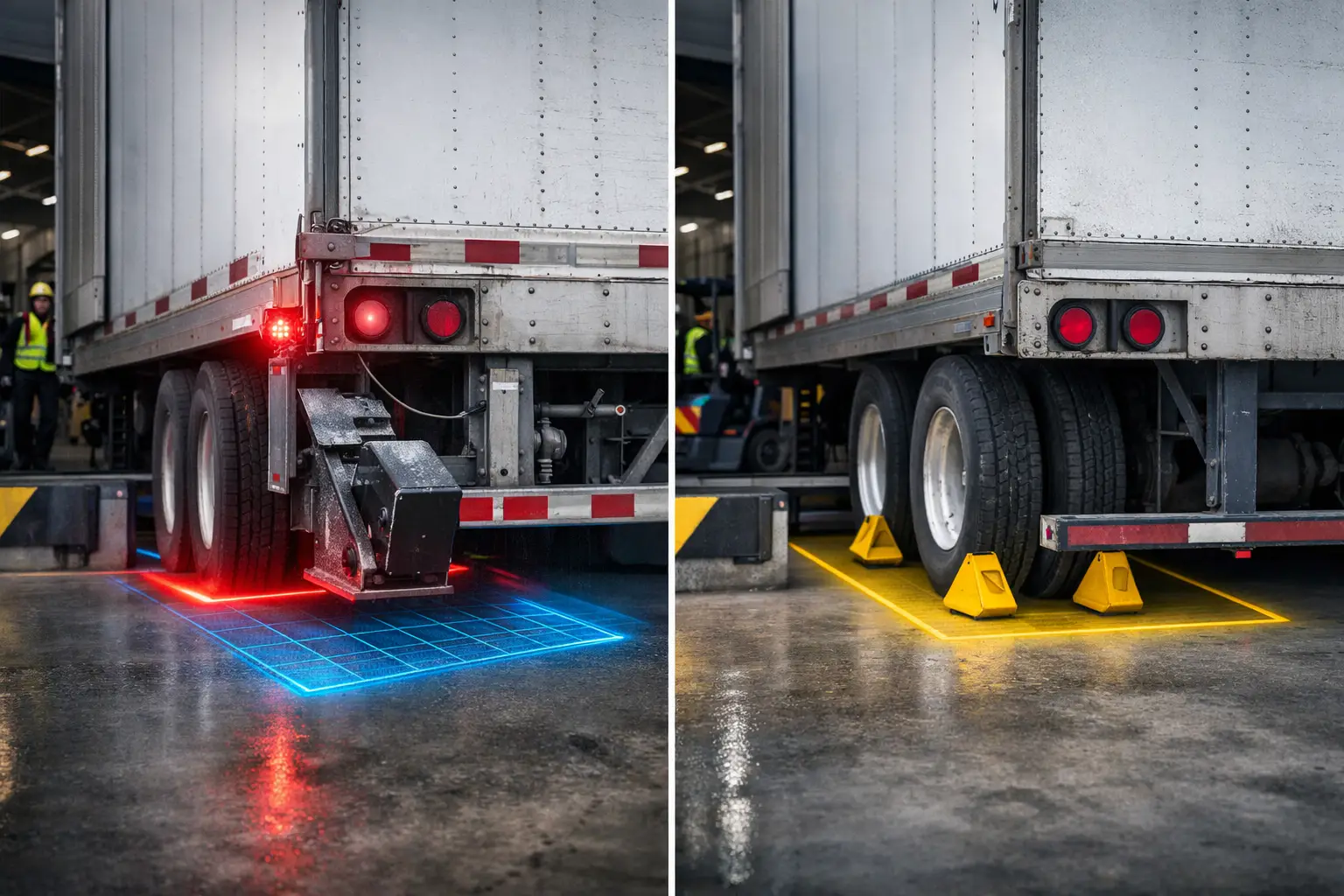
Wheel chocks are physical blocks placed against a trailer’s tires to reduce the risk of rolling. They rely on correct placement, sufficient contact with the tire and ground, suitable surface conditions, and consistent worker action. They can be an appropriate basic control for certain low-traffic or temporary operations, provided they are correctly specified and supported by disciplined procedures.
Vehicle restraints are dock-mounted systems that engage a designated point on the rear of a trailer, commonly the rear impact guard. Once engaged, the system is designed to resist trailer separation from the dock. Many systems work with internal and external status indicators, helping the dock team and driver understand whether the restraint is engaged, loading can proceed, or the vehicle is cleared to leave.
The difference is significant. A chock primarily seeks to prevent wheel rotation. A restraint actively holds the trailer at the dock and can be integrated into a controlled loading sequence. This reduces dependence on manual placement and verbal coordination, two common weak points during busy operations.
| Consideration | Wheel chocks | Vehicle restraints | | — | — | — | | Primary control method | Blocks tire movement | Secures trailer at the dock | | Reliance on manual action | High | Lower after correct setup | | Visual communication | Usually procedural or signage-based | Often includes red/green status indicators | | Suitability for frequent forklift loading | Limited by process reliability | Stronger fit for high-traffic docks | | Initial investment | Lower | Higher, with installation required |
Where wheel chocks can be a practical choice
Wheel chocks are not automatically inadequate. In a controlled environment with infrequent deliveries, limited dock activity, and no routine forklift entry into trailers, properly selected chocks may form part of a workable risk-control process. They are also useful where dock geometry or a mixed fleet makes a standard restraint system difficult to apply across every vehicle.
However, their effectiveness depends on conditions that must be actively managed. The chock must be large enough for the tire, positioned on a stable surface, and placed before loading begins. The process also needs clear responsibility: who places it, who verifies it, and who authorizes its removal. If a driver retains access to the vehicle cab while the dock team is loading, the facility needs additional communication and control measures to prevent an unplanned departure.
Chocks can be affected by wet, oily, uneven, or contaminated surfaces. They may also be misplaced when teams are under pressure. For this reason, facilities should avoid treating chocks as a standalone answer where the consequences of trailer movement are severe.
When vehicle restraints are the stronger control
A vehicle restraint system is generally better suited to loading bays with regular truck movements, multiple dock doors, powered industrial truck traffic, or high-value, time-sensitive operations. It provides a consistent physical control point at the dock and can reduce the risk created when procedures vary between shifts or delivery drivers.
The value of a restraint extends beyond holding the trailer. Clear external signals can tell the driver to remain stopped, while internal indicators can confirm to warehouse personnel that the trailer is secured. When connected with dock-door or leveler controls, the system can support an interlocked sequence that prevents loading activity from starting before the trailer is secured.
This approach helps remove ambiguity. Instead of relying on a worker to remember several manual steps and communicate them perfectly, the dock uses physical engagement and visible status information to guide the process. That can improve safety performance while reducing delays caused by uncertainty at the bay.
Still, a restraint is not a universal fit without planning. Some trailers may have damaged, unusually shaped, or incompatible rear impact guards. Low-clearance trailers, liftgate-equipped vehicles, and varied fleet types may require specific restraint designs or alternative controls. A site survey should confirm compatibility before a system is selected.
Installation and maintenance matter
The performance of a vehicle restraint depends on proper engineering, installation, inspection, and maintenance. Dock approach, driveway slope, bumper projection, trailer geometry, structural mounting points, and local vehicle patterns all affect system selection.
Teams should also establish inspection routines for the restraint mechanism, sensors, signs, and traffic-light indicators. A damaged hook, misaligned sensor, or failed signal can lead workers to rely on assumptions rather than confirmed dock status. Safety technology is most effective when its condition is visible, understood, and maintained.
Evaluate the loading process, not just the device
The best choice cannot be made by comparing product specifications alone. Review the actual behavior at each loading bay. Consider how many trailers arrive per day, whether forklifts enter the trailer, the types of vehicles served, the frequency of driver changes, and the consequences if a vehicle moves unexpectedly.
Also examine how the team works during peak periods. A control that appears adequate on a quiet shift may be bypassed when several trucks are waiting, a supervisor is absent, or an agency worker is unfamiliar with the process. This is where engineered controls offer a meaningful advantage: they can make the safe action easier to follow under real operating pressure.
Facilities with mixed risks may use more than one control method. For example, a restraint system may protect primary forklift-loading bays, while defined chocking procedures apply at temporary or nonstandard positions. The key is to document the conditions, train employees and drivers, and make the release process unambiguous.
Build clear dock communication around the chosen control
Whether your facility uses wheel chocks, vehicle restraints, or a combination of both, communication is essential. Drivers need to know when to stop, when loading is underway, and when they are authorized to depart. Dock personnel need a reliable indication that the trailer is secure before a forklift crosses the threshold.
Visual indicators, audible alerts, floor markings, and written bay procedures can reinforce that sequence. Supervisors should verify that the process works across day and night shifts, especially when external transport providers and changing drivers are involved. A safety control that is technically sound but poorly communicated can still fail in practice.
SysGuard supports loading-bay safety programs by helping facilities assess dock hazards, select appropriate vehicle restraint solutions, and integrate warning and control systems into daily operations. The objective is not to add technology for its own sake. It is to prevent the moment when a moving trailer turns a routine loading task into an accident.
Every loading bay has its own vehicle mix, traffic pattern, and risk profile. Choose the control that gives your people a clear, dependable answer to one critical question before loading begins: is this trailer truly secured?