A forklift turning out of a rack aisle, a pedestrian crossing a travel lane, and a truck leaving a loading bay are ordinary moments in industrial operations. They are also moments when visibility, timing, and human judgment can fail. This industrial safety technology guide explains how warehouse, plant, and logistics leaders can apply practical controls where risk is highest – before an incident causes injury, damage, or costly downtime.
Technology does not replace disciplined operating procedures, trained people, or sound facility design. It strengthens them. The right solution gives operators and pedestrians earlier warnings, gives supervisors better visibility of unsafe conditions, and helps facilities create physical separation where people and vehicles must work in close proximity.
Start With the Risk, Not the Device
Industrial sites rarely have one isolated safety problem. A warehouse may have blind intersections, narrow aisles, mixed pedestrian and forklift routes, damaged rack uprights, and loading bays with changing vehicle movements. Installing a warning light at one location may help, but it will not resolve the underlying traffic conflict if routes remain unclear or pedestrians still need to enter active vehicle zones.
Begin with a site-specific risk assessment. Observe shifts, not just the facility layout. Peak receiving periods, temporary staging, seasonal labor, contractor access, and changes in product flow can all create hazards that are absent during a quiet walkthrough. Review incident and near-miss records, equipment damage reports, and the locations where operators routinely slow down, reverse, or sound horns.
The goal is to identify the point of exposure: where a person can enter a forklift path, where a trailer can move unexpectedly, where a driver loses sight of a pedestrian, or where an impact can damage a rack or facility structure. Once that exposure is clear, safety technology can be selected as part of a wider control strategy rather than as a standalone purchase.
Industrial Safety Technology Guide: Key Control Areas
The most effective programs prioritize hazards with the potential for serious injury and frequent operational disruption. In most warehouses, factories, and distribution centers, that means focusing on vehicle-pedestrian interaction, loading bay movement, blind spots, and asset protection.
Forklift and Pedestrian Collision Prevention
Forklifts are essential to material flow, but their operating environment changes constantly. Loads can obstruct forward vision. Reversing is common. Noise, racking, doors, and temporary stock can hide people from view. Marked walkways are valuable, yet markings alone may not be enough when pedestrians must cross active routes.
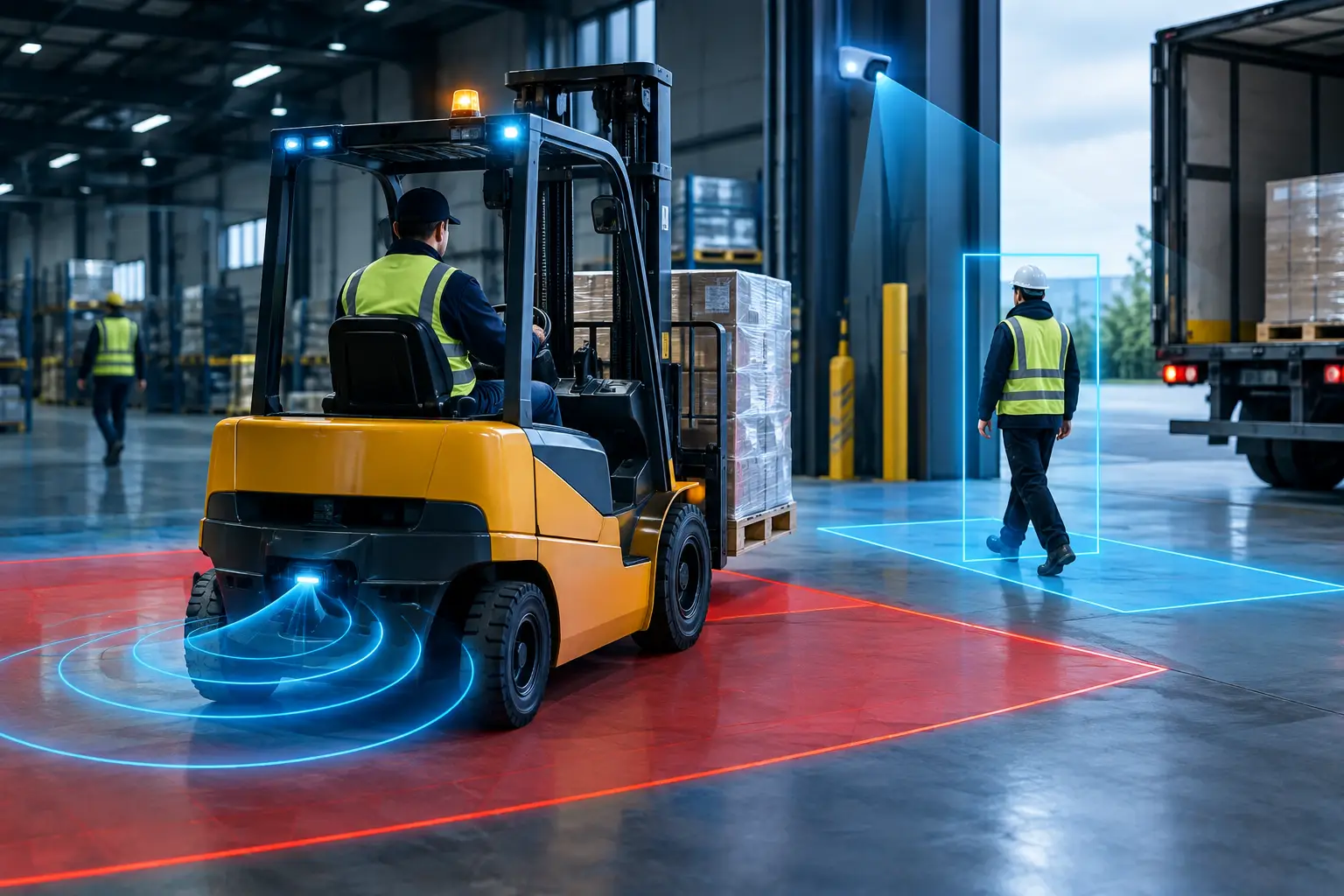
Proximity warning systems can detect or identify interactions between mobile equipment and people, then provide audible, visual, or in-cab alerts. The most suitable system depends on the task. A busy cross-aisle may benefit from area-based warning technology, while a site with regular pedestrian access near forklifts may need personnel detection or wearable-based controls.
The trade-off is alert quality. If alerts trigger constantly in normal operations, operators may become desensitized. Detection zones, warning distances, speed thresholds, and escalation settings should be configured around actual travel speeds and stopping distances. A system that provides fewer, more meaningful warnings is often more effective than one that alarms at every movement.
Vision AI Monitoring at High-Risk Locations
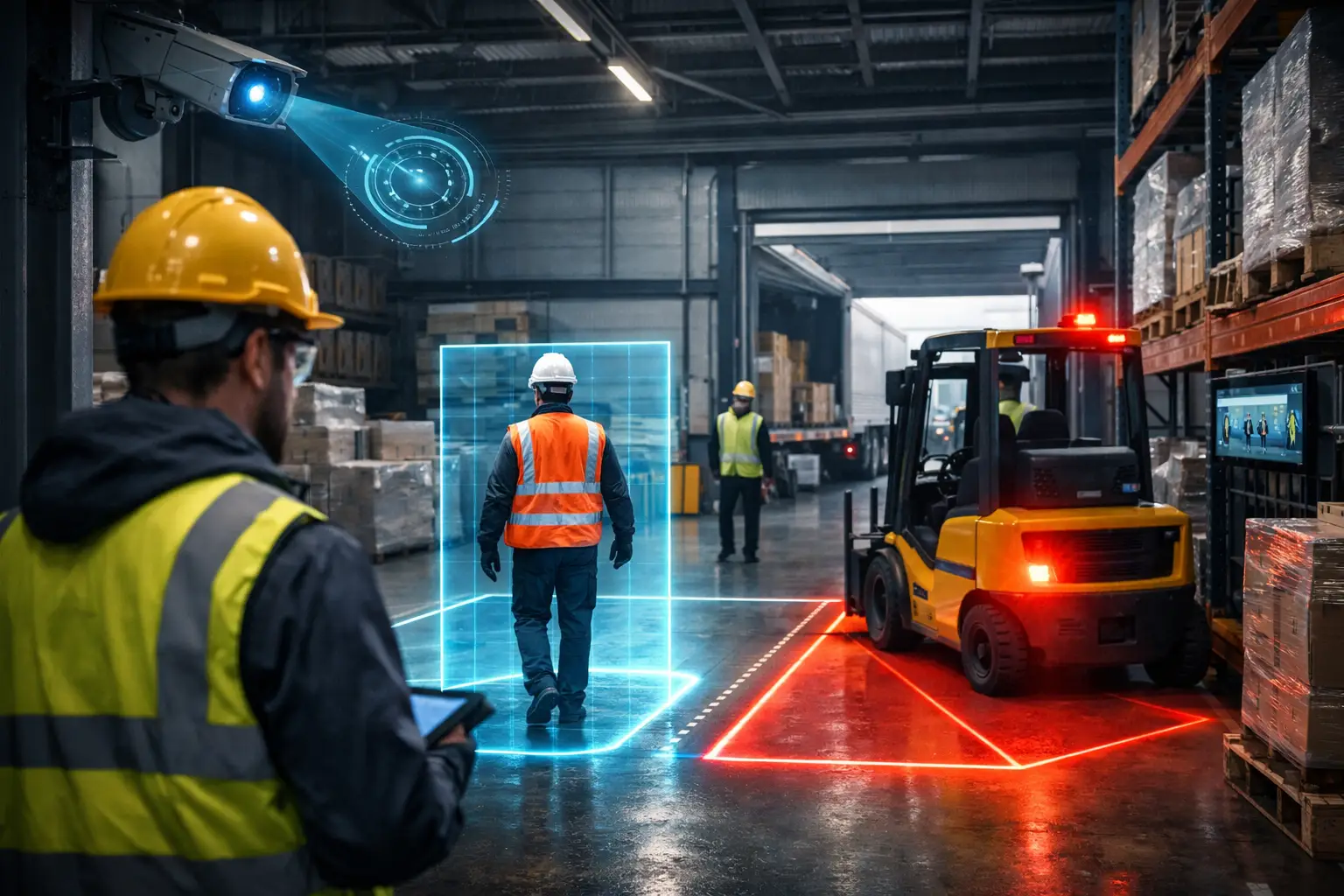
Vision AI safety monitoring can add a layer of awareness in areas where fixed rules are difficult to enforce consistently. It can identify conditions such as pedestrians entering restricted zones, forklifts approaching crossings, blocked walkways, or unsafe activity around designated work areas. When integrated with visual alarms, projectors, or warning devices, it can trigger an immediate response at the location of risk.
This is particularly useful at blind corners, production interfaces, dispatch areas, and shared work zones. Unlike a simple motion sensor, an AI-enabled system can be configured to distinguish relevant objects and events. That said, its performance depends on camera placement, lighting, line of sight, environmental conditions, and clear definitions of what constitutes unsafe behavior.
Use Vision AI where it can support a specific control objective. It should not become a source of unnecessary data or a substitute for correcting an unsafe layout. For example, if a pedestrian shortcut crosses a forklift route every shift, redesigning the route or installing a protected crossing may provide a more reliable primary control.
Audible, Visual, and Floor Projection Warnings
Visible warnings help people recognize danger before they enter it. Blue spotlights, red zone lights, projected crossing symbols, speed reminders, and intersection alerts can improve awareness around moving equipment and low-visibility areas. They are especially useful where noise makes horns less effective or where workers need a clear visual cue before entering a travel lane.
Floor projection is not simply signage. Because the projected message can be placed directly in a person’s field of travel, it can reinforce exclusion zones, crossing points, and vehicle approach warnings without relying solely on painted lines. However, projected warnings work best on suitable surfaces and in lighting conditions that preserve visibility. They should be validated during normal operating hours, not only during installation.
Loading Bay Safety and Vehicle Restraint
Loading bays combine moving trucks, forklifts, dock equipment, changing elevations, and time pressure. A trailer that departs too early or moves during loading can create severe risk for personnel and equipment inside the trailer or on the dock.
Vehicle restraint systems help secure a truck at the dock and communicate whether loading can proceed. Combined with dock traffic lights, audible alarms, and clear operating sequences, they reduce reliance on verbal coordination between drivers and warehouse teams. The practical question is not whether a restraint system is useful in general. It is whether the loading bay configuration, vehicle types, trailer condition, and dispatch process can support its reliable use.
A site may also need controls for dock approach routes, pedestrian separation, reversing vehicles, and restricted access during loading activity. The safest loading bay is one where each party can clearly see the status of the operation and no one must guess whether a vehicle is secure.
Barriers, Rack Protection, and Impact Control
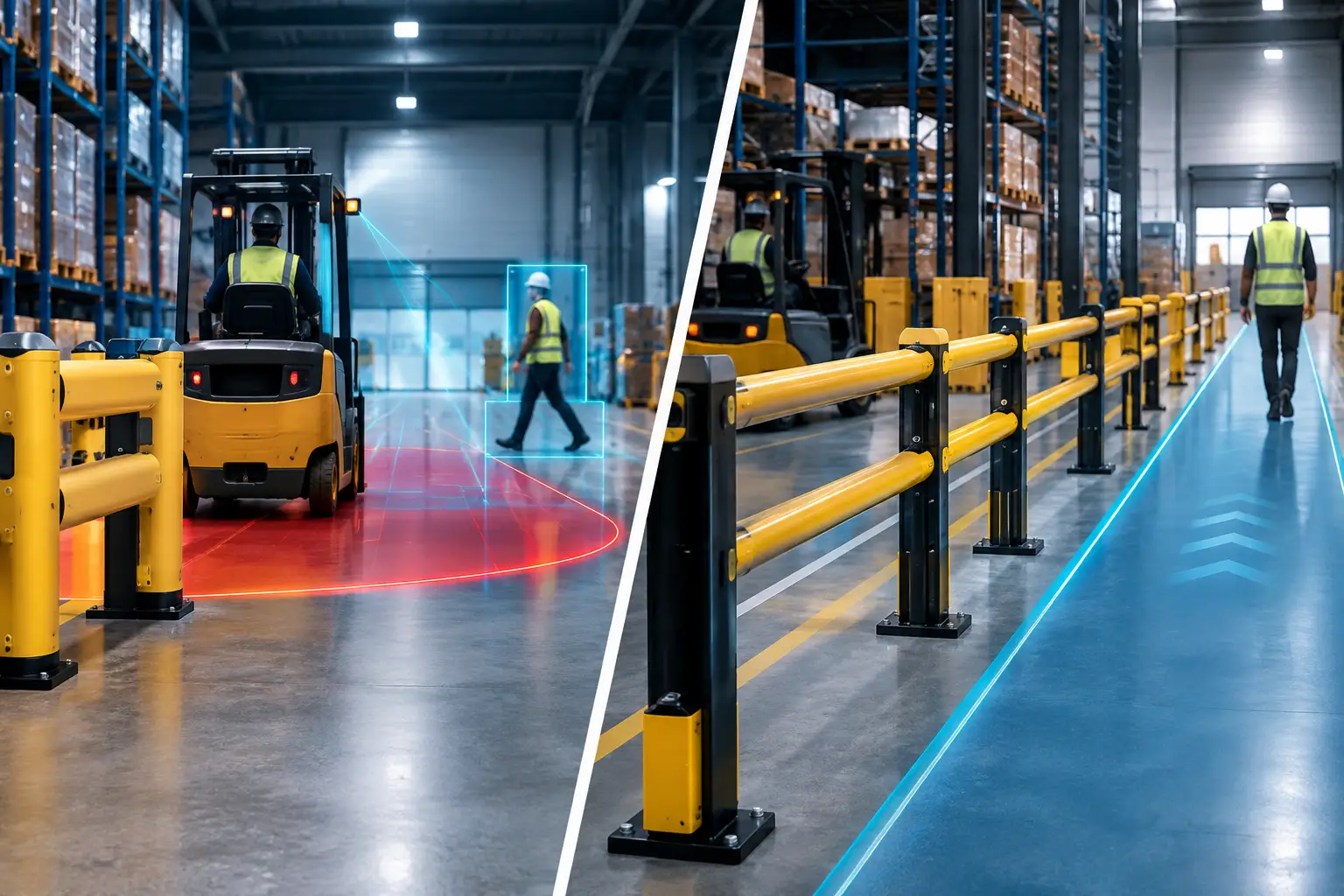
Some hazards should not depend on warnings at all. Physical separation remains one of the strongest controls for preventing contact between people, vehicles, and infrastructure. Warehouse safety barriers can protect pedestrian walkways, workstations, doors, charging areas, and building columns from vehicle impact.
Rack protection deserves the same attention. A damaged upright or unreported impact can compromise storage integrity and trigger operational disruption. Column guards, end-of-aisle barriers, rack-end protection, and properly designed impact barriers help absorb or deflect routine contact before it reaches critical structures.
Not every barrier is appropriate for every location. Barrier selection should consider vehicle mass, travel speed, turning behavior, floor condition, anchoring requirements, clearance, and access needs. An underspecified barrier may create false confidence, while an oversized installation can restrict flow and introduce new pinch points.
Build Controls Into the Operating System
Safety technology delivers better results when it is treated as part of the operation, not as a project that ends at installation. Assign ownership for inspections, testing, fault reporting, and review of warning events. Supervisors should know what normal operation looks like, what an alert means, and when a recurring event indicates a layout or behavior issue.
Training should be role-specific. Forklift operators need to understand how in-vehicle alerts behave and what actions are expected. Pedestrians need to recognize projected warnings, protected routes, and exclusion areas. Maintenance teams need a practical method to check sensors, lights, barriers, anchors, and detection zones without disrupting production unnecessarily.
Measure outcomes that connect directly to risk reduction. Useful indicators include vehicle-pedestrian near misses, rack impacts, loading bay deviations, equipment damage, repeated alerts at a location, and downtime linked to safety incidents. A reduction in alerts is not automatically a success if people have simply learned to ignore the system. Pair data with site observations and worker feedback.
A Practical Implementation Sequence
For complex facilities, a phased approach is usually more effective than deploying every technology at once. First, address severe exposure with physical segregation, vehicle restraint, or controls at known conflict points. Next, add warning and detection technologies where visibility and behavior require additional support. Finally, review performance after real operating conditions have tested the system.
Before procurement, involve operations, EHS, maintenance, and frontline supervisors. Their input will expose practical issues such as battery charging schedules, cleaning requirements, access constraints, temporary staging patterns, and how operators actually navigate the site. An engineering-led consultation can help translate those realities into a solution that is practical to install and maintain.
SysGuard approaches industrial safety as a layered system: assess the exposure, apply the right control, verify that it works in the real environment, and maintain it over time. Every worker deserves to return home safely every day. The best next step is to walk the areas where people and vehicles meet, ask where visibility or control breaks down, and act before the next near miss becomes an accident.