
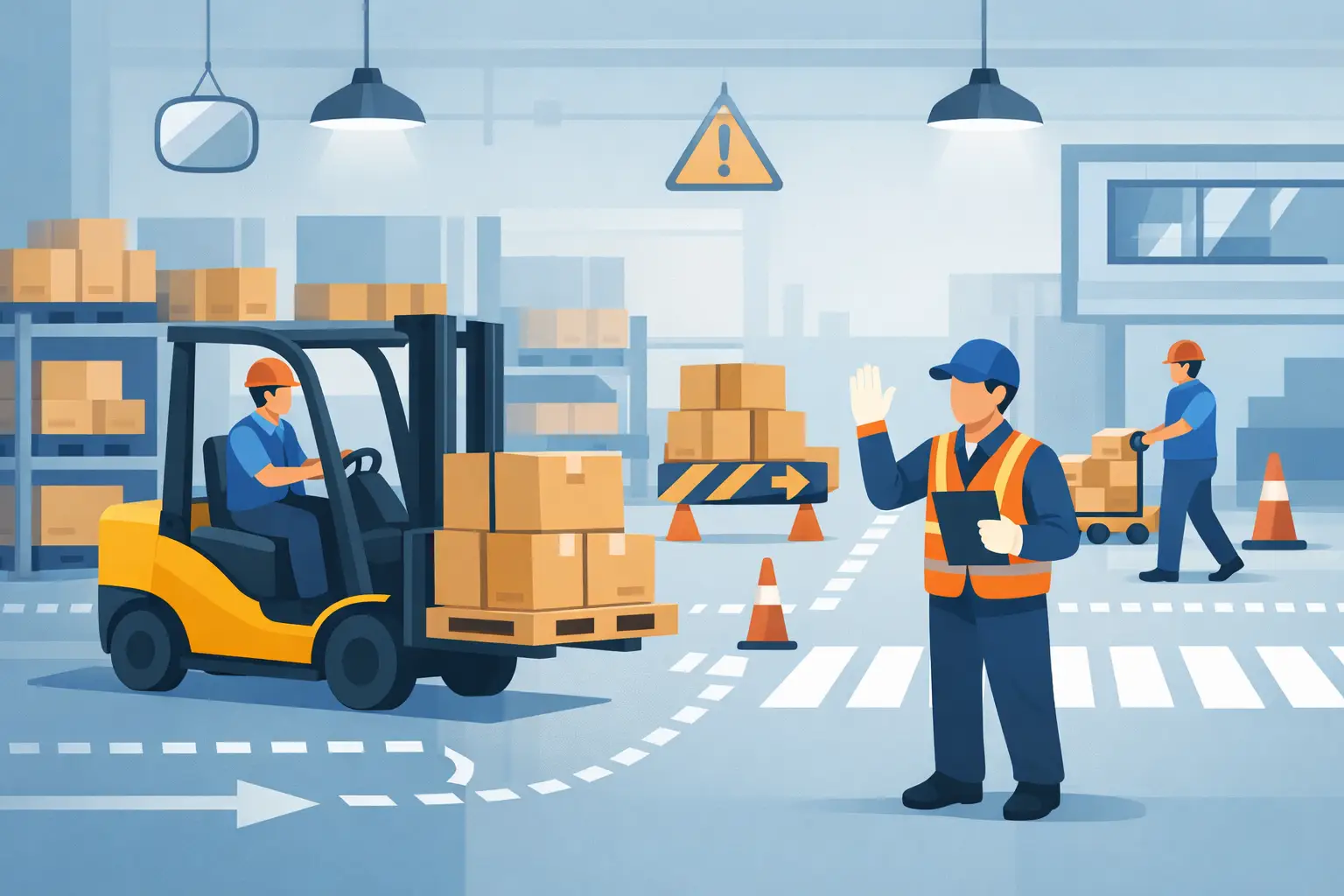
A near miss at a warehouse cross-aisle rarely looks dramatic. A horn sounds late, a pedestrian steps back fast, and a forklift stops just short of contact. Then the shift continues. That is exactly why a forklift traffic management guide matters. The highest-risk traffic problems in industrial facilities are often normalized long before they are controlled.
Forklift incidents are rarely caused by one mistake. More often, they come from predictable friction between people, vehicles, racking, blind corners, loading activity, and production pressure. If traffic routes are unclear, if pedestrian paths are informal, or if speed control depends only on operator judgment, risk builds into the operation. A strong traffic plan reduces that exposure while improving throughput, asset protection, and business continuity.
What a forklift traffic management guide should actually solve
Traffic management is not just painted floor lines and a few safety signs. It is the system that decides how forklifts move, where pedestrians can walk, how visibility is improved, and what controls are used when ideal separation is not possible. In a busy warehouse or plant, that system needs to work under real conditions, not just during audits.
The core objective is simple: separate people and vehicles wherever possible, and control interaction where separation cannot be fully achieved. That includes travel routes, intersections, staging zones, dock approaches, battery charging areas, production interfaces, and maintenance access points. Each of these locations creates a different risk profile. A receiving dock with reversing vehicles needs different controls than a narrow picking aisle or a mixed-use production corridor.
This is where many facilities fall short. They apply one standard across the entire site, even though traffic density, visibility, floor conditions, and pedestrian exposure vary by zone. Effective management starts with recognizing that forklift traffic is not one hazard. It is a network of hazards.
Start with real traffic mapping, not assumptions
Before adding barriers, sensors, or warning systems, map how traffic actually moves today. The practical route is often different from the official route. Operators may cut through staging areas to save time. Pedestrians may cross aisles where no crossing is designated because the marked route adds too many steps. Supervisors may know this already, but unless it is documented, risk remains informal.
A proper review should identify where forklifts travel, stop, reverse, turn, queue, and interact with other vehicles. It should also capture pedestrian shortcuts, contractor access, peak congestion times, and temporary obstructions such as pallets or outbound staging. Near misses are especially useful here because they point to recurring design failures, not just unsafe behavior.
Video review, supervisor walkthroughs, operator interviews, and shift-based observation all help. If one shift has orderly movement but another operates around congestion, the traffic plan is incomplete. Good design has to survive operational variation.
Separate pedestrians from forklifts wherever possible
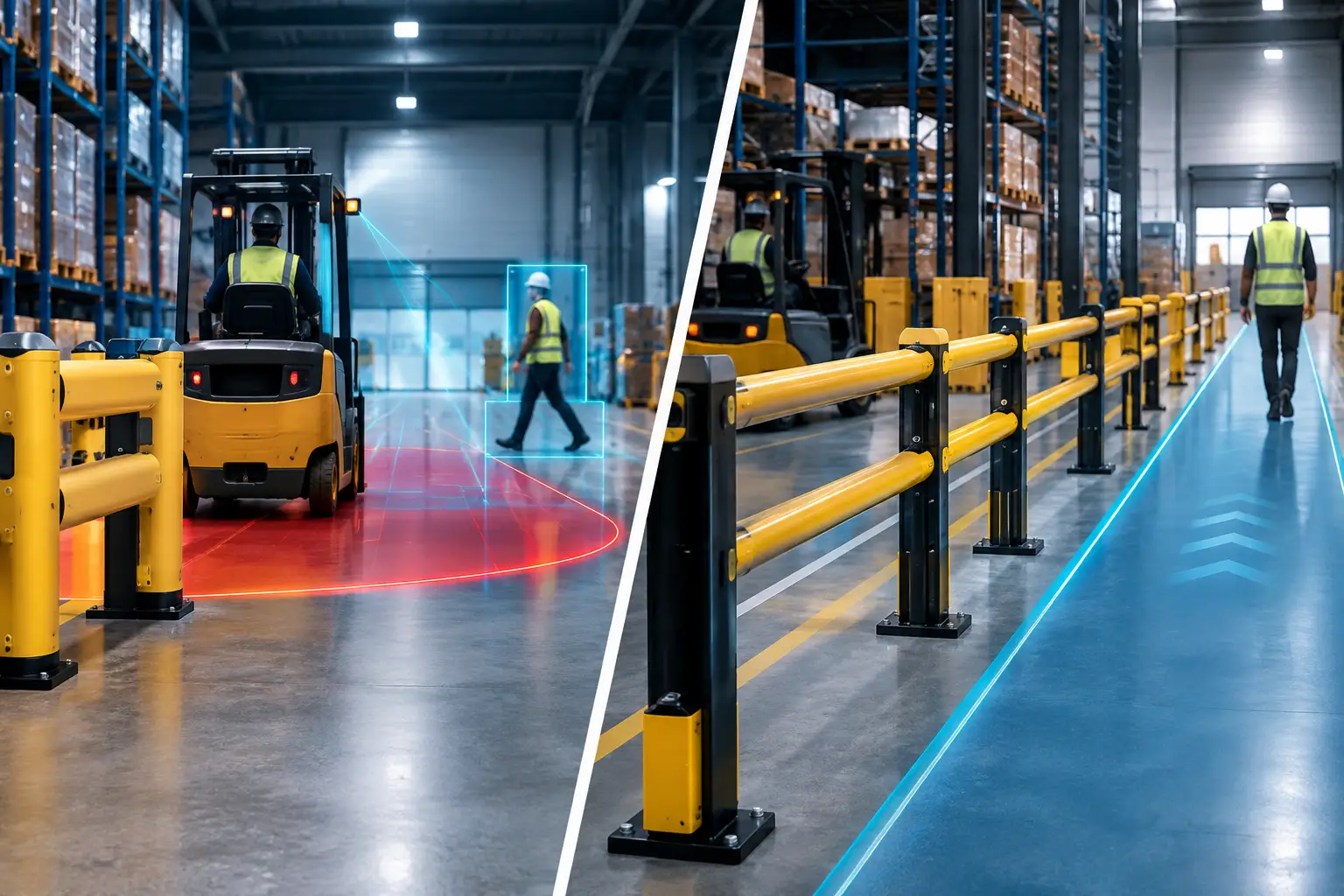
Physical separation is the most reliable control because it does not depend on perfect human behavior. If a pedestrian walkway is fully protected by barriers, the chance of contact drops significantly. If separation relies only on painted markings, the protection is weaker, especially in high-noise or low-visibility environments.
That does not mean every aisle needs heavy infrastructure. The right level of control depends on traffic speed, vehicle type, turning radius, available space, and pedestrian frequency. In some locations, marked walkways and gated crossings may be sufficient. In others, impact-rated barriers, guardrails, or controlled access points are the safer choice.
The trade-off is space and flexibility. More separation can reduce usable floor area or require route changes that affect travel time. But facilities usually absorb those costs faster than they recover from an injury, equipment damage, or a shut-down area after an incident. When people and forklifts must share a zone, that decision should be explicit and engineered, not accidental.
High-risk pedestrian interaction points
Some areas deserve more attention because they combine movement, distraction, and low visibility. Cross-aisles are one example. So are dock entrances, pick faces near forklift lanes, and doors connecting office or production spaces to warehouse traffic. These are places where a worker may step into a route without seeing an approaching vehicle.
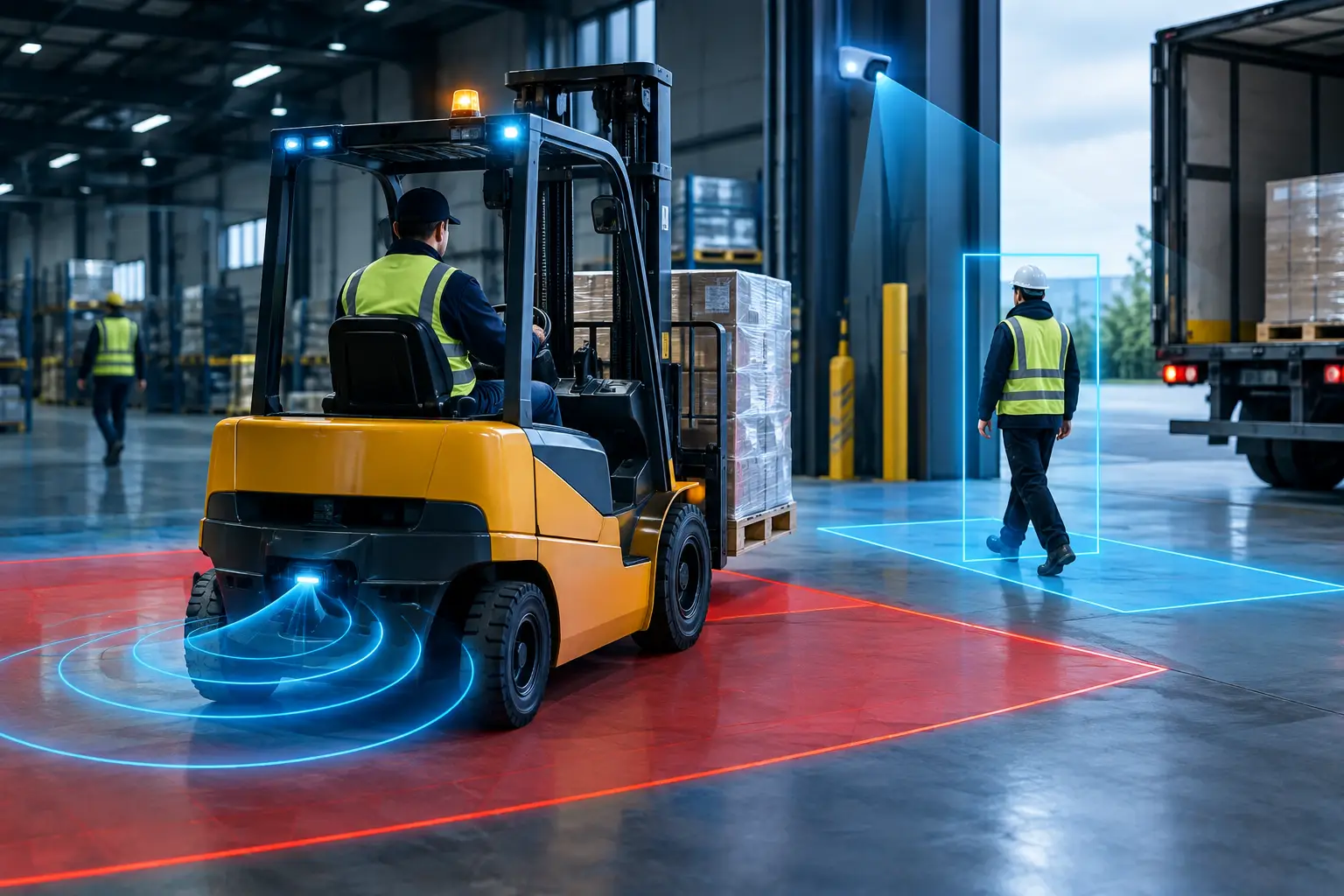
At those points, layered controls work best. Barriers guide movement. Visual alerts signal approaching traffic. Audible warnings help where sightlines are poor. Convex mirrors can improve awareness, but they should support engineered controls rather than replace them. Mirrors help with visibility. They do not slow a forklift or stop a distracted pedestrian from stepping into danger.
Build routes around visibility and decision time
Many forklift collisions happen because operators and pedestrians see each other too late. Blind corners, tall loads, rack ends, shrink-wrapped pallets, and parked equipment all reduce reaction time. A traffic plan should improve sightlines first, then reduce the consequences when visibility cannot be fully restored.
That may mean changing rack-end storage rules, widening turning pockets, restricting pallet staging near intersections, or redesigning one-way flow. One-way forklift routes are often underused, but they can reduce head-on conflicts and simplify pedestrian awareness. Not every facility can adopt them because of layout limits, but where they fit, they reduce complexity.
Speed control also matters, especially at transition points. A forklift moving at a reasonable speed in a long aisle may still be unsafe at a cross-aisle, near a dock edge, or beside a pedestrian door. Zone-based speed rules are often more effective than a single site-wide limit because they match the actual hazard.
Use technology where human awareness is not enough
Even well-trained operators cannot see through racking, walls, or stacked loads. That is where technology supports the traffic plan. Audible and visual warning systems can alert people before they enter a conflict zone. Sensor-triggered corner lights, pedestrian detection systems, and AI-supported monitoring can add another layer where exposure is high.
The key is to use technology to solve a specific failure point. If operators are frequently surprised at blind intersections, install a control that addresses blind-intersection risk. If pedestrians cut through mixed-traffic areas, use access control, barriers, and alerts together. Technology works best when it is targeted and integrated with route design, signage, and operating rules.
It also needs discipline. Too many alarms can create fatigue, and poorly placed warning devices can be ignored. The system should be noticeable, credible, and tied to actual risk. In industrial safety, more devices do not automatically mean better control.
Training matters, but design carries the load
Facilities often respond to traffic risk with refresher training. Training is necessary, but it should not be the main control. If a safe route is inconvenient, workers will eventually bypass it. If an operator must inch around blind obstacles every shift, exposure remains high even after retraining.
Strong forklift traffic management combines clear rules with an environment designed to support those rules. Operators should know route priority, speed expectations, horn use, parking requirements, and dock approach procedures. Pedestrians should know where crossings are allowed, what restricted zones mean, and how vehicle alerts are communicated on site.
Supervisors play an important role here. They see where production pressure erodes traffic discipline. If staging regularly spills into travel lanes or temporary work blocks a pedestrian path, the issue is not individual noncompliance alone. It is a management signal that the system is under strain.
Keep the plan live as operations change
A traffic plan is not finished once markings are painted and barriers are installed. Warehouses change. Throughput grows, product profiles shift, layouts are reworked, and seasonal congestion appears. A route that worked six months ago may now include new choke points or visibility problems.
That is why review cycles matter. Reassess after layout changes, new equipment deployment, racking expansion, or repeated near misses. Monitor damage to barriers, rack ends, and doors because infrastructure strikes often reveal route design weaknesses before a serious injury occurs. If operators keep clipping the same corner, that corner is telling you something.
For many sites, the most effective approach is a structured assessment that combines operational review, engineering controls, and practical implementation support. That is where a specialist partner can help turn general safety intent into site-specific controls. SysGuard approaches forklift safety this way because prevention works best when it is built into the environment, not left to chance.
A warehouse with active forklift traffic will never be risk-free. But it can be controlled, measured, and improved. Every worker deserves to return home safely every day, and every facility deserves a traffic system designed to make that outcome more likely on every shift.
1 Comment
Your comment is awaiting moderation.
[…] most effective exclusion zones begin with an on-site traffic risk assessment. Before choosing barrier locations, floor colors, or warning devices, observe how forklifts and […]
Your comment is awaiting moderation.
[…] should be part of a wider traffic management plan. Clearly defined travel routes, controlled forklift speeds, pedestrian separation, operator […]
[…] Forklift-pedestrian interaction deserves special attention because it remains one of the most serious warehouse risk areas. If people and vehicles share space, the assessment should examine route separation, crossing controls, warning methods, visibility at intersections, speed management, and the effectiveness of barriers. Painted lines may help communicate intent, but in higher-risk areas they are often not enough on their own. […]