A near miss at a blind intersection is rarely caused by one mistake. More often, it is the result of a route design that allows forklifts, pedestrians, staging activity, and time pressure to collide in the same space. A strong forklift route planning guide starts there – with the understanding that traffic risk is usually built into the layout long before an operator turns the key.
In warehouses, factories, and logistics facilities, route planning is not just about moving goods faster. It is about separating hazards, reducing decision points, and creating predictable movement. When routes are planned well, operators spend less time reversing in tight areas, pedestrians know where not to walk, and managers see fewer impacts to racking, doors, barriers, and loading areas.
What a forklift route planning guide should actually solve
Too many traffic plans exist only on paper. They show arrows on a layout, but they do not reflect congestion at shift change, pallets staged outside marked zones, or battery charging areas that force trucks to cross pedestrian paths. A useful forklift route planning guide should solve operational problems, not just satisfy documentation requirements.
That means identifying where traffic conflicts are happening now, where they are likely to happen as volume grows, and what controls will reduce risk without slowing the operation unnecessarily. In some facilities, the main issue is speed on long straight aisles. In others, it is mixed traffic around dispatch lanes, production lines, or loading bays. The route plan must match the real environment.
Start with movement, not markings
Before painting lines or installing signs, map how people, forklifts, pallet jacks, and delivery vehicles actually move through the site. Watch travel patterns across multiple shifts. A route that looks clear at 10 a.m. may become a conflict point during receiving peaks or outbound loading windows.
Focus on where forklifts stop, turn, reverse, queue, and cross paths with pedestrians. These moments create exposure. A straight travel lane is usually low risk compared with a congested pick face, a doorway with limited visibility, or a transfer point between production and storage.
This is also where many facilities uncover the gap between designed flow and real flow. Operators take shortcuts for practical reasons. They avoid blocked aisles, congested intersections, or awkward one-way systems that add unnecessary travel time. If the official route is inefficient, the unofficial route will take over.
Key route planning data to gather
Useful planning depends on evidence. Incident history is important, but near misses, equipment damage records, maintenance reports, and supervisor observations often reveal more. If a section of rack protection is hit repeatedly, or floor markings wear out faster in one area, those are traffic signals worth paying attention to.
Volume matters too. Consider how many forklift trips happen per hour, what types of loads are moved, how often trucks carry oversized or unstable pallets, and whether operators need to reverse because of space constraints. A route that works for low-volume replenishment may fail under high-throughput dispatch activity.
Separate forklifts and pedestrians wherever possible
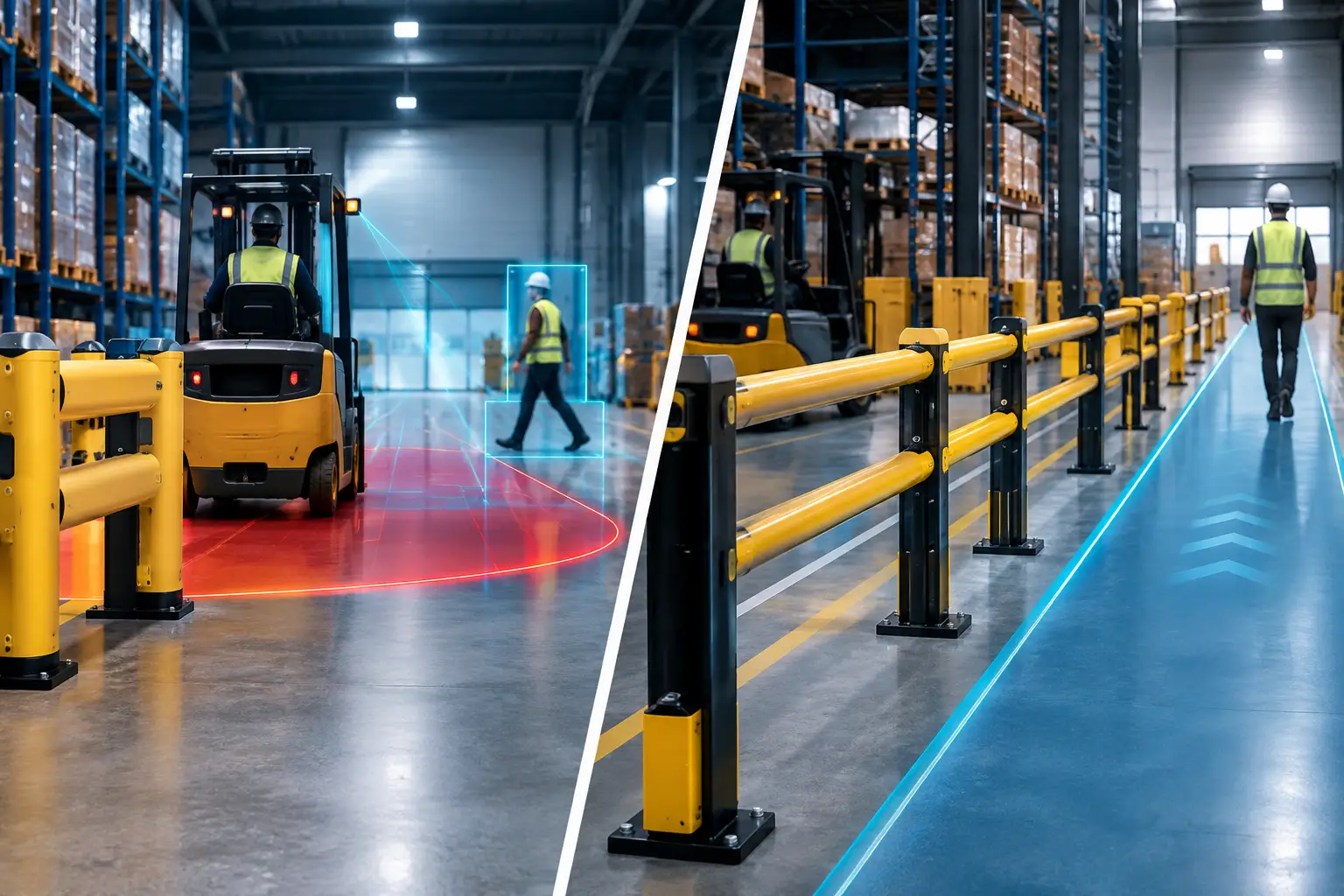
The safest interaction between a forklift and a pedestrian is the one that never happens. Separation should be the starting principle of route design. If people and forklifts must share space, the route plan should reduce frequency, limit speed, improve visibility, and add clear warnings.
Physical separation is stronger than painted separation. Floor markings help with guidance, but they do not stop a truck from entering a walkway or a person from stepping into a travel lane. In higher-risk zones, barriers, controlled crossings, gates, and warning systems provide a much more dependable layer of protection.
This is especially important in mixed-use areas such as packing zones, production supply points, maintenance access routes, and loading bay approaches. These spaces often develop gradually, and traffic complexity increases before controls catch up. Route planning should be revisited when layout changes, not months after incidents start appearing.
Design routes around visibility and decision points
Every turn, crossing, doorway, and blind corner asks an operator to make a decision. More decision points usually mean more risk. Good route planning reduces these moments by simplifying travel paths and improving line of sight.
One-way systems can help, but only if they are practical. They reduce head-on encounters and simplify movement, yet they may also increase travel distance. If a one-way route creates delays, operators may cut across restricted zones or reverse in unsafe areas. The trade-off is straightforward: better order versus potential noncompliance. The right answer depends on the facility layout and how disciplined traffic management already is.
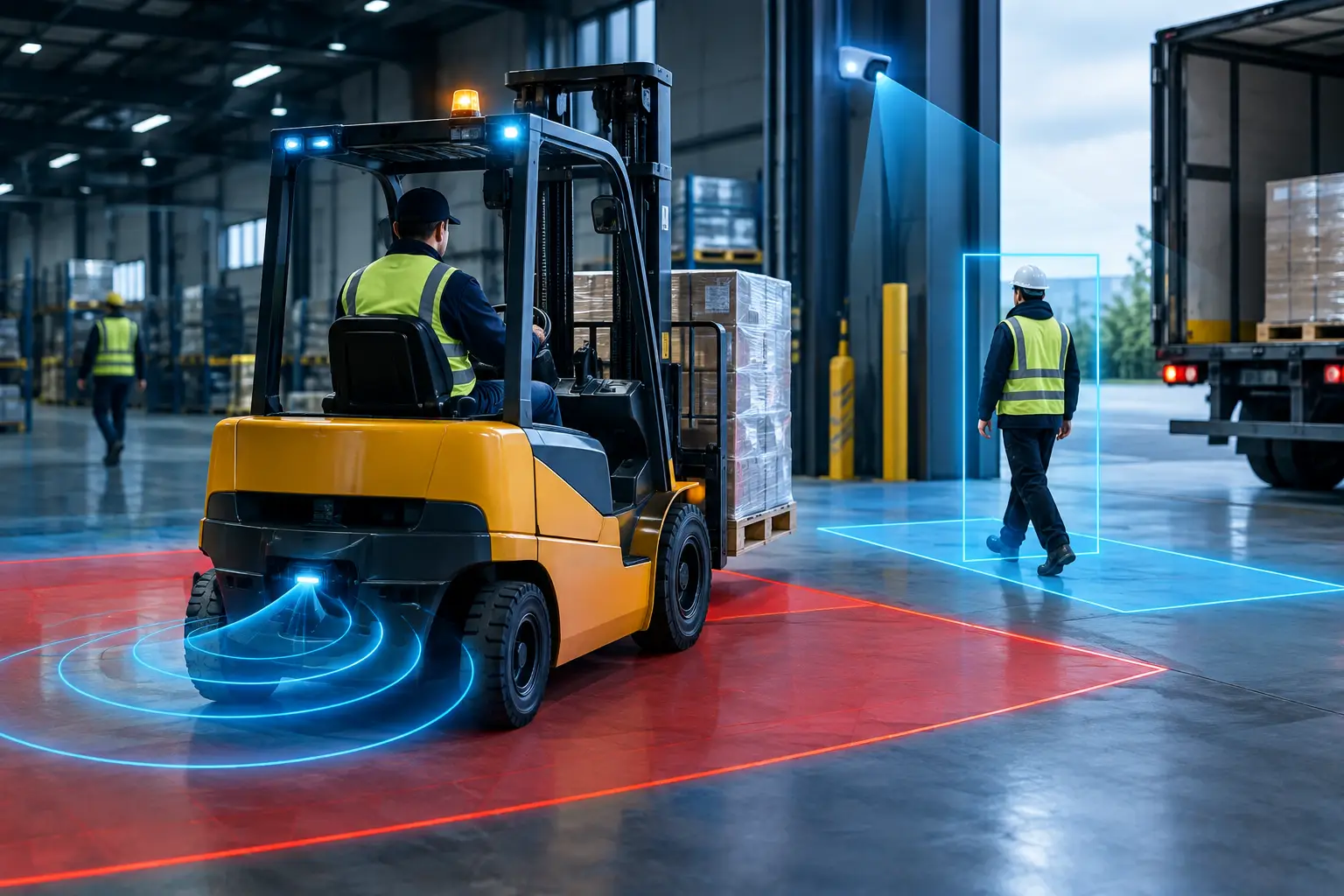
Intersections deserve particular attention. If operators cannot see cross traffic early, the route should be changed or the area should be controlled with mirrors, warning lights, projected signals, audible alerts, or access restrictions. Technology cannot fix a poor layout on its own, but it can make a good route plan more reliable.
Forklift route planning guide for high-risk zones
Some areas should always trigger a closer review. Loading bays combine vehicle movement, time pressure, dock equipment, and frequent pedestrian activity. Dispatch staging areas often become cluttered during peaks. Narrow aisles can force forklifts into repeated reversing. Production support routes may include abrupt crossings with foot traffic and inconsistent load sizes.
These are not just busy areas. They are areas where routine work creates repeated exposure. Route controls should be stronger there, and that may mean more than paint and signs. Proximity warning systems, visual alerts, safety barriers, and monitored crossings often make the difference between a route plan that exists and one that actually prevents harm.
Build for human behavior, not ideal behavior
Operators are under pressure to keep goods moving. Pedestrians are focused on tasks, conversations, scanners, paperwork, and handovers. Route planning fails when it assumes everyone will always follow the intended path without friction.
That is why practical design matters. Walkways should lead where people naturally need to go. Crossing points should be placed where crossings already happen or where they can realistically be redirected. Forklift routes should avoid forcing operators into awkward maneuvers to save a few feet of floor space.
Training remains essential, but training works best when the environment supports the right behavior. If people must choose between the safe route and the efficient route, they will often choose efficiency. The better strategy is to make the safe route the easiest route.
Use technology to strengthen route control
A modern forklift route planning guide should include where technology adds real operational value. This is not about adding devices everywhere. It is about targeting known failure points.
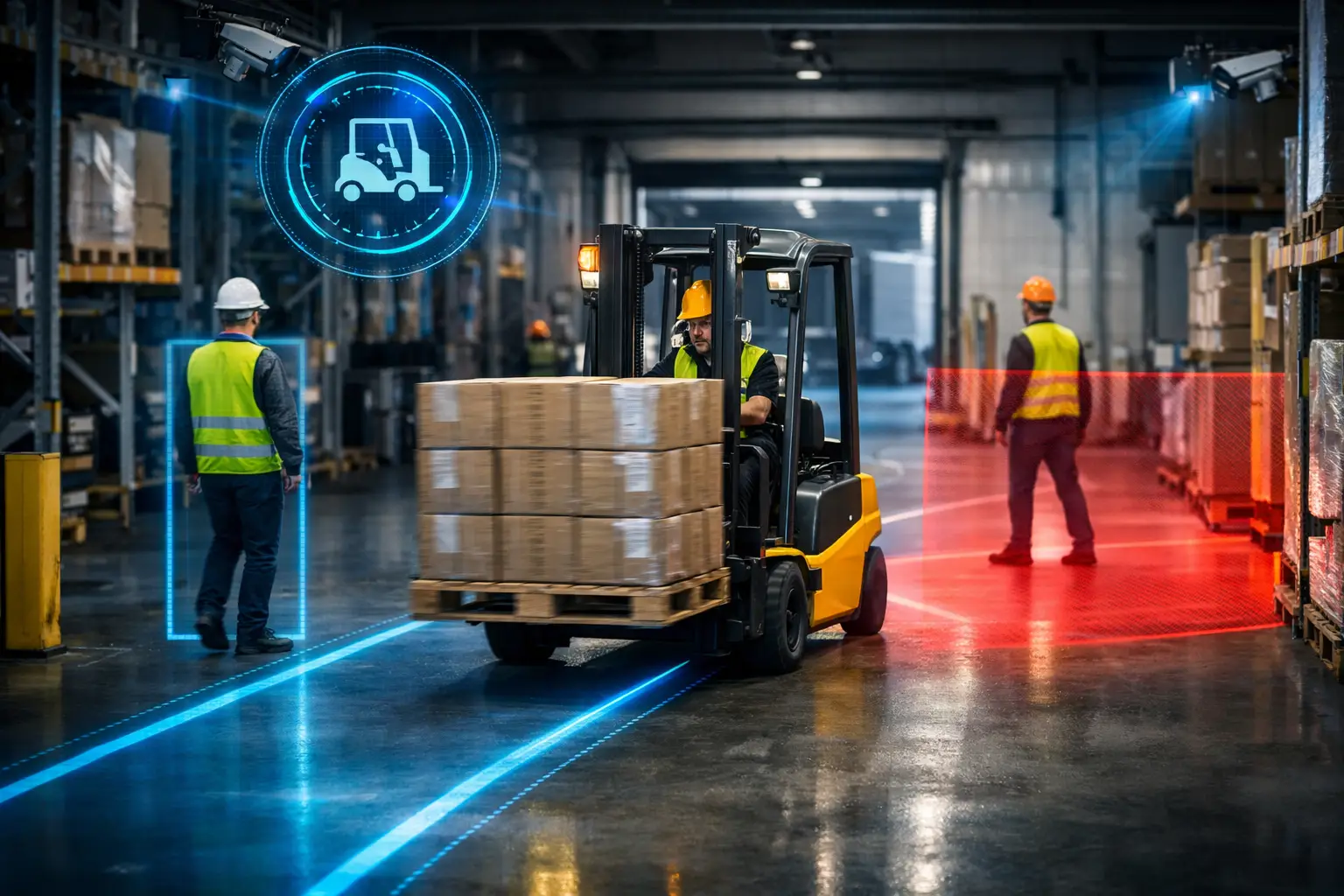
In blind spots and intersections, audible and visual warning systems can alert both operators and pedestrians before a conflict develops. In mixed-traffic areas, proximity detection can provide an added layer of awareness. In large or complex operations, Vision AI monitoring can help identify recurring unsafe movement patterns that are easy to miss during manual audits.
These tools work best when tied to route design. If a facility repeatedly depends on warnings to compensate for uncontrolled crossings, the layout still needs work. But when route planning, physical controls, and intelligent alerts are aligned, risk reduction becomes far more consistent.
Measure whether the route plan is working
A route plan should change operational results, not just appearance. Look at collision and near-miss trends, but also track rack damage, barrier impacts, congestion delays, operator travel time, and unauthorized pedestrian crossings. These indicators show whether traffic flow is becoming safer and more predictable.
It also helps to review the plan after operational changes. New storage density, revised picking methods, temporary staging overflow, and new equipment types can all undermine a previously effective route. The best route plans are maintained, not installed once and forgotten.
When to redesign instead of adjust
Sometimes minor improvements are enough. A crossing relocation, better barrier placement, or clearer lane control can remove a major hazard. But if the facility layout regularly forces forklifts and pedestrians into shared bottlenecks, or if impact damage keeps recurring despite training and signage, the issue is likely structural.
That is the point where redesign becomes the safer and more economical choice. Reworking traffic flow may feel disruptive in the short term, yet repeated incidents, equipment damage, and downtime are usually far more expensive over time. Accidents happen. But you can prevent them when traffic risk is treated as an engineering problem, not just a behavior problem.
Effective route planning is not about drawing cleaner lines on the floor. It is about creating a workplace where movement is predictable, exposure is controlled, and every worker has a better chance of going home safely at the end of the day.