A forklift turning out of a blind aisle can cover several meters before a pedestrian even realizes it is there. In a busy warehouse or plant, that moment is where serious injuries, damaged racking, and costly downtime begin. That is why forklift safety systems Malaysia facilities install are no longer treated as optional add-ons. They are becoming part of how responsible operators manage traffic, visibility, and risk in real working environments.
The issue is not simply that forklifts are dangerous. It is that warehouses are getting tighter, faster, and more complex. More pallet movements, mixed traffic, contract labor, narrow aisles, and loading activity all increase the chance of contact between vehicles, pedestrians, doors, racks, and building structures. Safety depends less on a single rule and more on how well the site controls interaction between people and moving equipment.
Why forklift safety systems in Malaysia matter more now
Many facilities still rely heavily on operator skill, mirrors, painted walkways, and basic warning lights. Those controls remain useful, but they have limits. A painted line does not stop a forklift from entering a pedestrian path. A mirror helps only when it is positioned correctly, kept clean, and actually checked in time. A horn depends on the operator using it consistently and on nearby workers recognizing where the sound is coming from.
This is where engineered safety systems make a practical difference. They add layers of protection that do not depend entirely on human behavior. In high-throughput operations, that matters because even experienced drivers and well-trained pedestrians make mistakes under pressure.
For Malaysian warehouses, factories, and logistics hubs, the push is also operational, not just safety-driven. A collision with a rack upright, dock door, or loading area barrier can halt activity, damage stock, and create inspection delays. The cost of one incident often exceeds the cost of prevention, especially when disruption spreads across multiple shifts.
What counts as a forklift safety system
When buyers hear the term, they sometimes think only of a flashing beacon or reversing buzzer. In practice, forklift safety systems cover a wider set of technologies designed to reduce vehicle-related risk.
Warning and visibility systems
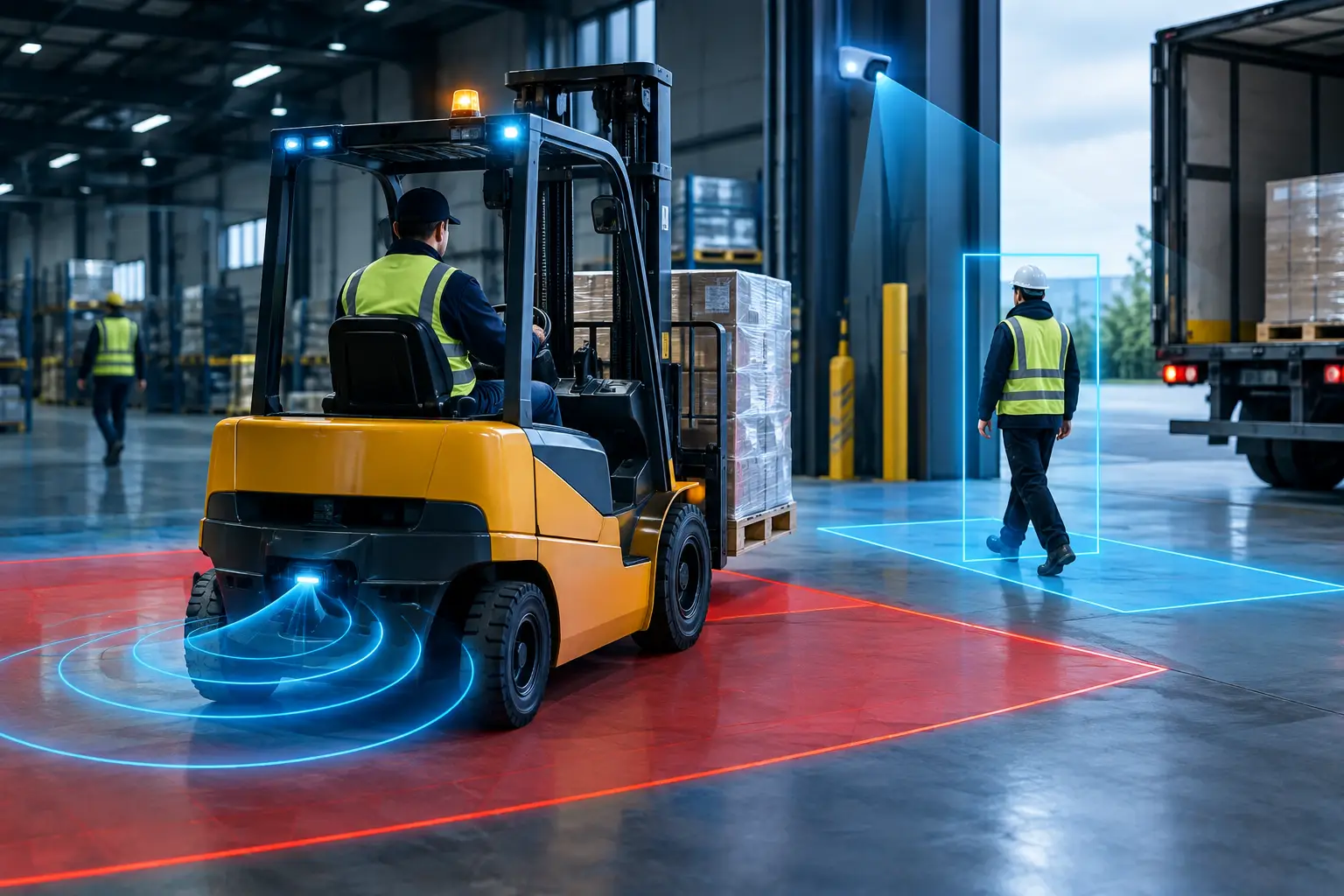
These include blue spot lights, red zone lights, strobe lights, and audible alarms that help nearby workers detect approaching forklifts. They are useful in noisy or visually cluttered areas, especially at intersections, aisle exits, and loading lanes. Their strength is simplicity. Their weakness is that they warn, but they do not actively detect intent or proximity.
Proximity warning systems
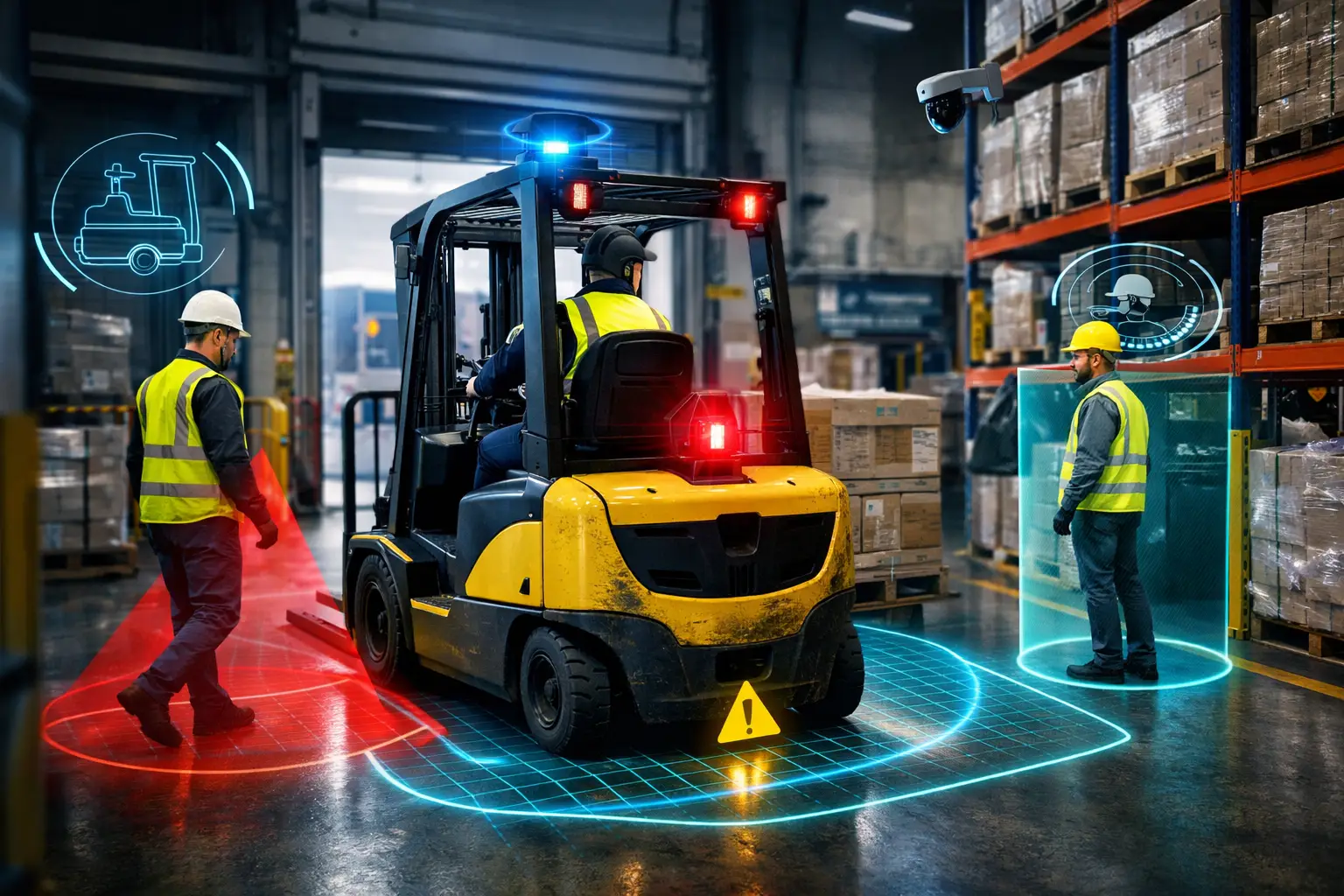
These systems monitor the distance between forklifts and pedestrians, or between forklifts and other assets, then trigger alerts when separation becomes unsafe. In the right environment, they are a major upgrade over passive warnings because they respond to real movement and location rather than assuming everyone will see or hear a signal in time.
Safety floor projection and intersection alerts
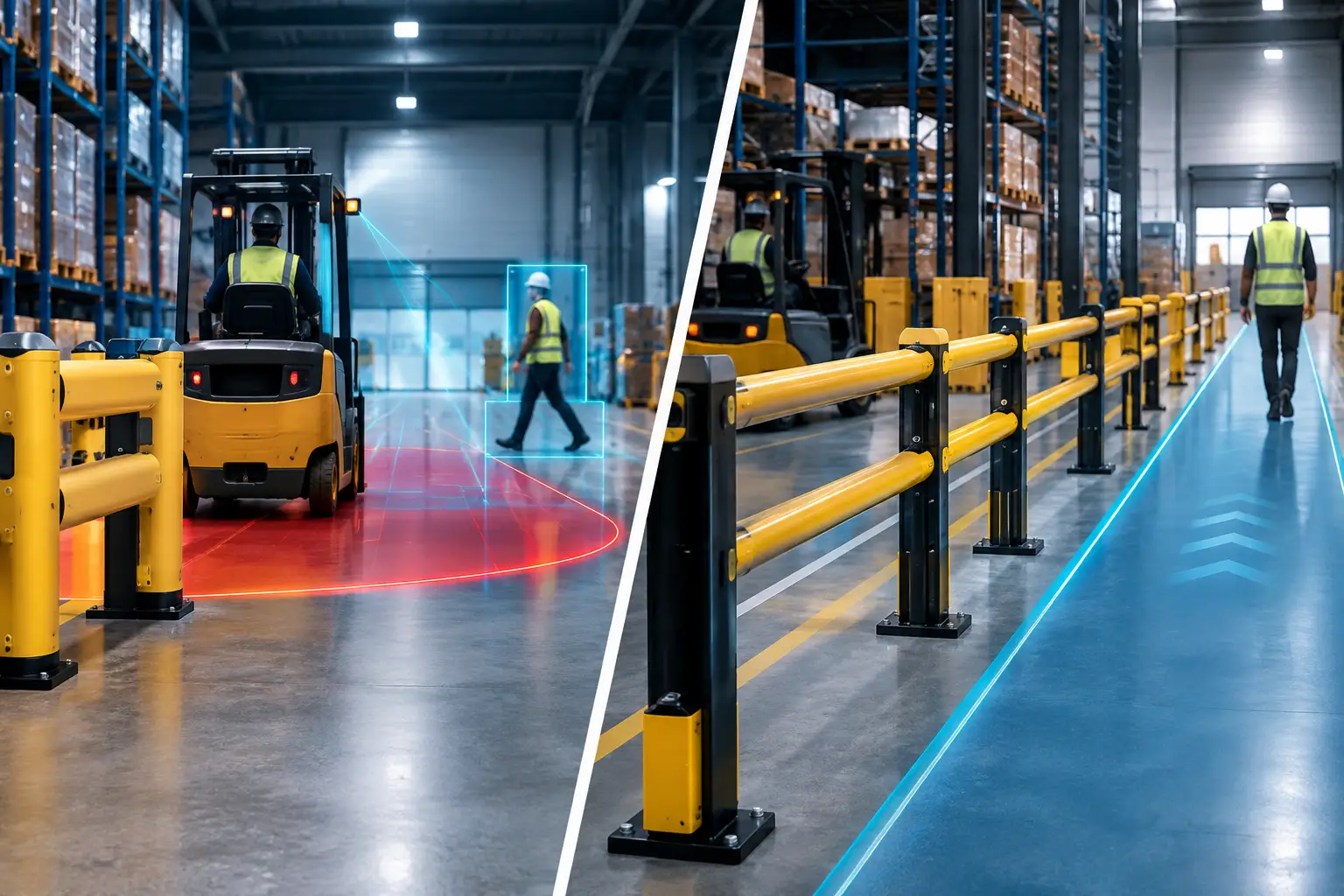
Projected stop signs, pedestrian crossings, exclusion zones, and hazard symbols make traffic controls more visible on the warehouse floor. They are particularly effective in dim areas or where painted markings wear quickly. At blind corners, motion-activated alerts can warn both pedestrian and vehicle traffic before they meet.
Vision AI and intelligent monitoring
More advanced sites are using Vision AI to detect unsafe interactions, monitor high-risk zones, and provide data on repeated exposure points. This does not replace supervisors or traffic rules. It gives safety and operations teams clearer evidence of where near misses, speeding, blocked sightlines, or unsafe crossing behavior are happening.
Physical protection and traffic segregation
Not every forklift safety problem should be solved with electronics. Barriers, guardrails, rack protection, and controlled pedestrian gates are often the most effective control where traffic routes can be separated. Good system design usually combines active warning technology with physical infrastructure.
Choosing forklift safety systems Malaysia sites will actually use
The best system is not the most advanced one on paper. It is the one that fits the way the facility operates, the types of hazards present, and the level of discipline the site can maintain over time.
A narrow-aisle warehouse with dense pedestrian picking activity has different needs from a manufacturing plant where forklifts mainly serve production lines. A loading bay with frequent trailer movement creates another risk pattern entirely. That is why a proper site assessment matters. Before selecting technology, teams need to understand where interactions occur, what visibility is like, how traffic flows during peak periods, and which incidents or near misses keep repeating.
There is also a trade-off between broad coverage and targeted intervention. Some companies try to install one solution across the entire facility. That can work, but it may also waste budget on low-risk areas while leaving critical conflict points underprotected. In many cases, the better approach is to start with the highest-risk zones such as blind corners, pedestrian crossings, dock approaches, and transfer aisles.
Common mistakes when implementing forklift safety systems
One of the biggest mistakes is treating technology as a substitute for traffic management. A warning light cannot compensate for poor route design. If pedestrians and forklifts are forced into the same space because of layout constraints, the site still carries high residual risk.
Another common mistake is overloading the workplace with alarms. If every forklift flashes, projects, and sounds multiple warnings all day, people begin to tune them out. Alert fatigue is real in industrial settings. The goal is not maximum noise or maximum lighting. The goal is meaningful intervention where it matters most.
Maintenance is another issue buyers underestimate. A safety system that is misaligned, uncalibrated, damaged, or ignored during inspections quickly loses value. The same applies to floor projections in dusty environments, sensors installed without considering reflective surfaces, or AI monitoring set up without a plan for reviewing and acting on the data.
Training also matters, but not in the usual checkbox sense. Operators, supervisors, and pedestrians need to understand what each system does and what it does not do. If workers assume a proximity alert will always prevent impact, behavior may become less cautious rather than safer. Good implementation reinforces responsibility instead of reducing it.
How to evaluate return on investment
Safety buyers are often asked to justify technology in operational terms. That is reasonable. The business case for forklift safety systems is stronger when it connects risk reduction to measurable outcomes.
Look at damage to racks, doors, dock equipment, and stock. Review incident records, near-miss reports, temporary work stoppages, vehicle repair costs, and congestion-related delays. In many facilities, the hidden cost is not a major accident but the accumulation of minor impacts, disrupted workflows, and recurring unsafe behavior that drains time and confidence.
It also helps to think in layers. A blue light may be inexpensive and easy to deploy, making it suitable for broad visibility improvement. A proximity warning system may cost more, but it can be justified in zones with heavy pedestrian interaction. Vision AI may make sense where management needs site-wide insight and evidence for continuous improvement. Different tools support different levels of control.
A practical path for safer deployment
For most operations, the smartest path is phased. Start with a site review focused on traffic routes, blind spots, crossing points, and recent incidents. From there, identify which hazards need visual warning, which need active detection, and which need physical separation.
Then test selected controls in live conditions. Warehouses rarely behave exactly as they do on a floor plan. Pallets get staged in temporary areas, routes change during peak demand, and drivers adapt their movements around real-world bottlenecks. A pilot helps confirm whether the system supports the operation or creates new friction.
Finally, treat forklift safety as an ongoing engineering function, not a one-time purchase. Review event data, inspect hardware, refresh floor controls, and adjust placement as traffic patterns evolve. The strongest results come from combining technology, site design, and management discipline into one practical safety strategy.
For organizations evaluating forklift safety systems Malaysia operations can rely on, the real question is not which device looks best in a brochure. It is which combination of controls will reduce actual exposure in your aisles, dock areas, and work zones without slowing the business unnecessarily. Accidents happen. But with the right system design, they can be prevented long before a forklift and a pedestrian ever reach the same point.