A forklift reversing from a rack aisle, turning out of a blind intersection, or approaching a loading bay creates a short window in which one missed cue can become a serious incident. The question of forklift spotters vs sensors is not simply about choosing people or technology. It is about identifying where risk arises, then applying controls that still work when visibility is limited, traffic is heavy, and operations are under pressure.
A spotter can interpret a changing situation. A sensor can monitor continuously without distraction. Neither is a complete safety strategy on its own. The most effective approach depends on the facility layout, vehicle movements, pedestrian exposure, task frequency, and the level of separation that can realistically be maintained.
Forklift Spotters vs Sensors: The Core Difference
Forklift spotters are designated personnel who guide vehicle movements in areas where operators have restricted visibility or where the consequences of a wrong movement are high. They are often used during trailer loading, oversized-load handling, tight maneuvering, maintenance activities, and temporary changes to traffic flow. Their value lies in judgment. A trained spotter can recognize a pedestrian entering a work zone, a loose load, an uneven dock plate, or a driver who has not understood an instruction.
Sensors are vehicle-mounted or infrastructure-based systems that detect, warn, or intervene when predefined risk conditions occur. Depending on the technology, they may identify people in a hazard zone, alert a forklift operator to an obstacle, project a warning light onto the floor, activate audible alarms, slow a vehicle, or notify supervisors of repeated high-risk events.
The difference is consistency versus context. Sensors provide repeatable detection and warning. Spotters provide situational awareness and communication. Facilities should avoid treating either one as a substitute for traffic design, operator training, and clear operating procedures.
Where Spotters Provide the Greatest Safety Value
A spotter is most valuable when the task is irregular, complex, or difficult to define through fixed detection rules. For example, guiding a forklift around a temporary construction area requires someone who can assess changing clearances and coordinate with multiple people. The same applies when moving unusually shaped machinery or positioning loads where an operator’s view is obstructed.
Spotters also support controlled movements at loading bays. A reversing truck, forklift, and dock worker may all be active in the same space. A capable spotter can coordinate the sequence of movement, confirm that people are clear, and stop activity when conditions change. This is particularly useful when a facility is handling variable truck types, nonstandard loads, or seasonal traffic peaks.
However, spotter-based controls have practical limitations. The spotter must be present, trained, visible to the driver, and authorized to stop the job. Hand signals must be understood consistently. Communication can fail in noisy environments, when sightlines are blocked, or when the spotter is assigned competing tasks. Fatigue, distractions, and staffing gaps can also weaken the control precisely when production demand is highest.
For these reasons, a spotter should never be treated as a passive observer. The role needs a defined position, a clear communication method, and the authority to halt vehicle movement. If the operation relies on a spotter every day in the same location, that recurring risk may justify a more permanent engineering control.
Where Sensors Improve Forklift-Pedestrian Safety
Sensors are especially effective in repetitive, high-traffic environments where the same conflict points occur throughout every shift. Blind corners, cross-aisles, pedestrian crossings, rack-end intersections, staging areas, and loading approaches are common examples. In these locations, technology can deliver warnings every time a risk condition occurs, rather than relying on a person to recognize it consistently.
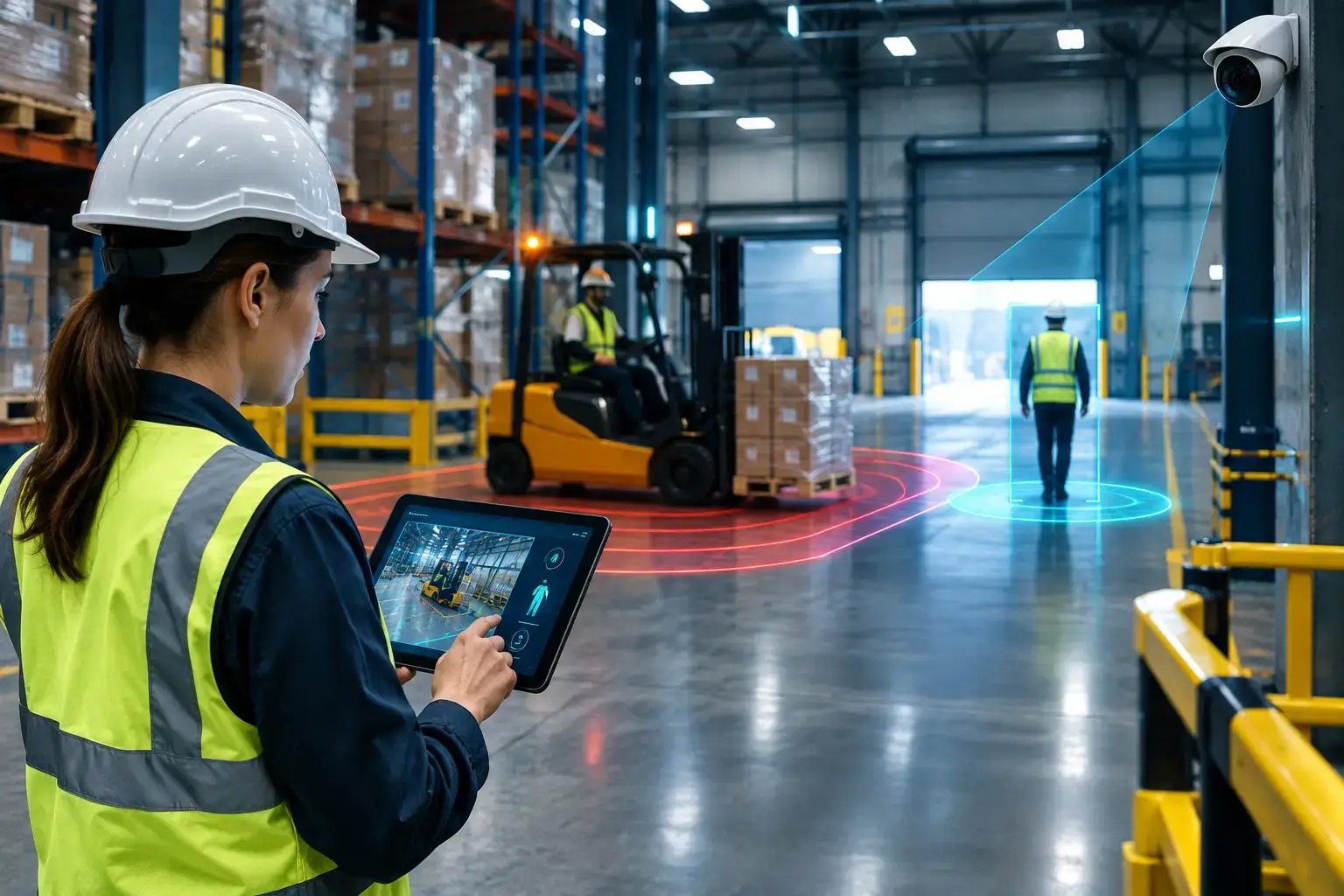
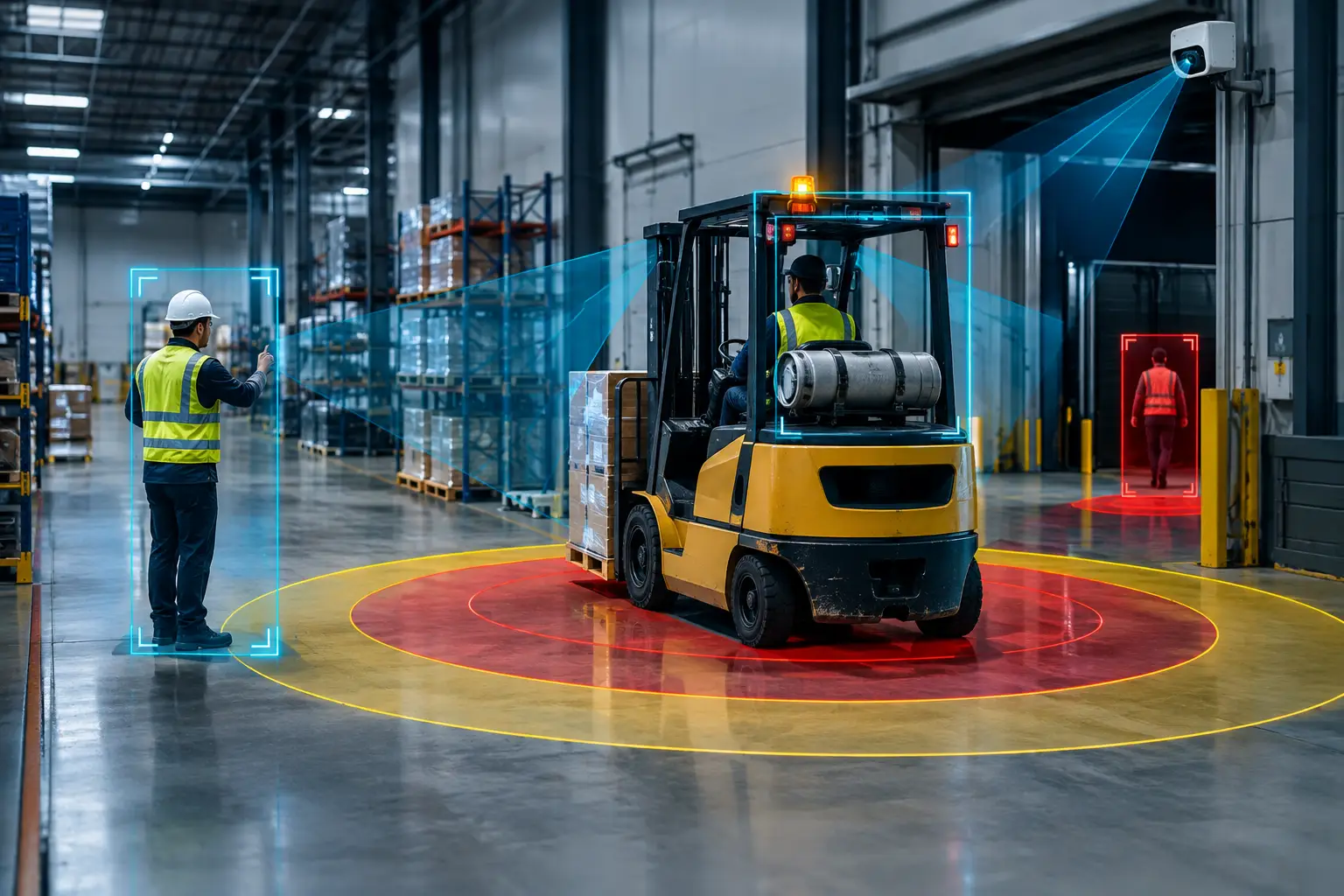
Proximity warning systems can alert operators when pedestrians or obstacles enter a defined danger zone. Pedestrian detection technologies, including Vision AI systems, can distinguish people from surrounding warehouse activity and generate targeted warnings. Floor projection systems can create visible exclusion zones or approaching-vehicle warnings, helping pedestrians recognize forklift movement before they step into its path.
Audible and visual alerts can also strengthen awareness at blind intersections. A warning beacon or projected symbol does not replace safe driving behavior, but it can provide an additional cue when noise, congestion, or racking obstructs visibility. Vehicle speed control, where suitable for the application, adds another layer by reducing the severity of a potential impact in designated high-risk areas.
The main advantage is continuous coverage. Sensors do not become distracted, leave for a break, or interpret a familiar route as low risk. They can also create useful operational data, such as repeated near-miss alerts at a particular aisle crossing or frequent speeding at a loading area. That information helps safety and operations teams focus improvement efforts where they will have the greatest effect.
The Limits of Sensor-Only Controls
Technology must be selected and configured for the real operating environment. A sensor that produces frequent false alerts can lead to alarm fatigue, causing operators to disregard warnings. Detection performance may also be affected by vehicle configuration, mounting position, aisle geometry, reflective surfaces, dust, weather exposure, or the presence of mixed equipment.
Sensors are also not a replacement for physically separating people and forklifts where possible. A warning that a pedestrian is too close is useful. A guarded pedestrian walkway, designated crossing point, or barrier that prevents the conflict is usually stronger. The objective is not to add alarms everywhere. It is to reduce the opportunity for a person and moving vehicle to occupy the same hazardous space.
Successful implementation requires site assessment, equipment compatibility checks, installation quality, operator familiarization, and ongoing maintenance. Warning systems should be tested as operating conditions change, especially after layout modifications, new vehicle purchases, or changes in shift patterns.
Choosing the Right Control for the Task
The best decision begins with a practical risk assessment of how forklifts, pedestrians, trucks, and materials move through the facility. Review where people and vehicles cross paths, which activities create blind spots, how often the exposure occurs, and whether the task is routine or exceptional.
Spotters are generally appropriate for nonroutine movements, complex load handling, temporary changes, and activities where human judgment is essential. Sensors are generally appropriate for recurring hazards, high-volume traffic, blind zones, and locations where continuous monitoring is needed. For high-consequence operations, using both can be appropriate.
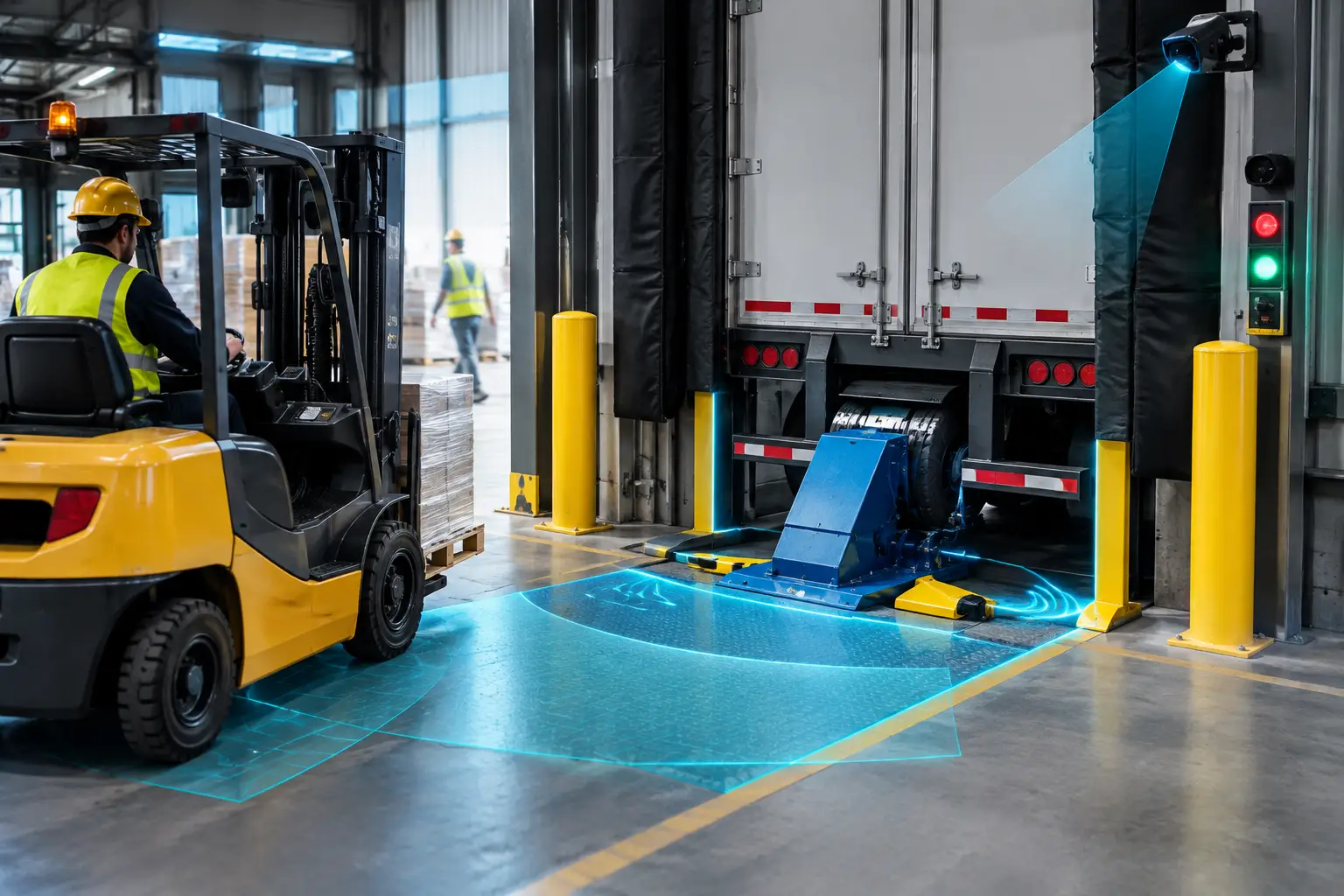
Consider a loading bay where forklifts transfer pallets into trailers. A trained spotter may be needed when positioning a damaged pallet or coordinating an unusual delivery. At the same time, fixed warning systems, dock safety controls, vehicle restraints, and clearly defined exclusion zones can manage the daily hazards that occur shift after shift. The spotter handles the exception. Engineered controls manage the baseline risk.
Build Layers, Not Single Points of Failure
The strongest forklift safety programs use multiple complementary controls. Traffic routes should be designed to minimize interaction between pedestrians and vehicles. Physical barriers and rack protection should protect walkways, workstations, and vulnerable infrastructure. Marked crossings, floor projections, signs, and warning devices should make remaining conflict points visible.
Forklift operators need clear rules for speed, reversing, horn use, load handling, and stopping when visibility is compromised. Pedestrians need defined walking routes and a clear understanding that a forklift operator may not see them, even when eye contact appears possible. Technology can reinforce those controls by detecting hazards, warning people earlier, and revealing patterns that require management attention.
This layered approach matters because every control has limits. A barrier may not cover a temporary staging area. A sensor may not interpret a complex work task. A spotter may be unavailable. When one measure is weakened, another should still reduce exposure and provide time to react.
How to Implement Sensors Without Creating New Problems
Before selecting a system, observe actual movements across different shifts. Do not base the design only on a site drawing or a short daytime walk-through. Peak receiving periods, end-of-shift congestion, contractor activity, and temporary storage practices often reveal hazards that are not visible during normal conditions.
Define what the system must achieve: warn pedestrians at a blind corner, detect people near reversing forklifts, control speed in a crossing zone, or identify repeated unsafe interactions. Then test the technology in the intended environment. Detection range, warning type, mounting location, and operator response all need validation before a full rollout.
SysGuard approaches forklift safety as an operational system rather than a single device. The objective is to match practical engineering controls, warning technology, and site procedures to the risks workers face every day. A well-designed solution should reduce avoidable alerts, fit the workflow, and be maintainable over time.
Every worker deserves to return home safely every day. When a facility chooses between spotters and sensors based on actual exposure rather than habit, it can turn that responsibility into controls that work when they are needed most.