A forklift turning into a cross-aisle can cover ground faster than a pedestrian expects. In a busy warehouse, that short gap between assumption and reality is where serious injuries happen. This warehouse pedestrian safety guide focuses on the controls that reduce that risk in real operations – not just on paper, but at intersections, picking lanes, staging areas, and loading zones where people and vehicles regularly cross paths.
Pedestrian safety in warehouses is rarely solved by one rule or one device. Most incidents come from a combination of factors: blocked sightlines, inconsistent traffic routes, rushing during peak periods, poor aisle discipline, and weak separation between people and equipment. If you want fewer near misses and fewer damaging events, you need a system that addresses layout, behavior, visibility, and warning controls together.
Why warehouse pedestrian safety fails in everyday operations
Many facilities already have marked walkways, posted speed limits, and forklift training. Yet near misses still occur because formal controls often break down under production pressure. A pedestrian steps outside the marked lane to avoid pallets. A forklift operator takes a familiar shortcut. Temporary stock blocks a crossing. Over time, normal workarounds quietly replace the intended safe path.
That is why warehouse pedestrian safety should be treated as an operational design issue, not only a training issue. Training matters, but people work within the environment they are given. If the layout creates repeated blind corners, mixed traffic zones, and congested handoff points, even experienced teams will be exposed to unnecessary risk.
A stronger approach starts with asking where pedestrian and forklift interaction is actually unavoidable. In some facilities, the answer is receiving and dispatch. In others, it is replenishment zones, battery charging areas, or picking aisles near packing stations. The goal is not to eliminate movement. The goal is to control interaction points so they are visible, predictable, and supported by physical and visual safeguards.
Warehouse pedestrian safety guide: start with traffic separation
The most effective control is still separation. If pedestrians and forklifts do not occupy the same path, the exposure drops immediately. That sounds simple, but in practice the right level of separation depends on your building, throughput, and equipment mix.
In higher-traffic environments, painted floor lines alone are rarely enough. They provide guidance, but they do not prevent encroachment. Physical barriers, guardrails, and protected walkways are more reliable where pedestrian routes run close to forklift travel lanes. This is especially important near production support areas, clock-in points, maintenance access paths, and break-transition routes where foot traffic is frequent and repetitive.
That said, not every area can be fully segregated. Warehouses often have shared zones where staff need access for picking, scanning, inspection, or inventory checks. In those locations, the design challenge is to reduce uncertainty. Defined crossing points, controlled approach speeds, and clear right-of-way expectations matter more than broad painted warnings that everyone eventually stops noticing.
When evaluating separation, look beyond the main aisles. Some of the most dangerous interactions happen at secondary access points – doorways opening into travel lanes, rack ends, outbound staging corners, and temporary overflow zones. If your traffic plan ignores those spaces, your real risk picture is incomplete.
Visibility is a control, not a convenience
A large share of pedestrian incidents involve limited visibility. Rack ends, stacked pallets, shrink-wrapped loads, trailers, and even building columns can create blind spots. Add noise, time pressure, and variable lighting, and both operators and pedestrians can miss each other until it is too late.
Improving visibility should start with line-of-sight management. If material is regularly staged near corners or crossings, that practice needs to be challenged. A good traffic route can become a dangerous one when visibility is reduced by temporary storage. Housekeeping and storage discipline are part of pedestrian safety, because clutter changes what people can see and how they move.
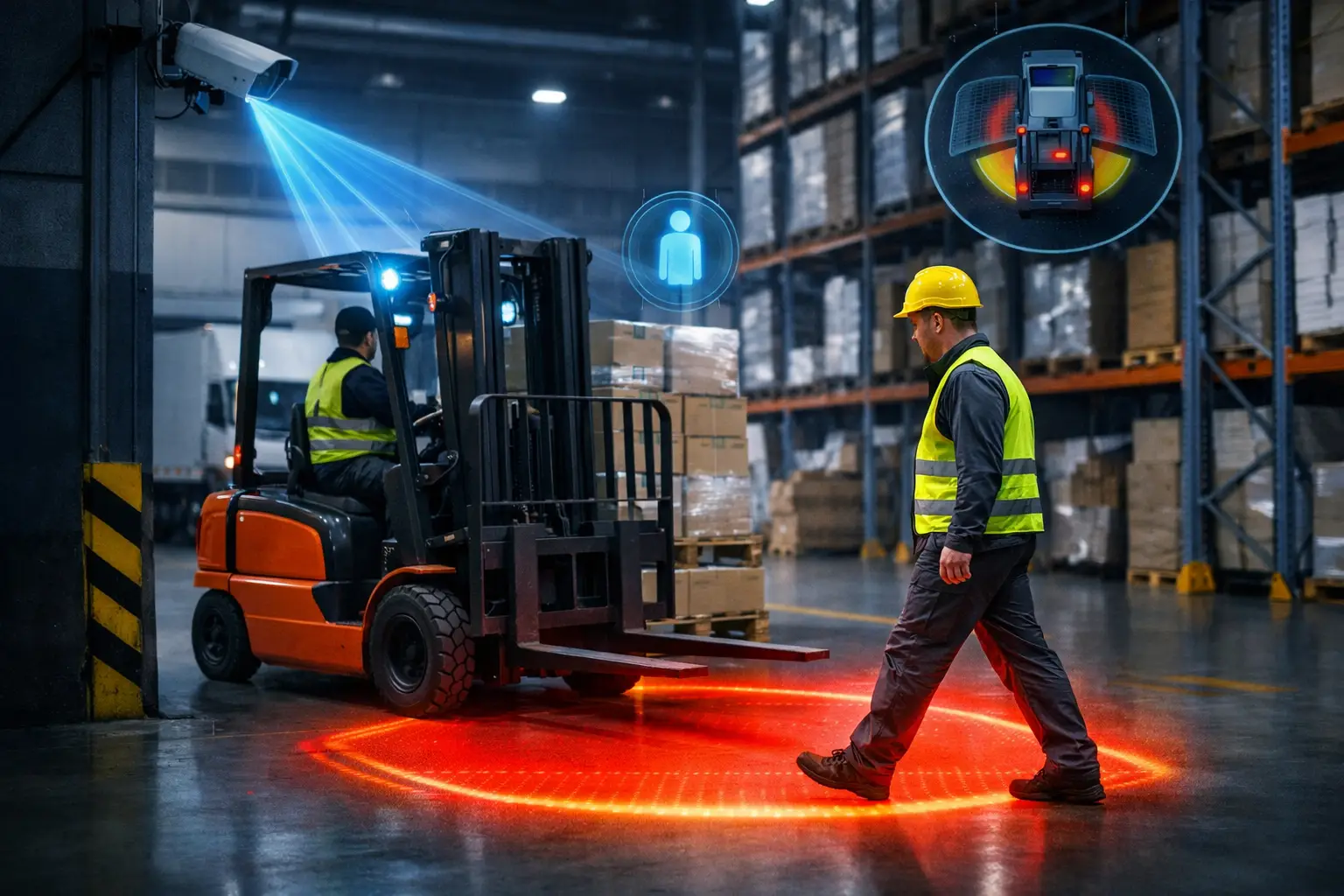
Visual warning systems can reinforce that control. Safety floor projection at crossings, doorways, and forklift approach zones gives pedestrians a much clearer cue than painted markings alone. Unlike static signs, projected warnings are more noticeable in active work areas and can signal movement risk where attention is divided.
Audible and visual alerts on vehicles and at high-risk intersections also help, but they should be matched to the environment. In a noisy warehouse, a basic beeper may be ignored. In a visually busy area, a small indicator light may not stand out. Effective warning systems are site-specific. What works well in a narrow-aisle distribution center may be less effective in a mixed-use manufacturing warehouse.
Managing forklift-pedestrian interaction points
A practical warehouse pedestrian safety guide has to focus on interaction points, because that is where controls are tested. The key question is not whether pedestrians and forklifts can coexist in theory. It is whether people can reliably predict each other in the moment.
Cross-aisles deserve special attention. Forklift operators may be watching load stability, rack clearance, and travel direction at the same time. Pedestrians may be focused on scanners, paperwork, or pick instructions. At these intersections, passive awareness is not enough. You need design features that slow movement, improve sightlines, and prompt deliberate behavior.
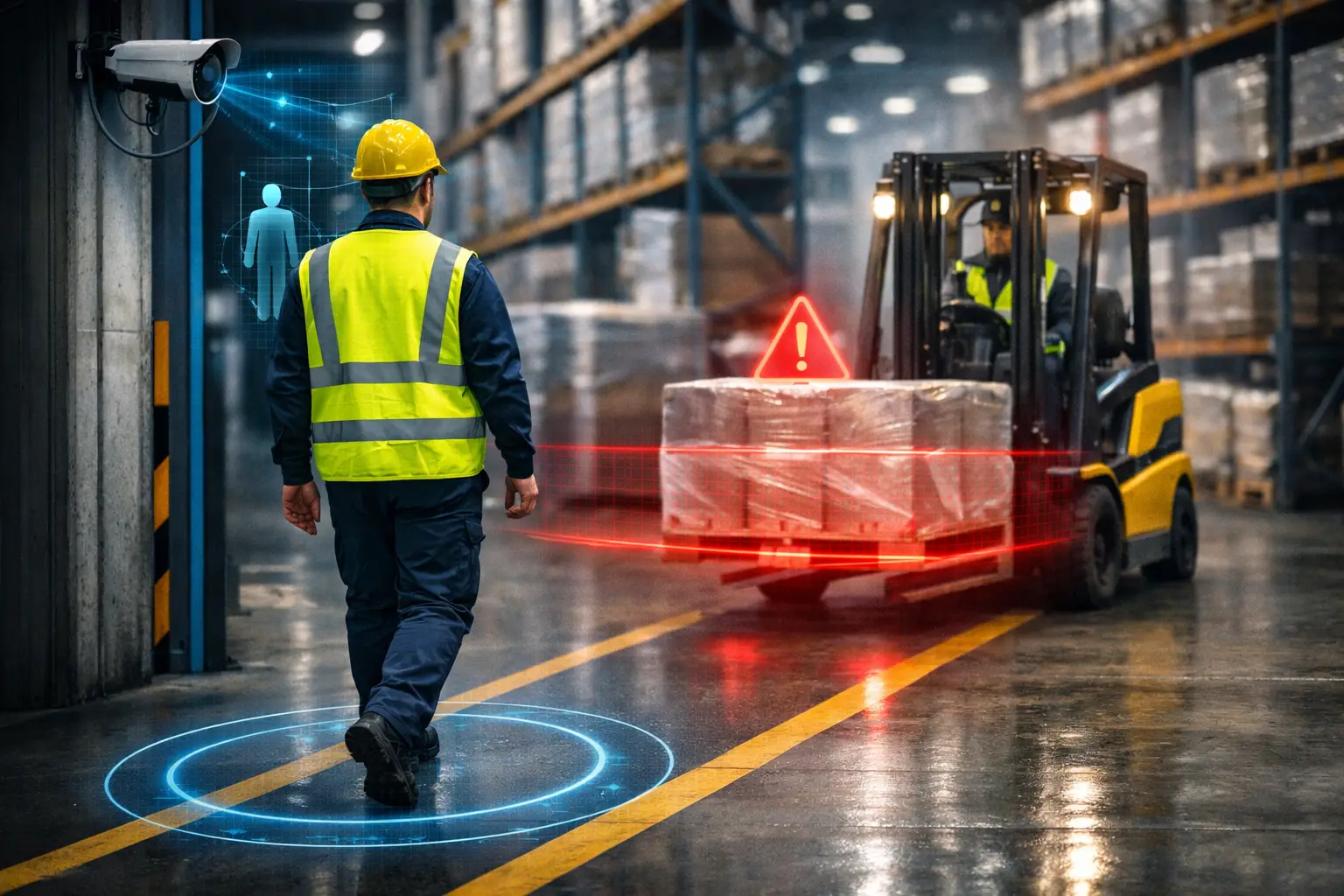
Proximity warning systems can add another layer of protection where traffic density is high or visibility is inconsistent. These systems are useful in facilities where fixed routes still involve frequent interaction, particularly during shift changes or peak dispatch windows. The value is not only in the alert itself. It is in creating a more responsive environment where risk is identified before contact occurs.
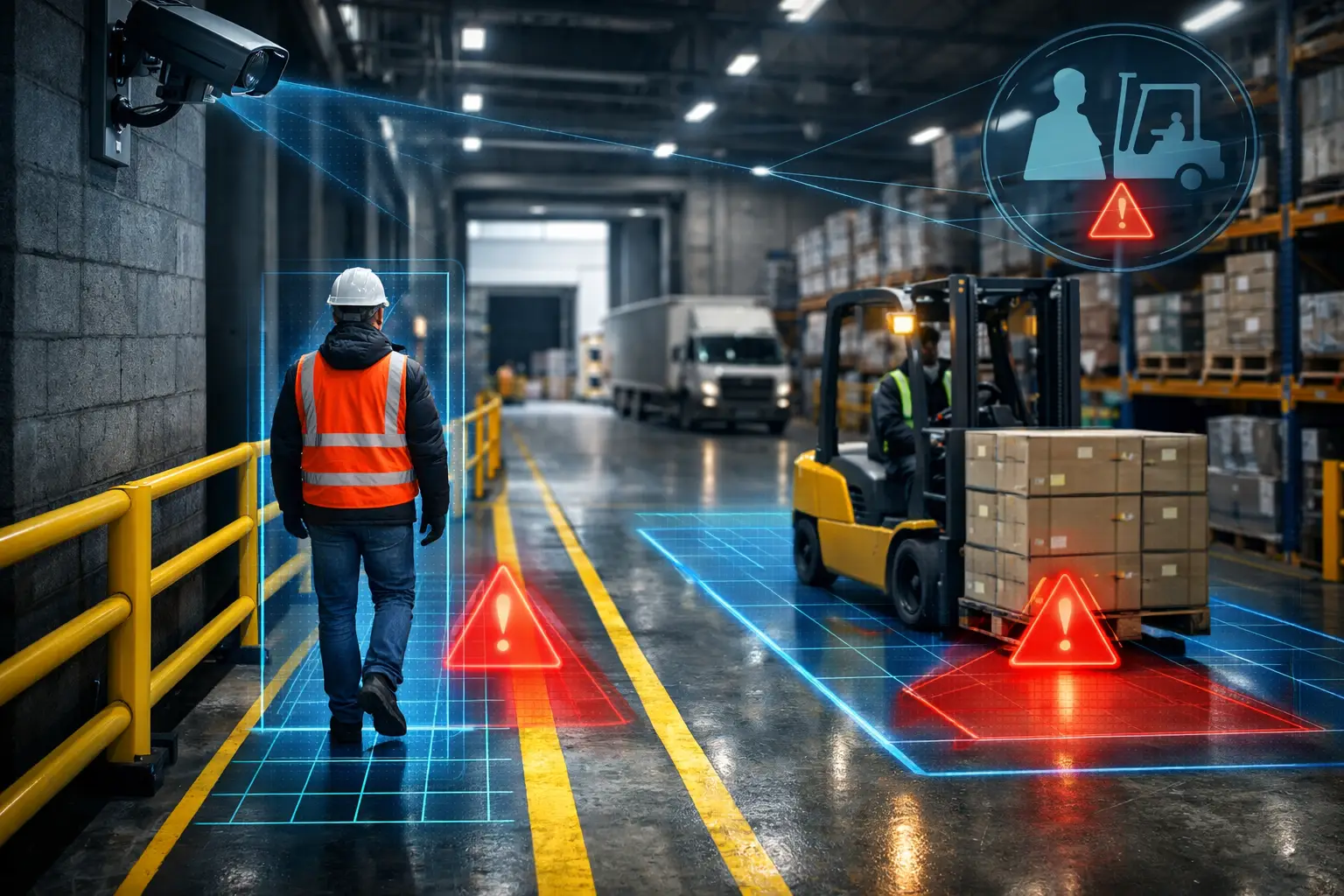
Vision AI safety monitoring can also help organizations understand where unsafe interaction patterns are happening repeatedly. That matters because many warehouse teams rely on incident reports alone, and reported incidents show only a fraction of exposure. Near misses, routine route deviations, and repeated encroachment into vehicle lanes often go unmeasured. AI-based monitoring, when used correctly, can reveal problem zones, recurring behaviors, and layout weaknesses that need engineering attention.
Procedures matter, but only when they fit the operation
Rules that slow work without solving the real hazard are usually ignored over time. That is why pedestrian safety procedures need to reflect actual workflow. If a pedestrian route adds several minutes to every task, staff will eventually take a shorter path. If crossing rules are too vague, each shift will interpret them differently.
Good procedures are specific. They define where pedestrians should walk, where crossings are allowed, who has right of way, and what operators must do before entering blind or shared zones. They also account for exceptions such as maintenance access, overflow storage, and contractor movement. If exceptions are common, they should be designed into the traffic plan rather than treated as one-off deviations.
Supervision is also part of control effectiveness. Not in the sense of constant policing, but in verifying whether the system is working during normal and high-pressure periods. A route that looks safe during a quiet walkthrough may fail during receiving peaks or outbound cutoffs. Safety leaders need to test conditions when the warehouse is under load.
What a stronger pedestrian safety program looks like
A mature program combines engineering controls, traffic management, technology, and routine review. It does not rely on floor paint as the main defense. It uses barriers where separation is needed, warning systems where visibility is weak, and monitoring where risk patterns are hard to see with the naked eye.
It also recognizes trade-offs. Too many alarms can create fatigue. Too many physical restrictions can interfere with productivity if routes are poorly planned. Too little control leaves risk to individual judgment. The right balance depends on your site conditions, equipment types, and traffic volume. The point is to reduce reliance on luck.
For many operations, the most useful next step is a focused risk review of pedestrian routes and forklift travel paths. Look at where people actually walk, not where the map says they should walk. Check whether barriers protect the right areas, whether warning devices are placed where decisions are made, and whether temporary storage habits are undermining visibility. In facilities with recurring near misses, the answer is often not more signage. It is better control at the exact points where exposure happens.
SysGuard supports this kind of improvement by combining practical risk assessment with engineered safety solutions for warehouses, factories, and logistics environments. That approach matters because pedestrian safety is not a standalone issue. It affects downtime, asset damage, operator confidence, and overall operational stability.
Every worker deserves to return home safely every day. In a warehouse, that depends on more than awareness. It depends on building an environment where safe movement is clear, protected, and consistently supported by the way the operation actually runs.