A forklift rounds a blind aisle end at the same moment a picker steps out with a pallet jack. Nobody intended to take a risk, yet that is how many warehouse incidents begin – in ordinary movements, routine pressure, and split-second visibility gaps. Warehouse accident prevention technology exists to control those moments before they become injuries, equipment damage, or operational disruption.
For warehouse and operations leaders, the challenge is not simply identifying hazards. Most teams already know where risks sit: vehicle and pedestrian interactions, loading bay activity, blind corners, damaged racking, congested traffic routes, and areas where operators rely too heavily on human judgment alone. The real question is which technologies actually reduce risk in a measurable way, and how they should be applied in a working facility.
Why warehouse accidents still happen in well-managed facilities
Many warehouses already have markings on the floor, operator rules, standard work instructions, and site inductions. Those controls matter, but they do not remove the limits of attention, line of sight, fatigue, noise, or traffic complexity. A busy operation changes by the hour. Inventory moves, temporary staff rotate in, trailers arrive late, and pedestrian routes get interrupted by real production demands.
That is why accidents often occur in facilities that are not careless, but simply exposed to repeat risk. A well-run warehouse can still have near misses at intersections, loading bay falls, forklift impacts on racking, or reversing incidents in shared zones. Static controls help, yet they are rarely enough when the environment is dynamic.
This is where technology becomes practical. The best systems do not replace supervision or training. They strengthen them by improving awareness, enforcing safer behavior, and creating faster warnings where people and vehicles interact.
The role of warehouse accident prevention technology
Warehouse accident prevention technology works best when it addresses specific operating risks rather than acting as a general add-on. In practice, that means matching a safety solution to a hazard pattern. A blind corner needs a different control than a live loading bay. A pedestrian crossing in a forklift route needs a different intervention than a high-value rack aisle where repeated impact damage is occurring.
The strongest implementations usually combine three functions. First, they increase visibility where the human eye is limited. Second, they provide active warnings before contact happens. Third, they create physical or procedural separation where exposure remains high.
That sounds straightforward, but the trade-off is important. More technology does not automatically mean better safety. If alerts trigger too often, operators start ignoring them. If a system is poorly positioned, it can miss the real hazard. If a solution is difficult to maintain, performance drops over time. Good accident prevention depends on fit, not volume.
Forklift and pedestrian collision prevention
In most warehouses, forklift and pedestrian interaction is the highest-priority risk because it combines vehicle speed, limited visibility, tight turning areas, and frequent human movement. Traditional mirrors and painted walkways still have value, but they rely heavily on constant attention and site discipline.
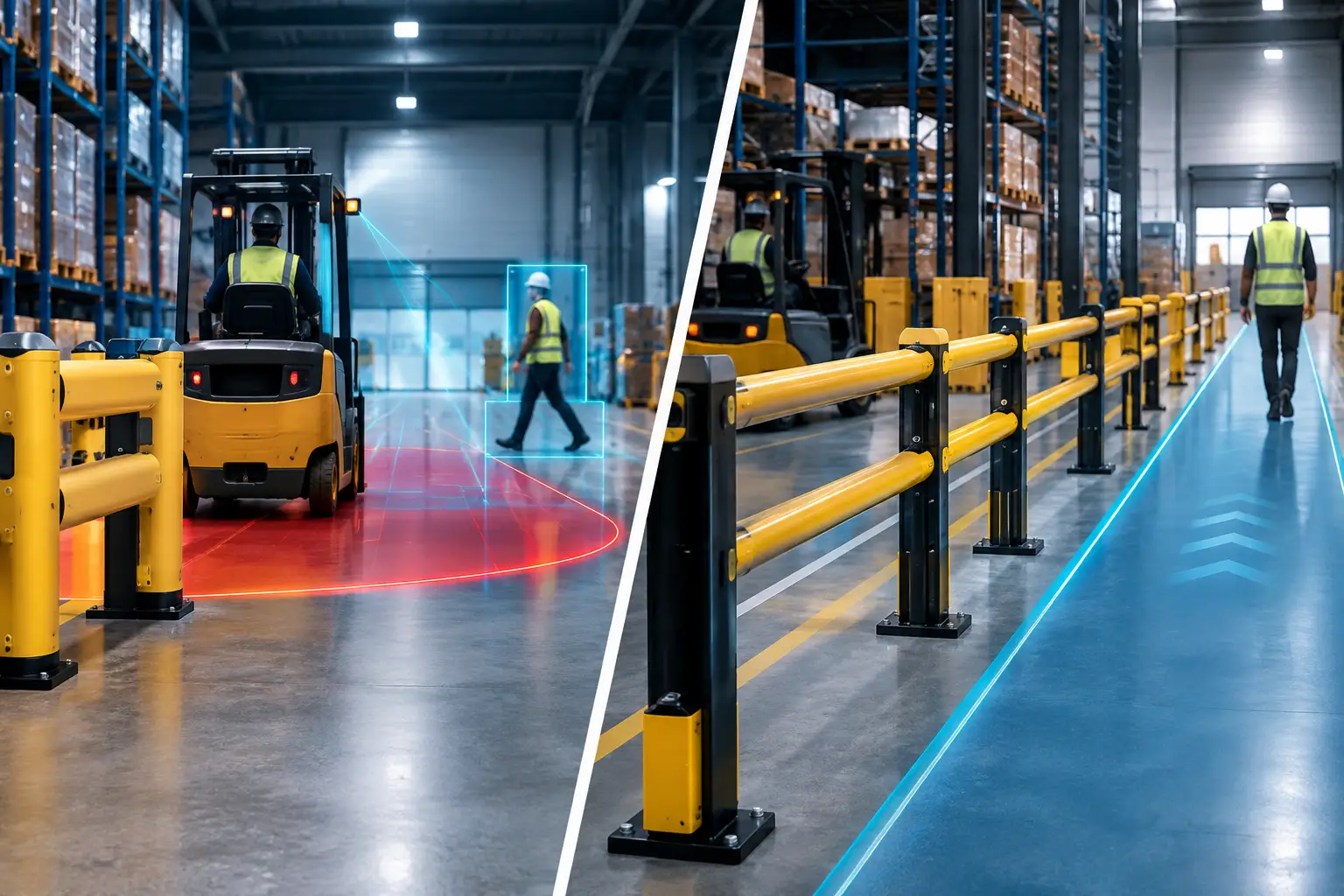
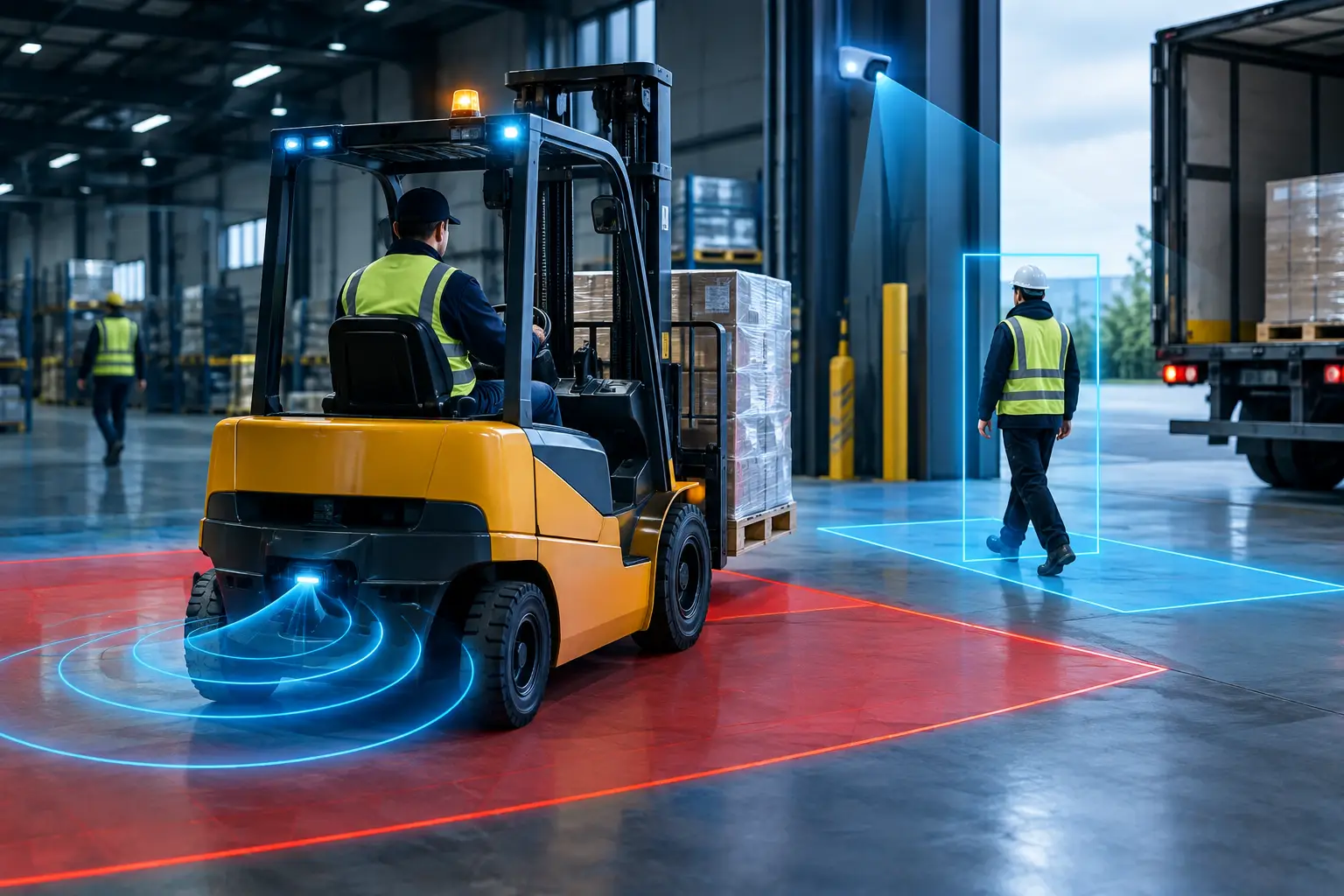
Modern proximity warning systems add another layer by detecting vehicle or pedestrian presence and triggering audible or visual alerts before a crossing conflict occurs. These systems are particularly effective at blind intersections, aisle exits, doorways, and transition zones between storage and picking areas. Floor projection warnings can reinforce the message by placing bright visual indicators directly in the line of travel, where workers are more likely to notice them.
There is no single setup that suits every site. In a high-traffic distribution center, you may need multiple warning points integrated into traffic routes. In a manufacturing warehouse with lower traffic but tighter aisle geometry, focused protection at a few conflict zones may deliver more value. The goal is to reduce uncertainty at the exact point where a decision has to be made.
Vision AI safety monitoring in active environments
Where AI adds value
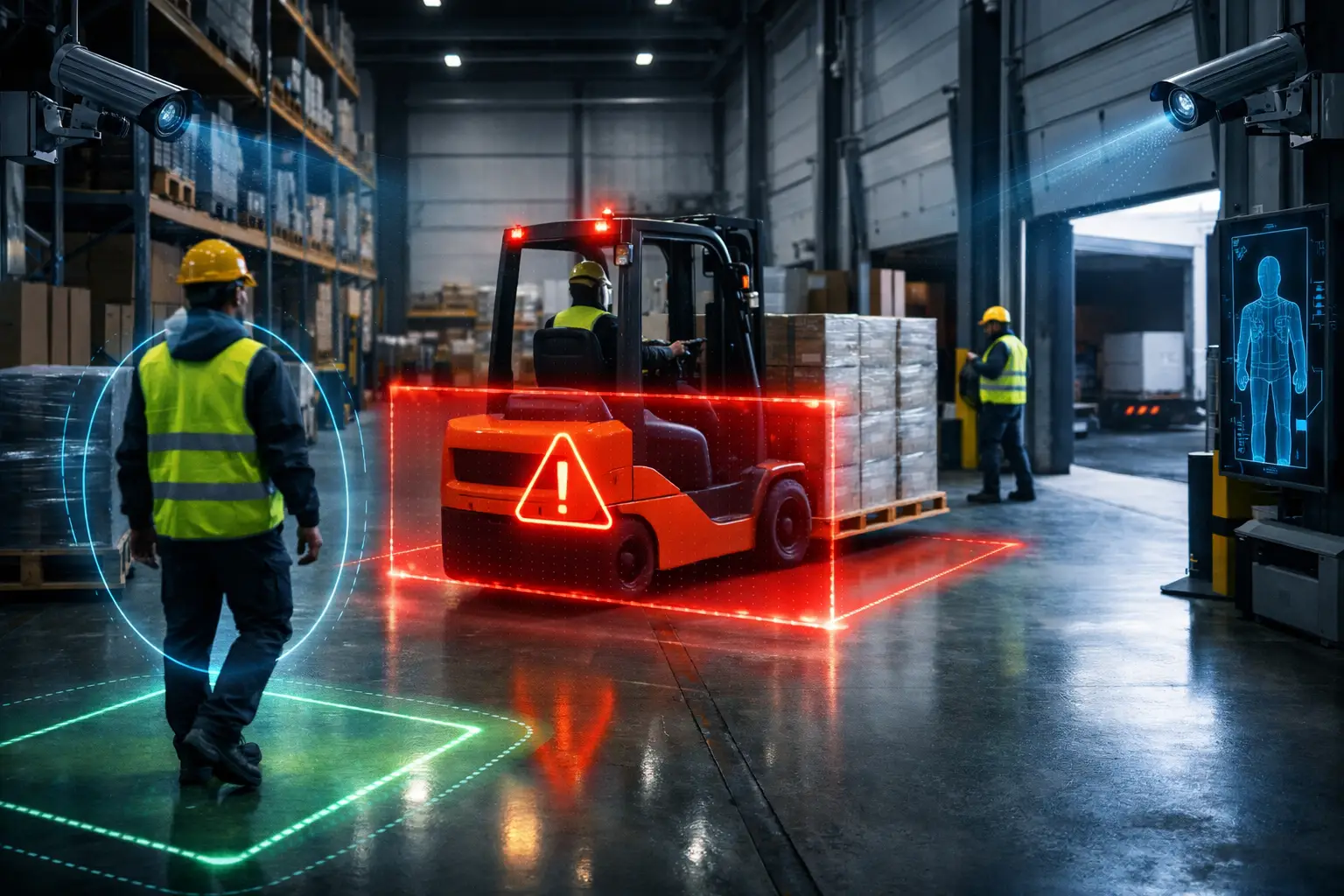
Vision AI safety monitoring is useful when managers need better visibility into repeated unsafe interactions, restricted zone breaches, or behavior patterns that are hard to capture through spot checks alone. It can identify when pedestrians enter vehicle paths, when forklifts travel through non-approved routes, or when traffic density increases beyond a safe threshold.
This matters because many facilities know they have risk, but lack clear evidence of when, where, and how often exposure occurs. AI-enabled monitoring helps turn assumptions into actionable findings. Instead of responding only after an incident, managers can prioritize interventions based on actual movement patterns.
Where AI is not the whole answer
AI should not be treated as a complete solution by itself. It does not physically stop a forklift, repair damaged racking, or secure a trailer at the dock. It is most effective when paired with site controls such as barriers, alerts, traffic segregation, and operational discipline. The value is in better detection and faster corrective action, not in replacing core engineering controls.
Loading bay hazards need dedicated controls
Warehouse safety discussions often focus on internal traffic, but loading bays remain one of the most exposed operational areas. Vehicle creep, premature truck departure, trailer movement during loading, and the gap between vehicle and dock all create conditions where a routine loading task can become a serious incident.
Dedicated loading bay safety technology addresses these risks directly. Vehicle restraint systems help secure trailers during loading and unloading. Dock warning lights and communication systems improve coordination between drivers and dock teams. Safety barriers and gate systems reduce the chance of falls from open dock edges when no truck is present.
These controls are especially important because loading bays combine time pressure with cross-functional activity. Transport schedules, warehouse throughput, and driver movements all converge in one area. If controls are weak, even experienced teams can be exposed. If controls are consistent and visible, the loading process becomes safer and more predictable.
Physical protection still matters
Not every safety improvement needs to be digital. Warehouse safety barriers, rack protection, column guards, and impact-resistant separation systems remain essential because they reduce the consequences of human error. In many facilities, repeated low-speed impacts do not cause immediate injury, but they create cumulative damage to racking, infrastructure, and traffic routes. Over time, that damage increases operational risk.
Physical protection works best when it is placed based on incident history and traffic behavior, not only general layout plans. A barrier that protects a pedestrian walkway from forklift encroachment delivers a different benefit than one installed around a building column. Both matter, but they solve different problems.
This is also where engineering judgment becomes critical. Overuse of barriers can restrict maneuverability or create bottlenecks. Underuse leaves workers and assets exposed. The right balance depends on traffic flow, turning radius, vehicle type, and the frequency of shared-space interaction.
How to choose the right safety technology
A practical approach starts with risk concentration. Where are the repeat near misses? Which activities expose people to moving equipment? Where does asset damage keep occurring? Technology should be selected to control known operational patterns, not to satisfy a general desire for modernization.
It also helps to separate high-severity risks from high-frequency nuisances. A rare but potentially catastrophic loading bay event may deserve immediate investment. Frequent rack contact may call for protective barriers and route redesign. A congested crossing may need active warning systems before anything else. Prioritization matters because budgets and implementation windows are always limited.
The most successful projects are usually phased. Start with the zones where exposure is clear and the intervention is easy to validate. Measure changes in near misses, traffic behavior, response times, equipment damage, and operational interruptions. Then expand with better evidence and stronger internal support.
Implementation is where results are won or lost
Even strong technology can underperform if implementation is treated as a simple product installation. Site assessment, positioning, operator training, maintenance planning, and post-installation review all affect outcomes. A warning light placed outside normal sight lines will be missed. A restraint system without clear loading procedures will be bypassed. A monitoring system without follow-up action becomes background noise.
That is why many organizations benefit from working with a safety partner that understands both engineering constraints and warehouse operations. SysGuard, for example, focuses on aligning safety technology with real facility risks so that solutions are not only installed, but used, maintained, and trusted on the floor.
The point is not to build a warehouse filled with devices. It is to create an environment where fewer unsafe interactions occur, operators get clearer signals, pedestrians have better protection, and managers can act on real risk data instead of assumptions.
Every worker deserves to return home safely every day. The facilities that make that happen consistently are usually not the ones with the most rules on paper. They are the ones that use the right controls, in the right places, before routine hazards turn into serious accidents.