A forklift turning out of a rack aisle can cover several meters in seconds. A pedestrian stepping around a pallet stack may be completely hidden until the final moment. This forklift proximity warning guide explains how facilities can identify these high-risk interactions and apply warning technology that gives people and operators time to react.
Forklift-pedestrian incidents are rarely caused by one failure alone. Restricted sightlines, noise, speed, mixed traffic, loading activity, and changing shift conditions can combine quickly. A practical warning system adds another layer of control where markings, mirrors, operator training, and traffic rules may not be enough by themselves.
Where Forklift Proximity Warnings Make the Greatest Difference
Proximity warnings are most valuable at points where people and mobile equipment can unexpectedly enter the same space. The goal is not to place an alert on every forklift and assume the risk is controlled. The goal is to address specific collision scenarios identified through a workplace risk assessment.
Common high-risk locations include blind corners between racking, cross-aisles with frequent pedestrian movement, staging zones, battery charging areas, packing stations, dock approaches, and entrances connecting production and warehouse areas. Loading bays deserve particular attention because forklift traffic, truck movement, uneven activity levels, and visitor access can create rapidly changing conditions.
Look beyond the facility layout on paper. Observe how work actually happens across different shifts. A route that appears clear during a site walk may become congested during peak receiving hours. Similarly, a pedestrian walkway may be marked correctly but still be used as overflow storage during busy periods. Warning technology performs best when installed around real operating behavior rather than an idealized traffic plan.
Understanding the Warning Technologies Available
Forklift proximity warning systems use different sensing methods and alert formats. The right choice depends on the hazard, the environment, the number of vehicles, and the response expected from the operator or pedestrian.
Visual projection and directional warnings
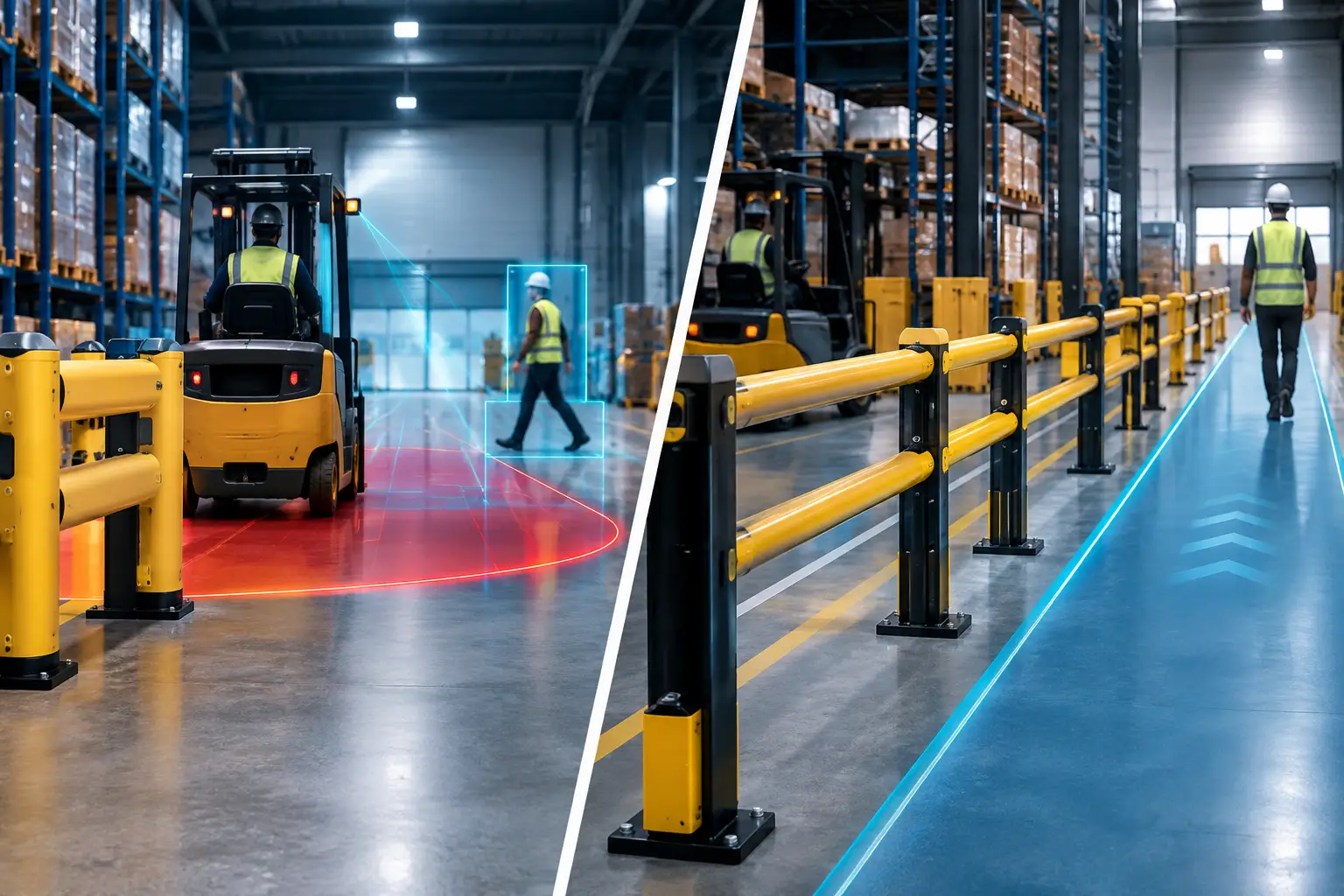
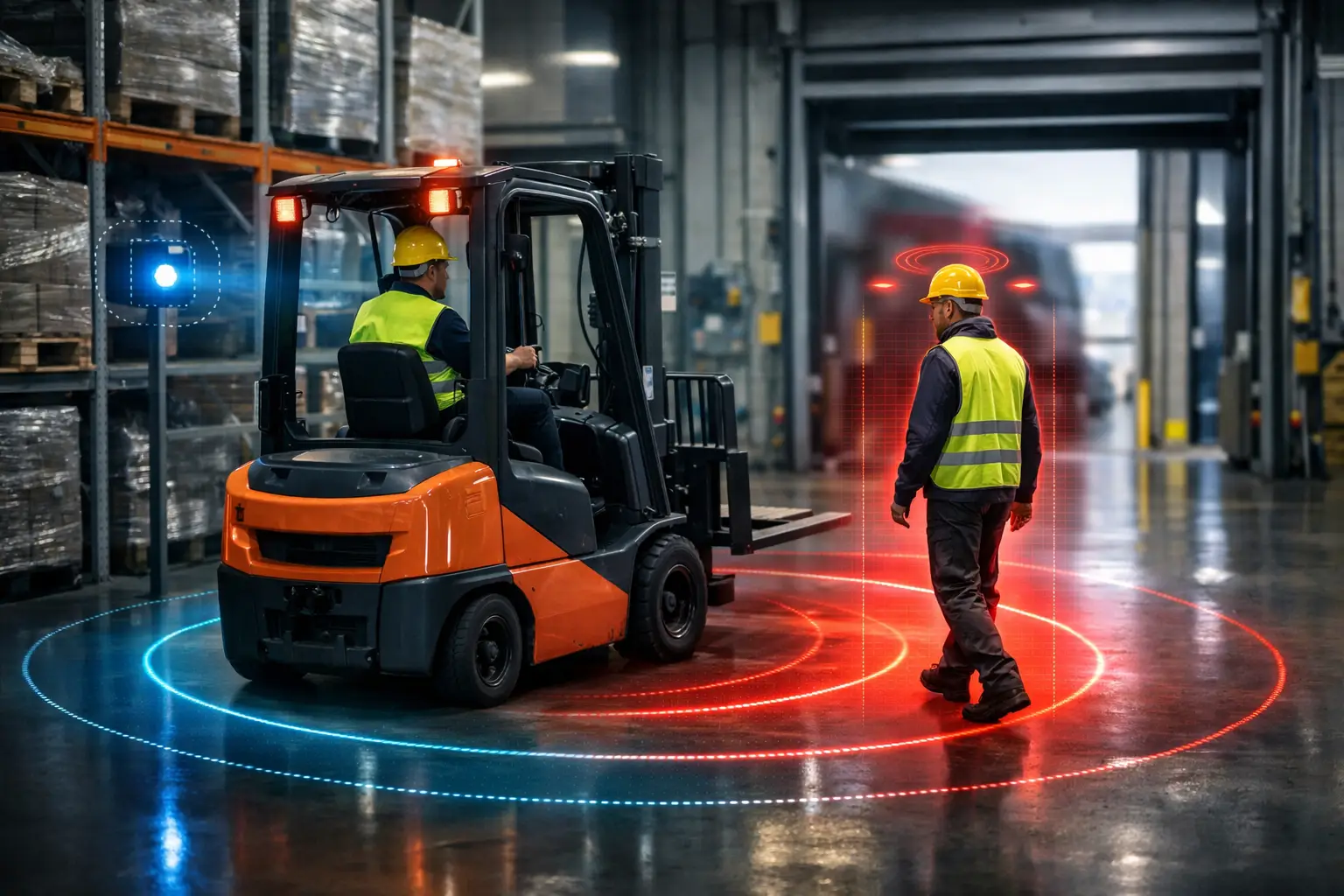
Blue spot and red zone lights project a visible warning onto the floor around a moving forklift. A forward or rear blue spot can alert people approaching an aisle intersection that a vehicle is nearby before the forklift itself comes into view. Red zone lights define a visible exclusion area along the sides or rear of equipment, reinforcing the need to stay clear of turning and reversing paths.
These solutions are straightforward and effective in areas with clear floor visibility. Their limitation is that a projected light can be less noticeable on bright surfaces, in direct sunlight, or where floors are heavily obstructed. They should support, not replace, physical segregation and disciplined pedestrian behavior.
Audible alarms and spoken alerts
Reverse alarms, travel alarms, and direction-specific voice alerts can warn nearby personnel when a forklift is moving or reversing. They are useful where workers may not be facing the vehicle, such as behind pallet stacks or at busy dock doors.
However, more noise is not always better safety. In a facility with constant alarms, workers can become desensitized and stop responding. Select alarms that are clear, relevant, and appropriate for the ambient noise level. Directional or targeted warnings often provide more value than a generic alarm heard throughout the warehouse.
Sensor-based detection systems
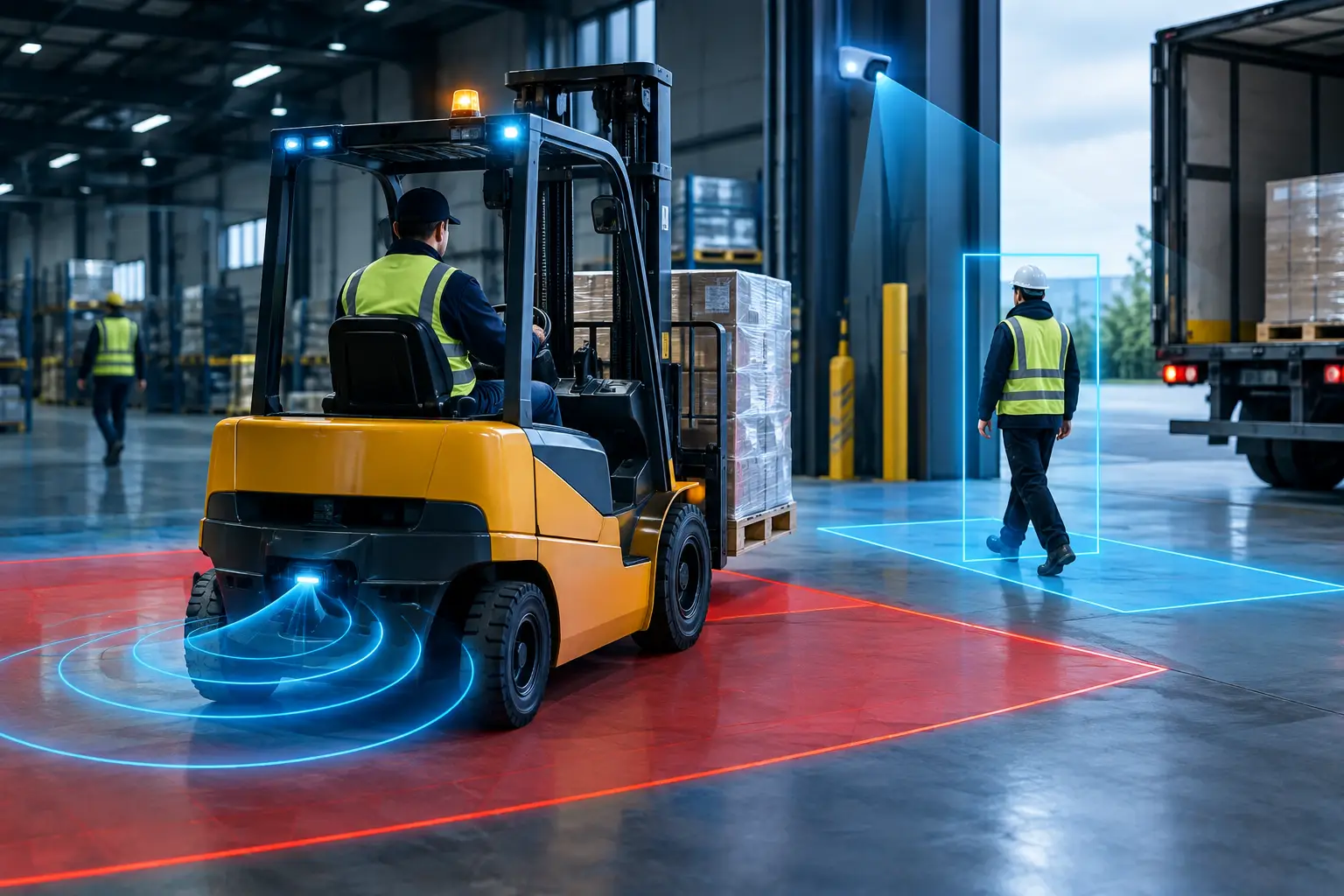
Ultrasonic, radar, RFID, ultra-wideband, and camera-based systems can detect people, tags, vehicles, or obstacles within defined zones. Depending on the system, detection may trigger a light, sound, cab alert, speed reduction, or event recording.
Sensor-based technology is particularly useful for blind spots and recurring interaction zones where visual warnings alone cannot provide enough protection. For example, a system may warn a forklift operator when a pedestrian enters a predefined range at a rack aisle exit. More advanced configurations can differentiate between a person, another vehicle, and fixed infrastructure, helping reduce irrelevant alerts.
Vision AI monitoring
Vision AI safety monitoring uses cameras and intelligent detection to identify unsafe proximity, pedestrian presence, restricted-zone entry, or traffic-rule violations. It can provide live alerts and generate data that reveals patterns: repeated near misses at one intersection, frequent pedestrian entry into a staging area, or reversing behavior that needs attention.
This approach can be highly valuable in complex operations, but it needs correct camera placement, lighting evaluation, system commissioning, and a clear process for acting on findings. Data without follow-up will not reduce risk.
How to Select the Right Forklift Proximity Warning System
Start with the incident potential, not the product. Ask where a pedestrian could be struck, trapped, or surprised by a forklift. Then determine whether the core problem is poor visibility, uncontrolled access, excessive speed, insufficient separation, operator awareness, or a combination of these factors.
A warning system should match the required response. If pedestrians need advance notice of an approaching forklift at a blind corner, a projected light and audible alert may be appropriate. If people regularly work close to vehicle routes, sensor detection with escalating alerts may be needed. If the main issue is unauthorized access to a high-traffic zone, physical barriers and controlled crossings may be more effective than adding another alarm.
Consider these practical selection factors:
- Detection range and accuracy in the actual operating environment
- Performance around metal racking, reflective surfaces, dust, noise, and variable lighting
- Alert type, visibility, volume, and likelihood of alarm fatigue
- Whether the system warns, records events, controls speed, or integrates with vehicle functions
- Installation requirements, maintenance needs, and compatibility across the forklift fleet
No technology is infallible. False alarms can lead to disengagement, while missed detections undermine confidence. Testing a system in the intended work area before broader deployment helps confirm that detection zones, alert thresholds, and operator responses are suitable.
Installation Is a Safety Design Task, Not Just a Hardware Task
Mounting a warning device is only one part of implementation. Its location, aiming angle, configuration, and relationship to site traffic controls determine whether it will improve safety in practice.
For floor projection, verify that the warning appears early enough to be useful at intersections and remains visible around common obstructions. For detection systems, define zones that reflect forklift speed and stopping distance. A warning zone set too close may provide little reaction time. One set too far away may create frequent alerts during normal operations.
Include operators and frontline supervisors during commissioning. They understand where loads block views, where pedestrians take shortcuts, and which corners create the most stress during peak activity. Their input can expose design issues before the system becomes part of daily operations.
Clear communication also matters. Workers need to understand what each color, sound, or cab message means and what action is expected. A red projected zone is ineffective if employees see it as a decorative light rather than a boundary that must not be crossed.
Keep Warning Systems Effective Over Time
Proximity warning technology needs inspection and maintenance just like forklifts, racking, barriers, and dock equipment. Lens contamination, damaged wiring, misaligned sensors, weak lights, and altered site layouts can reduce performance gradually.
Build checks into planned maintenance and routine safety inspections. Confirm that alarms are audible at expected noise levels, projected lights remain visible, sensors detect at the configured distance, and event reports are reviewed. When racking changes, pedestrian routes move, or a new process is introduced, reassess the warning system as part of the change.
Near-miss reports are especially useful. They show whether the system is warning people early enough and whether teams are responding as intended. Repeated alerts at one location may indicate a need for better route separation, a revised crossing point, or changes to storage practices rather than more sensitive settings.
The Strongest Control Is a Layered One
A forklift proximity warning system is a critical supporting control, but it cannot compensate for poor traffic design. Effective facilities combine technology with clearly separated pedestrian routes, protected crossings, speed management, sightline improvements, operator training, supervision, and physical barriers where exposure remains high.
This layered approach protects people while reducing costly equipment damage, product loss, investigation time, and operational disruption. It also gives safety and operations teams a clearer view of where risk is increasing before an incident occurs.
Every worker deserves to return home safely every day. Start with the places where forklifts and pedestrians meet unexpectedly, then implement warning measures that give both sides the time, visibility, and space to stay out of harm’s way.