A forklift rounds a rack end as a picker steps from a staging lane. At most facilities, this is an ordinary movement repeated hundreds of times per shift. It is also the moment where the future of warehouse safety becomes real: not after an incident report, but in the seconds before people, vehicles, and equipment enter the same space.
Warehouses are moving faster, operating with tighter labor capacity, and handling greater pressure to maintain throughput. Traditional controls such as painted walkways, warning signs, mirrors, and operator training remain necessary. But on their own, they cannot account for every blind corner, blocked line of sight, temporary work area, or change in traffic flow.
The next stage of safety is predictive. It combines better physical design with connected warning technologies and operational data, helping teams identify developing risk before it results in injury, damage, downtime, or a disrupted loading schedule.
Why warehouse risk is becoming harder to control
The core hazards have not changed. Forklifts and pedestrians still share active areas. Trucks still reverse into loading bays. Pallets still create obstructions. Racks, doors, and building columns remain vulnerable to vehicle impact. What has changed is the pace and variability of work.
A facility may run different shift patterns, alter storage layouts for seasonal demand, introduce new lift equipment, or add temporary staging zones to meet a surge in orders. Each adjustment can change how people and vehicles interact. A traffic plan that worked six months ago may no longer reflect actual movement on the floor.
This is why incident history alone is not enough to guide safety decisions. Near misses, unsafe shortcuts, repeated congestion, sudden braking, and frequent forklift-pedestrian proximity events can reveal exposure long before a serious accident occurs. The challenge is making those signals visible and actionable.
The future of warehouse safety starts with visibility
Better visibility is not simply about installing more cameras or brighter lights. It means understanding where risk occurs, why it occurs, and which control will reduce it without slowing necessary work.
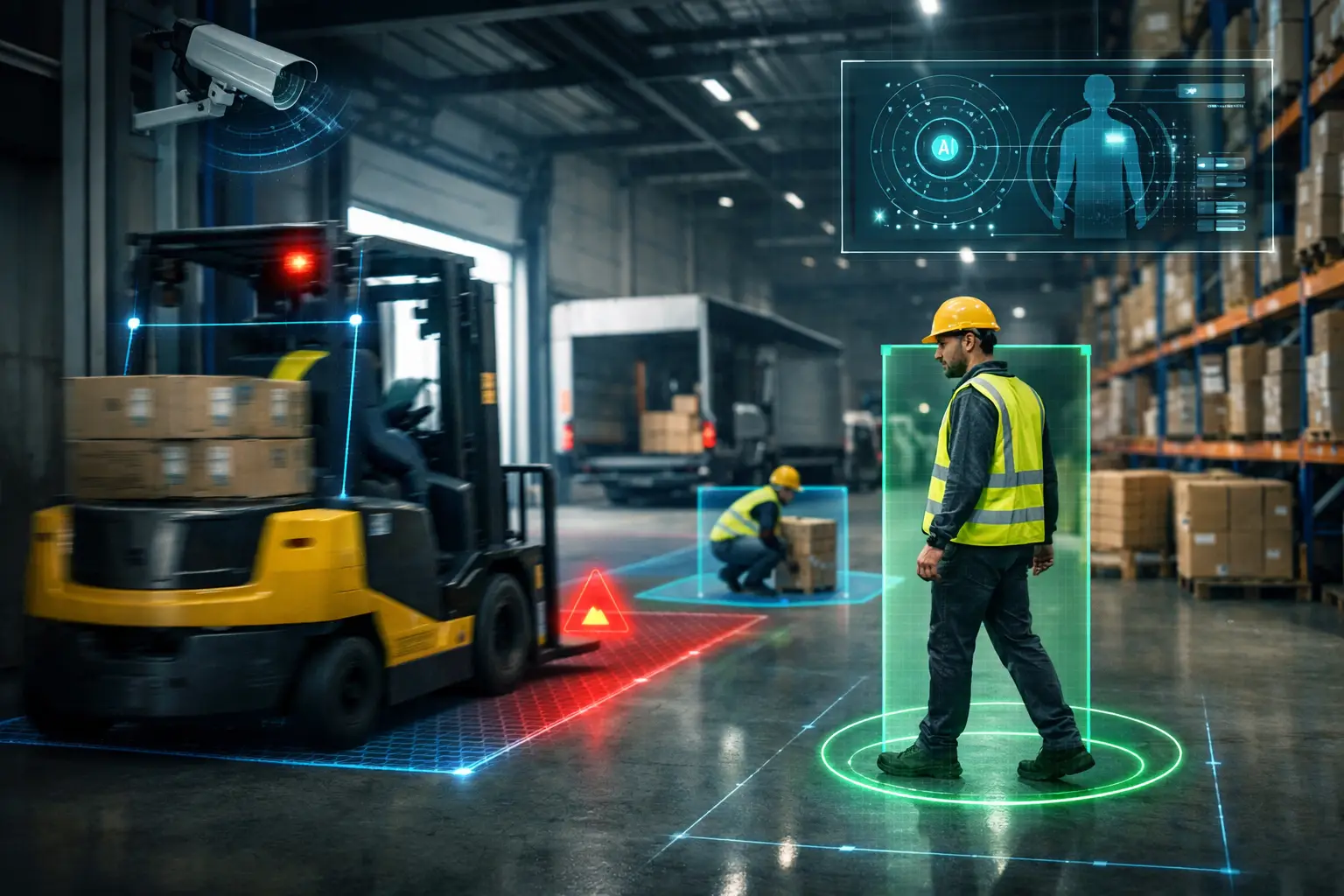
Vision AI safety monitoring is becoming a practical tool in this area. Properly configured for an industrial environment, it can detect unsafe interactions such as pedestrians entering active vehicle zones, vehicles traveling in restricted directions, or people standing too close to loading activity. Safety leaders can then review patterns by location, shift, or process instead of relying only on manual observations.
The value is not in collecting footage. The value is in turning recurring exposure into a defined improvement plan. If a crossing repeatedly generates close interactions during dispatch peaks, the appropriate response may be a revised route, a segregated pedestrian path, an automatic warning system, or a change to staging practices. Technology identifies the pattern. Operations and safety teams decide how to control it.
Data must support action, not create another dashboard
A common concern is that connected safety systems will produce more alerts than a team can manage. That concern is valid. An alarm that activates constantly soon becomes background noise, and data that is never reviewed has no preventive value.
The most effective approach is to focus monitoring on high-consequence zones and defined risk scenarios. A blind intersection, a loading bay approach, a pedestrian crossing near high-bay racking, or a congested battery charging route may justify real-time detection and alerts. A low-traffic storage aisle may require a different level of control.
This risk-based approach helps teams prioritize investment and avoid treating every part of the warehouse as if it carries the same exposure.
Safer traffic systems will be active, not passive
Painted lines and floor markings establish intent, but they do not react when conditions change. The future of warehouse safety will increasingly rely on active traffic controls that respond to vehicle and pedestrian movement in real time.
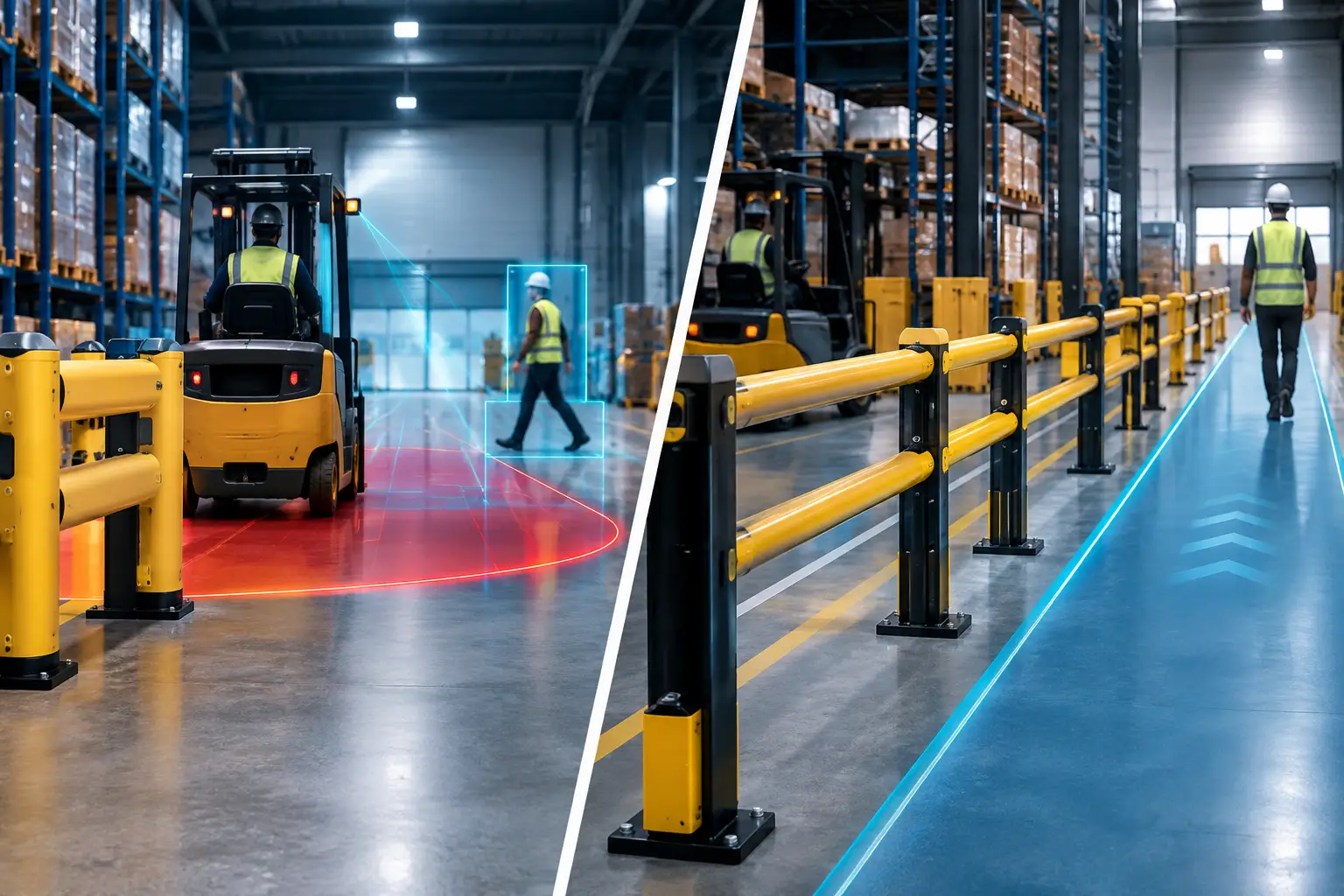
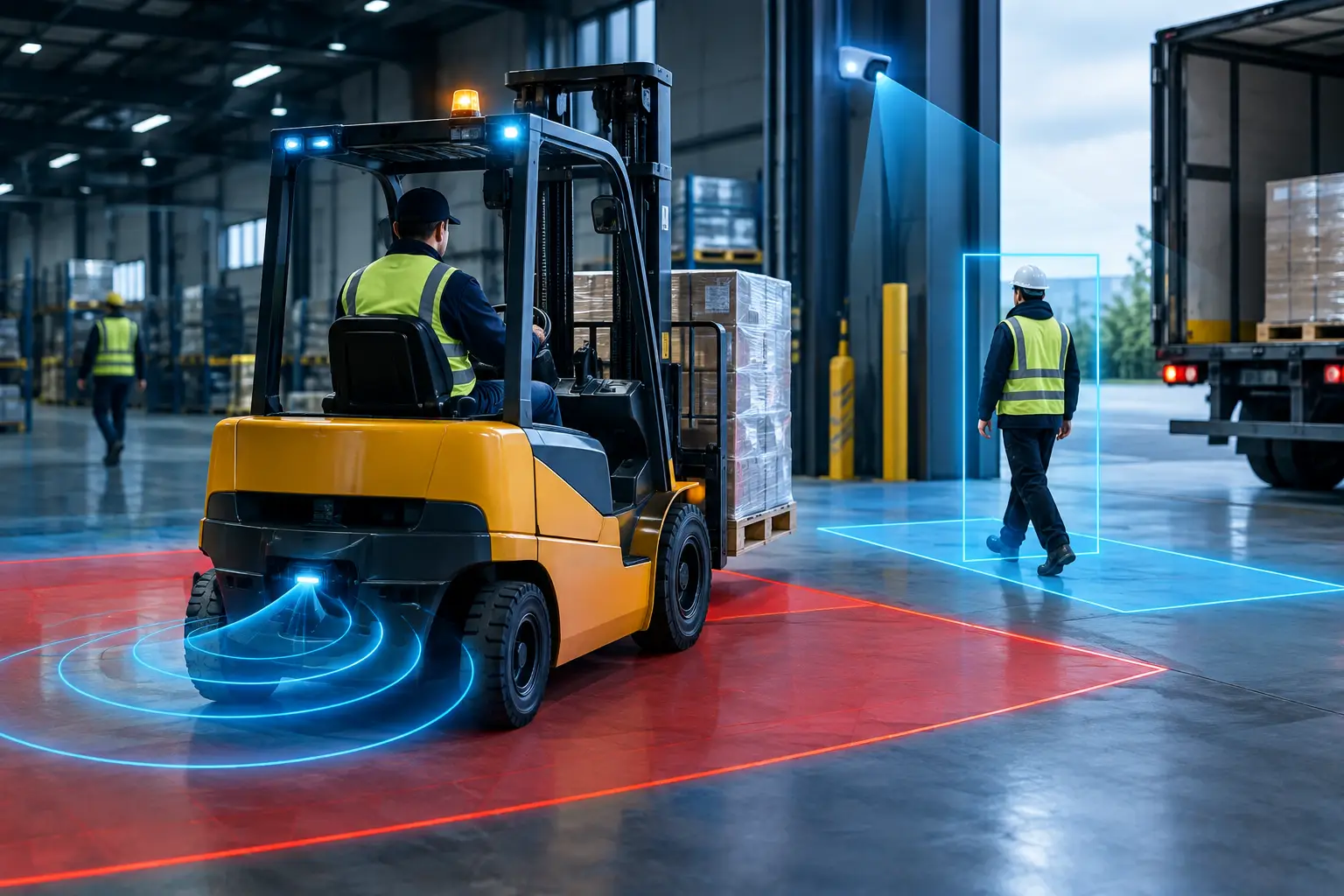
At intersections and rack-end crossings, safety floor projection can create a highly visible projected symbol or warning zone when a forklift approaches. Audible and visual alerts can reinforce that warning where visibility is limited or ambient noise is high. Proximity warning systems can notify operators and pedestrians when they are entering a defined danger zone.
These technologies work best as part of a designed traffic system. For example, a forklift route should have clear priority, pedestrian crossings should be placed where people naturally need to travel, and warning devices should be installed where they add a meaningful layer of protection. Adding devices without addressing poor layout or conflicting workflows may only treat the symptom.
Forklift-pedestrian separation remains the strongest control
Where practical, physical separation is still one of the most reliable ways to reduce collision risk. Barriers, guardrails, protected walkways, gates, and designated crossing points reduce reliance on split-second decisions in high-energy environments.
However, full separation is not always possible. Loading areas, picking zones, maintenance work, and space-constrained facilities often require people and vehicles to work close together. In those cases, layered controls matter: physical protection where feasible, clear traffic rules, intelligent warnings, equipment operating controls, and ongoing supervision.
The goal is not to create a warehouse filled with alarms. It is to create a workplace where people can predict how traffic will behave and where the system provides additional protection when normal controls are challenged.
Loading bays will demand more connected protection
Loading bays combine several high-risk activities in a compact area. Forklifts move between the warehouse and trailer. Drivers may be waiting nearby. Dock doors open and close. Vehicle movement, trailer stability, and communication between teams all affect the safety of each loading cycle.
Future-ready loading bay safety will place greater emphasis on preventing movement conflicts before loading begins. Vehicle restraint systems can help keep a trailer secured at the dock, while clear status indicators can communicate whether it is safe for a forklift to enter. Visual warnings and interlocks can support a more disciplined sequence of arrival, restraint, loading, and release.
The correct solution depends on the types of vehicles, dock configuration, trailer condition, loading methods, and throughput requirements. A busy distribution center with frequent trailer turnover may need a more integrated system than a facility with occasional deliveries. In both cases, the objective is the same: remove ambiguity at the point where people, forklifts, and trucks converge.
Automation will change safety controls, not eliminate them
As facilities introduce automated storage, conveyors, autonomous mobile equipment, and digital workflow tools, safety management will become more complex rather than disappear. Automation can reduce exposure to repetitive travel and remove people from certain hazardous tasks. It can also create new interfaces between manual workers, powered equipment, and automated systems.
That is why safety must be considered during process design, not added after a system is installed. Teams need to assess where people will enter automated zones, how exceptions will be handled, what happens during maintenance, and how temporary work affects normal traffic patterns.
The best automated facilities do not assume people will always follow the ideal route. They account for real behavior, including urgency, distraction, unfamiliar contractors, and operational disruptions. Intelligent warning systems, physical segregation, and clearly controlled access points help create tolerance for human variability.
From compliance activity to operational discipline
Safety performance improves when it is treated as an operating condition, not a periodic audit exercise. That means reviewing traffic flow after layout changes, investigating near misses with the same seriousness as damage events, checking whether barriers and rack protection remain fit for purpose, and confirming that warning devices are functioning as intended.
Maintenance is especially important as safety technology becomes more connected. Sensors, projectors, alert systems, restraints, and barriers must remain properly positioned, tested, and maintained. A system that is present but unreliable can create false confidence.
For many operations, the most productive first step is a focused assessment of high-risk interactions rather than a facility-wide technology rollout. Identify the places where forklifts, pedestrians, trucks, and fixed assets most often conflict. Observe actual workflows across shifts. Then select controls that address the root cause and can be sustained by the site team.
Every worker deserves to return home safely every day. The facilities that lead on safety will be those that combine engineering controls, intelligent technology, and disciplined daily practice to prevent the next incident before it has the chance to happen.