A pedestrian steps from behind a rack end just as a forklift reverses from an adjacent aisle. The operator has checked mirrors and sounded the horn, but the pedestrian has not yet seen the vehicle. This is the moment where forklift lighting safety options can create the extra second needed to stop, wait, or change course.
Lighting is not a substitute for traffic rules, trained operators, or physical separation. It is a practical control that makes moving equipment more visible in the places where human attention is limited: blind intersections, noisy loading bays, congested staging areas, and aisles with high racking. When specified correctly, visual warning systems help reduce pedestrian-vehicle conflict, equipment damage, and unplanned downtime.
Why forklift visibility fails in real operations
Forklift incidents rarely result from one failure alone. A driver may have an obstructed view from a raised load. A pedestrian may be focused on a scanner, pallet location, or approaching truck. Ambient noise can mask a reversing alarm, while rack uprights, shrink-wrapped pallets, and dock doors create sightline obstructions.
Lighting conditions can make these risks worse. Bright exterior light at a loading dock can wash out indoor visibility. Shadowed aisles can hide a vehicle until it reaches the intersection. In facilities operating multiple shifts, the risk changes as daylight, workforce density, and task patterns change.
The objective is not to make every forklift brighter. It is to provide a clear, timely visual signal that tells people where the truck is, which direction it is moving, and where a potential interaction may occur. The best solution depends on traffic layout, vehicle type, pedestrian behavior, and the specific hazards identified in the site risk assessment.
Core forklift lighting safety options
Blue spot lights
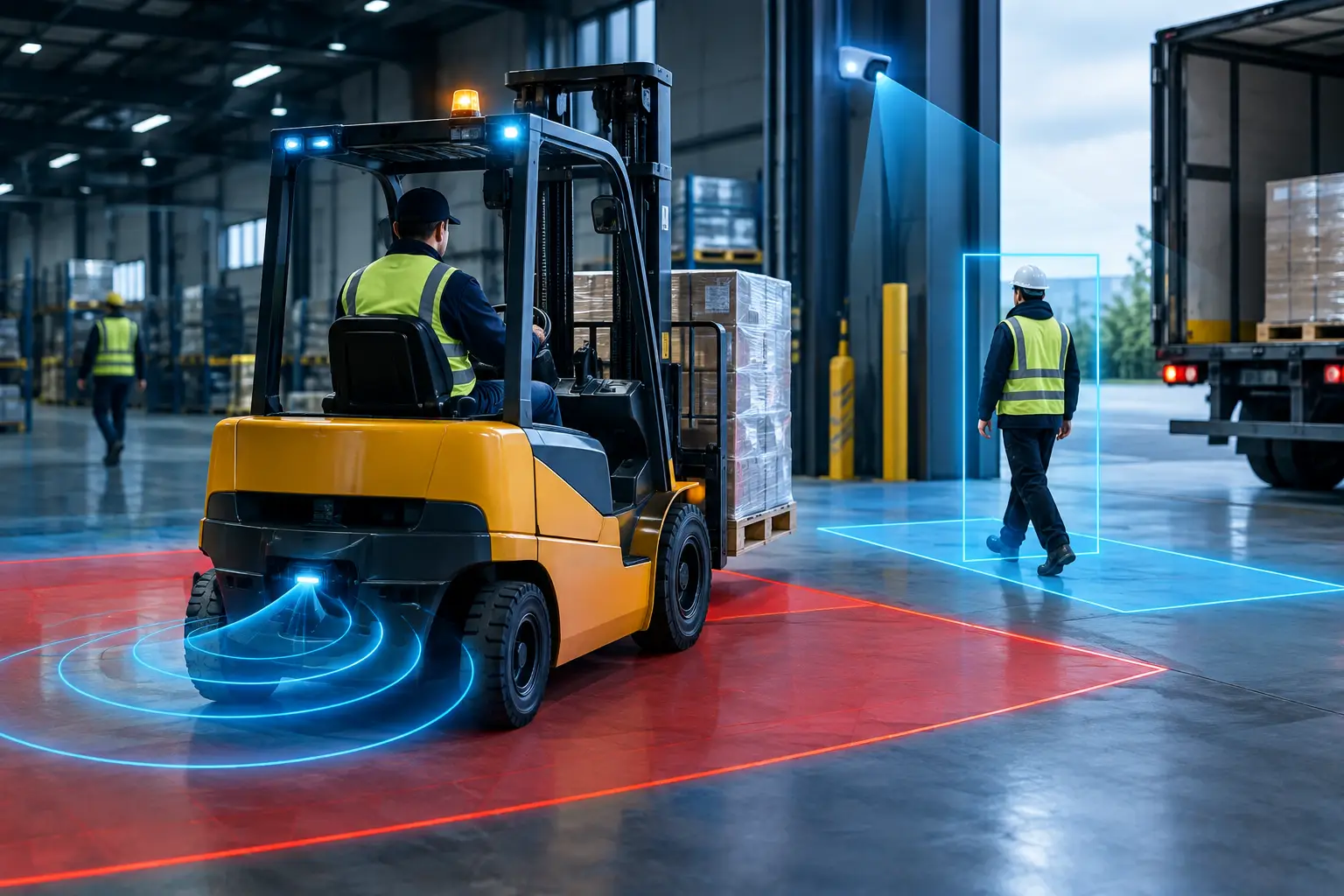
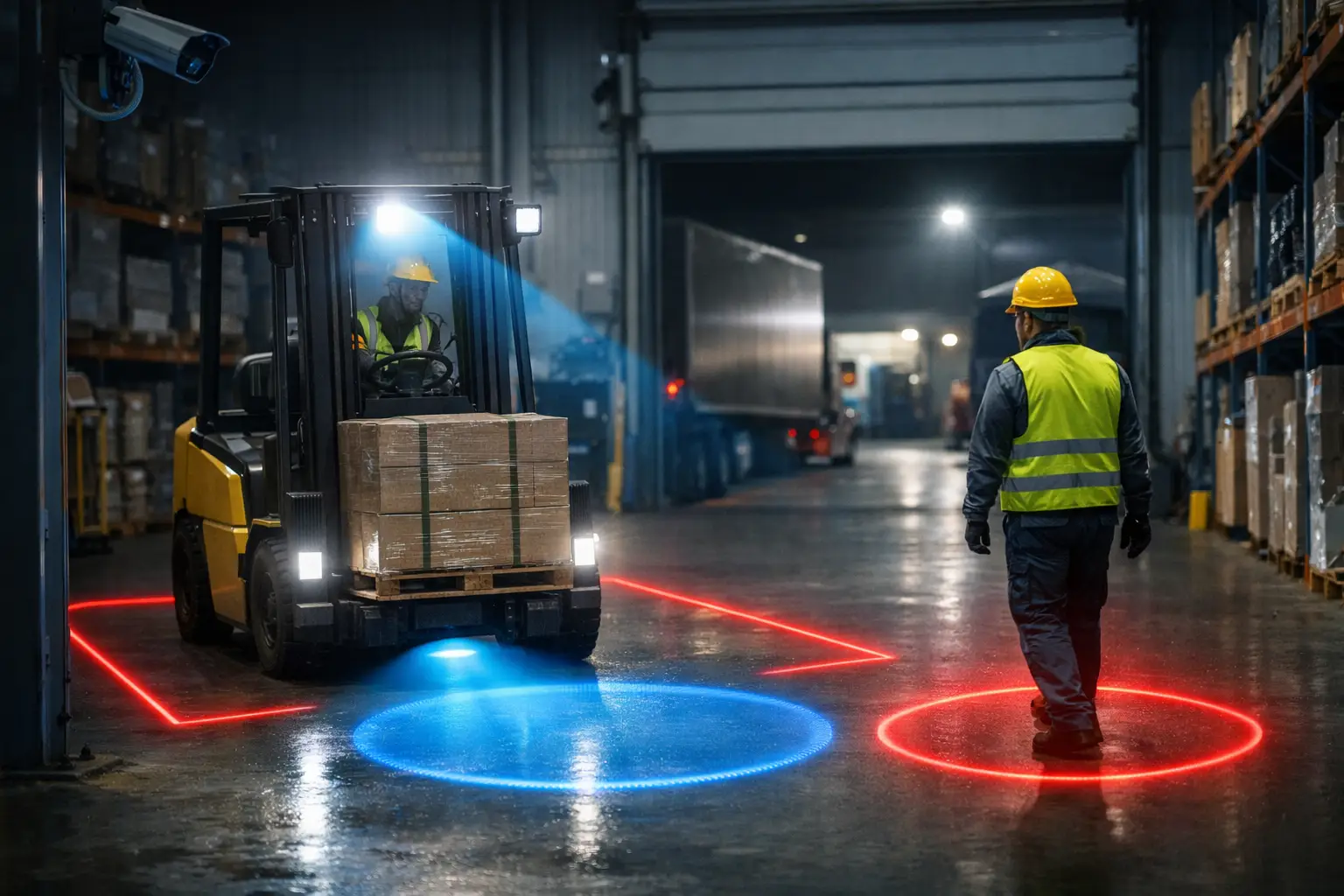
A blue spot light projects a concentrated blue beam onto the floor ahead of or behind a forklift. It provides pedestrians with an advance visual cue, particularly when the vehicle itself is hidden by racking, loads, or a doorway.
These lights are widely used because the projected spot is simple to recognize and does not require floor markings. A forward-facing light can warn people approaching an intersection, while a rear-facing light supports reversing movements. The projection distance must be set carefully. Too close to the forklift and it offers little advance notice; too far away and it can be confused with another vehicle’s warning zone.
Blue spot lights are effective in standard warehouse aisles and intersections, but they can be less distinct on highly reflective floors or in areas with strong daylight. They should be tested under actual operating conditions rather than evaluated only during installation.
Red danger zone lights
Red danger zone lights project lines or a rectangular boundary on the floor around a forklift. Their purpose is different from a blue spot: they communicate a keep-clear area around the vehicle, commonly along the sides where turning radius, rear swing, or load movement can create a strike risk.
This option is especially useful where pedestrians work close to active vehicle routes, such as staging zones, packing areas, and loading bay approaches. The projected line gives a visible reminder of the separation distance workers should maintain.
A danger zone light must support, not replace, defined pedestrian walkways and physical barriers where those controls are feasible. Floor projections can be obscured by debris, damaged flooring, or intense sunlight. They are most valuable as a dynamic warning around an active vehicle, not as the only boundary in a high-risk mixed-traffic area.
Forward and reverse work lights
Work lights improve the operator’s ability to see the travel path, pallet position, dock surface, and obstacles. They are particularly relevant for dim warehouses, trailers, container loading, and outdoor-to-indoor transitions.
Unlike projected safety lights, work lights are primarily designed to illuminate the environment for the operator. Their indirect safety benefit can still be significant: better visibility supports earlier hazard detection, more accurate load placement, and safer maneuvering around dock edges or uneven surfaces.
Glare is the key trade-off. Poorly aimed lights can distract pedestrians, create reflections, or reduce visibility for nearby drivers. Beam pattern, mounting position, and aiming angle should be selected for the task rather than treated as an off-the-shelf add-on.
Strobe and beacon lights
Flashing beacons and strobes make forklifts easier to identify in busy areas and at a distance. They can be useful on equipment that operates around trucks, in outdoor yards, or in facilities where overhead sightlines allow workers to see the beacon before seeing the truck body.
They are not always the right primary warning for close-quarter warehouse traffic. In an environment with many vehicles, constant flashing can become visual background noise. Beacon lights work best as part of a coordinated signaling strategy, with consistent color and flash behavior across the fleet so workers understand what the signal means.
Directional and turn warning lights
Forklifts frequently turn at intersections where pedestrians assume the truck will continue straight. Directional indicators or turn warning lights provide an additional cue about intended movement, particularly on larger vehicles or routes with frequent cross-traffic.
This option is most practical when combined with clear site traffic rules. A signal is useful only if workers are trained to interpret it and operators use it consistently. It should not create a false assumption that a driver has seen every person in the turning path.
Floor projection systems at fixed hazards
Not every lighting control belongs on the forklift. Fixed floor projection systems can mark pedestrian crossings, warn of approaching vehicle lanes, or create high-visibility stop zones at blind intersections. Some systems can be triggered by vehicle movement, sensors, or traffic-control logic.
At a rack-end crossing, for example, a projected pedestrian symbol or red stop line can draw attention to a conflict point before a worker enters the vehicle route. This approach is valuable where the layout creates a repeatable hazard that affects multiple forklifts, not just one unit.
Fixed projections need a clear operational purpose. Installing visual effects throughout a facility can dilute attention. Prioritize locations with a documented history of near misses, poor sightlines, frequent crossings, or high vehicle speed.
Selecting lighting controls by risk, not preference
A blue spot light is familiar, but familiarity is not a design standard. The right combination of forklift lighting safety options begins with observing actual movement patterns. Walk the facility during peak activity, shift changes, replenishment, and loading operations. The conditions at noon may differ sharply from those during early-morning receiving or night-shift dispatch.
Assess the following factors before selecting a system:
- Where forklifts and pedestrians cross, merge, or work in close proximity.
- Whether loads, racks, doors, trailers, or equipment obstruct sightlines.
- How far in advance a pedestrian needs to recognize an approaching vehicle.
- The floor color, surface reflectivity, ambient light, and exposure to sunlight.
- Vehicle travel direction, speed, turning behavior, and reversing frequency.
- Whether operators, pedestrians, and visitors can understand the warning signal consistently.
This assessment often reveals that different zones need different controls. A narrow storage aisle may benefit from blue spot lights and strict pedestrian exclusion. A packing area with frequent crossings may need side danger zone lights, marked walkways, and fixed intersection warnings. A loading bay may require work lights, beacon visibility, and additional controls for truck movement and dock-edge hazards.
Installation and maintenance determine real performance
Lighting systems should be mounted securely, protected from impact, and positioned so they remain visible without creating glare. Wiring, charging arrangements, and compatibility with the forklift’s electrical system must be evaluated for reliability. A poorly installed light that flickers, shifts out of alignment, or fails during a busy shift becomes a source of uncertainty rather than protection.
Maintenance should be incorporated into routine forklift inspection and planned servicing. Operators can check whether lights activate, flash patterns are correct, lenses are clean, and projected beams remain aligned. Supervisors should also watch for changes in the work environment, such as new rack layouts, altered traffic routes, or floor resurfacing, that affect visibility.
Standardization matters across a fleet. If one vehicle projects blue forward and another uses blue for reverse, workers may misread the signal. Define the purpose of each color, beam, and placement, then apply that convention consistently wherever practical.
Lighting works best within a layered safety system
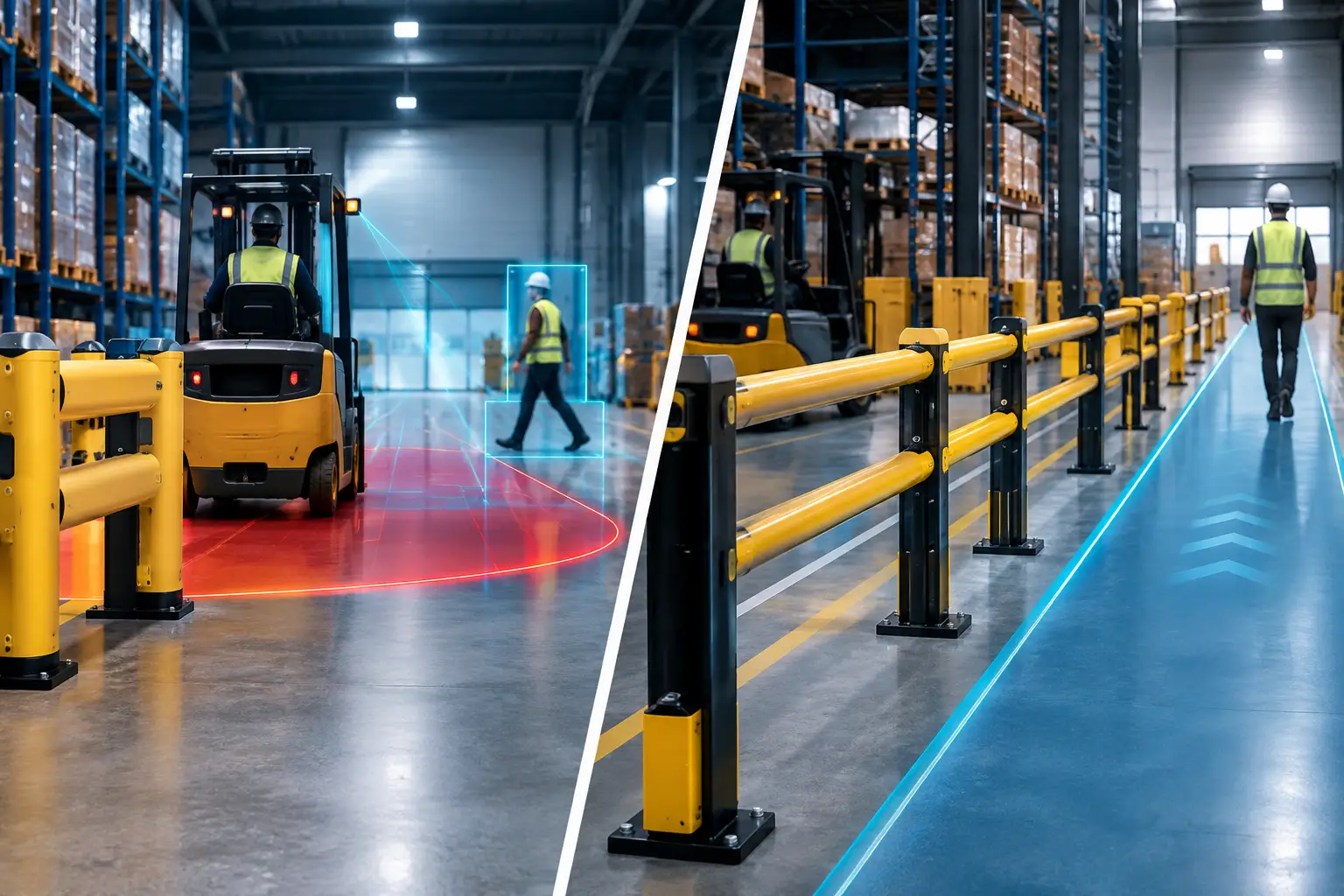
Visual warnings are one layer of protection. Higher-risk areas may also require separated walkways, impact barriers, speed controls, convex mirrors, audible alarms, proximity warning systems, or Vision AI monitoring that identifies pedestrian-vehicle interactions before an incident occurs.
The priority should be risk reduction, not technology quantity. For example, a persistent blind-corner hazard may be better addressed by rerouting pedestrians or adding a physical barrier than by adding more lights. Conversely, where operations cannot fully separate people and forklifts, intelligent visual and proximity warnings can provide meaningful additional protection.
SysGuard approaches these decisions as an operational design issue: understand the movement, identify the conflict points, and apply controls that people can use consistently. Every worker deserves to return home safely every day. Start by examining the places where a forklift is seen too late, then make that warning visible before the next near miss becomes an accident.