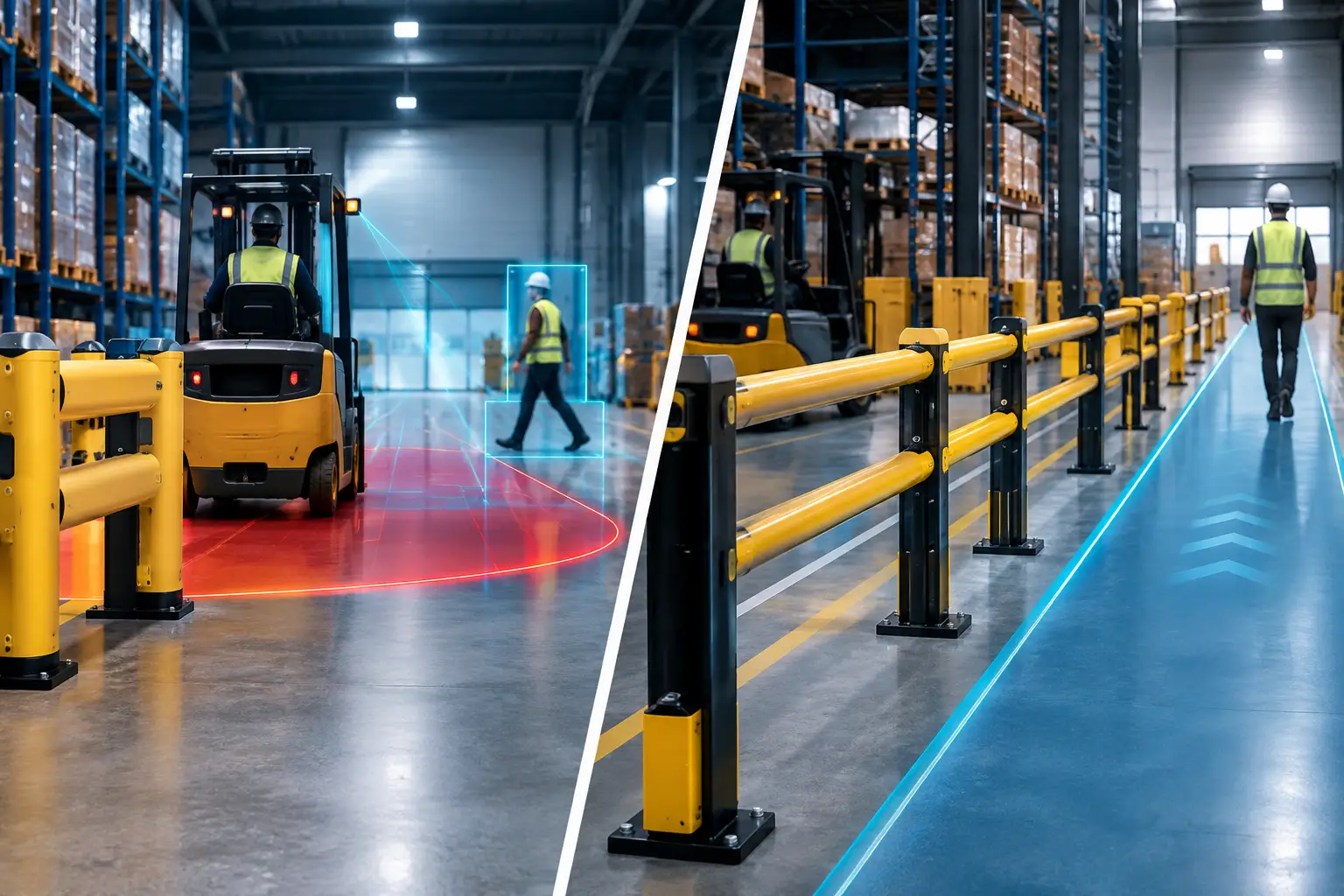
A painted line is not a physical control. In a busy warehouse, it can disappear under pallets, be blocked by staging, or be ignored when a forklift operator is focused on a tight turn. The best warehouse walkway barriers create a clear, durable boundary between people and moving equipment, helping facilities reduce one of their most serious daily risks: forklift-pedestrian interaction.
The right barrier is not simply the strongest one available. It must fit the traffic pattern, likely impact forces, pedestrian behavior, aisle width, floor condition, and the work taking place on both sides of the route. A poorly selected barrier can narrow an aisle, create a new obstruction, or encourage people to bypass the protected path. Effective separation starts with understanding how the facility actually operates.
Why Walkway Barriers Matter in Active Facilities
Forklifts, reach trucks, pallet jacks, and tugger trains all have blind spots, turning limits, and stopping distances that change with load, speed, surface condition, and operator visibility. Pedestrians may be carrying items, stepping out from behind racking, or crossing to reach workstations. Even well-trained teams are exposed when routes overlap.
Walkway barriers establish a physical line of defense. They guide people toward designated crossings, discourage shortcuts into vehicle lanes, and help drivers recognize where pedestrian activity is expected. They also protect walkways from encroachment by pallets, carts, or parked equipment.
This matters beyond injury prevention. A controlled traffic layout can reduce product damage, rack strikes, equipment downtime, and the operational disruption that follows a near miss or collision. It also gives EHS and operations teams a visible control that supports risk assessments, site rules, and safety reviews.
What the Best Warehouse Walkway Barriers Should Do
A suitable barrier system should match the hazard, not just mark the route. In low-risk areas where vehicle access is restricted, a visual boundary and light-duty guardrail may be sufficient. Along a forklift travel lane, beside a high-traffic intersection, or near loading activity, the barrier needs credible impact performance.
Separate pedestrians from moving vehicles
The primary purpose is to prevent unplanned entry into a vehicle route. Barriers should run continuously where practical, with deliberate openings only at designated crossing points, access doors, and work areas. Gaps without a clear reason tend to become informal crossing locations.
Separation is especially valuable near end-of-aisle turns, blind corners, battery charging areas, production line access points, and staging zones. These are places where people and machines naturally converge, often while attention is divided.
Manage impact energy without creating secondary hazards
Warehouse barriers are commonly manufactured from steel or engineered polymer systems. Steel barriers can provide high rigidity and are often appropriate where significant impact resistance is required. However, a severe strike may transfer force into anchors or the concrete slab, potentially requiring repair to the barrier, fixings, or floor.
Impact-absorbing polymer barriers flex and return to shape within their tested design limits. They can be highly effective in areas with frequent low- to medium-energy contact, helping reduce damage and maintenance interruptions. The trade-off is that they must be selected according to the vehicle type, speed, mass, and likely angle of impact. A light-duty polymer rail is not a substitute for a system engineered for heavy forklift exposure.
Keep routes usable and visible
A walkway is only protective when people use it. Barrier height should provide a clear physical and visual boundary without preventing necessary sightlines. Bright, high-contrast colors can improve route recognition, while reflective elements or projected warning zones may help in dimmer areas.
The layout must also preserve enough width for pedestrian flow, materials handling, cleaning, and emergency access. Before installation, measure the usable route rather than relying on a drawing alone. Doors opening into the path, temporary staging habits, and columns are frequent causes of real-world conflicts.
Barrier Types and Where They Fit
There is no universal barrier for every warehouse. Most facilities need a combination of controls based on local risk.
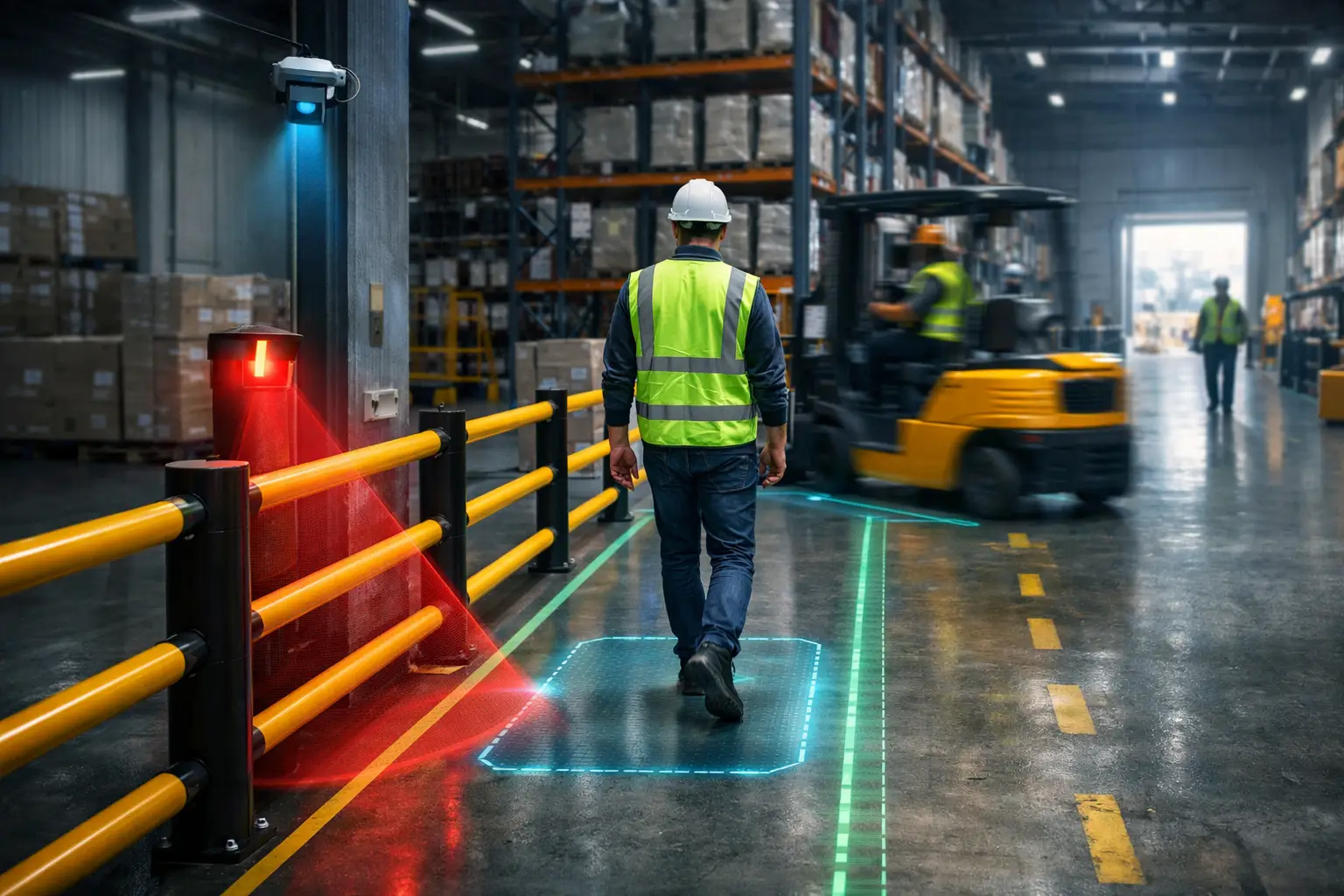
Pedestrian guardrails are commonly used to create continuous protected walkways alongside forklift aisles and around work zones. They are effective where people need to travel parallel to vehicle movements but should not enter the lane.
Heavy-duty vehicle barriers are designed for higher-impact locations, such as main travel routes, loading approaches, sharp turns, and areas where forklifts carry dense loads. These systems may also protect building columns, machinery, office partitions, and critical infrastructure adjacent to the walkway.
Modular railing systems are useful where routes may need to change as operations expand. Their flexibility can simplify future modifications, but installation still needs to follow the manufacturer’s anchoring and spacing requirements.
Swing gates, self-closing gates, and pedestrian access gates control entry at crossing points and restricted areas. A gate can be more effective than an open gap, particularly where pedestrians must pause and look before entering a shared zone. It should not, however, force workers into an inconvenient detour. If the designed route adds too much time, people may create an unsafe shortcut.
Bollards and end-of-rail protection are valuable at barrier terminations, doorway corners, rack ends, and exposed columns. These components prevent a vehicle from clipping the vulnerable edge of a walkway system.
Start With Traffic Risk, Not a Product Catalog
The most reliable selection process begins on the warehouse floor. Observe traffic during peak receiving, replenishment, order picking, and dispatch periods. A route that appears safe during a quiet walkthrough may be exposed during shift change or when staging space is under pressure.
Document where pedestrians cross, where forklifts reverse, where loads obstruct visibility, and where near misses have occurred. Look for evidence of minor contact such as scraped rails, damaged rack uprights, cracked concrete, bent posts, and faded floor markings. These signs often reveal risks that incident reports do not capture.
Then consider the operating conditions. A counterbalance forklift traveling beside a walkway presents a different impact profile from a reach truck operating in narrow aisles. Battery-powered pallet jacks, autonomous mobile equipment, and tow tractors create their own interaction patterns. The barrier specification should account for vehicle weight, typical speed, load characteristics, route geometry, and the chance of angled strikes.
It is also essential to identify what the barrier is protecting. A pedestrian walkway beside racking may need separation from vehicles, while a walkway beside a production cell may need both vehicle protection and controlled access. One system may serve both needs, but only if its design reflects the full risk picture.
Design the Whole Walkway, Not Just the Rail
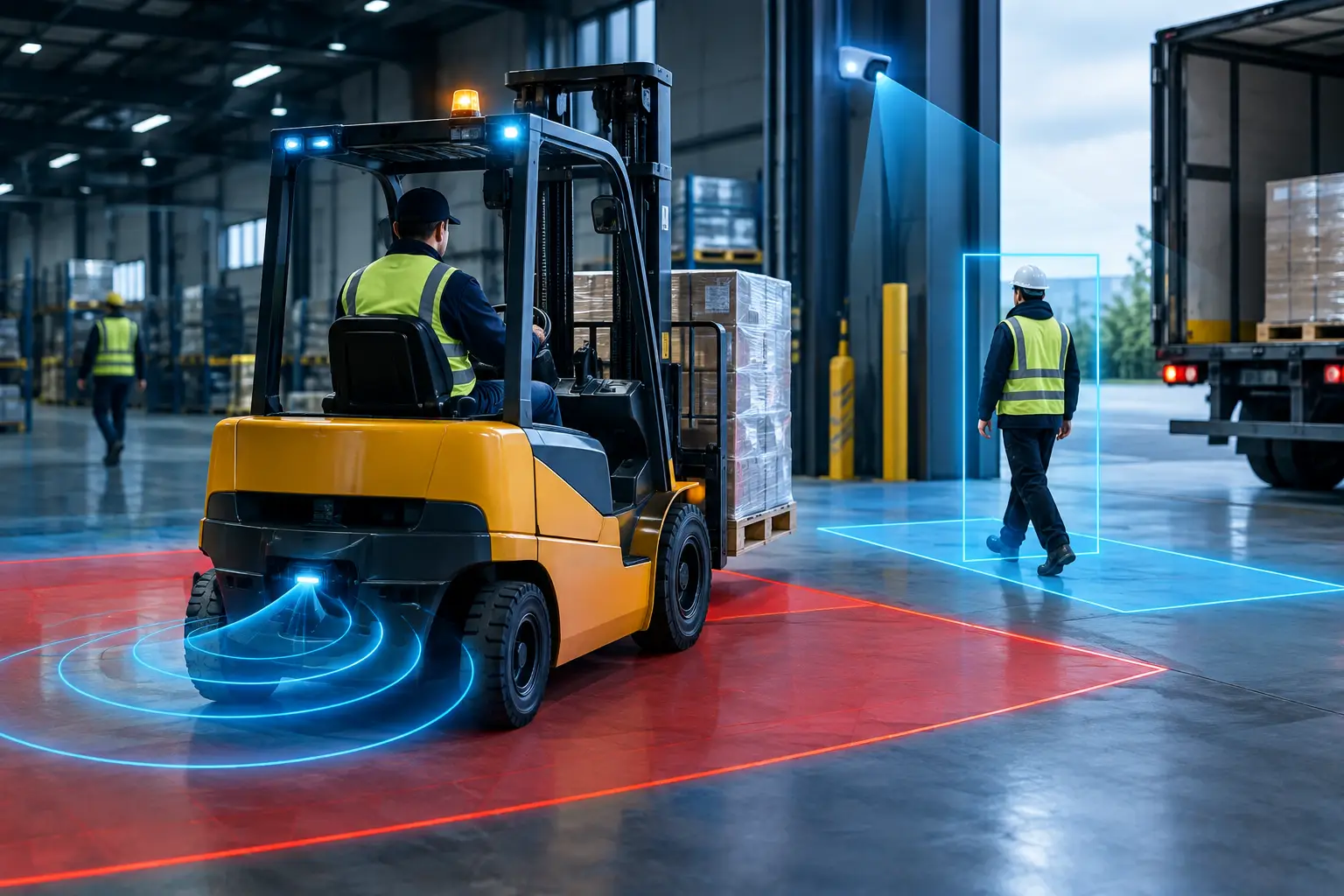
Barriers work best as part of a coordinated traffic-management system. Clear floor markings, directional signs, designated crossings, speed controls, mirrors at blind corners, and visual or audible alerts all reinforce the same behavior. In higher-risk areas, forklift-pedestrian detection systems and Vision AI monitoring can provide another layer of warning when people or vehicles enter conflict zones.
At crossings, make the interaction intentional. Good sightlines, stop points, warning lights, and physical chicanes can slow pedestrian movement enough to encourage a deliberate check for traffic. The goal is not to make workers navigate an obstacle course. It is to make the safe action the easiest action.
Avoid placing barriers so close to vehicle lanes that a forklift can snag a rail with a protruding load or rear swing. Likewise, do not install rails where they conceal approaching vehicles at intersections. An engineering review of turning paths and clearances is worthwhile before anchors are drilled into the slab.
Installation and Maintenance Determine Long-Term Performance
A barrier system performs only as well as its installation. Floor slab condition, anchor type, embedment depth, post spacing, and baseplate alignment all affect performance. Installation should follow the selected system’s tested configuration rather than a convenient field adjustment.
After commissioning, inspect barriers as part of routine facility checks. Look for loosened anchors, distorted rails, cracked bases, impact marks, corrosion, and changes in walkway use. Any barrier that has sustained a significant strike should be assessed before it is assumed to remain serviceable.
Maintenance is also a behavioral issue. If a damaged gate stays open for weeks or a rail is removed to make room for overflow inventory, employees quickly learn that the control is optional. Restore the barrier and address the operational pressure that caused the bypass.
Make Protected Routes Part of Daily Operations
The best warehouse walkway barriers are the ones workers recognize, trust, and use without hesitation. They should make routes obvious, crossings controlled, and shared spaces less dependent on split-second judgment. For facilities managing frequent forklift movements, that physical separation is not a cosmetic improvement. It is a practical investment in preventing incidents, protecting assets, and keeping operations moving safely.
Every worker deserves to return home safely every day. Start by walking the routes they use, watching the traffic they work beside, and designing barriers around the risks they actually face.