A forklift can move a pallet from receiving to storage in minutes. It can also enter a blind aisle intersection, reverse from a loading bay, or pass a pedestrian walkway with very little margin for error. Warehouse traffic control devices turn these high-risk movement points into controlled zones, helping teams separate people and vehicles, communicate hazards clearly, and prevent collisions before they occur.
For warehouse and facility leaders, traffic control is not simply a matter of painting lines on the floor. Layouts change, peak volumes create congestion, temporary staging spreads into travel paths, and familiar workers can become complacent around routine hazards. Effective controls must fit how the operation actually moves – not how it looks on a site plan.
Why warehouse traffic conflicts keep occurring
Most vehicle-pedestrian incidents are not caused by one failure alone. They develop where several conditions overlap: restricted visibility, reversing vehicles, tight turning radii, noise, poor separation, rushed movements, and unclear right-of-way rules. A marked pedestrian route may be present, yet still cross directly through a forklift travel lane. A convex mirror may improve visibility, yet cannot stop a vehicle if the driver sees a person too late.
Loading bays are particularly demanding. Forklifts, reach trucks, delivery drivers, dock personnel, and pedestrians may all work in a confined area while trailers arrive and depart. In storage aisles, racking can create blind corners. At packing and dispatch zones, changing pallet locations can narrow routes without anyone formally redesigning the traffic plan.
This is why risk assessments should examine movement patterns rather than individual pieces of equipment. Observe where people naturally walk, where trucks reverse, where operators pause to scan, and where queues build during busy shifts. Near-miss reports, equipment damage records, and operator feedback often reveal the locations that need attention first.
Warehouse traffic control devices for different risks
The right device depends on the hazard, the available space, vehicle speed, and the behavior the control needs to influence. A device that provides a warning is useful when people have time to respond. Where a person and forklift can occupy the same space, physical segregation or an automated access control is usually the stronger measure.
Physical barriers and pedestrian segregation
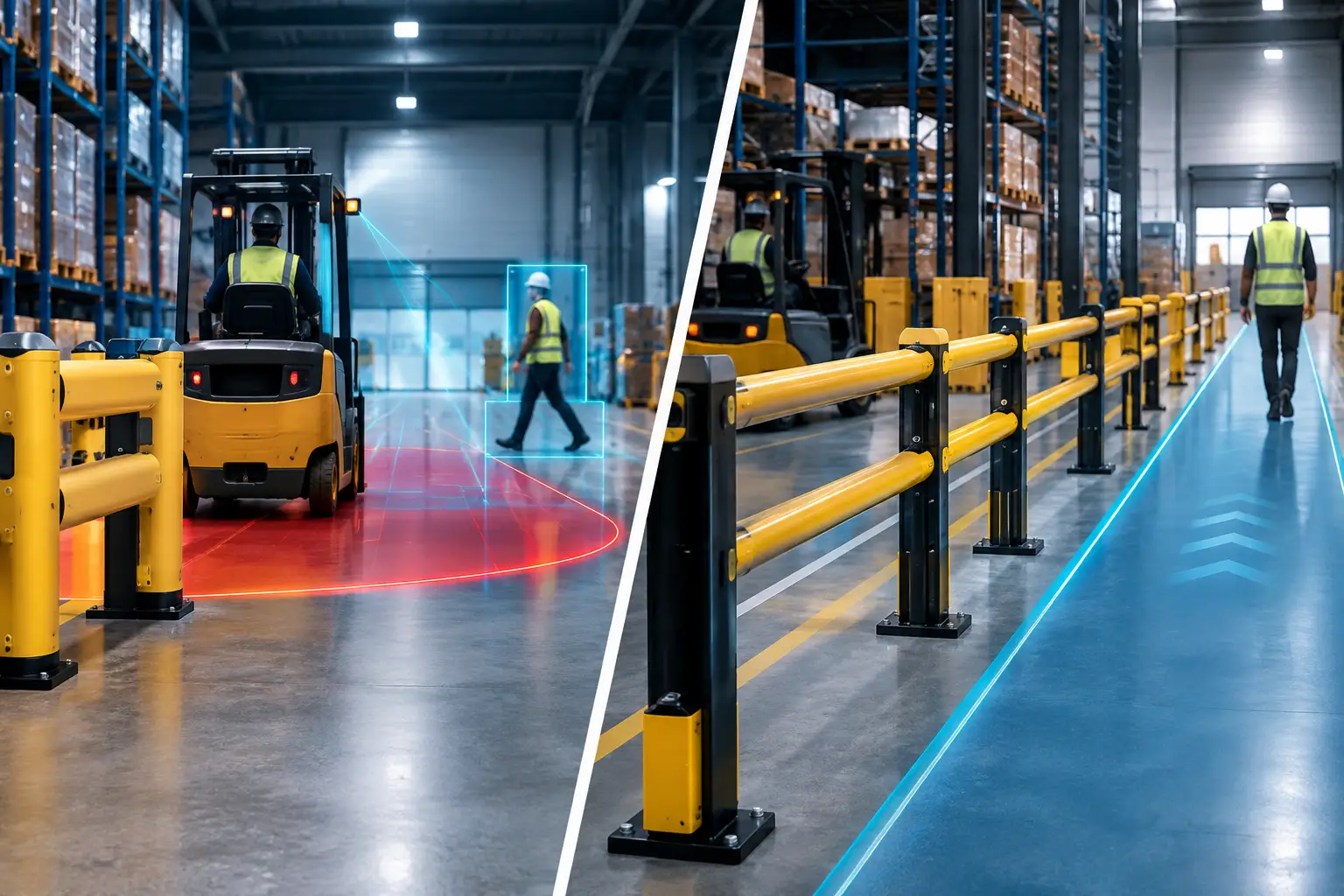
Safety barriers, guardrails, and impact-resistant bollards create a clear boundary between vehicle routes and pedestrian areas. They are well suited to fixed walkways beside loading lanes, workstations near forklift traffic, office entrances opening onto warehouse floors, and vulnerable racking ends.
Physical separation is one of the most dependable traffic controls because it does not rely solely on a person noticing a sign or remembering a rule. However, barriers must be installed with enough clearance for vehicle envelopes, loads, and turning movements. A poorly placed barrier can create a pinch point, obstruct evacuation routes, or encourage pedestrians to step outside the protected route.
Gates and controlled crossing points can further manage where pedestrians enter vehicle areas. In higher-risk locations, interlocked gates or warning systems can indicate when it is safe to cross and when vehicle movement has priority.
Floor markings, signs, and speed controls
High-visibility lane markings establish forklift routes, pedestrian walkways, exclusion zones, crossing points, and no-staging areas. Directional arrows, stop lines, and speed limit signs support consistent movement rules, especially for new employees, contractors, and visiting drivers.
These controls are practical and cost-effective, but they require maintenance. Worn tape, faded paint, and obstructed signs quickly lose authority. More importantly, markings alone should not be treated as protection at a blind corner or active loading bay. They work best as part of a layered system that includes separation, visibility, and operator awareness.
Speed control measures can reduce impact severity and give operators more time to react. Their use should be considered carefully in busy operations. Overusing speed bumps or restrictive controls may disrupt material flow, encourage route avoidance, or introduce load stability concerns. The goal is to manage speed where the risk is greatest, not create unnecessary friction across the whole facility.
Visual and audible warning systems
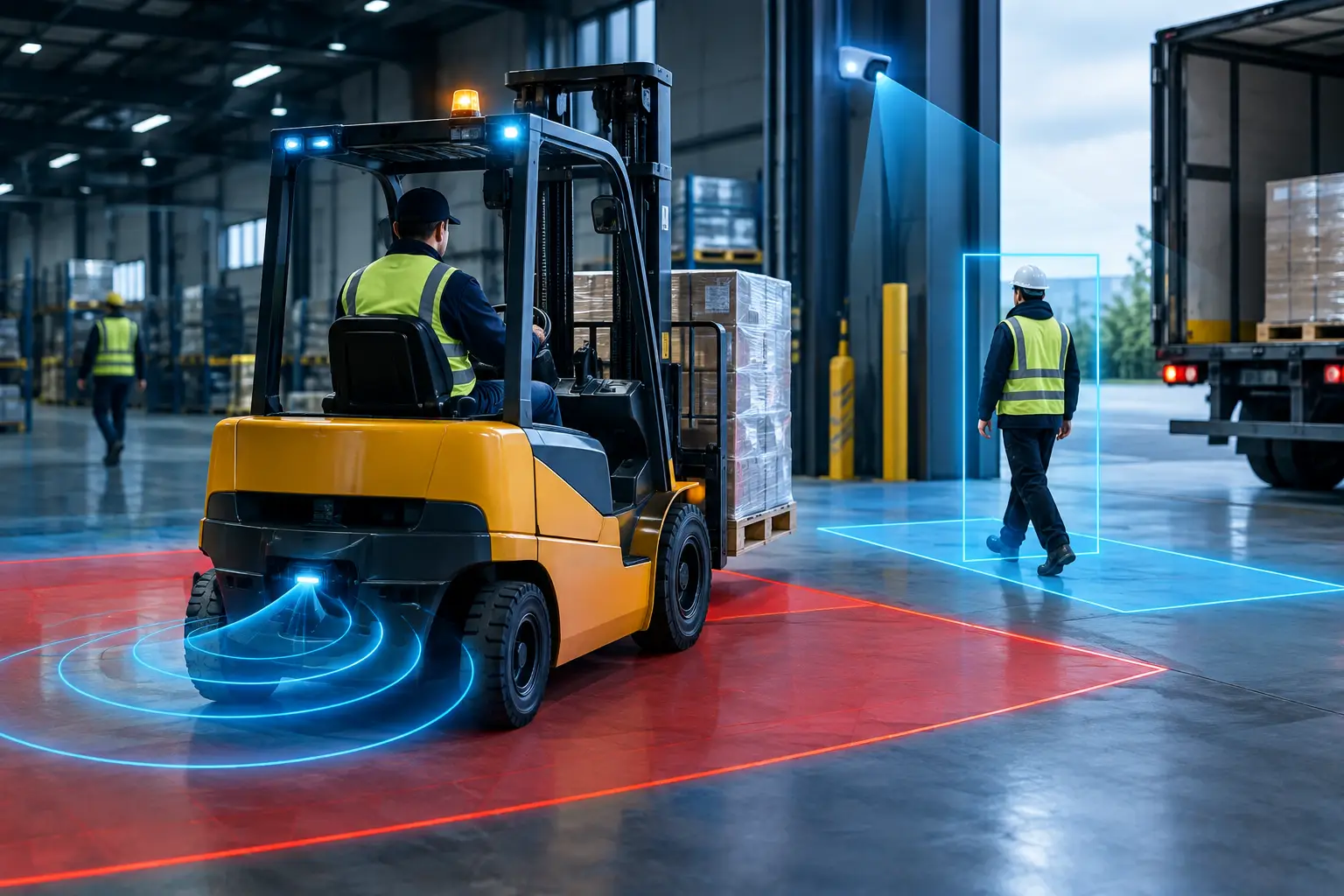
Forklift-mounted blue spotlights, red zone lights, strobes, reverse alarms, and floor projection systems provide early warning of vehicle approach or operating danger. At blind intersections, projected stop signs, crossing symbols, or approaching-vehicle warnings can make hazards visible before a pedestrian enters the conflict area.
Audible alarms are valuable where workers may not have a direct line of sight to moving equipment. Yet sound should be used with care. Facilities with many reversing vehicles can become saturated with alarms, causing people to tune them out. Adjustable alarms, targeted activation, and visual signals can improve effectiveness while reducing unnecessary noise.
Visual alerts also need appropriate positioning and contrast. A projected symbol is only useful if it remains visible under the facility’s lighting conditions and is placed far enough from the hazard to allow a person to stop safely.
Intersection warnings and proximity detection
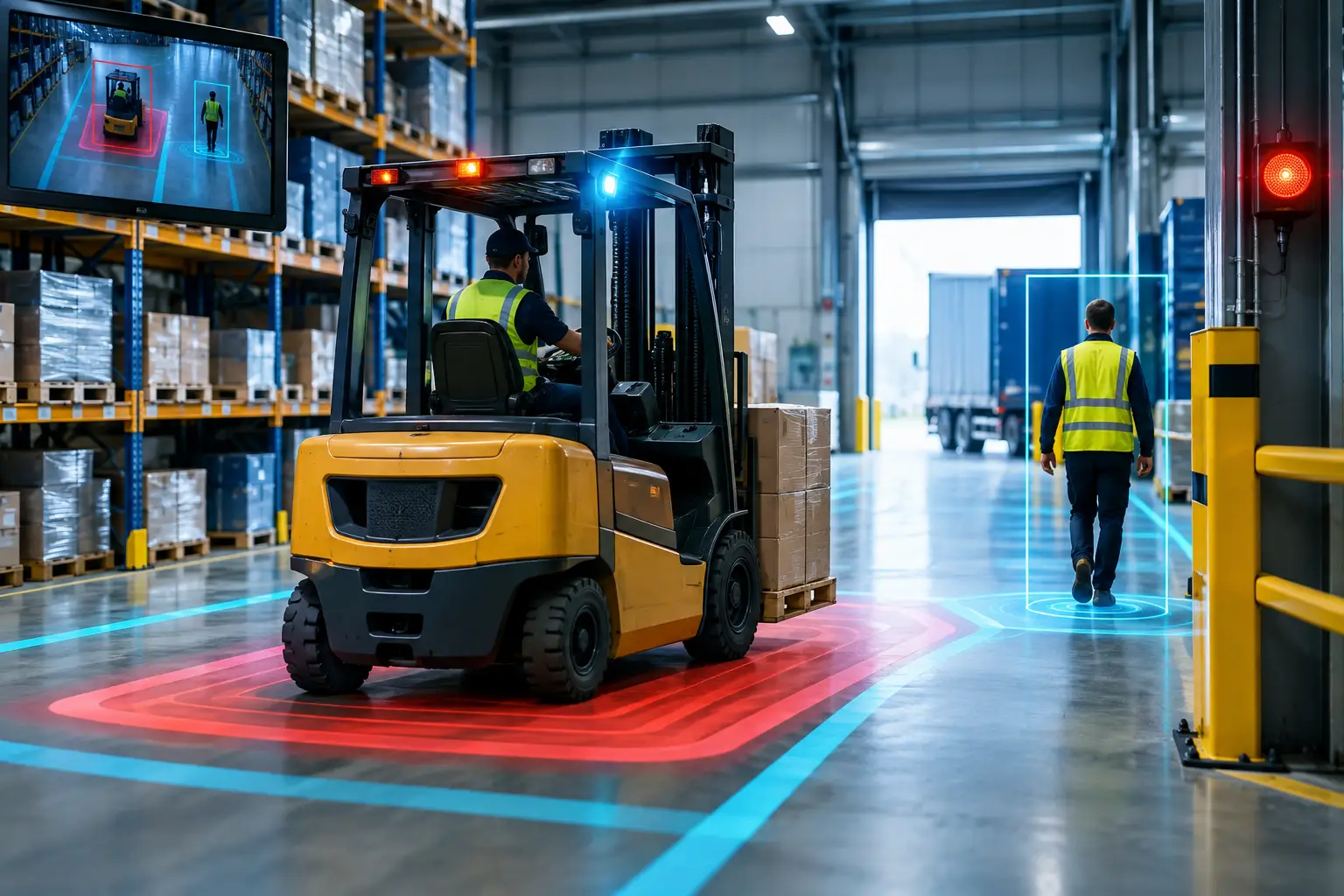
Blind corners deserve specific attention because both the pedestrian and forklift operator may have limited time to react. Intersection warning systems can detect approaching traffic and activate flashing lights, audible alerts, or projected warnings on each side of the crossing. These systems help make an otherwise hidden movement visible.
Proximity warning systems add another layer by detecting people or vehicles within a defined range. Depending on the application, they can alert forklift operators, warn pedestrians, or trigger both. They are useful in areas with frequent mixed traffic, limited visibility, or variable layouts where fixed barriers are not practical.
Detection technology should be selected and configured around real site conditions. Metal racking, reflective surfaces, dust, vehicle speed, forklift attachments, and the desired warning distance can all affect performance. A site survey and trial configuration help prevent nuisance alerts, which can undermine user confidence in the system.
Controlled loading bay devices
A loading bay is a traffic interface between internal operations and external transport. Clearly marked exclusion zones, dock traffic lights, wheel guides, vehicle restraint systems, and warning signals can help control the sequence of arrival, loading, and departure.
The key is to prevent conflicting actions. A forklift should not enter a trailer that is not secured, and a driver should not depart while loading activity is underway. Traffic control devices make the safe state visible to everyone involved. They also reduce reliance on verbal handoffs that may be missed during shift changes or high-volume periods.
Build controls around the hierarchy of risk reduction
Warning devices can improve awareness, but awareness is not the same as protection. When reviewing warehouse traffic control devices, start by asking whether the hazard can be eliminated or separated. Can pedestrian access be rerouted? Can staging be moved away from a travel lane? Can one-way vehicle flow remove a reversing maneuver?
Where separation cannot be fully achieved, combine controls. A protected walkway may use barriers, markings, a designated crossing, and an intersection warning. A loading bay may use traffic lights, restraint equipment, floor exclusions, and operating procedures. Each measure addresses a different point of failure.
Technology should support, not replace, safe operating discipline. Forklift operators still need appropriate training, clear travel routes, load visibility, and local site rules. Pedestrians need routes that are convenient enough to use. If the safest route adds a long detour, workers may create shortcuts that reintroduce risk.
How to select the right traffic control solution
Begin with the highest-consequence conflict points, not the most visible ones. Review collision history, near misses, racking damage, recurring congestion, and changes in workflow. Then observe the location across different shifts. Daytime traffic may look very different from night operations, dispatch peaks, or end-of-shift cleanup.
For each location, define the risk in practical terms: who could be struck, what vehicles are involved, how fast they move, whether reversing occurs, and whether the hazard is fixed or changing. This makes device selection more precise. A permanent blind intersection may justify an activated warning system, while a temporary overflow area may need movable barriers and revised route controls.
Implementation should include installation planning, operator and pedestrian briefings, testing, and routine inspection. Devices that are dirty, damaged, misaligned, or poorly understood cannot deliver the intended protection. Establish ownership for maintenance and review performance after the system has been in use. If near misses continue, treat that as useful evidence that the control needs adjustment rather than assuming workers are at fault.
SysGuard helps industrial facilities assess mixed-traffic risks and apply safety technologies that fit operational realities, from physical segregation and rack protection to intelligent warnings and Vision AI monitoring. The strongest outcome comes from matching the control to the task, the layout, and the people who use the space every day.
Every worker deserves to return home safely every day. Start with the crossing, aisle, or loading bay where a single missed sightline could change that outcome, then put a control in place that does not depend on luck.