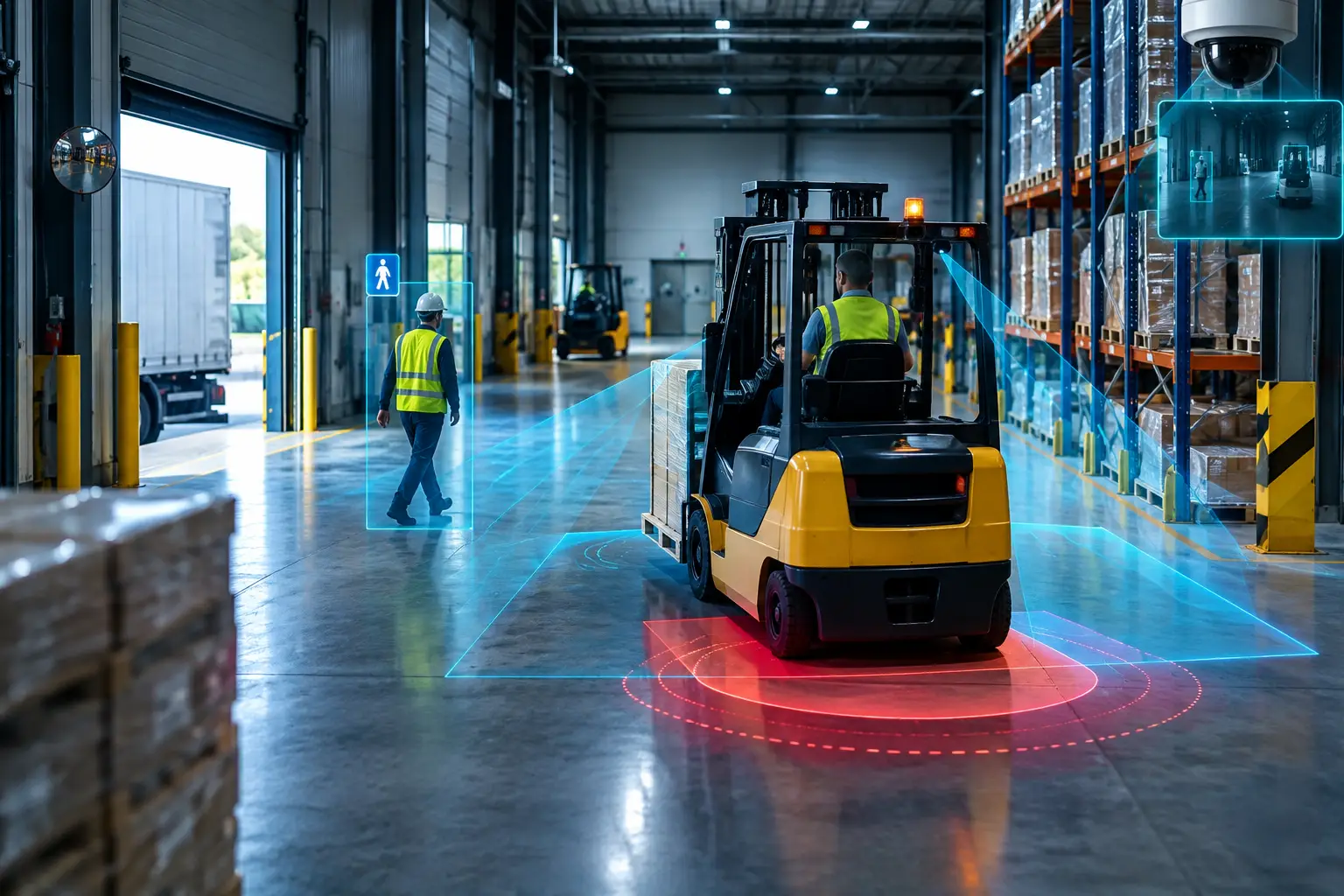
A forklift rounds the end of a rack aisle. A picker steps out from behind a pallet stack. Neither has enough time to react. This is the everyday reality behind many warehouse near misses, and why organizations need to manage warehouse blind spots as a defined operational risk, not an occasional visibility issue.
Blind spots are rarely caused by one failure alone. They develop where layout, traffic flow, changing inventory, vehicle design, human behavior, and limited sightlines overlap. The right response is not simply adding a mirror or telling operators to be more careful. It is identifying where visibility breaks down, deciding what control is appropriate for each risk, and maintaining those controls as the operation changes.
Where warehouse blind spots create the greatest risk
A blind spot is any area where an operator, pedestrian, or vehicle cannot reliably detect another person, vehicle, or hazard in time to avoid a collision. In a busy facility, these areas move and change throughout the day.
Intersections between storage aisles are a common example. Racking, stacked pallets, stretch-wrapped loads, and equipment parked near corners can block a forklift operator’s line of sight. The risk rises when the intersection also serves pedestrians moving between picking, packing, and break areas.
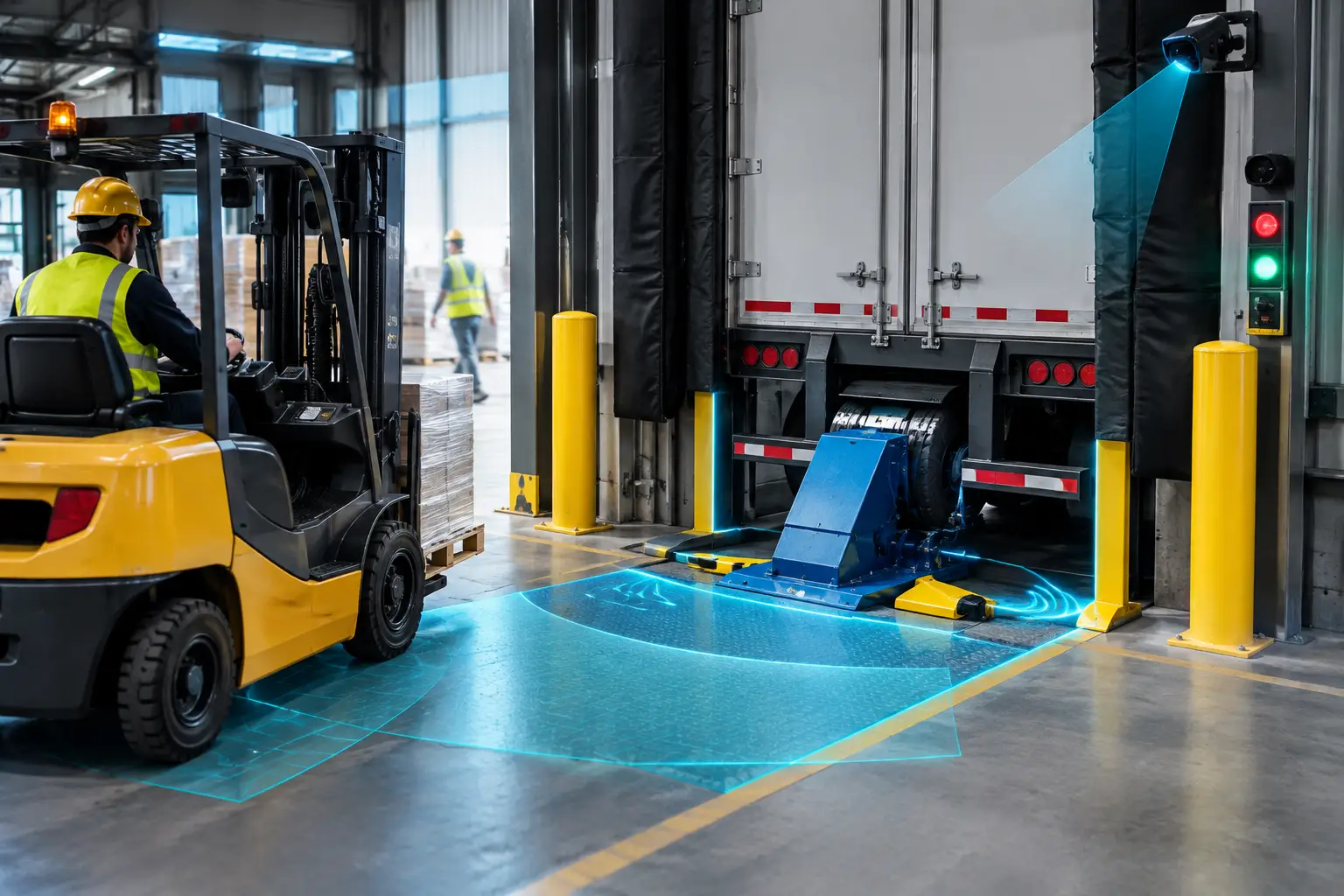
Dock doors and loading bays create another high-risk zone. Trailer walls, staging loads, dock equipment, and reversing vehicles can obstruct visibility. A driver may not see a worker approaching from the side, while a worker may assume the vehicle has seen them. This is particularly dangerous when loading schedules create pressure to turn vehicles around quickly.
Other frequent blind spots include battery charging areas, workstations beside main travel routes, doorways, end-of-aisle turns, and locations where personnel transition between brightly lit and dimmer areas. Forklift masts and carried loads can also create significant forward blind spots, especially when loads must be moved at a height that limits the operator’s view.
The key question is not whether a location has limited visibility. Nearly every warehouse does. The question is whether people and mobile equipment can enter that area at the same time without a reliable control preventing conflict.
How to manage warehouse blind spots through risk assessment
Start with observation during real operating conditions. A walk-through conducted during a quiet period may miss the congestion, temporary storage, and competing movements that create risk during peak receiving, replenishment, or dispatch activity.
Map the routes used by forklifts, reach trucks, pallet jacks, pedestrians, delivery drivers, and maintenance teams. Then observe where those routes cross, merge, or force people to make sharp turns. Review both intended travel paths and informal shortcuts. Workers often create practical routes around congestion, even when those routes were not part of the original facility plan.
Incident records are useful, but near misses are equally valuable. A minor impact with racking, a sudden stop at an aisle crossing, a horn heard too late, or recurring complaints about a difficult corner can reveal a weak control before someone is injured. Encourage reporting that focuses on the conditions involved rather than blame.
A practical assessment should consider four factors together:
- How often pedestrians and vehicles enter the same area
- The speed, direction, and stopping distance of mobile equipment
- Whether sightlines are permanently or temporarily obstructed
- The likely consequence if a person or vehicle is not detected
This process helps teams prioritize. A rarely used, low-speed corner may need basic visual guidance. A congested pedestrian crossing near active forklift traffic may require physical separation, active warning technology, and a change in traffic flow.
Separate people and vehicles before relying on warnings
The strongest control is often eliminating the interaction altogether. Where practical, create dedicated pedestrian walkways, protected crossing points, and clearly defined vehicle lanes. Safety barriers, guardrails, and rack-end protection can help keep people out of travel paths while also protecting infrastructure from impacts.
Physical separation is not always possible, particularly in older facilities or operations with variable staging requirements. Even then, small layout changes can reduce exposure. Relocating a printer station, removing ad hoc storage from an aisle end, shifting a pedestrian doorway, or creating a one-way route can restore critical visibility.
Traffic design must fit the operation. One-way systems may reduce opposing vehicle movements, but they can add travel distance and encourage shortcuts if they are poorly planned. Design changes should be tested with the operators and supervisors who work the routes every day.
Use visibility controls that match the hazard
Convex mirrors can improve visibility at selected intersections, but they are not a complete solution. Their effectiveness depends on correct placement, good lighting, clean surfaces, and realistic travel speed. A mirror cannot prevent a collision if an operator has no time to react after seeing someone in it.
Visual controls work best when they reinforce a predictable route. Floor markings can identify pedestrian zones, stop lines, crossing locations, and forklift exclusion areas. Projected warning signs and lines can be especially useful where painted markings wear quickly or where the layout needs flexibility. Clear visual cues reduce uncertainty, but they must remain visible around pallets, temporary staging, and changing traffic patterns.
Audible warnings also have limits. In a noisy warehouse, workers may become accustomed to reversing alarms, horns, and equipment noise. Use audible alerts as part of a coordinated control strategy, not as permission to operate faster through a blind area.
Lighting deserves the same attention. Shadows at racking ends, glare from dock openings, and poor contrast between people, flooring, and equipment can all weaken detection. Improving illumination may be a simple intervention, but it should be evaluated alongside the actual sightline and traffic behavior at that location.
Add intelligent detection where exposure remains high
For high-risk intersections, active warning systems provide an additional layer of protection. Forklift-mounted blue or red spot lights can give pedestrians an early indication that a vehicle is approaching, particularly around corners. Proximity warning systems can alert operators and nearby personnel when equipment and pedestrians enter a defined risk zone.
Vision AI safety monitoring can add greater awareness in areas with recurring interactions. Depending on the application, cameras and analytics can identify pedestrian presence, unsafe entry into vehicle zones, congestion, or traffic patterns that create repeated near misses. The value is not simply detecting an event. It is giving supervisors actionable information to improve layout, procedures, and behaviors before an incident occurs.
Technology should be selected according to the risk. A simple aisle corner may only need a mirror, markings, and speed discipline. A busy cross-aisle with frequent pedestrian movement may justify active alerts. Loading bay approaches, high-speed vehicle routes, or mixed-traffic zones may require multiple controls working together.
Keep blind spots from returning
A warehouse is not static. Peak-season stock, new racking, temporary overflow, changed picking methods, and contractor activity can create blind spots after a risk assessment has been completed. Controls must therefore be reviewed whenever operational conditions change.
Include blind-spot checks in routine safety inspections. Look for blocked mirrors, damaged barriers, worn floor markings, poorly placed staging pallets, failed warning devices, and routes that are no longer being used as designed. Supervisors should also observe whether operators slow down at intersections and whether pedestrians use designated crossings.
Training remains essential, but it should be specific. Rather than relying on general reminders to stay alert, train forklift operators on the facility’s identified high-risk zones, required travel behavior, and expectations when visibility is obstructed. Pedestrians need equally clear guidance on crossing routes, exclusion zones, and the limits of assuming that a driver has seen them.
For sites with several shifts, involve representatives from each shift in reviews. The risks present during daytime receiving may differ from those during night replenishment or end-of-shift cleanup. A control that works under one set of conditions may need adjustment under another.
Build safety into the way work moves
Managing warehouse blind spots is ultimately a traffic-management and operational-design task. It requires more than signs, mirrors, or a policy statement. The most effective facilities combine clear routes, physical protection, visibility improvements, intelligent warnings, and regular verification that controls still match the work.
Every worker deserves to return home safely every day. When a blind corner, obstructed aisle, or busy crossing is treated as a preventable risk, safety improvements also protect equipment, reduce disruption, and support the reliable flow of work.