A forklift turning out of a rack aisle has very little room for error. When a pedestrian walkway, loading area, rack end, or machine zone sits within that turning path, the question of warehouse barriers vs guardrails becomes a practical risk-control decision, not a matter of terminology.
Both systems can reduce injuries, asset damage, and downtime. But they are not interchangeable. The right choice depends on what needs protection, the vehicles operating nearby, the likely direction of impact, available floor space, and how the area functions during a normal shift.
Warehouse Barriers vs Guardrails: The Core Difference
Warehouse barriers are a broad category of physical protection systems used to separate people, vehicles, equipment, and infrastructure. They may include pedestrian barriers, impact barriers, bollards, rack-end protection, column guards, safety gates, and segregated walkways. Their purpose is to control movement and absorb, deflect, or stop vehicle impacts before they reach a vulnerable target.
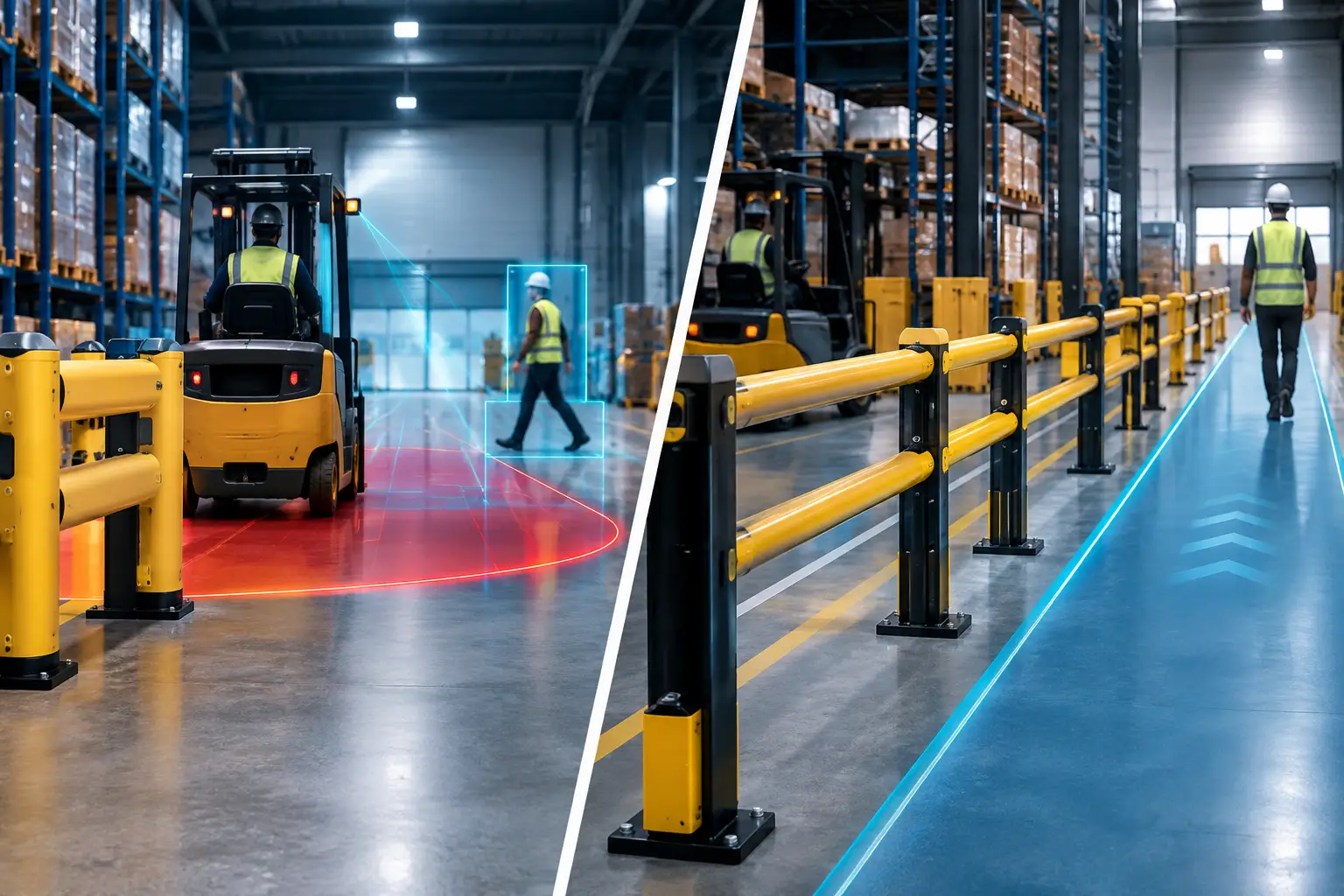
Guardrails are typically a specific type of barrier. They are usually continuous, horizontal rail systems installed along traffic routes, pedestrian walkways, workstations, building walls, loading areas, or equipment zones. A guardrail creates a clear boundary while helping shield the protected side from forklift contact.
In simple terms, a guardrail is often best suited to long, linear separation. A warehouse barrier may be a guardrail, but it can also be a more specialized solution designed for a rack upright, doorway, machine corner, crossing point, or vehicle access point.
The distinction matters because safety performance depends on the application. Installing a standard guardrail where a high-energy forklift impact is likely may create a visible boundary without providing the level of protection the area requires.
Where Guardrails Perform Best
Guardrails are highly effective where vehicle and pedestrian routes run alongside one another. They establish a physical divide that is far more reliable than floor markings alone, particularly in busy facilities where pallets, temporary staging, and changing traffic patterns can obscure painted lines.
A properly positioned guardrail can protect pedestrian aisles running beside forklift lanes, work cells located near material-handling routes, and building walls that face low-to-moderate traffic exposure. It can also guide vehicle travel by narrowing the usable path and discouraging shortcuts through restricted zones.
For many facilities, this is the main value of guardrails: they turn traffic-management rules into a physical control. Workers do not need to rely solely on awareness, eye contact, or a driver’s ability to stop in time.
However, guardrails need openings where people, carts, or materials must cross. Those openings can quickly become weak points if they are not controlled with gates, designated crossings, warning systems, or clear operating rules. A continuous rail is only effective if the overall route design prevents people from bypassing it.
Guardrails are not automatically high-impact barriers
A rail system’s appearance does not indicate its impact capability. Steel rails, polymer systems, and hybrid designs can all look substantial, yet their tested performance, deflection characteristics, post spacing, anchors, and installation requirements may differ significantly.
A forklift traveling at low speed can still produce considerable impact force, especially when carrying a load. The relevant question is not whether a rail looks strong. It is whether the system is engineered and rated for the expected vehicle type, speed, approach angle, and impact energy.
When Warehouse Barriers Are the Better Choice
Dedicated warehouse barriers are generally better suited to localized or high-consequence hazards. Think of rack ends at the entrance to an aisle, exposed structural columns, automated equipment, conveyor corners, battery-charging zones, and high-traffic intersections. These locations may need protection that is more targeted and more impact-resistant than a standard run of guardrail.
Rack protection is a good example. A rack upright can be damaged by a single low-level strike, yet the resulting risk may extend beyond that one component. Repeated impacts can compromise the storage system, require inspections and repairs, disrupt inventory flow, and create avoidable operational exposure. A purpose-designed rack-end or upright protection system addresses the point where contact is most likely to occur.
Similarly, bollards may be the better choice for isolated assets such as door frames, control panels, charging equipment, and vulnerable building corners. They protect a small footprint without blocking access across an entire area. Safety gates can protect a pedestrian opening that must remain accessible, while swing gates or automated gates can support controlled entry into forklift-exclusion zones.
The lesson is straightforward: use the barrier form that matches the hazard. Long exposure calls for continuous protection. Concentrated exposure calls for focused protection.
Start With the Risk, Not the Product
The most reliable selection process starts with observing how work actually happens. A layout drawing is useful, but it will not always show a forklift reversing to clear a pallet, a pedestrian taking the shortest route to a workstation, or a temporary staging area that narrows a travel lane during peak hours.
Assess the vehicle types in operation, including counterbalance forklifts, reach trucks, pallet jacks, tow tractors, and delivery vehicles. Consider their operating speeds, turning radii, load heights, and typical travel paths. Then identify who or what is exposed: pedestrians, racking, dock doors, conveyors, machinery, electrical infrastructure, or structural elements.
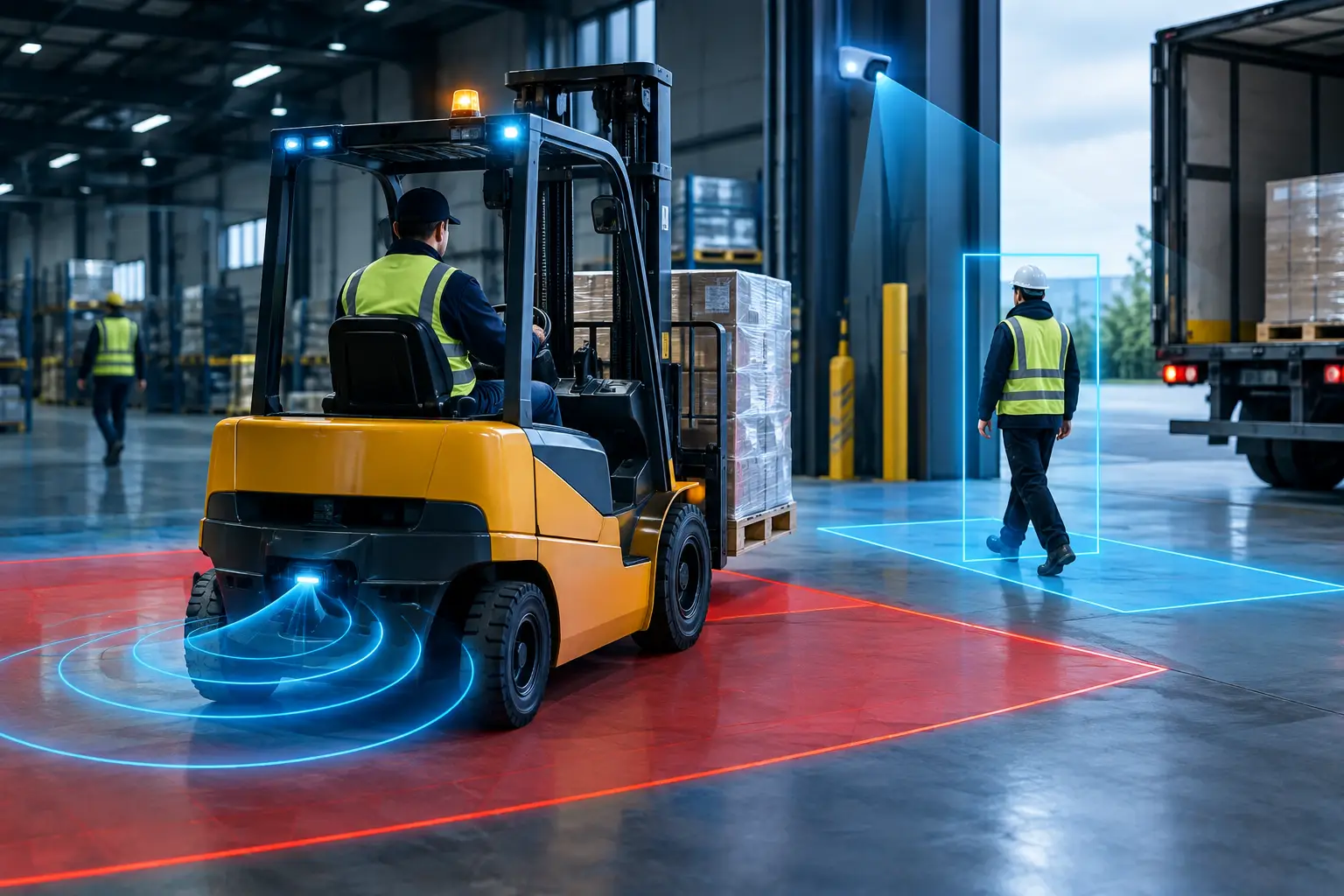
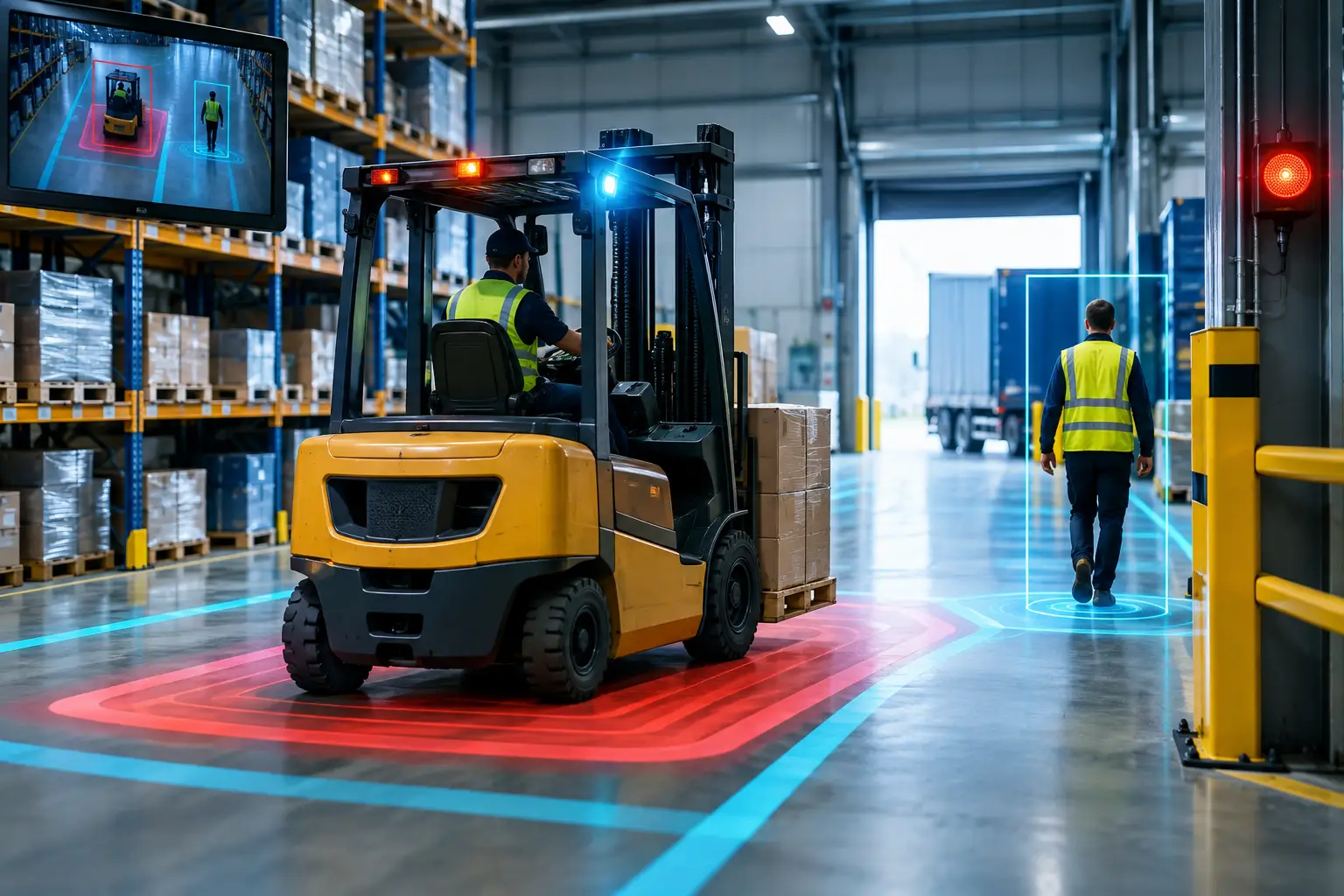
Pay particular attention to areas where visibility is limited. Blind corners, rack-aisle exits, loading bays, and crossings are often better managed by combining physical segregation with active warning measures. Floor projection, audible alerts, proximity warnings, and Vision AI monitoring can reinforce barriers by giving drivers and pedestrians earlier notice of conflict risks.
A barrier should never be treated as permission for unsafe driving. It is a critical layer of protection when other controls fail.
Impact Rating, Deflection, and Floor Condition Matter
When comparing warehouse barriers vs guardrails, decision-makers should look beyond height, color, and material. A protection system must be appropriate for the energy it may need to manage.
Impact rating indicates the level of collision force a system is designed or tested to withstand. The required rating depends on the mass and speed of the vehicle, as well as the angle of contact. A direct forklift strike is very different from a light brush along a travel lane.
Deflection is equally important. Some barrier systems flex to absorb energy. This can reduce damage to the barrier and vehicle, but it also means the system requires clear space behind it. If a barrier is installed too close to a rack upright, machine, wall, or walkway, it may deflect into the very asset or person it is intended to protect.
Anchoring and slab condition also deserve careful attention. Even a well-engineered barrier can underperform if it is fixed into deteriorated concrete, installed over unsuitable joints, or positioned where anchors are vulnerable to repeated impact. Installation should account for floor integrity, drainage channels, expansion joints, clearance requirements, and future maintenance access.
Design for Operations, Not Just Compliance
The best warehouse safety layouts protect people without creating new inefficiencies. A barrier that blocks access to a frequently used workstation may be moved, removed, or bypassed. A narrow walkway may push pedestrians back into vehicle lanes. A gate that takes too long to operate may be left open.
This is why barrier selection should involve operations, maintenance, engineering, and safety teams. Warehouse managers can identify peak-flow constraints. Operators can explain real maneuvering requirements. Maintenance personnel can flag service-access needs. Safety leaders can ensure pedestrian routes remain intuitive, protected, and visible.
Where a crossing cannot be eliminated, design it intentionally. Use a clearly defined crossing point, physical channeling, good sightlines, and suitable warning technology. Do not rely on informal habits at a high-traffic intersection.
A Layered Approach Delivers Better Protection
Physical barriers are most effective when they support a broader traffic-management strategy. Clear route separation, speed control, adequate lighting, aisle discipline, operator training, and incident reporting all contribute to safer movement. Intelligent systems can add another layer by detecting people or vehicles in risk zones and activating visual or audible alerts before a collision occurs.
For example, a pedestrian guardrail may prevent casual entry into a forklift lane, while a controlled gate manages access at the crossing. A projected warning sign can alert approaching drivers, and proximity detection can provide an additional warning when a person enters the conflict area. Each measure addresses a different part of the risk.
SysGuard approaches these decisions as an engineering and operational challenge. The aim is not to place more steel or polymer around a facility. It is to reduce the likelihood and consequence of the specific interactions that cause injuries, rack damage, equipment downtime, and disruption to daily operations.
The right protection system is the one that still works at the busiest moment of the shift, when visibility is reduced, operators are under time pressure, and normal assumptions about people and vehicle movement no longer hold.