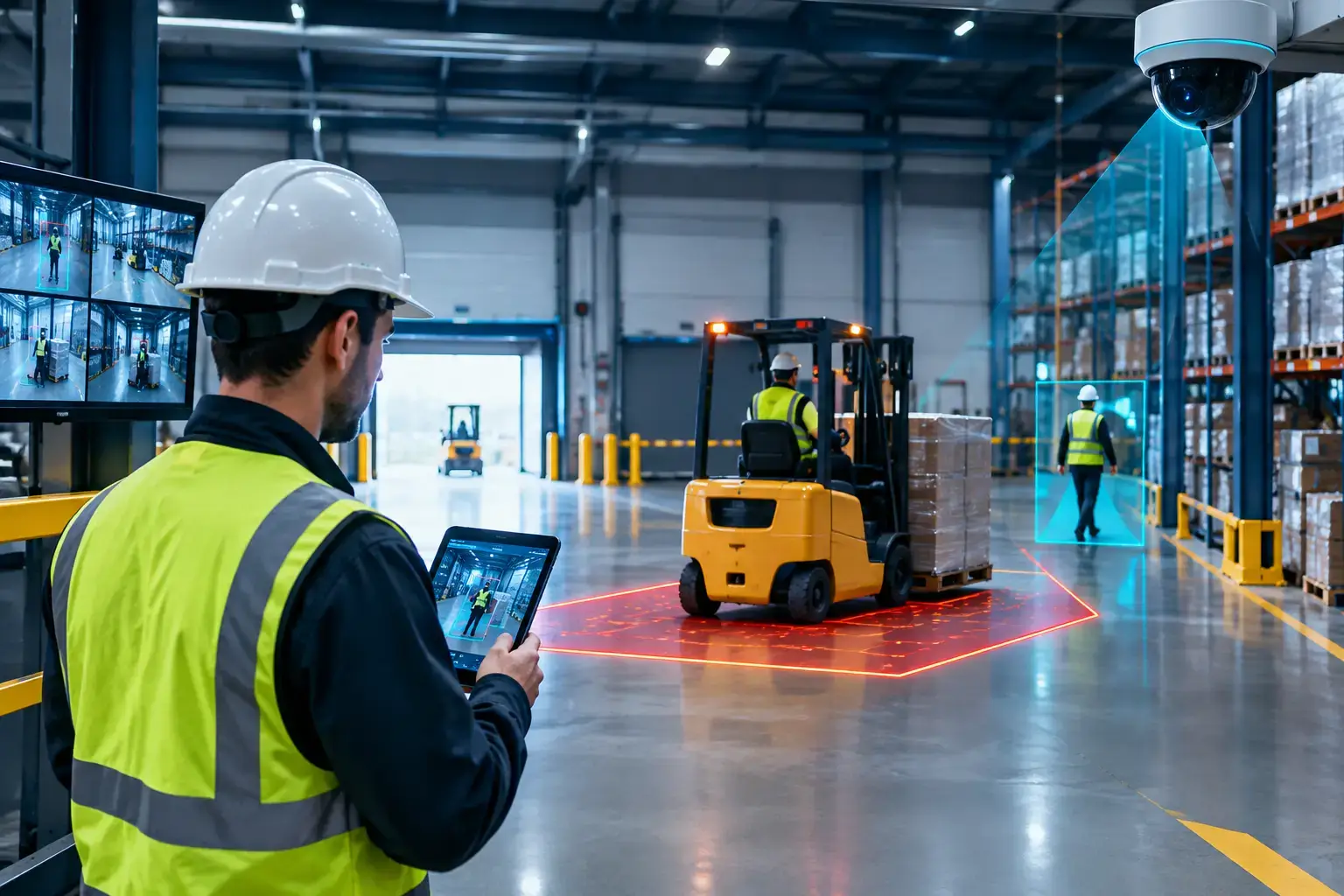
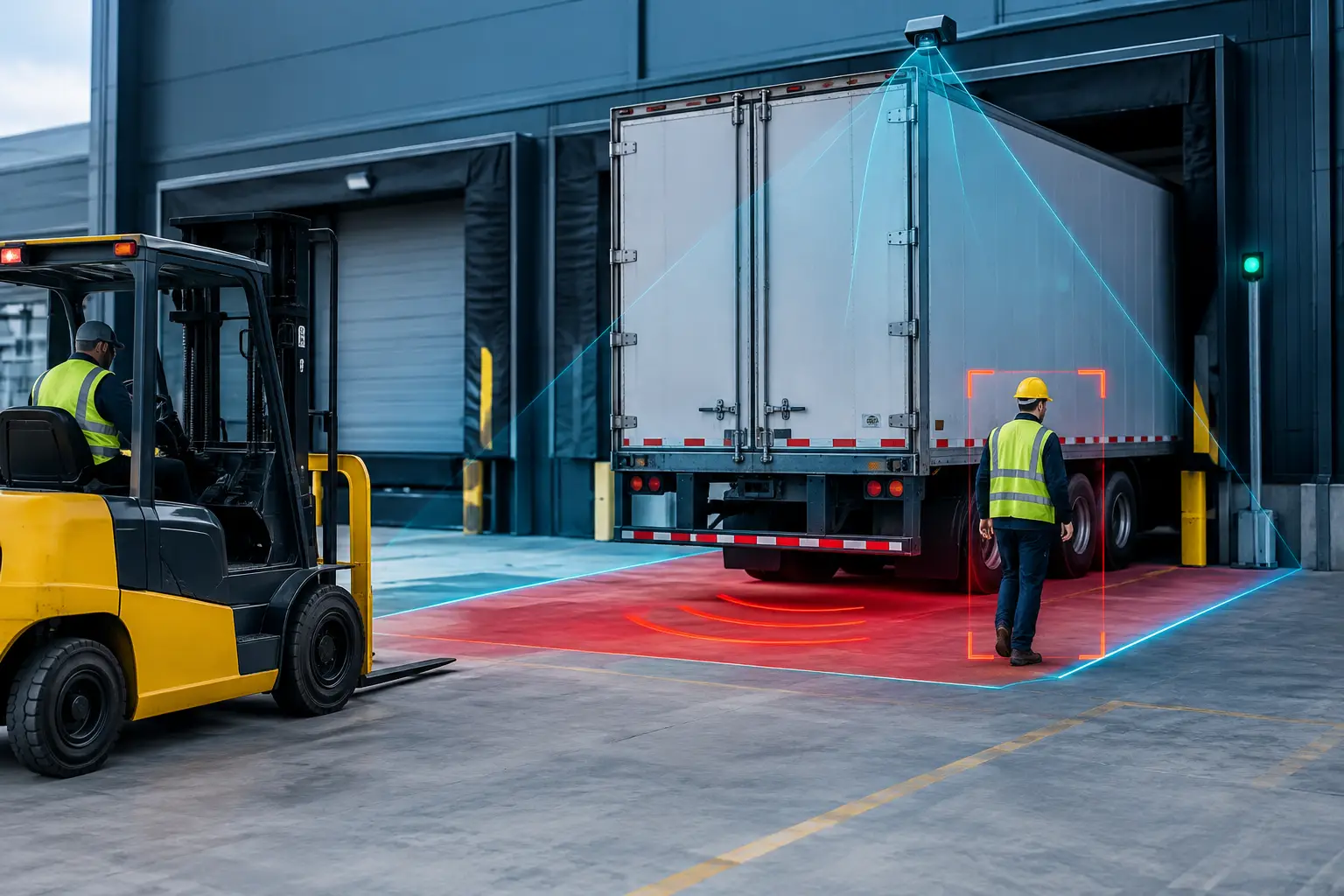
A trailer leaving the dock while a forklift is still loading is not a minor procedural failure. It can create an open gap at the loading bay, putting the operator, dock workers, product, and equipment at immediate risk. This trailer departure prevention example shows how a combined restraint, warning, and operating-control strategy prevents a routine loading task from becoming a serious incident.
The Risk Behind Early Trailer Departure
At a busy loading bay, drivers, forklift operators, warehouse teams, and dispatch personnel often work to different schedules. A driver may believe loading is complete, while a forklift operator is still making a final pallet movement inside the trailer. Without a clear physical and visual control system, the driver can pull away before the dock team has exited.
The consequences can be severe. A forklift may fall from the dock edge, a worker may be caught between the trailer and dock face, and product or infrastructure can be damaged. Even where no injury occurs, the resulting downtime, investigation, equipment repair, and disruption to outbound schedules can be significant.
Wheel chocks and verbal instructions can help, but they rely heavily on consistent human action. In high-throughput operations, particularly where multiple drivers and shifts are involved, a stronger engineered control is usually required. The goal is not simply to remind a driver to wait. It is to make an unsafe departure difficult or impossible while loading activity is underway.
A Trailer Departure Prevention Example in Practice
Consider a distribution center with several loading bays receiving and dispatching palletized goods. Forklifts enter trailers throughout the day, and drivers may be unfamiliar with site-specific loading procedures. The facility has experienced near misses involving trailers moving slightly away from the dock before loading was fully complete.
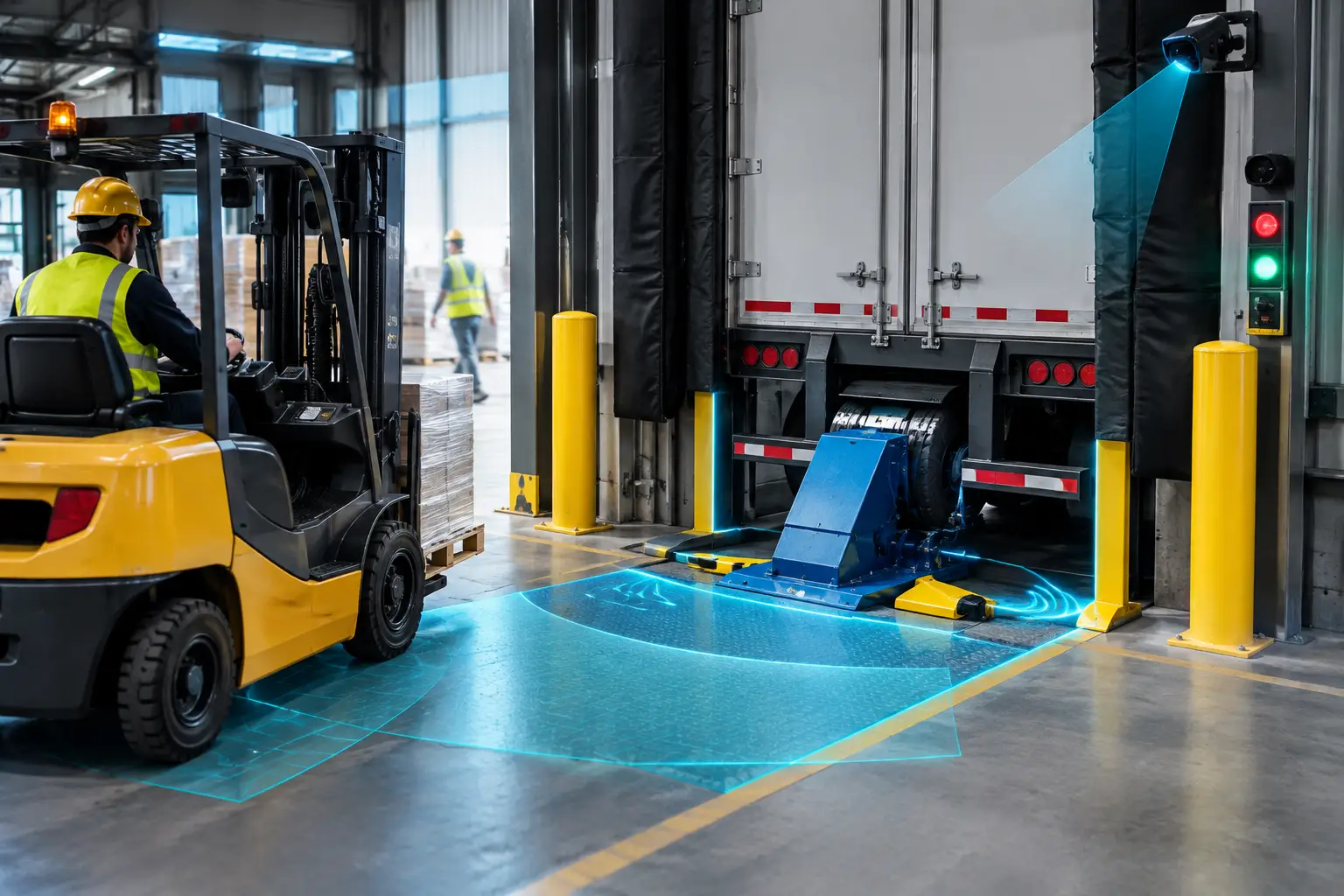
The facility installs a vehicle restraint system at each active dock position. Once the trailer has reversed into place, the dock operator confirms alignment and activates the restraint. The system engages with the trailer’s rear impact guard, helping prevent the trailer from moving forward from the dock.
An exterior traffic light provides the driver with a clear red signal: do not depart. Inside the building, an indicator informs the dock team that the trailer is secured and safe for loading. The dock door and leveler are then operated only after the restraint has been confirmed.
During loading, the forklift operator can see the internal status light before entering the trailer. If the restraint is not engaged, or if an abnormal condition is detected, the system provides a warning and loading activity stops. When the final pallet has been placed and the forklift has cleared the trailer, the dock team closes the door, returns the leveler to its stored position, and releases the restraint. Only then does the external signal change to green, authorizing the driver to leave.
This trailer departure prevention example is effective because it does not depend on a single person remembering every step. It creates a controlled sequence that connects vehicle restraint, dock equipment, operator visibility, and driver communication.
Why Physical Restraints Are More Reliable Than Procedures Alone
Standard operating procedures remain essential. Drivers need site instructions, dock teams need defined responsibilities, and supervisors need to verify that safe practices are being followed. However, procedures by themselves are vulnerable to time pressure, language differences, staff turnover, distractions, and assumptions between teams.
A physical restraint adds a layer of protection that is not dependent on verbal confirmation. It helps control the trailer’s movement at the point where the hazard exists. When combined with red and green signal lights, the condition of the bay is visible to both the driver and the loading crew without requiring them to interpret hand signals or search for information.
The correct solution depends on trailer types, dock configuration, site traffic patterns, and operating conditions. Some trailers have rear impact guards that suit a hook-style restraint. Others may require alternative restraint designs or additional measures because of damaged, nonstandard, or incompatible rear structures. A site assessment should identify these exceptions before a system is specified.
Interlocks Turn Separate Devices Into a Safety System
A restraint device is valuable, but its effectiveness increases when connected to dock doors, levelers, and warning signals through an interlock sequence. Interlocks prevent equipment from being used out of order and make the safe condition easy to recognize.
For example, a loading bay can be configured so that the door cannot be opened until the trailer is secured. The dock leveler can be prevented from deploying unless the restraint status is confirmed. Likewise, the restraint should not be released while the door remains open or the leveler is still bridging the dock and trailer.
This matters because a parked trailer can still be unsafe. It may not be fully backed into position, it may creep due to brake or coupling issues, or the driver may assume the loading process has ended. Interlocked controls reduce the opportunity for these conditions to be missed.
A well-designed loading bay system should also provide a clear response to a fault. If the restraint cannot achieve a secure engagement, the bay should not display a false safe condition. The operating team needs an established alternative process, such as moving the trailer to another suitable bay, using an approved secondary control, or escalating the issue to supervision.
Build the Process Around Real Dock Activity
Technology works best when it reflects how the loading bay actually operates. Before implementation, observe vehicle arrival, check-in, reversing, loading, documentation, and departure across different shifts. Ask where responsibility changes hands and where people currently rely on assumption.
In many facilities, the greatest risk sits between the driver and the warehouse team. The driver may wait in a designated area after positioning the trailer, while the dock coordinator controls the release sequence. This arrangement can reduce conflicting actions, provided the signals and instructions are unambiguous.
The loading process should establish four conditions before a forklift enters a trailer:
- The trailer is correctly positioned against the dock.
- The vehicle restraint is engaged or an approved alternative control is in place.
- The dock door and leveler are correctly deployed and visually checked.
- The internal indicator confirms that the bay is safe for loading activity.
These checks should be short enough to complete consistently, yet meaningful enough to identify an unsafe condition before equipment and people are exposed to it. A rushed checklist that no one can verify does not improve safety.
Address the Limits of Any One Control
Vehicle restraints significantly reduce the risk of early departure, but they do not replace loading bay management. Trailer floors can be damaged, landing gear can be unstable, and dock levelers can be incorrectly positioned. Forklift operators may also encounter shifting loads, poor lighting, or inadequate trailer condition inside the vehicle.
For this reason, trailer departure prevention should sit within a broader dock safety program. This includes marked traffic routes, adequate dock lighting, maintenance of levelers and restraints, clear driver communication, and training for workers who operate or supervise loading activities.
Inspection and maintenance are particularly important. A restraint that is misaligned, damaged, or not regularly tested can create false confidence. Teams should inspect visible components, verify indicators and alarms, test interlocks, and record faults for prompt correction. Repeated restraint engagement failures at a particular bay may indicate a dock alignment issue, incompatible trailer fleet, or equipment condition that needs engineering attention.
Measure Whether the Control Is Working
Safety improvements should be checked against operational evidence, not treated as complete once equipment is installed. Facilities can track restraint engagement rates, attempts to open a dock before securement, early-release alarms, maintenance issues, and reported near misses. These indicators reveal whether the system is being used as intended and where procedures need refinement.
Operational measures matter too. A properly designed system should support efficient loading, not create unnecessary delay. If teams routinely bypass a control because it slows the process, investigate the workflow, equipment layout, or training gap. The answer is rarely to remove the safety control. It is to make the safe process practical under real operating conditions.
Make Safe Departure a Controlled Release
The most effective loading bays treat trailer departure as a controlled release, not a driver decision made from the cab. Physical restraint, clear visual signals, equipment interlocks, and disciplined operating procedures create multiple barriers against a preventable event.
Every worker deserves to return home safely every day. By designing the dock so a trailer cannot leave until people and equipment are clear, organizations protect their teams while reducing damage, disruption, and uncertainty at one of the facility’s highest-risk areas.