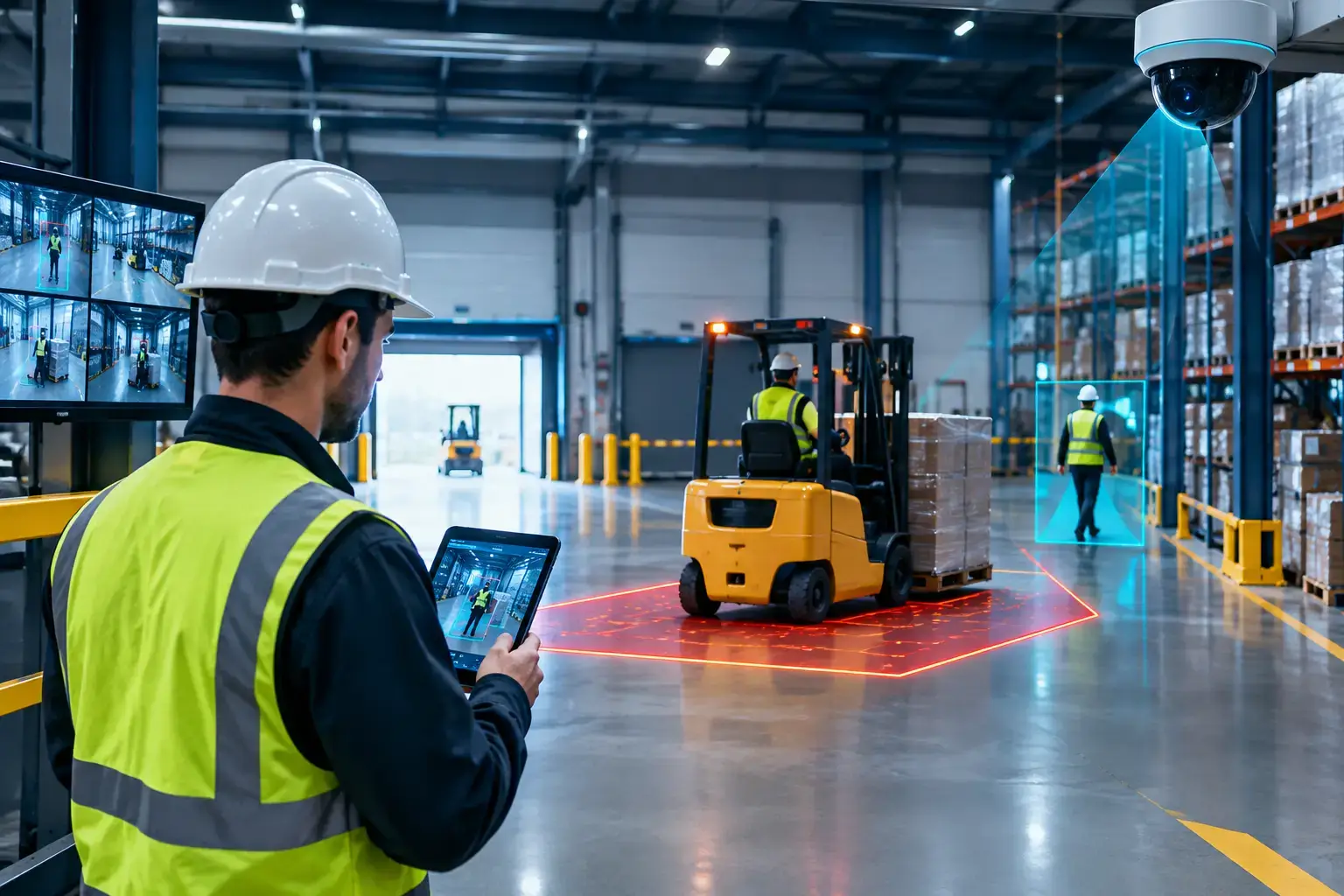
A forklift reversing from a rack aisle may have only seconds to react when a pedestrian steps into its path. Mirrors, floor markings, horns, and operating rules all help, but they rely on people seeing the hazard and responding at the right moment. Vision AI adds another active layer of protection: it detects developing risk and triggers a warning before an incident occurs.
For warehouse, plant, and logistics leaders, the value is not simply a camera that records activity. Vision AI safety monitoring can help make high-risk interactions visible in real time, reinforce traffic-management controls, and provide operational evidence for improving unsafe conditions. Used correctly, it supports a safer workplace without slowing the movement of goods.
What Vision AI Does in an Industrial Setting
Vision AI uses cameras and trained software models to recognize defined objects, movements, and situations within a work area. In industrial operations, those objects may include forklifts, reach trucks, pedestrians, pallet jacks, trucks, doors, loading bays, and restricted zones.
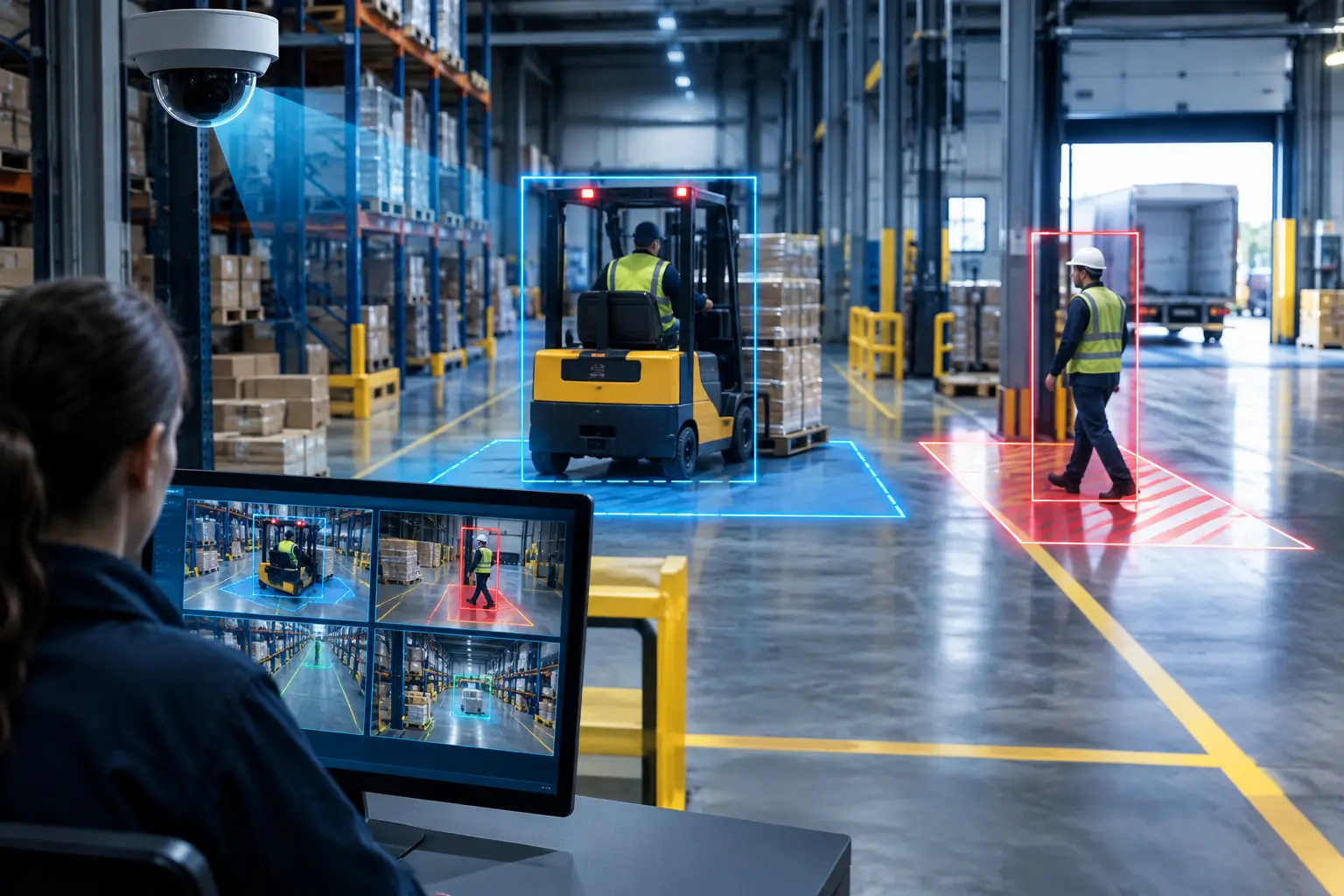
Unlike conventional video recording, which is normally reviewed after an event, a vision AI system analyzes live images against preconfigured safety rules. When it identifies a person in a forklift exclusion zone, a vehicle moving in an unauthorized direction, or a pedestrian approaching a blind intersection, the system can activate a visual or audible alert. Depending on the design, it can also log the event for later review.
The technology does not replace competent operators, supervisors, or physical safeguards. It provides an additional control where visibility is limited, traffic is mixed, and the consequences of a missed observation can be serious.
Where Warehouse Risks Are Hardest to Control
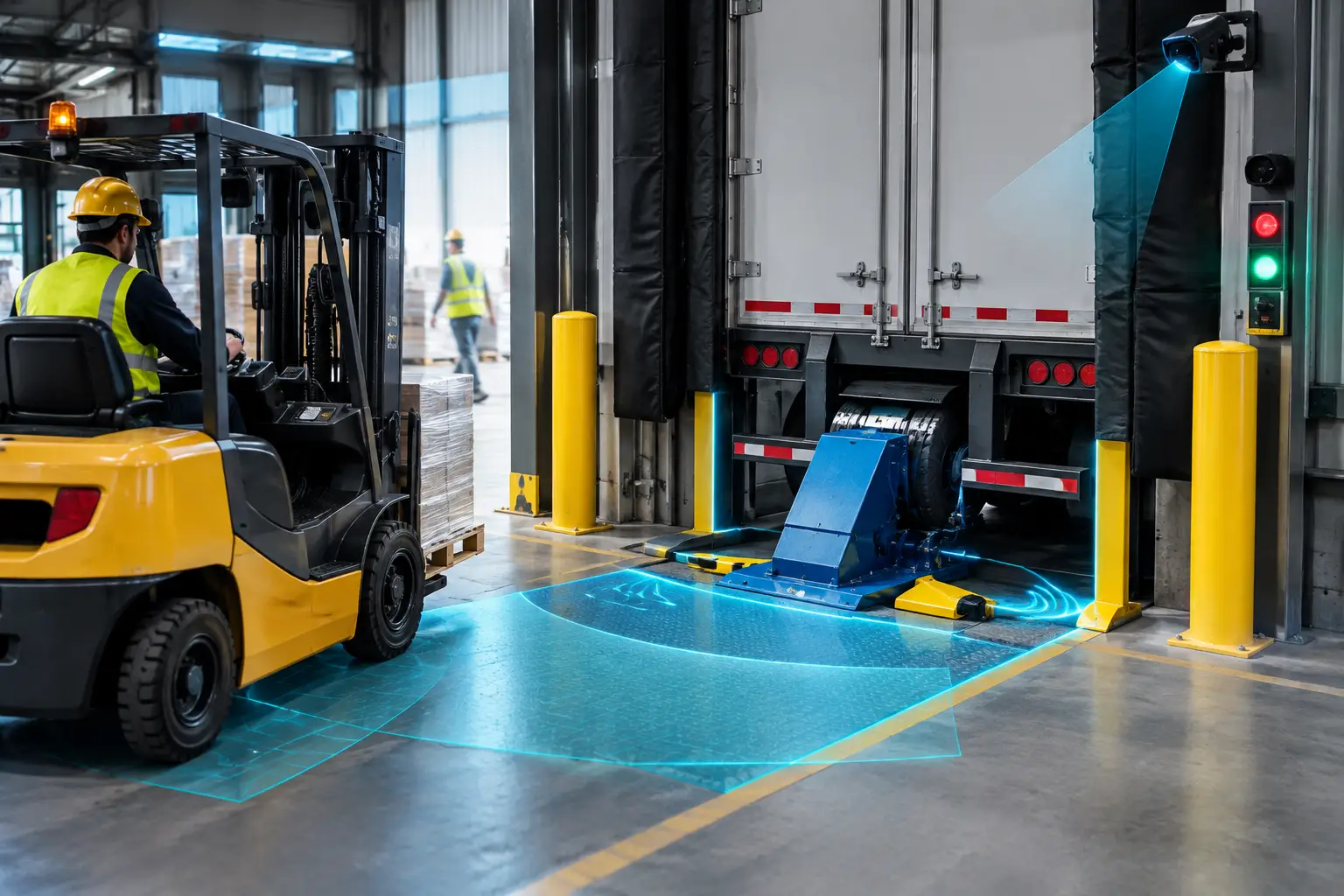
The strongest use cases are usually locations with repeatable, high-exposure hazards. A busy cross aisle, for example, may have clear floor markings but still create frequent conflict points as vehicles and pedestrians approach from behind racking. In a loading bay, changing vehicle positions, open dock doors, and time pressure can create conditions that are difficult for one supervisor to monitor continuously.
Vision AI can be configured to focus on specific operational risks, including:
- Pedestrians entering designated forklift travel lanes or exclusion zones
- Forklifts and pedestrians approaching blind corners or intersections
- Unsafe interactions around loading bays, dock doors, and trailer access points
- Vehicles traveling against a defined traffic direction
- Unauthorized access to restricted equipment or operating areas
- Repeated congestion in zones where people and material-handling equipment mix
Not every camera location will deliver the same value. A clear, fixed view of a crossing point is often more useful than broad coverage of an entire facility. The goal is to target the moments where people and vehicles are most likely to come into conflict.
Real-Time Warnings Matter More Than Recorded Footage
Recorded footage has a role in incident investigation, but it cannot prevent an event that has already happened. The practical advantage of vision AI is its ability to support immediate intervention.
When a defined hazard is detected, the system can activate a projected warning, beacon, audible alarm, display, or other local alert. This gives the forklift operator and pedestrian a prompt to reassess their position. In high-noise environments, visual warnings may be more effective than sound alone. In areas with limited sightlines, combining a warning system with floor projection or proximity technology can strengthen awareness before people enter the danger zone.
The right response depends on the task and environment. An alert that is too sensitive can create alarm fatigue, causing workers to ignore it. An alert that activates too late may not provide enough time to respond. Site assessment, camera placement, detection-zone design, and controlled testing are therefore as important as the AI model itself.
From Safety Events to Better Decisions
A safety manager cannot stand at every aisle end or loading bay throughout every shift. Vision AI can provide data on the patterns that deserve attention: where near-misses recur, when pedestrian traffic peaks, which shifts experience the most alerts, and whether a control is changing behavior over time.
This information should not be treated as a tool for fault-finding. Its greater value is in identifying system weaknesses. If repeated alerts occur at the same corner, the answer may be to adjust pedestrian routes, improve signage, revise rack-end protection, change staging practices, or separate traffic flows. If loading bay alerts increase during peak dispatch periods, the process may need clearer vehicle-pedestrian separation or revised scheduling.
Reviewing trend data also helps leaders prioritize investments. Rather than applying the same control everywhere, they can focus engineering effort on the areas with the greatest exposure and the clearest opportunity to reduce risk.
Vision AI Works Best With Layered Controls
No single technology can eliminate warehouse risk. Cameras may have limitations in poor lighting, obstructed views, dense traffic, or layouts that change frequently. AI detection is also only as effective as the rules, zones, and response methods configured around it.
A stronger approach combines vision AI with practical physical and operational controls. These may include segregated walkways, safety barriers, protected crossing points, speed management, rack and column protection, designated loading zones, and clear site traffic rules. Forklift-mounted pedestrian warning systems can provide another layer where mobile detection is needed, while fixed AI monitoring can protect high-risk intersections and work zones.
This layered approach reflects how accidents actually occur. Serious incidents rarely result from one missing safeguard alone. They happen when visibility, behavior, layout, communication, and time pressure fail at the same moment. Multiple complementary controls reduce dependence on any single action or device.
How to Implement Vision AI Without Creating New Problems
Successful implementation begins with risk assessment, not equipment selection. Start by identifying the locations where forklifts, pedestrians, trucks, or moving loads interact and where current controls have known limitations. Incident records, near-miss reports, supervisor observations, and employee feedback can all help identify priority zones.
Before installation, define what the system needs to detect and what should happen when it does. A pedestrian crossing a vehicle lane may require a local warning, while an unauthorized entry into a restricted area may require a different response. Clear decisions at this stage prevent vague configurations that produce low-value alerts.
Camera position requires careful engineering. The view must cover the risk area without regular obstruction from racking, loads, doors, or equipment. Lighting conditions should be assessed across operating hours, particularly in loading bays where sunlight, shadows, and trailer movements can change the scene. If layouts change often, the system should be reviewed whenever routes or storage configurations are altered.
Workers and supervisors should understand the purpose of the system before it goes live. Explain the hazards being addressed, what an alert means, and how people are expected to respond. The objective is to prevent injuries and improve site conditions, not to add unnecessary pressure to already demanding work.
Finally, measure performance after deployment. Are alerts identifying genuine exposure? Are there excessive false activations? Has traffic behavior improved? Is the location still the highest-risk point after process changes? Ongoing review keeps the solution useful as the operation evolves.
Choosing the Right Scope for the Facility
Vision AI is not always the first or only answer. A simple barrier may be the most effective control where pedestrian and forklift routes can be fully separated. At a blind corner with constant traffic, however, AI-triggered warnings may provide a meaningful advantage. At a loading bay, the answer may combine vehicle restraint, dock procedures, barriers, and monitored access rather than relying on camera detection alone.
The key question is not, “Where can cameras be installed?” It is, “Where can earlier hazard detection materially reduce exposure?” That distinction keeps investment focused on safety outcomes instead of technology for its own sake.
For facilities seeking to reduce forklift-pedestrian risk, protect workers, and maintain operational continuity, vision AI can turn recurring blind spots into manageable safety controls. Every useful alert is an opportunity to prevent a near-miss from becoming the incident everyone wishes they had seen coming.