A forklift moving only a few miles per hour can still cause a life-changing injury, collapse a rack upright, damage a dock door, or turn a minor blind-corner conflict into extended downtime. Knowing how to reduce forklift speed is not about making operations unnecessarily slow. It is about setting the right speed for the actual risk in each part of the facility.
A single site-wide speed limit rarely delivers that result. A clear aisle with separated pedestrians presents a different risk from a congested pick area, an intersection, a loading bay, or a trailer entry. Effective forklift speed reduction combines traffic design, equipment controls, operator behavior, and ongoing verification. The objective is simple: give operators enough time and distance to recognize hazards, stop safely, and protect people, loads, and infrastructure.
Start With the Conditions That Make Speed Dangerous
Forklift speed becomes a serious risk when visibility, stopping distance, stability, or shared space is compromised. Before changing truck settings or posting new signs, walk the operation and identify where speed contributes directly to exposure.
Look closely at blind corners, cross-aisles, pedestrian doors, battery-charging approaches, pick faces, rack ends, dock transitions, trailer interiors, ramps, and areas where people routinely step into travel routes. Also consider load characteristics. A tall, wide, unstable, or vision-blocking load changes what a safe speed looks like, even on a route that appears straightforward.
Incident records, near-miss reports, damage patterns, and operator feedback can reveal risks that are easy to miss during a single walkthrough. Repeated scuffs on rack columns, damaged guards, sharp braking marks, or recurring conflicts at an aisle junction are operational signals. They indicate that the travel environment may be asking too much of operators.
The assessment should distinguish between maximum travel speed and safe operating speed. The truck may be capable of traveling quickly, but capability is not a safe-speed instruction. Factors such as floor condition, turning radius, load height, pedestrian activity, and sight lines determine the appropriate limit at that moment.
How to Reduce Forklift Speed by Zone
The most practical approach is to establish zones with controls matched to the hazard. This avoids a blunt rule that slows low-risk movement while still allowing excessive speed where the consequences are highest.
High-risk zones typically need the lowest speeds. These include pedestrian crossings, blind corners, narrow aisles, congested staging areas, dock approaches, trailer entry points, and locations where forklifts reverse frequently. In these areas, lower speed limits should be supported by physical and technological measures, not left to memory alone.
Medium-risk travel paths may allow a controlled operating speed when visibility is clear and pedestrian access is restricted. Higher-speed travel should be limited to routes designed for it, with good lighting, sufficient width, clear separation from pedestrians, and minimal conflicting movements.
Zone rules must be visible at the point of decision. Floor markings, speed signs, stop lines, projected warning symbols, and direction arrows can reinforce expectations. However, signs do not slow a forklift by themselves. They work best when paired with route design and controls that make safe behavior the easiest behavior.
Improve the Route Before Blaming the Operator
Many speed-related issues are traffic-management issues. If an operator must make up time because routes are poorly organized, staging areas overflow into aisles, or pedestrian doors open directly into forklift paths, retraining alone will not correct the risk.
Create dedicated pedestrian walkways with physical separation where practical. Use barriers, guardrails, and controlled crossing points to reduce unplanned interaction between people and mobile equipment. At intersections, improve sight lines by relocating obstructions, managing pallet storage, and using convex mirrors or warning projections where they add value.
One-way forklift routes can reduce reversing and head-on conflicts in busy areas. Separating receiving, put-away, replenishment, and dispatch flows may also remove unnecessary cross-traffic. At loading bays, establish clear approach lanes and keep people out of the vehicle movement zone during dock operations.
Physical traffic design has a lasting advantage: it does not depend on every person making the right judgment under pressure. It reduces exposure before a forklift reaches the hazard.
Apply Engineering Controls to Enforce Lower Speeds
When a risk assessment identifies a need for speed reduction, engineering controls provide a more reliable outcome than policy alone. Depending on the truck model and site requirements, a qualified technician may be able to configure a lower maximum travel speed, acceleration profile, or speed limit for specific operating conditions. Any adjustment should follow the equipment manufacturer’s guidance and be documented as part of the site’s safety management process.
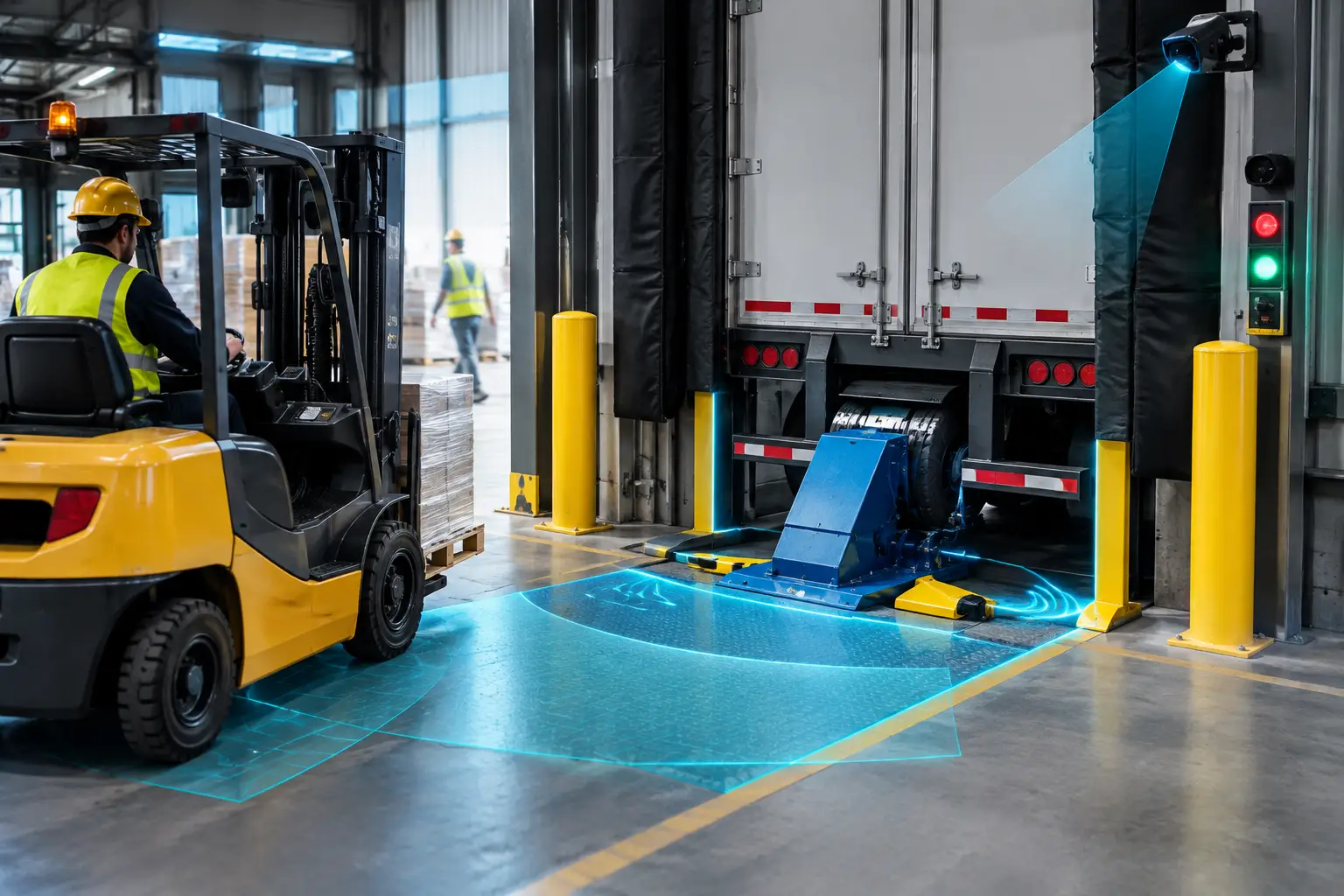
For mixed-risk facilities, zone-based speed control can be more effective than permanently limiting every forklift to the same low setting. Location-aware systems can trigger a reduced speed when a truck enters a designated area, such as a pedestrian crossing, dock approach, narrow aisle, or blind intersection. The truck can then resume its normal controlled speed once it returns to a lower-risk route.
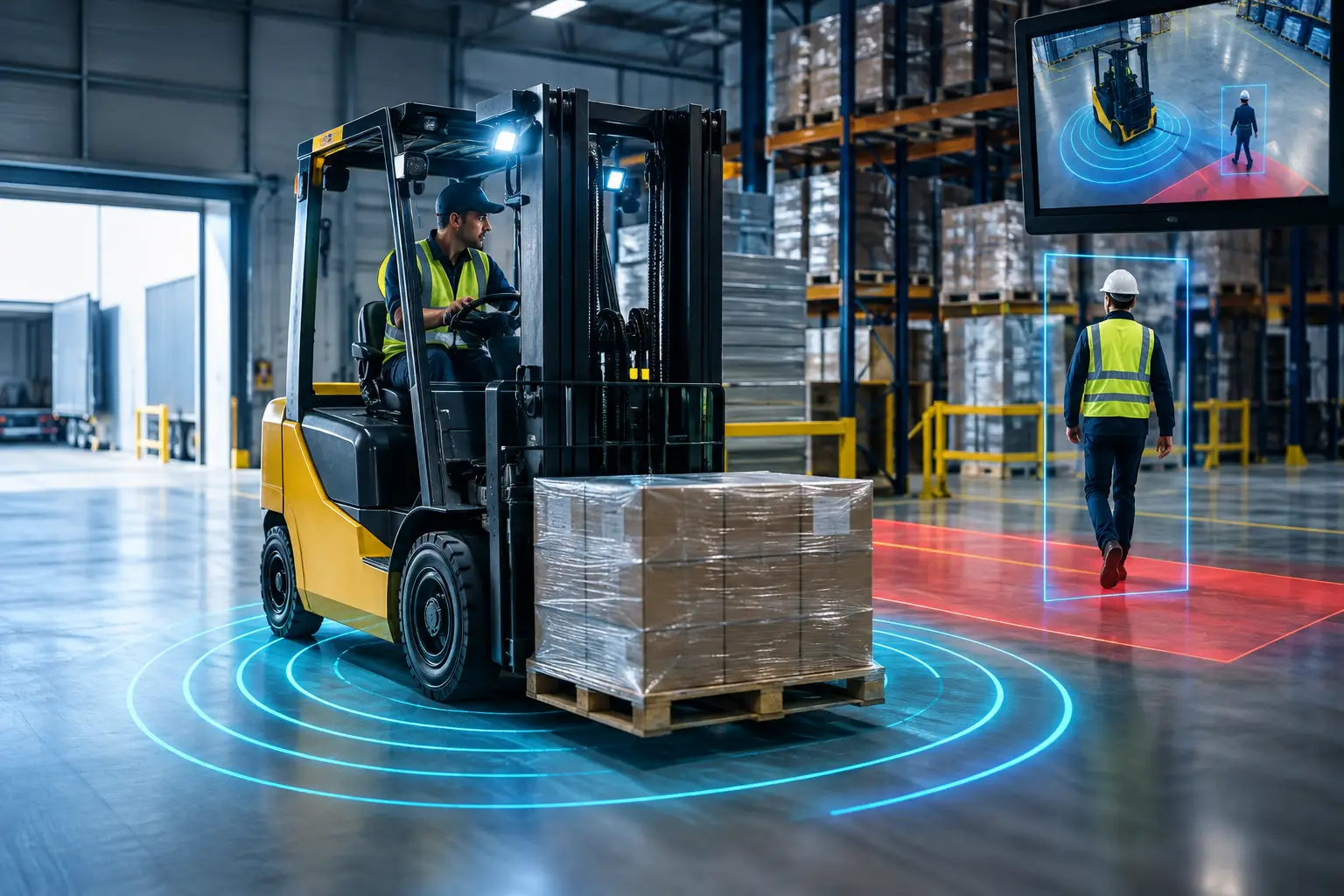
Proximity warning systems can add another layer of protection where forklifts and pedestrians may come too close. Audible and visual warnings give operators and pedestrians immediate awareness of an approaching hazard. Vision AI monitoring can further identify unsafe interactions, repeated speeding behavior, or noncompliant movement patterns that may otherwise go unnoticed.
These systems should be selected carefully. A warning device alerts people, but it does not replace safe routes, competent operation, or speed limiting where the risk requires it. Too many alarms can also create alarm fatigue, causing workers to tune out signals that matter. Set alerts for meaningful events, test their effectiveness in real operating conditions, and adjust them as the workflow changes.
Account for Loads, Turns, and Surface Conditions
Travel speed must be controlled before a turn, not during it. A forklift’s stability can be affected by load weight, load height, turning angle, surface condition, and abrupt steering or braking. Operators should approach turns at a speed that allows stable, deliberate movement, particularly when carrying elevated or uneven loads.
Ramps, dock levelers, wet floors, damaged concrete, and transitions between surfaces require additional caution. A truck may need more distance to stop, while uneven surfaces can shift the load or reduce stability. Maintaining floors, dock equipment, and aisle housekeeping is therefore part of a forklift speed-control program, not a separate facility concern.
Visibility deserves the same attention. If a forward load blocks the operator’s view, travel direction and speed must be adjusted according to safe operating procedures. At blind corners, operators need sufficient time to stop for a person or another vehicle that cannot yet be seen. No horn or flashing light changes the physics of stopping distance.
Train for Judgment, Then Verify Performance
Operator training should explain why limits differ by zone and condition. A generic instruction to “drive slowly” is subjective. Define expected behaviors: slow before intersections, stop where sight lines are blocked, maintain control on ramps, reduce speed with elevated or unstable loads, and never use speed to recover lost schedule time.
Supervisors also need to support those expectations. If productivity targets, dispatch practices, or understaffing encourage rushed travel, operators receive a conflicting message. Safe speed is an operational standard, not an individual preference.
Use observation and data to verify that controls are working. Telematics, impact events, speed-exception reports, Vision AI insights, supervisor observations, and near-miss reporting can show whether speeding is concentrated in certain zones, shifts, or tasks. Review the findings with operations, maintenance, and safety teams. The goal is to correct the condition driving the behavior, not simply discipline the last operator involved.
A useful measure is whether speed-related damage and conflict points decline after changes are made. Monitor rack strikes, barrier impacts, dock incidents, abrupt-braking events, pedestrian proximity alerts, and unplanned equipment downtime. If these indicators remain high, reassess the route, the limit, and the controls around it.
Balance Speed Reduction With Throughput
Reducing forklift speed can create concerns about throughput, especially in high-volume distribution and manufacturing environments. That concern is valid, but it should be evaluated against the cost of an accident, damaged inventory, blocked aisle, injured worker, truck repair, or interrupted dock operation.
The answer is often not to slow every movement equally. Remove wasted travel, improve slotting, stage loads closer to their next task, reduce cross-traffic, and use zone-based controls. This protects high-risk areas while allowing efficient movement where the environment supports it.
A safer speed program works when it reflects the real operation rather than an idealized one. Engage operators in the review because they understand where visibility disappears, where congestion builds, and where schedules create pressure. Combine that insight with engineered controls and measurable monitoring, and the facility can reduce risk without sacrificing control of the operation.
Every worker deserves to return home safely every day. The right forklift speed is not simply the number on a sign – it is the speed that gives people, equipment, and the operation enough margin to prevent the next incident.