A forklift turning out of a racking aisle has limited sightlines. A pedestrian stepping around a pallet may have only seconds to react. That is why understanding how to separate warehouse traffic is not simply a matter of painting lines on a floor. It is a practical risk-control strategy that protects people, prevents equipment damage, and keeps operations moving without unnecessary disruption.
Traffic separation works best when the warehouse is treated as a living operating environment. Forklifts, pallet jacks, reach trucks, delivery vehicles, contractors, pickers, and maintenance teams all move differently, at different times, and for different reasons. Effective controls account for those movements rather than relying on workers to remain constantly alert in hazardous shared spaces.
Start With the Actual Movement of People and Vehicles
Before installing barriers or changing routes, map the traffic that already exists. Walk the facility during busy receiving, picking, replenishment, and dispatch periods. Observe where pedestrians cross vehicle paths, where forklifts reverse, where loads block visibility, and where employees take shortcuts.
This assessment should include more than main travel aisles. High-risk points are often found at dock doors, staging areas, battery charging locations, packing stations, break room entrances, washrooms, and access doors. A route that appears safe on a layout drawing may become hazardous when pallets accumulate or a temporary work area narrows the aisle.
Use incident reports, near-miss records, equipment damage data, and supervisor feedback to identify recurring conflict points. Near misses deserve particular attention. They often reveal risks before an injury or major asset loss occurs.
The objective is to identify every location where people and mobile equipment interact, then decide whether that interaction can be removed, controlled, or made clearly visible.
How to Separate Warehouse Traffic Through Layout Design
The strongest traffic control is physical separation. If pedestrians and forklifts do not share the same space, the opportunity for a collision is significantly reduced.
Create dedicated pedestrian walkways that are continuous, direct, and wide enough for the expected traffic. Routes should lead employees where they genuinely need to go, such as workstations, exits, offices, welfare areas, and dock access points. If the designated route is inconvenient or adds excessive walking time, people will predictably bypass it.
Vehicle travel lanes should be planned around forklift turning radii, rack positions, load dimensions, and the need to stop safely. Avoid forcing forklifts to make sharp turns near pedestrian crossings or into congested staging zones. One-way systems can help in narrow aisles or high-volume areas because they reduce opposing vehicle movements and simplify decision-making for operators.
At crossings, reduce the number of places where pedestrians and forklifts meet. Consolidating several informal crossings into one controlled crossing is often safer and easier to manage. Position crossings where sightlines are clear, not immediately beside rack ends, stacked pallets, dock equipment, or blind corners.
Physical changes must also accommodate operational reality. A fully barricaded route may be impractical where employees need controlled access to picking faces, maintenance points, or loading activity. In those areas, use guarded gates, designated crossing points, and clear procedures rather than leaving open gaps in the separation system.
Use Physical Barriers Where the Risk Is Highest
Floor markings provide guidance, but they do not stop a forklift or protect a worker from an encroaching load. In high-risk locations, engineered barriers create a dependable boundary between vehicle and pedestrian zones.
Warehouse safety barriers are particularly valuable along pedestrian walkways beside forklift aisles, around workstations, near packing benches, and at the ends of racking rows. They help contain vehicle movement while protecting people, building structures, and equipment from impact damage. Rack-end protection, bollards, and guardrails can also protect vulnerable assets in areas with frequent turning or reversing.
Barrier selection should match the hazard. A low pedestrian rail may provide route definition but may not withstand a forklift impact. A heavy-duty impact barrier may be appropriate around critical infrastructure or a high-speed travel lane, but it can consume valuable floor space. Engineering assessment is essential because poorly placed barriers can create blind spots, constrict vehicle movements, or shift risk to another area.
Protective systems should be installed with access and maintenance in mind. Gates, removable sections, and clearly controlled access points allow authorized personnel to enter restricted areas without normalizing unsafe shortcuts.
Make Crossings Intentional and Highly Visible
Some shared points cannot be eliminated. Loading bays, picking zones, and production interfaces may require pedestrians to cross vehicle routes. The goal is to make these interactions deliberate rather than accidental.
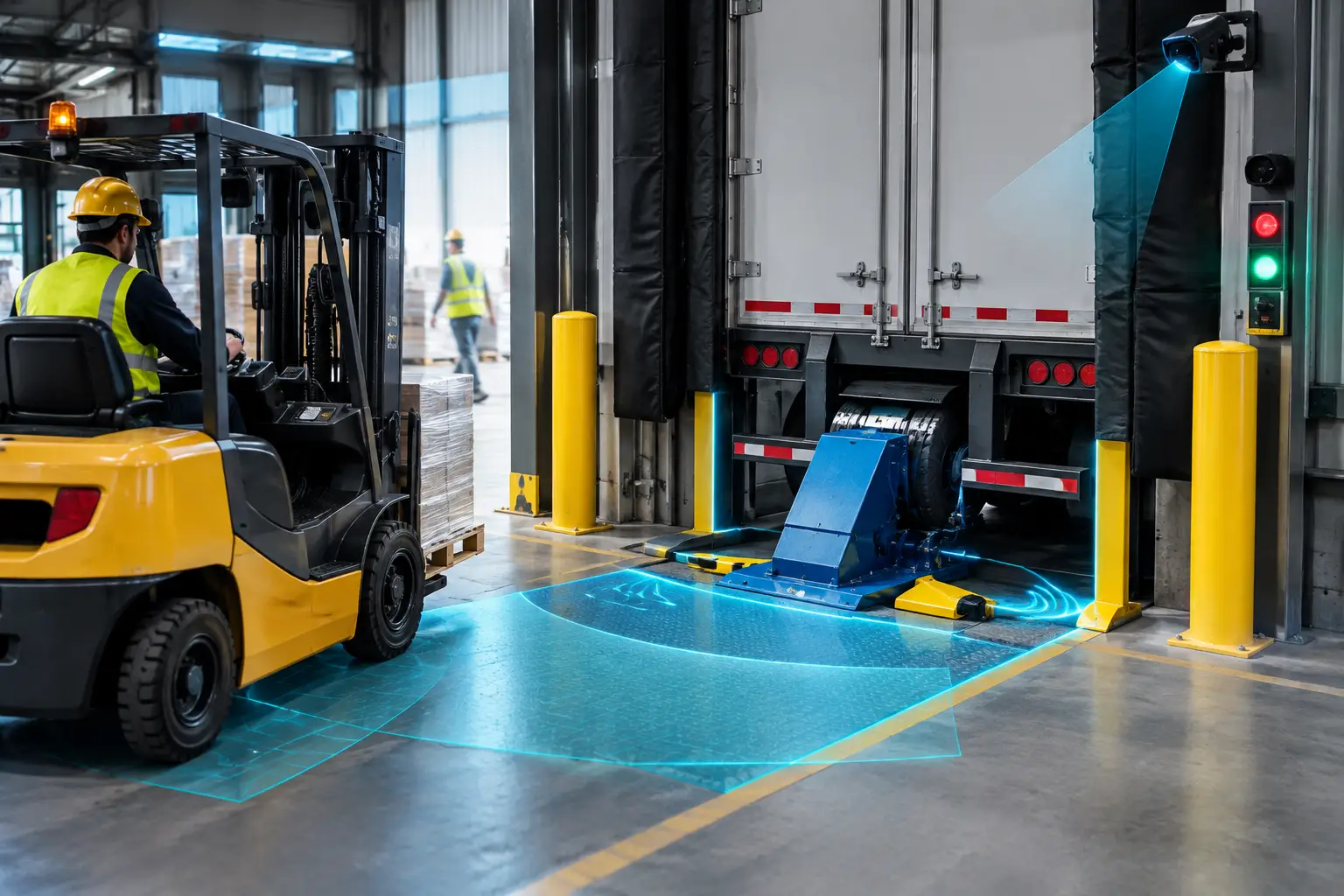
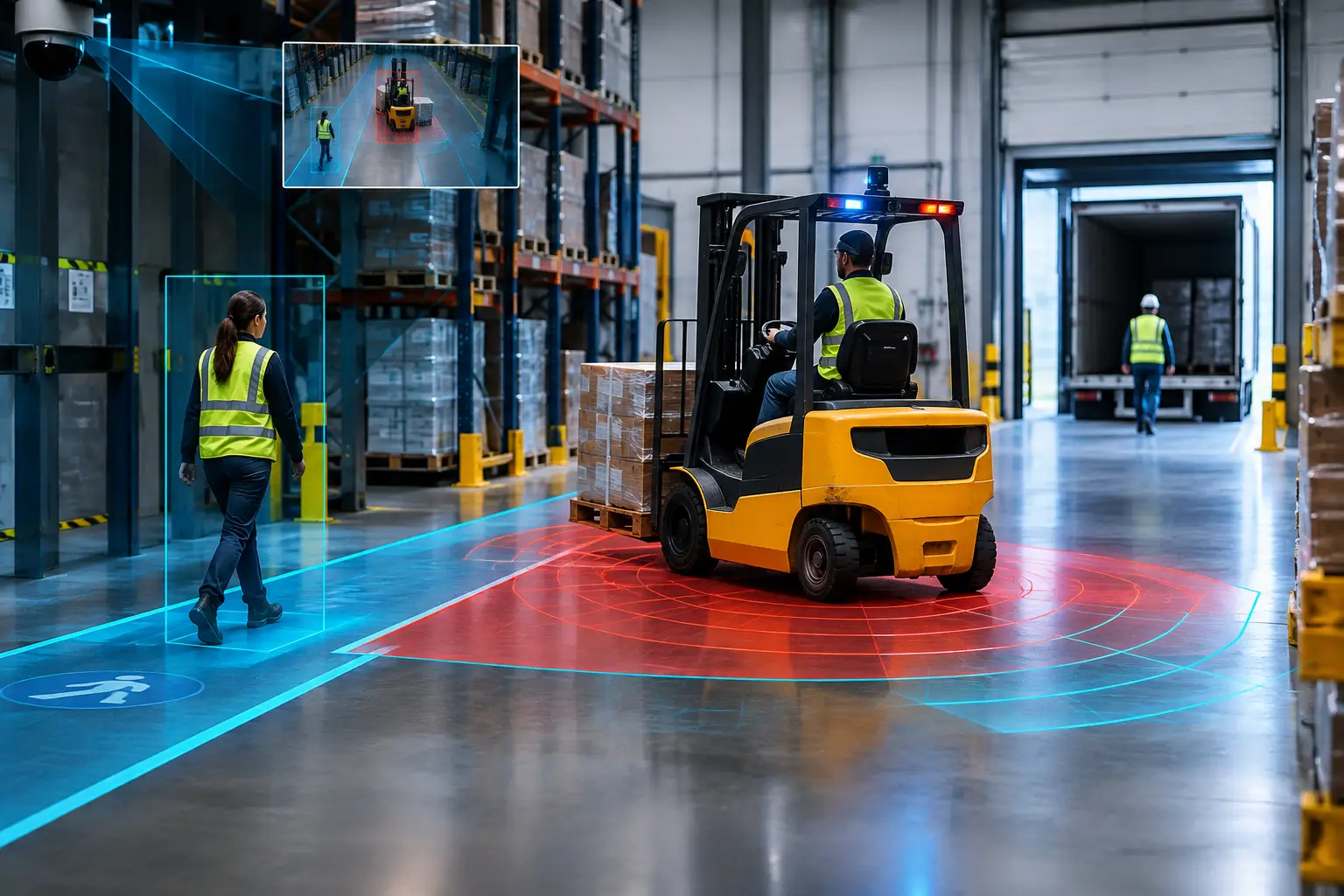
A controlled crossing should be visually distinct from the surrounding floor and supported by appropriate warning measures. High-visibility floor projection can place bright lines, symbols, or crossing indicators directly in the operator’s and pedestrian’s field of view. Unlike painted markings, projected markings can remain visible where floor wear, dust, or changing layouts make conventional markings less effective.
Audible and visual warning systems can provide an additional layer of protection at intersections, blind corners, doorways, and racking aisle exits. Blue or red safety lights, projected warning zones, and motion-triggered alerts can draw attention to an approaching vehicle. These controls are useful, but they should not be treated as a substitute for separation. A warning may prompt a person to stop, while a barrier and route design help prevent the conflict from arising in the first place.
Speed management also matters. Lower speed limits in pedestrian-adjacent areas provide forklift operators more time to identify hazards and stop. Design can reinforce speed control through lane geometry, controlled turns, stop points, and restricted zones rather than relying only on posted signs.
Address Blind Corners, Reversing, and Obstructed Views
Forklift-pedestrian incidents frequently occur where visibility is compromised. Rack aisles, stacked goods, dock staging, swinging doors, and oversized loads can all hide a person from an operator or hide a vehicle from a pedestrian.
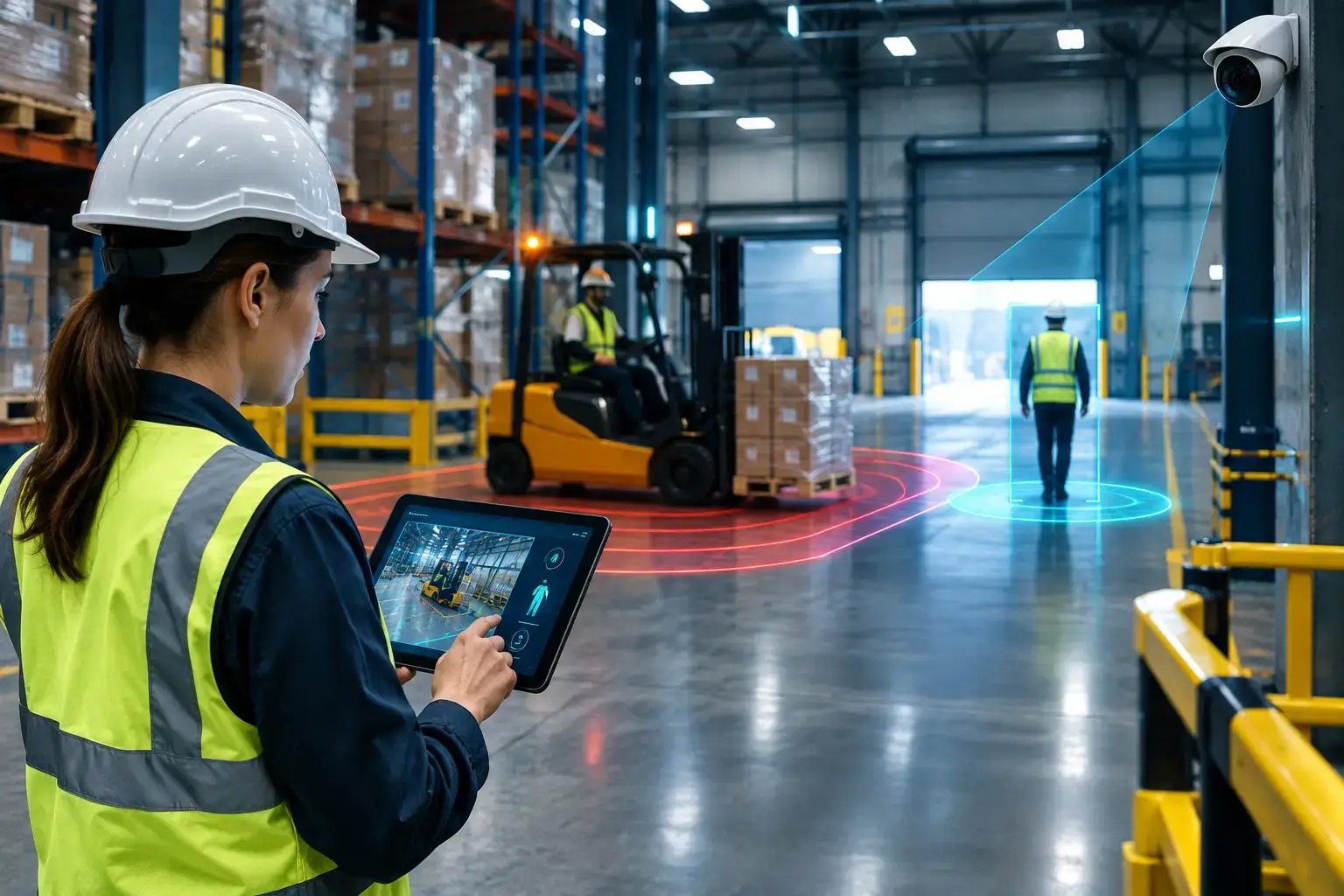
Where blind corners cannot be redesigned, install active warning measures that respond to movement. Proximity warning systems can alert operators and pedestrians when they enter a defined risk zone. Vision AI safety monitoring can identify unsafe interactions, such as people entering vehicle routes or forklifts operating too close to pedestrian areas, giving managers usable data to target corrective action.
Reversing deserves separate control because operators may have restricted rear visibility even when using mirrors and cameras. Minimize reversing through one-way traffic flow or drive-through layouts where feasible. Where reversing remains necessary, define reversing zones, keep them free from pedestrian access, and use warning technology suited to the environment.
Technology should support disciplined operations, not compensate for a poor layout. The most reliable approach combines clear routes, physical separation, operator training, site rules, and intelligent alerts at the points where residual risk remains.
Keep Pedestrian Routes Clear and Credible
A pedestrian route only works when it stays usable throughout the shift. Pallets, empty stillages, waste bins, parked equipment, and temporary inventory can quickly turn a protected walkway into an obstacle course. Once workers begin stepping outside the designated route, the traffic plan has already failed.
Assign ownership for inspecting pedestrian lanes, crossings, barriers, and signs. Supervisors should be able to correct blocked routes quickly, while employees should have a simple way to report damaged barriers, faded markings, malfunctioning alerts, or repeated congestion. Inspection findings should feed back into layout and process improvements, not disappear into a checklist.
Changes in operations require a fresh review. A new racking configuration, revised picking process, peak-season overflow area, or different fleet type can alter traffic risks immediately. This is especially relevant in facilities with rapid growth or frequent changes to product mix and storage density.
Measure Whether the Separation Plan Is Working
A warehouse traffic plan should produce observable improvements. Monitor near misses, pedestrian incursions into vehicle lanes, barrier strikes, rack damage, speeding observations, and congestion at crossings. These indicators reveal whether controls are changing behavior and reducing exposure.
Do not judge success only by the absence of reportable injuries. An increase in near-miss reporting may initially indicate stronger hazard awareness, not poorer performance. Review the details: where did the event occur, what was the task, what route was used, and which control was missing or ineffective?
For complex facilities, an engineering-led review can help prioritize investments. SysGuard supports this process by aligning physical protection, forklift safety systems, warning technologies, and monitoring tools with the facility’s actual traffic patterns. The right solution is rarely one product. It is a layered system designed around how work gets done.
Every worker deserves to return home safely every day. Start by making the safe route the easiest route to follow, then reinforce it with controls that do not depend on perfect attention in a busy warehouse.