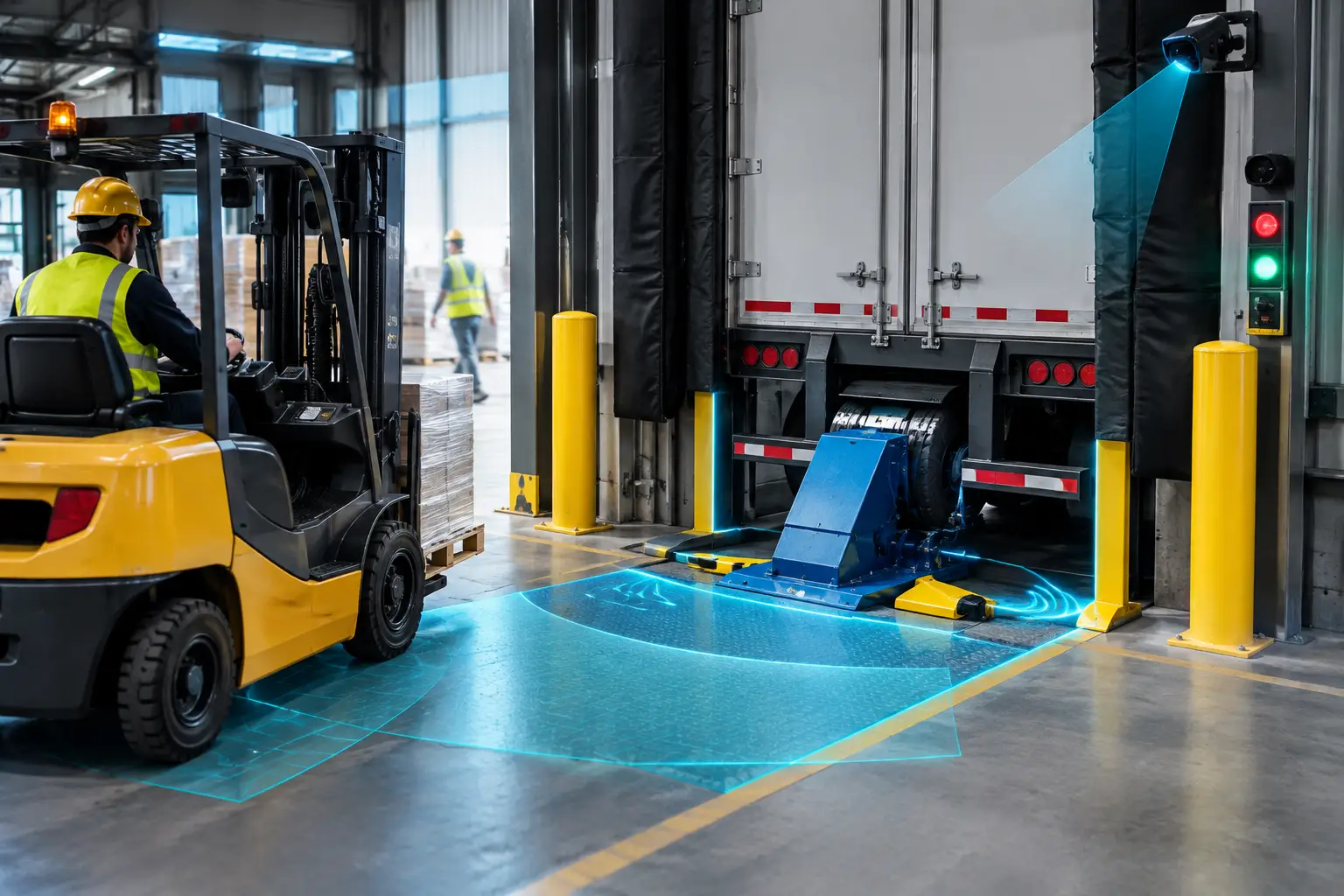
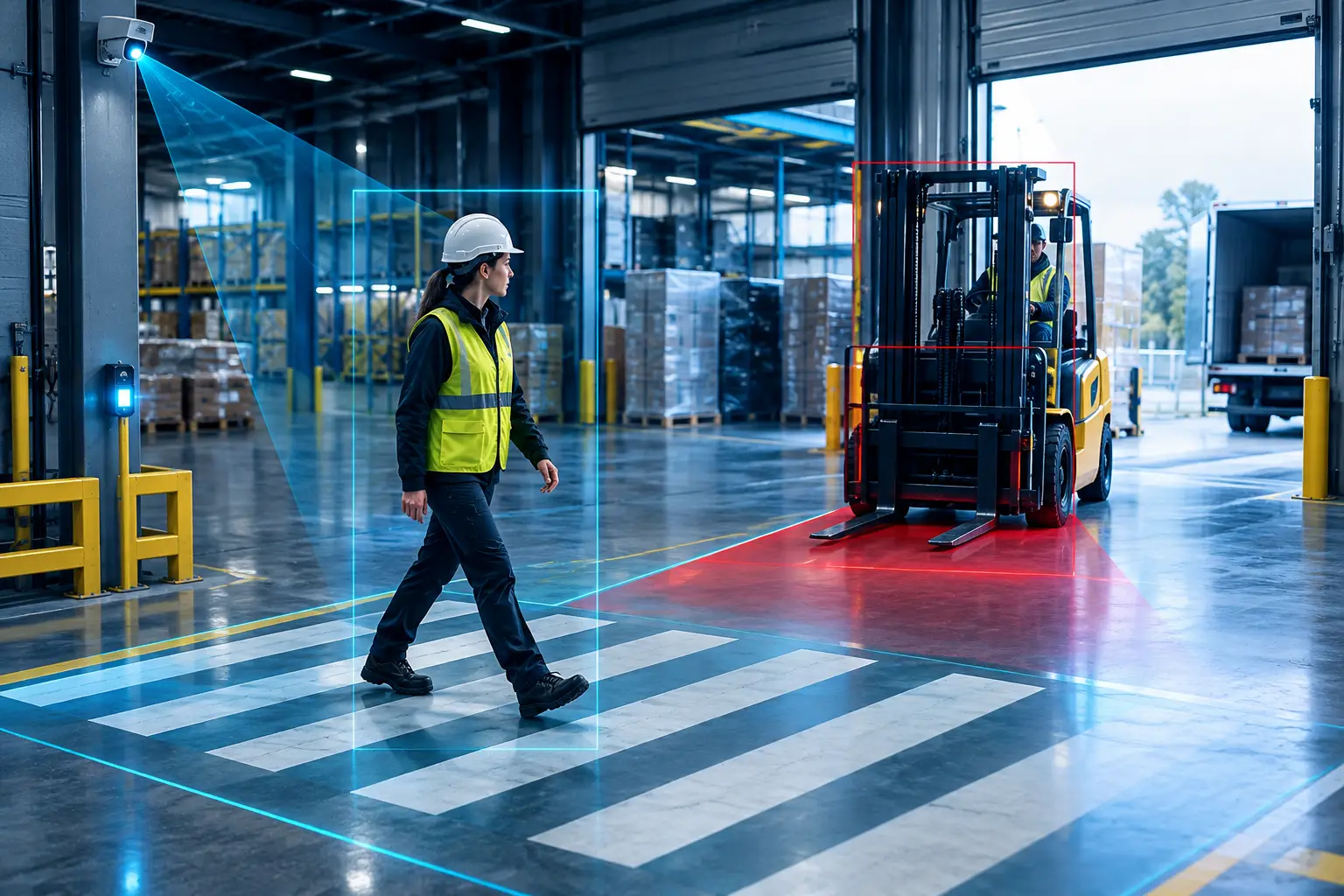
A marked crossing on a warehouse floor does not, by itself, make a pedestrian safe. Forklift operators may be turning with a restricted view, carrying loads that block forward visibility, or working against tight dispatch schedules. When pedestrians and mobile equipment meet at the same point, the crossing must actively control that conflict – not merely identify where it occurs.
The most effective essential pedestrian crossing features combine physical separation, clear right-of-way communication, and warnings that work in the real conditions of a busy industrial facility. The right design reduces collision exposure while keeping goods, people, and vehicles moving predictably.
Start With the Actual Vehicle-Pedestrian Conflict
A pedestrian crossing should be installed where people have a legitimate need to cross a vehicle route, not simply where a painted aisle happens to be available. Common locations include access points between production areas and storage zones, routes to workstations, doorways between departments, dispatch areas, and intersections near loading bays.
Before selecting equipment, observe how the area operates across different shifts. Note forklift travel direction, reversing activity, load heights, turning paths, congestion, lighting conditions, and the times when pedestrians are most likely to enter the route. A crossing that is visible from one direction but hidden around a rack end from another is still a serious exposure.
This assessment also determines whether a crossing is the right control. In some high-traffic areas, a protected pedestrian route, a redesigned travel path, or timed separation between people and forklifts will provide a safer outcome than asking pedestrians to cross active traffic. Good safety design removes unnecessary interactions before adding warnings to manage the remaining ones.
Essential Pedestrian Crossing Features That Reduce Risk
High-visibility floor markings
Clearly defined markings establish the crossing location and show pedestrians where to wait before entering a traffic route. Durable, high-contrast markings are particularly useful in wide aisles, intersections, and areas where the crossing needs to be recognized from a distance.
However, floor markings are subject to wear from forklift tires, pallet movement, cleaning, and abrasion. They should be specified for the floor condition and included in routine inspection plans. Faded markings send an unintended message that the route is uncontrolled.
Color alone is not enough. The crossing must be positioned so operators have sufficient time to see it, recognize the potential for pedestrians, and slow or stop safely. This depends on vehicle speed, sight lines, load configuration, and turning radius.
Physical barriers and protected waiting zones
Pedestrians need a safe place to stand before crossing. Guardrails, safety barriers, and protected walkways prevent people from drifting directly into forklift lanes and guide them toward the designated crossing point. They also discourage shortcuts that often develop around racking, staging zones, and high-use doors.
At crossings, barriers should create a waiting area set back from vehicle travel. The design needs to allow pedestrians to see approaching traffic without forcing them to lean around a barrier or step into the aisle. Openings should be sized to guide foot traffic without becoming wide, uncontrolled access points.
Physical protection is especially valuable where forklifts operate close to pedestrians or where operators may be distracted by picking, scanning, or maneuvering loads. It does require careful layout planning. A barrier that improves separation but creates a blind corner or obstructs emergency access has introduced a different operational problem.
Clear sight lines and intersection control
The safest crossing is one that both parties can see early. Remove visual obstructions where practical, including stacked pallets, temporary storage, opaque signage, and poorly placed equipment. Rack-end layouts and staging rules should support visibility rather than compete with it.
Convex mirrors can help operators and pedestrians identify movement around blind corners, but they are an aid, not a substitute for direct visibility. Their effectiveness depends on correct positioning, good lighting, and clean reflective surfaces. They should be paired with speed management and clear route rules.
In congested intersections, consider whether travel directions can be simplified. One-way forklift routes, separated crossing points, and designated stopping locations reduce the number of decisions required at the moment of interaction. Fewer conflicting movements generally mean fewer opportunities for error.
Active visual and audible warnings
Passive markings rely on people noticing them every time. Active warnings add a stronger cue when the risk is present. These may include projected floor signs, flashing lights, traffic signals, audible alerts, or warning devices triggered by approaching vehicles or pedestrian activity.
Projected safety markings can be particularly effective in areas where painted markings wear quickly or where lighting and floor conditions make conventional lines difficult to maintain. A projected stop line or crossing symbol can draw attention to a conflict point without creating additional floor maintenance demands.
Audible alerts should be used carefully. A facility already filled with reversing alarms, machinery, and radio traffic can create alarm fatigue. The best systems provide a distinct, relevant warning at the point of risk rather than adding continuous noise throughout the operation. Visual and audible alerts work best when workers understand exactly what action each signal requires.
Speed control and predictable approach behavior
A crossing cannot compensate for excessive vehicle speed. Clearly posted internal speed expectations, appropriate aisle geometry, and controls that encourage lower speed near crossing points give operators more time to react.
In higher-risk zones, physical traffic-calming measures or technology-based warning systems may be appropriate. The choice depends on the surface condition, forklift types, load stability requirements, and whether the area is shared by other industrial vehicles. Any measure that affects vehicle movement should be tested under normal operating conditions before full deployment.
Predictability matters as much as speed. Operators should know where pedestrians are likely to appear, and pedestrians should know where it is permitted to cross. Informal crossings and shortcuts undermine both expectations.
Design for Human Behavior, Not Ideal Behavior
Workers do not always follow the route drawn on a layout plan. They take the shortest practical path, respond to production demands, and may assume an operator has seen them. Forklift operators can be focused on load placement, scanning, or maneuvering through narrow spaces. A crossing strategy must account for these everyday realities.
This is where intelligent safety technology can strengthen conventional controls. Proximity warning systems can alert operators and pedestrians when they enter a defined risk zone. Vision AI monitoring can identify pedestrian presence or unsafe interactions and provide data on recurring near misses, route violations, and congestion patterns. The value is not simply the alert. It is the ability to identify where the traffic design is failing under real operating pressure.
Technology should not be treated as a replacement for barriers, sight lines, or disciplined traffic management. If a crossing is hidden behind staging, no warning device can fully restore the time needed to make a safe decision. Layered controls are more dependable because each one addresses a different point of failure.
Keep Crossings Effective After Installation
A crossing system needs operational ownership. Assign responsibility for checking markings, barriers, signs, lights, sensors, and nearby storage conditions. Changes in racking, workflow, seasonal volume, or fleet equipment can alter the risk profile quickly.
Review incident reports, near misses, operator feedback, and pedestrian observations together. A near miss at the same crossing may indicate that the route is poorly positioned, warning timing is inadequate, or people are bypassing the intended path. Treat this information as a design input, not only as a behavior issue.
Training should focus on the reason behind the controls. Pedestrians need to understand that a designated crossing does not grant automatic protection from moving equipment. Operators need consistent expectations for approach speed, stopping behavior, and visual checks. Supervisors play a central role by correcting blocked walkways, unauthorized storage, and shortcuts before they become normal practice.
For larger facilities, periodic traffic assessments can help determine whether a local issue is actually a system-wide pattern. Repeated conflicts near dispatch doors, for example, may point to insufficient pedestrian access planning rather than an isolated operator mistake.
Choose Controls That Fit the Site
There is no single crossing package that suits every warehouse or factory. A low-speed aisle with infrequent crossings may require durable markings, barriers, and clear sight lines. A busy intersection near packing and dispatch may justify active warnings, protected waiting areas, and proximity detection. High-volume operations with changing traffic patterns may benefit from data-driven monitoring that reveals risks not captured in routine walkthroughs.
The objective remains straightforward: prevent pedestrians and forklifts from reaching the same place at the same time without clear visibility, adequate reaction time, and a defined right of way. Every worker deserves to return home safely every day. Well-designed crossings turn that responsibility into a practical part of the operation, shift after shift.