A forklift can appear stable right up to the moment it is not. A turn taken slightly too fast, a load raised a little too high, or one wheel crossing an uneven dock plate can shift the machine’s center of gravity beyond its stability limits. Understanding what causes forklift tipovers gives warehouse and operations leaders a clear starting point for preventing serious injuries, product loss, rack damage, and unplanned downtime.
Forklift tipovers are rarely the result of one dramatic mistake. More often, they develop from ordinary operating conditions that have not been adequately controlled: congested travel routes, inconsistent load handling, poor visibility, equipment defects, or pressure to maintain throughput. Effective prevention requires a practical combination of operator discipline, site design, equipment maintenance, and safety technology.
What Causes Forklift Tipovers? The Stability Triangle
Every counterbalance forklift operates within a stability triangle. The truck’s two front wheels form the base of that triangle, while the pivot point of the rear axle forms the third point. For the forklift to remain upright, the combined center of gravity of the truck and its load must stay inside this area.
When the center of gravity moves outside the triangle, the forklift can tip forward or sideways. A forward tipover is more likely when a load is too heavy, carried too far forward, or handled on a slope. A lateral tipover commonly occurs during turns, when traveling across an incline, or when one side of the vehicle meets a pothole, ramp edge, debris, or uneven flooring.
This principle applies whether a forklift is moving a single pallet or working continuously in a high-volume distribution center. The available stability margin changes with the load, mast position, attachments, travel surface, and operator actions. That is why a forklift that handled one load safely may become unstable with the next.
Load Errors That Shift the Center of Gravity
Load handling is a major contributor to tipover risk. Forklifts have rated capacities, but that rating is not a guarantee for every load configuration. Capacity changes when the load center increases, an attachment is fitted, or the load shape prevents it from sitting close to the carriage.
An oversized pallet, long load, or irregular item can move the center of gravity forward even when the stated weight appears acceptable. Damaged pallets and unsecured materials create a separate risk: a load may shift suddenly during lifting, braking, or turning. That sudden movement can destabilize both the load and the forklift.
Operators should confirm load weight and condition before lifting, position forks fully under the load where possible, and keep the load against the load backrest. Tilting the mast back slightly during travel helps retain stability, but excessive tilt or elevated travel introduces other hazards. The objective is controlled handling, not simply getting the load from point A to point B faster.
Raised Loads and Elevated Work
Traveling with an elevated load raises the combined center of gravity and reduces lateral stability. A minor steering input that would be uneventful with forks low can become a tipover event when the load is high. Elevated travel also restricts forward visibility, which can lead operators to make abrupt corrections around pedestrians, racks, or obstructions.
Loads should be carried as low as operating conditions allow, with adequate clearance from the floor. Before raising a load to a rack position, the forklift should be stopped and properly aligned. Attempting to turn, reposition, or reverse while the load is elevated increases the chance of contact with racking and a loss of stability.
Speed, Turning, and Sudden Direction Changes
A forklift is not a passenger vehicle. Its steering characteristics, raised center of gravity, and rear-wheel steering make it particularly vulnerable to lateral instability during turns. Excessive speed is therefore not only a traffic-management concern. It is a direct tipover risk.
The risk rises at blind intersections, near rack ends, at loading bays, and in mixed pedestrian-forklift zones. Operators may accelerate to meet productivity targets, then brake or turn sharply when visibility is limited. A loaded forklift can continue shifting after the wheels have changed direction, especially on smooth or dusty surfaces.
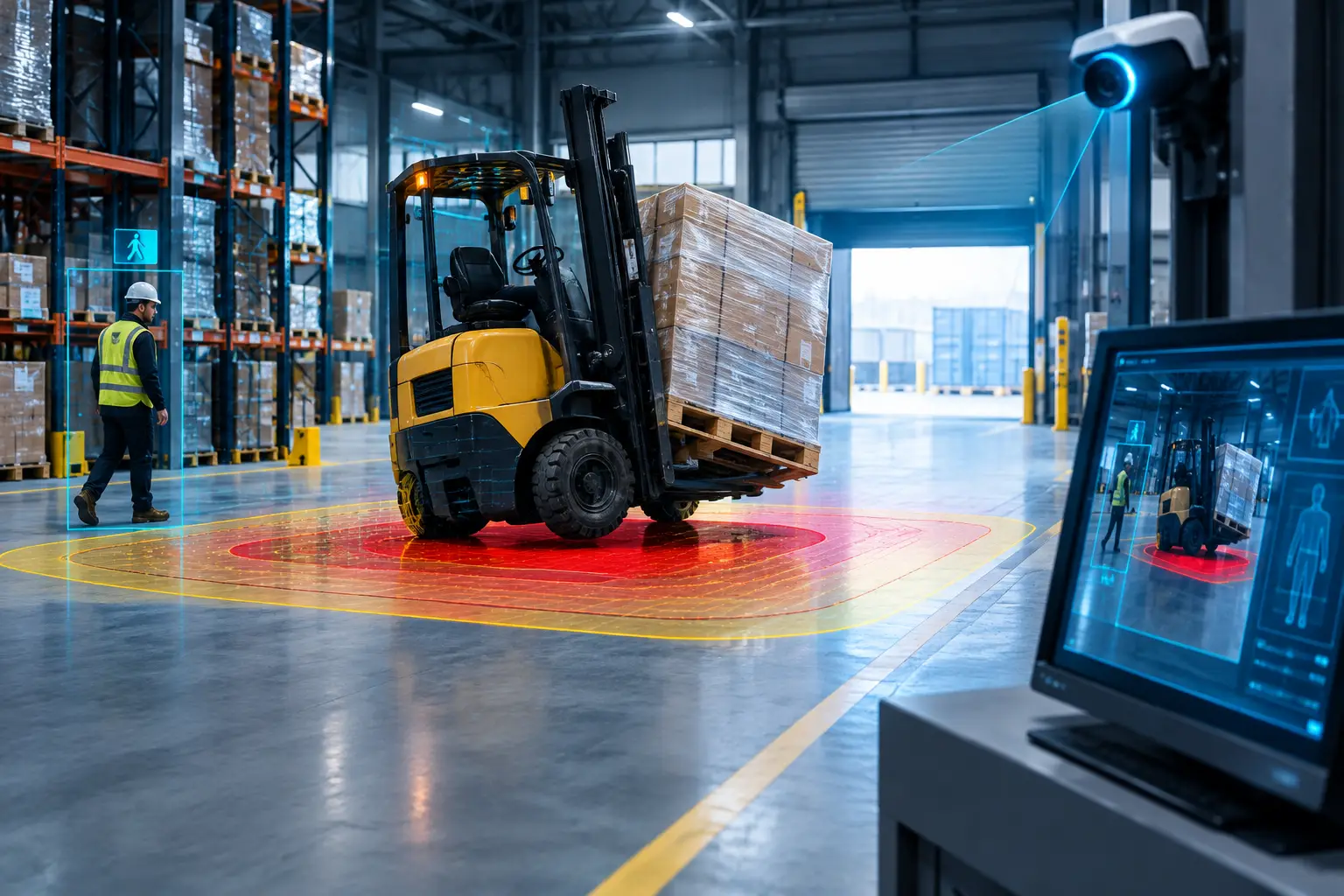
Speed limits are necessary, but signs alone do not control behavior. Facilities should match travel rules to actual operating conditions and reinforce them through training, supervisor observation, route design, and visible warning systems. At high-risk intersections, floor projections, audible alerts, proximity warnings, and Vision AI monitoring can provide an additional layer of protection by drawing attention to approaching vehicles and unsafe interactions.
Ramps, Dock Plates, and Uneven Surfaces
Changes in elevation demand disciplined forklift operation. Ramps, dock levelers, dock plates, potholes, broken concrete, drainage channels, and uneven transitions can shift the truck’s center of gravity or cause a wheel to lose stable contact with the ground.
When traveling on a grade with a load, the load should generally face uphill. This helps prevent the load from pulling the forklift forward or causing it to slide from the forks. Operators also need to avoid turning on ramps whenever possible. Even a shallow incline reduces the stability margin, and a turn can quickly create a lateral tipover condition.
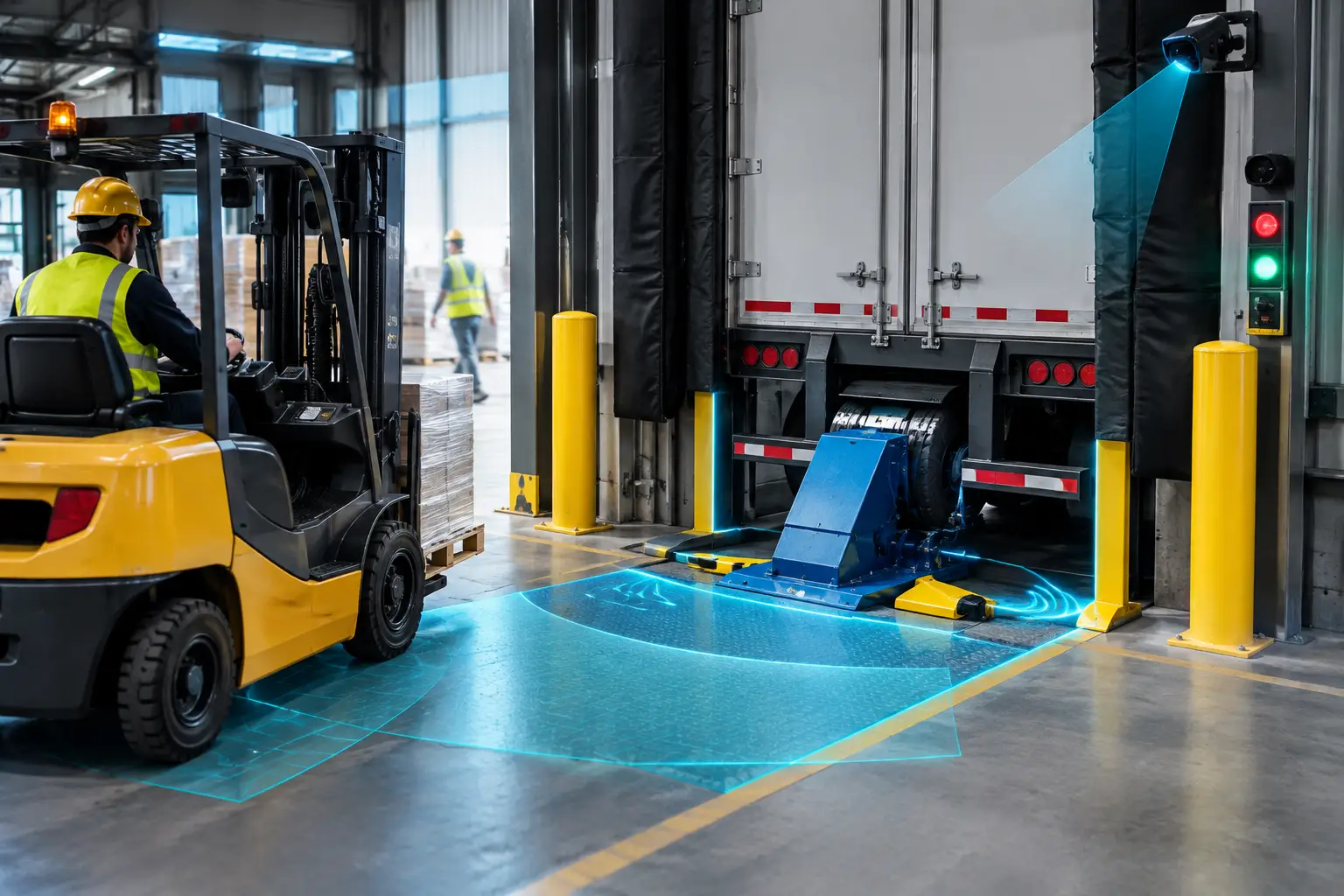
Loading bays require particular attention because conditions can change throughout the day. A trailer that moves unexpectedly, a damaged dock plate, a gap between trailer and dock, or a poorly maintained approach surface can all lead to a serious incident. Vehicle restraint systems, dock condition checks, clear operating procedures, and visible bay-status alerts help control these risks before a forklift enters the trailer.
Equipment Condition and Incorrect Configuration
A forklift’s stability depends on the equipment being in proper working condition. Worn tires, low tire pressure, damaged wheels, leaking hydraulics, uneven forks, malfunctioning brakes, and steering defects can all affect handling. On electric forklifts, battery condition and secure battery placement also matter because the battery is a significant part of the counterweight.
Attachments deserve the same scrutiny. A clamp, rotator, jib, or other attachment changes the truck’s weight, dimensions, and load center. Using an attachment without confirming the revised rated capacity can create a forward-tipover hazard even if the operator believes the load is within the standard truck rating.
Pre-shift inspections should identify defects before the truck enters service. More importantly, reported issues must be resolved promptly. A recurring steering problem or worn tire should not become an accepted part of daily operations simply because the forklift remains usable.
Workplace Layout Can Create Tipover Risk
Some tipovers begin long before an operator starts the ignition. Narrow aisles, poorly marked routes, sharp turns around racking, congested staging areas, inadequate lighting, and damaged floors encourage sudden maneuvers. These conditions also make it harder for operators to keep loads low, travel slowly, and maintain clear sightlines.
A practical risk assessment should observe actual vehicle movement during peak periods, not just review a floor plan. Watch where drivers reverse, where pedestrians cross, where loads are staged temporarily, and where forklift tires regularly strike floor joints or rack protectors. These repeated friction points reveal where the operation is asking too much of the operator and the equipment.
Traffic separation improves safety, but it must be workable. Barriers, designated walkways, controlled crossing points, and one-way travel routes can reduce conflict, provided they do not force forklifts into overly tight turning paths or create bottlenecks at loading and dispatch areas. The right solution depends on the facility’s vehicle mix, load types, shift patterns, and available space.
Controls That Prevent Forklift Tipovers
The strongest prevention programs do not rely on a single measure. They create layers of control that make unsafe conditions easier to recognize and harder to ignore. For most facilities, the essential controls include:
- verified operator training and regular practical observation
- load-capacity checks that account for load centers and attachments
- low-load travel rules, controlled speed, and no-turn expectations on ramps
- scheduled equipment inspections, maintenance, and defect reporting
- engineered traffic routes, maintained floors, and protected high-risk intersections
- warning technologies and monitoring where visibility, congestion, or pedestrian interaction creates persistent risk
Technology should support safe decisions rather than replace them. A proximity warning system can alert an operator to an approaching person or vehicle, but it cannot make an overloaded forklift stable. Vision AI can identify recurring unsafe behaviors and congestion patterns, but the findings must lead to changes in layout, supervision, or operating procedures. The most effective systems connect incident prevention with continuous operational improvement.
Treat Near Misses as Early Warnings
A forklift that rocks during a turn, catches a wheel on a dock plate, drops a load corner, or narrowly avoids a rack strike has exposed a control gap. These events may not result in injury, but they should not be dismissed as routine. They are evidence that the stability margin is being reduced by conditions, behavior, or equipment issues.
Review near misses with the people who operate in that area. Ask what made the task difficult: Was the aisle too narrow? Was the pallet damaged? Did a pedestrian route cross the forklift path? Was the operator’s view blocked? This approach produces more useful corrective actions than assigning blame after a close call.
Every worker deserves to return home safely every day. Preventing forklift tipovers starts by treating stability as an operating condition that must be actively protected, on every lift, turn, ramp, and loading-bay movement.