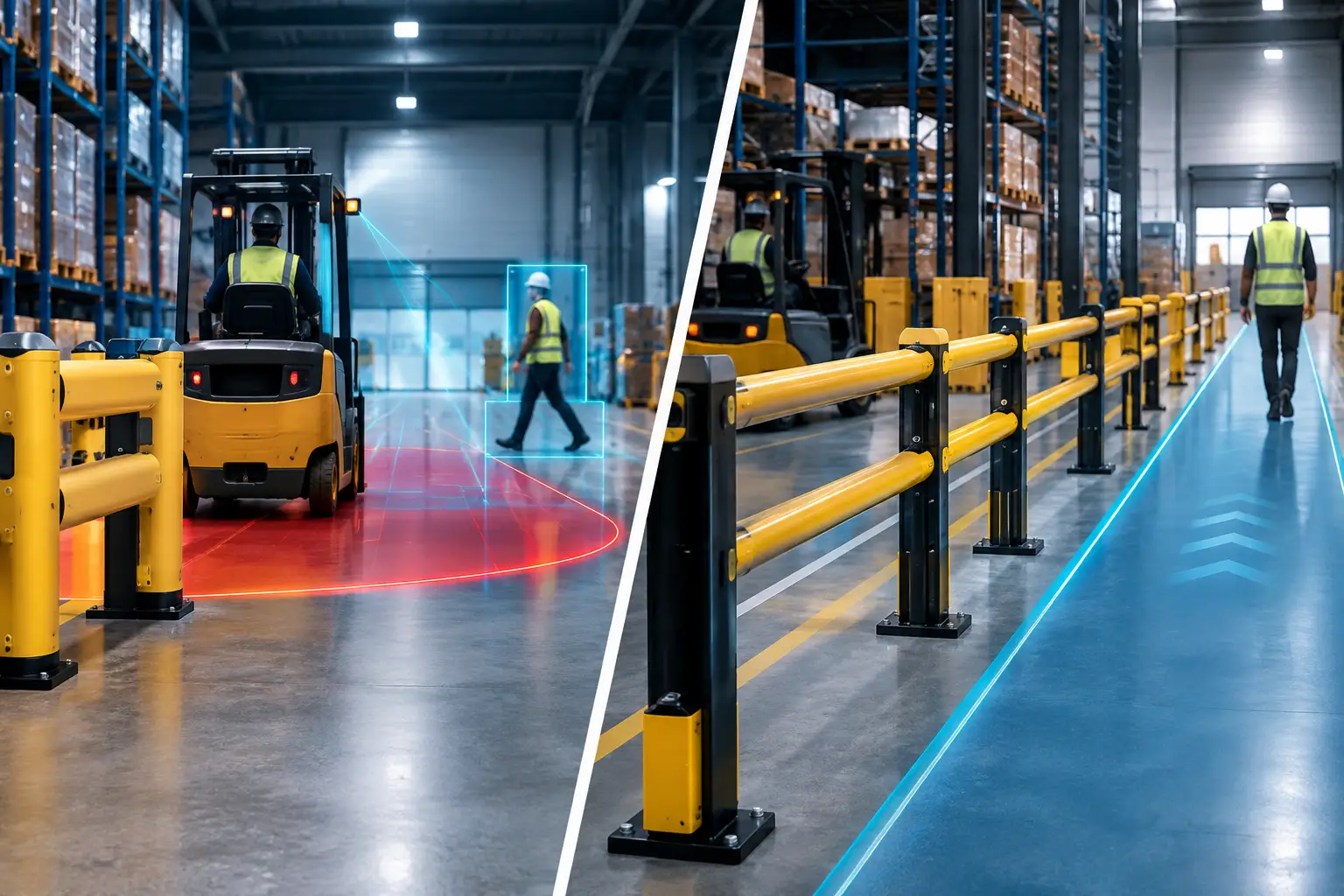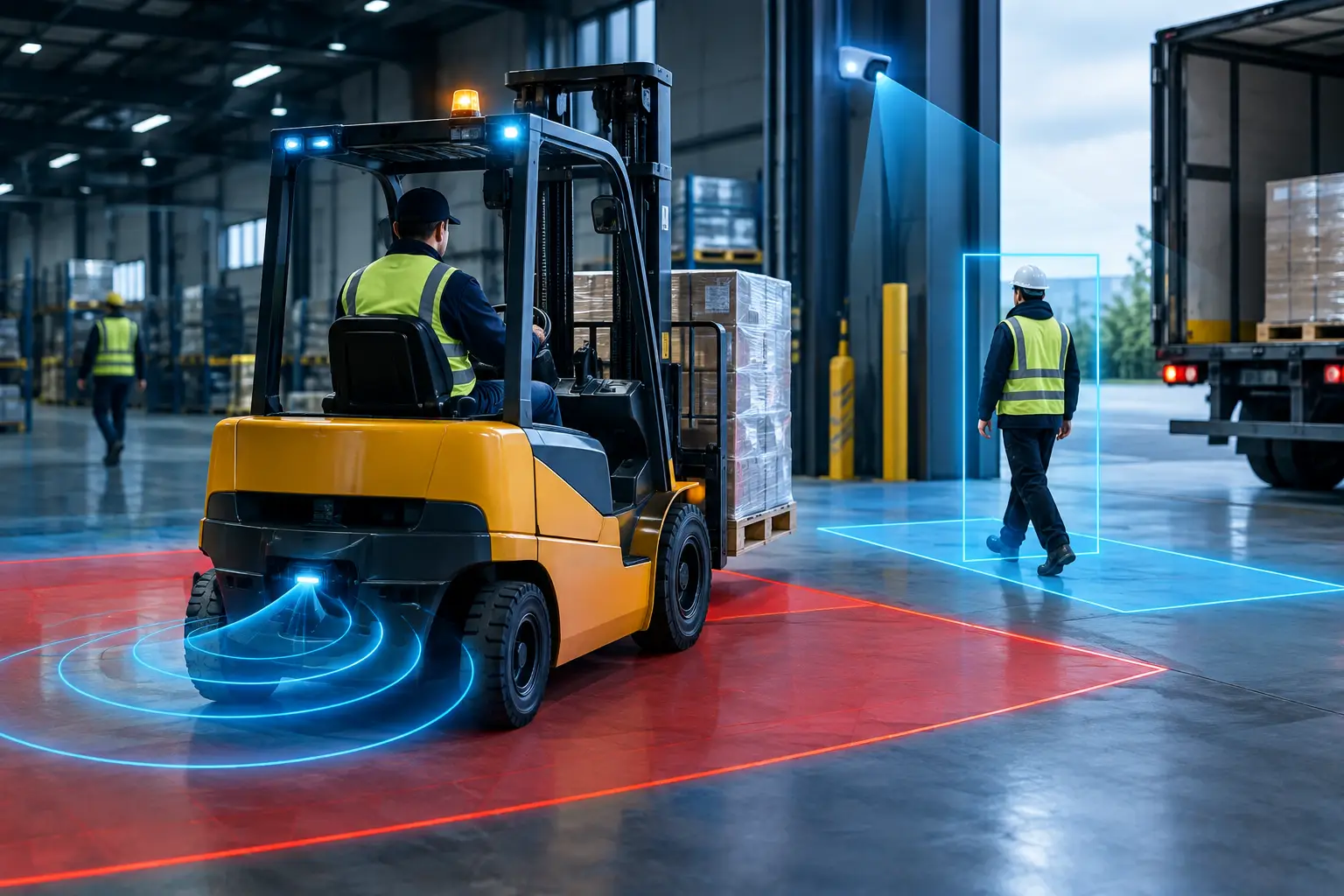
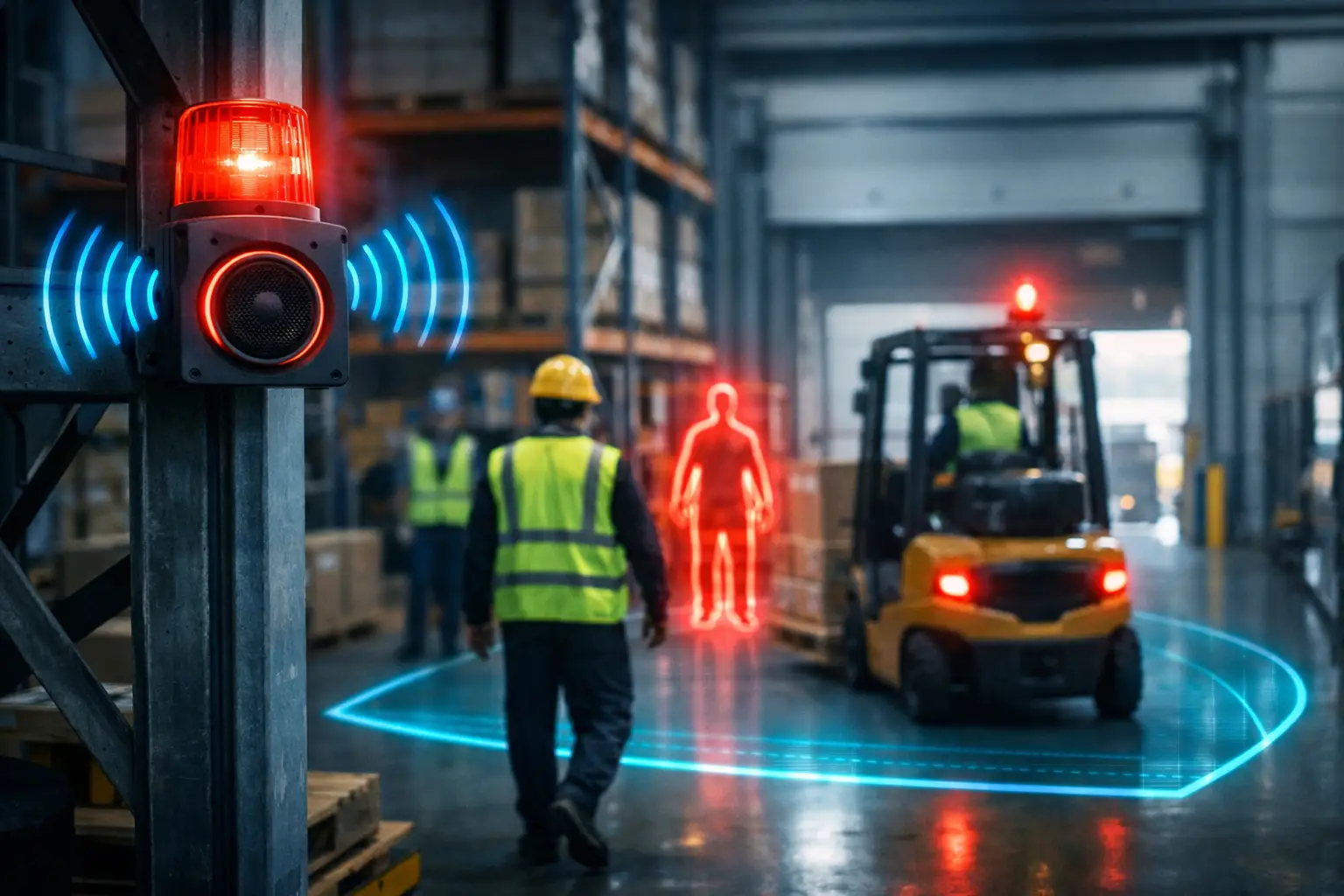
A forklift can emerge from a rack aisle, reverse from a loading lane, or approach a blind corner in seconds. In a busy facility, a warning that reaches only one sense is often missed. Audible visual alarm systems give workers a clearer, faster signal that a vehicle, moving load, or restricted-area hazard requires their attention.
For warehouse and plant managers, the goal is not to add noise or flashing lights for their own sake. It is to create warnings that people can recognize, understand, and act on before an unsafe interaction becomes an incident. When designed around real traffic patterns and operating conditions, these systems help reduce forklift-pedestrian exposure, protect assets, and keep operations moving.
Why audible visual alarm systems matter in industrial traffic
Industrial environments are full of competing signals. Forklift engines, conveyors, dock equipment, radios, pallet movement, and production machinery can mask an audible alarm. At the same time, workers may be facing away from vehicle routes, handling materials, or working in areas where lighting conditions reduce the impact of a standard beacon.
Combining sound and light addresses this gap. An audible signal draws attention where visibility is limited, while a visual signal supports workers who may not hear the warning clearly or may be operating in a high-noise area. The two signals reinforce each other, increasing the chance that a person notices a developing hazard quickly enough to maintain safe separation.
This matters most where forklifts and pedestrians share space. Blind intersections, cross-aisles, loading bays, packing areas, battery charging zones, and doorways between production and storage areas are common conflict points. A warning system can make these locations more predictable, but it should be one control within a broader traffic-management plan, not a substitute for segregated walkways, clear right-of-way rules, or operator training.
Where warning systems deliver the most value
The strongest applications are typically locations with a defined trigger and a clear action expected from personnel. For example, an intersection warning should tell pedestrians to stop and check for approaching vehicles, while a dock alert should indicate that vehicle or dock activity is taking place.
At blind corners, forklift-activated warning lights and sounders can alert people on the opposite side of a rack end before the vehicle enters the crossing. In higher-traffic areas, motion sensors or vehicle detection can activate the alert only when a genuine movement event occurs. This is preferable to a continuously operating alarm that workers may begin to ignore.
Loading bays present another high-risk setting. Reversing vehicles, forklifts transferring loads, and pedestrians carrying out checks can converge in a confined area. Audible and visual alerts can communicate that a bay is active, a vehicle is moving, or a restraint-related condition needs attention. The signal should be tied to a defined operating sequence so workers understand what it means and what behavior is required.
Facility entrances and high-speed doors also benefit from coordinated warnings. A door opening between a warehouse and production area may create a sudden vehicle-pedestrian crossing point. Visible warning indicators, combined with an audible pre-warning where appropriate, help prevent people from stepping into the path of a forklift or powered industrial vehicle.
Choosing the right signal for the risk
Not every alarm is suitable for every environment. Selection should start with the hazard rather than a catalog specification. A warning that is too quiet, too bright, poorly positioned, or triggered too frequently can be ineffective even if the equipment itself is functioning correctly.
Audible alarms need to be noticeable above normal background noise without creating unnecessary disturbance. Tone, volume, directionality, and duration all affect whether workers can identify the source and recognize the meaning of the signal. A reversing alarm may be appropriate for a moving vehicle, but a directional sounder or localized alert can be more useful where general noise levels are already high.
Visual alerts should be visible from the approach paths where people need to make a decision. Beacon placement above a doorway may work for a standing pedestrian but be obscured by pallets, racking, or equipment from another angle. Projected warning zones on the floor can add value at crossings and exclusion areas because they place the message directly in a worker’s line of travel. However, floor projection must be assessed against ambient light, floor condition, and the likelihood of visual clutter.
The selection process should consider at least these operational factors:
- Traffic volume and the mix of forklifts, reach trucks, pallet jacks, trucks, and pedestrians.
- Background noise, lighting levels, sightlines, rack layout, and seasonal or shift-based changes in activity.
- The trigger event, such as vehicle approach, reversing movement, door opening, dock activity, or entry into a restricted zone.
- The action required from the person receiving the warning, including stopping, giving way, waiting, or avoiding an area.
- The need for integration with barriers, sensors, vehicle restraints, access controls, or other safety technologies.
A signal that communicates one simple, consistent message is generally more effective than one system trying to represent several different conditions with minor variations that workers cannot easily remember.
Avoid alarm fatigue before it starts
The most common weakness in warning-system design is over-alerting. If sounders operate all day, or if lights flash whenever someone passes nearby, the warning becomes background noise. Workers adapt, and the alert loses the urgency it was intended to create.
Targeted activation is the answer. Use detection logic and zone design to activate warnings only when a vehicle or person is approaching a credible conflict point. In some facilities, a short pre-warning followed by a more prominent alert as the risk increases is appropriate. In others, a simple vehicle-triggered beacon is enough. It depends on vehicle speed, visibility, traffic density, and how much time people have to respond.
Standardization also reduces confusion. Similar hazards should use similar signals across the facility where practical. If a red projected line indicates a forklift exclusion zone in one department, using the same visual language elsewhere helps workers respond instinctively. Any change should be explained during site induction and reinforced through supervisor briefings and routine observations.
Integrating alarms into a layered safety approach
Audible visual alarm systems are most effective when they support physical and procedural controls. A warning beacon cannot compensate for an unprotected pedestrian walkway that crosses a forklift route several times per shift. Likewise, an alarm alone will not prevent a trailer from moving unexpectedly during loading activity.
Start with the hierarchy of practical controls: separate people and vehicles where possible, improve sightlines, establish controlled crossing points, and use barriers or gates to manage access. Warning systems then provide active awareness at the moments when separation is not possible or where a temporary conflict can develop.
For complex sites, intelligent detection can add another layer. Vision AI monitoring, proximity detection, and sensor-based warning systems can identify interactions that fixed alarms may not capture, such as a pedestrian entering a vehicle operating zone or a forklift approaching a blind crossing at speed. These technologies should be configured carefully to avoid excessive notifications and should be reviewed against actual incident data and near-miss observations.
The benefit is not simply more technology. It is better visibility of risk and a more timely warning for the people exposed to it.
Installation and maintenance determine reliability
A well-chosen warning system can fail operationally if it is installed without regard to the site. Sensors may be mounted where racking blocks detection. Beacons can be placed outside the normal field of view. Sounders can be drowned out by a nearby machine. Cable routes and equipment housings must also withstand the conditions of the operating environment, including dust, vibration, impact risk, washdown requirements where applicable, and vehicle contact.
Before commissioning, test the system during normal activity rather than only in an empty facility. Observe whether a pedestrian approaching from each relevant direction can see and hear the warning. Check whether operators understand what triggers it and whether the alert causes unwanted behavior, such as abrupt stops in an active travel lane.
Maintenance should be planned, not left until a device fails. Routine inspections can confirm sensor alignment, light output, sounder operation, mounting integrity, and the condition of cables and housings. If operational layouts change, the warning design should be reviewed as well. Moving a rack run, adding a packing station, or changing forklift routes can alter sightlines and create new conflict points.
Measure whether the system is changing behavior
A warning system should be evaluated by its effect on risk, not just by the fact that it was installed. Track near misses at the protected location, observe pedestrian compliance at crossings, review vehicle route deviations, and gather feedback from operators and supervisors. A decline in unsafe crossings, sudden braking events, or minor impacts can indicate that the control is improving awareness.
If the results are limited, investigate the cause before adding more alarms. The issue may be poor placement, an unclear signal meaning, a route design problem, or a control that does not match the pace of work. SysGuard approaches these decisions as an engineering and operational challenge: identify the interaction, apply the right warning and separation measures, and verify that the solution works in daily use.
Every worker deserves a clear warning before entering a vehicle conflict zone. The right system makes that warning visible, audible, and meaningful when seconds matter.