A forklift does not need to strike a rack at high speed to create a serious problem. A small impact at the base of an upright can bend a column, loosen anchors, damage stored loads, and create a risk that may not be visible during a busy shift. Choosing the right pallet rack protection types is therefore not just about reducing repair bills. It is a practical control for protecting people, inventory, equipment, and operational continuity.
Rack protection works best when it is selected around the actual traffic pattern, vehicle type, rack layout, and likely impact points. A warehouse with narrow aisles and high forklift activity needs a different approach from a distribution center where pallet jacks mainly operate at rack ends. The objective is not to add barriers everywhere. It is to place the right protection where it can absorb, deflect, or prevent the impact before the rack structure is affected.
Why Rack Impacts Need More Than a Quick Repair
Pallet racking is designed to carry vertical loads through its uprights, beams, bracing, and floor anchors. It is not designed to repeatedly absorb vehicle strikes. When an upright is damaged, its load capacity can be reduced even if the rack remains standing and operations continue.
The risks also extend beyond the damaged bay. An impact can shift beam connections, compromise adjacent frames, or introduce damage that becomes more significant when stock is replenished or load weights change. Taking a damaged section out of service, arranging an assessment, unloading stock, and replacing components can disrupt throughput at the worst possible time.
Protection should be part of a wider traffic management plan. Clearly defined travel routes, controlled forklift speeds, pedestrian separation, operator training, and routine rack inspections all matter. Physical protection adds a critical layer because it still performs when a driver misjudges a turn, a load restricts visibility, or an aisle becomes congested.
Core Pallet Rack Protection Types
Upright or Column Protectors
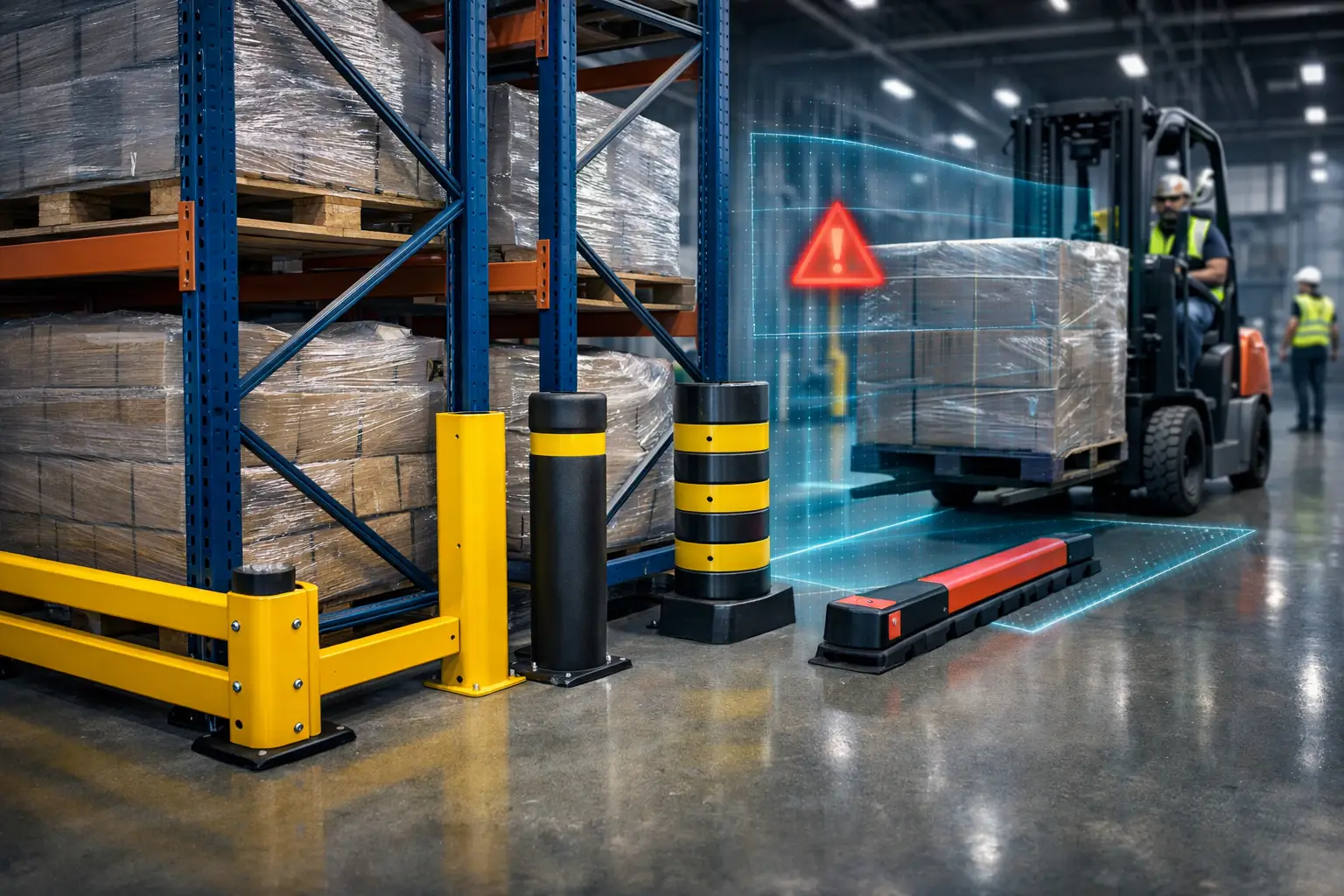
Upright protectors are installed around the lower portion of a rack upright, where forklifts most commonly make contact. They are often made from formed steel and anchored to the floor independently from the rack. This independent anchoring matters because it helps transfer the impact force away from the rack column and into the protected barrier system.
These protectors are a strong choice for aisle-facing uprights, especially at ground-level pick locations and in areas where forklifts turn close to the rack. They are compact, making them useful where aisle width is limited. However, compact upright guards have a defined impact capacity. They should not be treated as a substitute for heavier barriers in high-speed travel lanes or locations exposed to repeated reach-truck or counterbalance forklift impacts.
Polymer upright protectors are also used in some operations. They can provide visible, low-level deflection protection and may be appropriate for light vehicle contact. For areas with heavier forklift movement, a properly engineered steel protector is generally the more suitable control.
Rack End Barriers
Rack ends are among the most exposed parts of a storage system. Forklifts enter and exit aisles nearby, operators turn with loads, and the end frame can be struck from several directions. Rack end barriers create a more substantial line of defense across the front of the end frame.
A floor-anchored steel barrier is commonly used where counterbalance forklifts, reach trucks, or powered pallet trucks operate near the end of an aisle. The barrier should be positioned so it protects the rack without obstructing safe access to pallets, fire exits, or designated pedestrian routes. Height, stand-off distance, anchoring, and barrier length should be matched to the likely vehicle and impact direction.
Rack end barriers are especially valuable at cross-aisles, staging areas, and intersections. These are locations where operators are managing turns, mixed traffic, and changing visibility, rather than traveling in a straight and predictable aisle.
Full-Length Rack Guards and Aisle Barriers
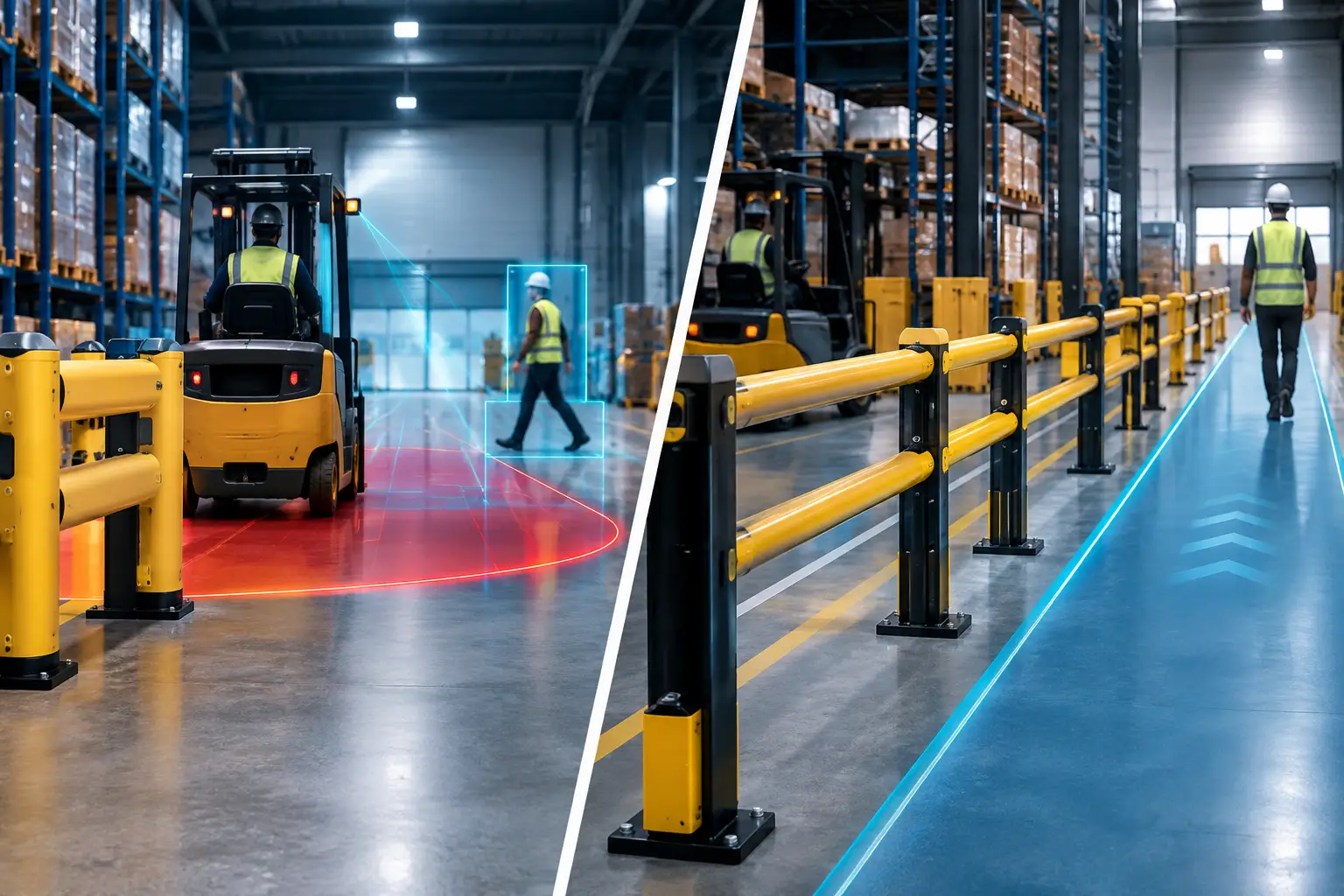
Where a whole rack face is exposed to traffic, protecting only the uprights may leave too much structure vulnerable. Full-length rack guards or continuous aisle barriers run along the lower front of a rack to create a physical separation between vehicles and the storage system.
This approach is useful along main travel routes, near conveyor interfaces, beside packing or dispatch zones, and in facilities where forklifts frequently pass parallel to racking. A continuous barrier reduces opportunities for side contact with multiple uprights and helps make the vehicle exclusion zone obvious to operators.
The trade-off is space. Barriers take up aisle width and need careful layout planning to maintain safe forklift clearance. Before installation, measure truck dimensions, load overhang, turning paths, and battery-change or maintenance access. A barrier that creates a new pinch point does not improve safety.
Bollards and Corner Protection
Steel bollards are effective for protecting isolated rack corners, building columns, door frames, control panels, and other fixed assets near forklift routes. At rack locations, they are commonly used to protect vulnerable external corners or to reinforce an area where a vehicle can approach from an angle.
Bollards provide concentrated protection rather than continuous coverage. They are well suited to defined strike points, but they may not prevent an impact between posts. For a long rack face or a broad turning zone, a rail barrier may provide more complete coverage. Where bollards are used, their placement must account for pallet handling clearance and avoid forcing drivers into tighter turning paths.
Guide Rails and Vehicle Restraint Rails
Guide rails are designed to guide vehicle movement and prevent drift into racks, machinery, or pedestrian areas. They are often installed along narrow travel lanes, charging areas, transfer points, and controlled approaches where repeatable vehicle paths can be established.
Unlike a rack-end barrier, which primarily absorbs a strike, guide rails help prevent the strike from occurring by keeping vehicles within a safe route. They are particularly useful where forklift drivers need to align with a process, such as an automated handling point or a constrained staging lane.
Their suitability depends on how consistently vehicles follow the route. In a highly flexible operation where forklifts need to access multiple positions along a rack, guide rails can reduce maneuverability. The layout must support the work, not fight against it.
Rear Mesh, Backstops, and Load Containment
Rear mesh panels and pallet backstops are often grouped with rack protection, but they address a different hazard. They are intended to prevent pallets, cartons, or loose goods from falling or being pushed through the back of a rack. They do not protect rack uprights from forklift impact.
They are valuable where racking backs onto pedestrian walkways, workstations, conveyors, or another storage aisle. Backstops can also help maintain appropriate pallet positioning, reducing the chance that loads project into an adjacent area. The system must be selected for the load type and installed so it does not interfere with sprinkler clearance, access, or planned pallet overhang.
How to Select the Right Protection
Start with evidence, not assumptions. Review rack inspection findings, maintenance records, forklift damage reports, and near-miss observations. Then walk the operation during active shifts. The highest-risk points are often visible: scraped paint at rack ends, bent guards, tight turning areas, blind intersections, and staging zones where pallets temporarily narrow the route.
Assess the vehicles as well as the racks. A powered pallet truck, reach truck, and counterbalance forklift create different impact heights, forces, and approach angles. Consider the heaviest and largest vehicle that uses the area, including contractors or peak-season equipment. Also consider whether operators travel with elevated loads, which may change visibility and turning behavior.
Protection should be rated and anchored for the anticipated duty. A light-duty plastic guard may be appropriate for minor contact, while a forklift-exposed cross-aisle needs a heavier floor-anchored system. Ask whether the barrier is designed for the likely impact direction and whether its installation leaves enough clearance for pallets and trucks.
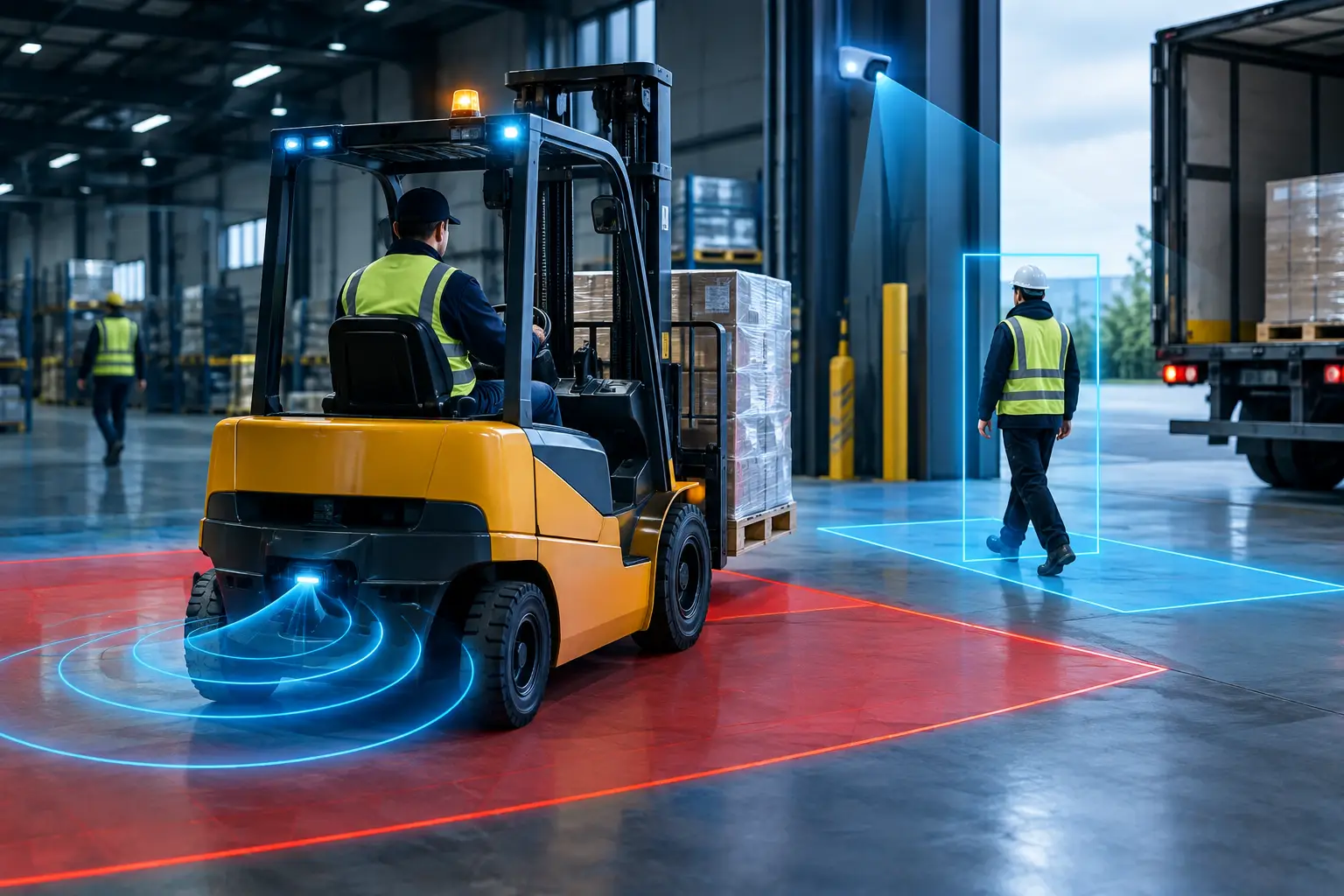
Visibility supports performance. High-visibility yellow finishes, reflective markings, floor projection, warning lights, and proximity alerts can draw attention to rack ends and restricted zones. These measures are most effective when combined with physical protection, not used as a replacement for it. An alert can prompt an operator to react. A barrier provides protection if the reaction comes too late.
Installation and Inspection Are Part of the Control
Even the right product will underperform if it is installed incorrectly. Floor condition, anchor selection, concrete strength, stand-off distance, and rack geometry all influence how a protective barrier behaves during impact. Installation should be planned by people who understand both warehouse traffic and rack structure.
After installation, include barriers and guards in routine inspections. Look for bent steel, cracked polymer, loose anchors, damaged welds, and repeated contact marks. A barrier that has absorbed a significant strike has done its job, but it may need assessment or replacement before the next impact. The same applies to the rack behind it.
The most effective warehouse safety programs do not wait for a rack collapse or injury to reveal a weak point. They identify the places where vehicle movement and storage infrastructure meet, then apply controls that fit the real operation. Well-selected rack protection preserves more than steelwork. It protects the people and processes your operation depends on every day.