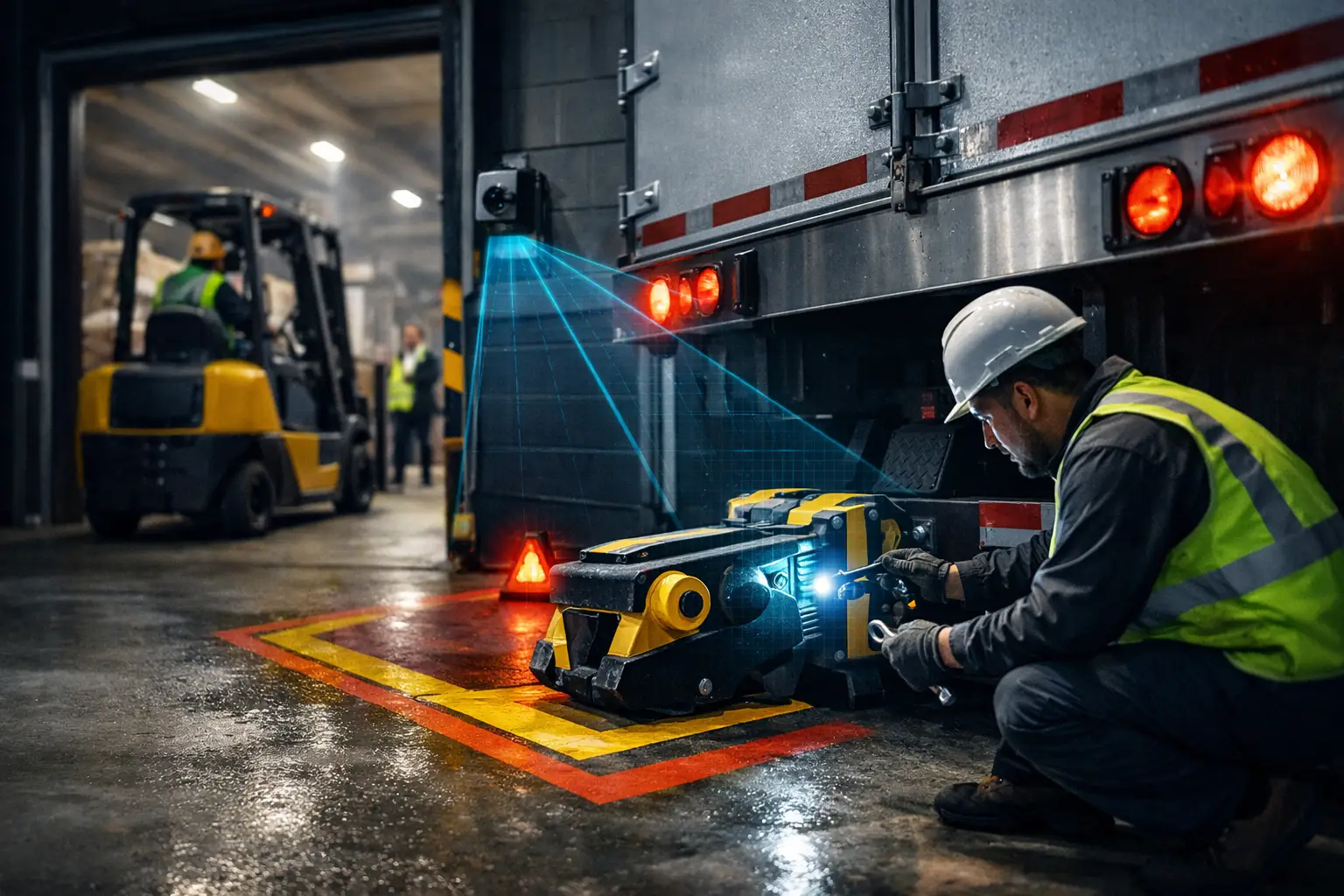
A trailer can appear secure at the dock while a worn locking mechanism, damaged sensor, or failed communication light tells a different story. Vehicle restraint maintenance is what keeps that hidden failure from becoming a trailer creep, early departure, forklift fall, equipment damage, or serious loading bay injury. For facilities handling frequent trailer movements, the restraint is not a fit-and-forget device. It is an active safety control that needs regular inspection, prompt repair, and clear operating discipline.
Why Vehicle Restraint Maintenance Matters at the Dock
Vehicle restraints are designed to hold a trailer in position while forklifts, pallet jacks, and personnel move between the building and the vehicle. Depending on the system, the restraint may engage a trailer’s rear impact guard, secure a wheel, or use another engineered method to reduce unplanned movement.
The loading bay is a high-consequence environment because several activities must work together: the truck must be correctly positioned, the restraint must engage, the dock door must be controlled, the dock leveler must be safe to use, and operators must receive a clear signal that loading can begin. A fault in one part of this sequence can undermine the entire process.
Maintenance protects more than the restraint itself. It helps protect forklifts from falling from a dock edge, prevents damage to dock levelers and building structures, reduces trailer movement incidents, and supports consistent loading procedures across shifts. It also reduces unplanned downtime caused by equipment being taken out of service at the busiest point of a loading operation.
What Can Cause a Vehicle Restraint to Fail?
Most vehicle restraint failures do not happen without warning. They develop through repeated impact, contamination, corrosion, electrical faults, poor adjustment, or operating practices that place the equipment under unnecessary stress.
Trailers do not arrive in identical condition. Rear impact guards may be bent, damaged, unusually low, or incompatible with a particular restraint design. A hook-style restraint may be physically sound but unable to achieve secure engagement with the trailer. Wheel restraints can also be affected by tire position, debris, damaged guide components, or misalignment.
At busy docks, dirt, ice, standing water, loose packaging, and accumulated debris can obstruct moving parts or sensors. In coastal or humid operating environments, corrosion can accelerate deterioration of structural components, fasteners, wiring enclosures, and exposed connections. Repeated truck impact can bend a restraint frame or mounting point, even when the damage is not immediately obvious from the operator’s position.
Electrical and communication issues deserve equal attention. A vehicle restraint with an unreliable inside or outside signal can create false assumptions between the driver and dock team. If the system’s lights, audible alarms, interlocks, or sensors do not correctly reflect restraint status, the process must not rely on visual guesswork.
Build Inspections Into Every Shift
The first line of defense is a brief pre-use check by the dock operator. This is not a substitute for scheduled servicing, but it catches obvious issues before a trailer is loaded.
Before loading begins, the operator should confirm that the restraint is free of visible damage, its engagement area is clear, and it moves through its intended cycle without unusual noise, hesitation, or binding. The operator should also verify that the trailer is properly positioned and that the restraint achieves the intended engagement or securing condition.
Communication signals should match the actual dock status. The external signal must clearly instruct the driver whether it is safe to depart, while the internal signal must accurately tell dock personnel whether loading is permitted. Where the vehicle restraint is integrated with a dock door, leveler, or control panel, the interlock sequence should be checked according to the facility’s operating procedure.
A useful daily inspection record should capture the dock position, date, shift, operator, observed condition, and action taken. The purpose is not paperwork for its own sake. It creates a traceable process for identifying recurring faults, repeat impact damage, and equipment that is becoming less reliable over time.
Remove unsafe equipment from service
If the restraint does not engage correctly, does not release as intended, has damaged structural components, or displays conflicting signals, the dock position should be isolated from use until it is assessed. Operators should not compensate with informal workarounds, such as relying only on a driver’s assurance, bypassing controls, or continuing operations with a known fault.
There may be approved temporary controls for specific situations, but these should be defined through the site’s risk assessment and operating procedures. They must not turn a defective restraint into an accepted normal condition. The safest decision is often to pause that dock position and redirect activity to a safe, available bay.
Schedule Deeper Vehicle Restraint Maintenance
Inspection frequency depends on trailer volume, equipment type, environmental exposure, operating hours, and the manufacturer’s requirements. A restraint at a high-throughput distribution center may need more frequent inspection and service than one at a lightly used dock. Impact-prone bays and sites handling mixed trailer fleets also require closer attention.
Planned service should be performed by competent personnel who understand the restraint’s mechanical, electrical, and control-system requirements. The service scope normally includes a detailed assessment of the following areas:
- Structural frame, welds, anchors, mounting points, and protective guards for impact damage or corrosion.
- Moving components, pivots, cylinders, springs, rollers, and locking parts for wear, alignment, lubrication, and smooth operation.
- Sensors, wiring, connectors, limit switches, control panels, lights, alarms, and interlocks for reliable status indication.
- Trailer engagement performance, including whether the system can safely accommodate the trailer types regularly arriving at the facility.
Do not treat lubrication as the whole maintenance program. Some components require specific lubricants, while others may attract dirt or operate best with minimal lubrication. Applying the wrong material can create contamination, interfere with sensors, or mask a developing mechanical issue. The equipment manufacturer’s service guidance should define the correct method and interval.
Check the system, not just the restraint
A vehicle restraint operates within a larger loading bay safety system. During planned maintenance, inspect the surrounding conditions that can affect its performance: dock surface condition, bumpers, trailer approach alignment, dock leveler operation, door controls, drainage, and bay lighting.
For example, severely worn dock bumpers can change how a trailer sits against the building, affecting the position of the rear impact guard relative to a hook restraint. Poor drainage can expose electrical components to repeated water ingress. Faded floor markings or unclear traffic controls can contribute to misaligned trailer positioning before the restraint is even activated.
This systems approach matters because maintenance teams can otherwise repair a restraint repeatedly without addressing the operating condition that keeps causing damage.
Use Fault Data to Prevent Repeat Problems
The most valuable maintenance records do more than show that service occurred. They help operations leaders understand why faults occur. Track the type of defect, the dock position, trailer type, shift, weather exposure where relevant, repair action, and downtime. Patterns often become visible quickly.
If one bay experiences frequent bent components, investigate trailer approach angles, bumper condition, driver positioning, and yard traffic flow. If communication lights fail repeatedly, review electrical protection, cable routing, water exposure, and the quality of prior repairs. If restraints regularly struggle to engage certain vehicles, assess trailer compatibility rather than forcing operators to improvise.
This information can guide targeted improvements, from revised traffic markings and operator training to upgraded restraints or intelligent dock monitoring. It also gives maintenance and safety teams a stronger basis for prioritizing capital work where risk and downtime are highest.
Keep Operators Part of the Safety Control
Even the best-maintained equipment depends on correct use. Dock personnel need practical training on how the restraint works, what normal engagement looks like, what each signal means, and when work must stop. Drivers and yard teams also need a clear understanding that a green departure signal, or the site’s equivalent release indication, is the only instruction to leave the dock.
Training should cover real site conditions, not only an ideal operating cycle. That includes damaged trailer rear guards, poor trailer positioning, blocked engagement areas, signal faults, and situations where the restraint cannot achieve a safe hold. Clear escalation routes help operators make the right call without pressure to keep freight moving at any cost.
For facilities with multiple dock technologies, standardize visual cues and procedures where possible. Consistency reduces confusion when employees move between bays or when temporary staff support peak operations.
Make Maintenance a Measurable Loading Bay Control
Vehicle restraint maintenance works best when it is planned as part of operational risk control, not handled only after a breakdown. Set inspection intervals based on use and exposure, document faults, close repair actions promptly, and review recurring issues with operations, engineering, and safety teams.
A well-maintained restraint gives people at the dock a dependable answer to a critical question: is this trailer truly secured for loading? Keeping that answer clear, verified, and visible is one of the most practical ways to protect every person working at the loading bay.