A forklift turning out of a rack aisle can cover several meters before its operator sees a pedestrian stepping around a pallet. At that point, painted lines and a reminder to “be careful” are not enough. An effective aisle traffic safety plan designs risk out of the movement itself, giving people and vehicles clear, predictable space to work.
For warehouse and plant leaders, this is not only a safety exercise. Poorly managed aisle traffic creates product damage, racking strikes, blocked travel paths, delayed picking, and avoidable downtime. A practical plan reduces these disruptions while helping workers make safer decisions under real operating pressure.
Start With How Traffic Actually Moves
A traffic plan should reflect the facility in operation, not an idealized floor drawing. Observe each shift, including peak receiving and dispatch periods, replenishment windows, and times when temporary labor is present. Follow a forklift from the dock to put-away, then follow a picker, cleaner, or maintenance technician through the same area. The points where their paths overlap are the starting point for risk control.
Document vehicle routes, pedestrian routes, crossing points, staging zones, battery charging areas, dock approaches, emergency access ways, and blind corners. Also identify where pallets, carts, waste bins, or work-in-progress routinely narrow an aisle. An aisle that is technically wide enough on a layout may become unsafe when it is partially occupied by inventory or waiting equipment.
The assessment should answer four operational questions:
- Where do pedestrians and powered vehicles share the same space?
- Where is an operator’s sightline restricted by racking, loads, doors, or aisle geometry?
- Which locations encourage shortcuts, informal crossings, or reversing?
- When does congestion make established travel routes impractical?
Near-miss reports, equipment damage records, and supervisor observations provide useful evidence. A recurring rack strike at one aisle end, for example, may indicate a turning-radius problem, inadequate protection, poor staging discipline, or a route that forces vehicles and people into conflict.
Build an Aisle Traffic Safety Plan Around Separation
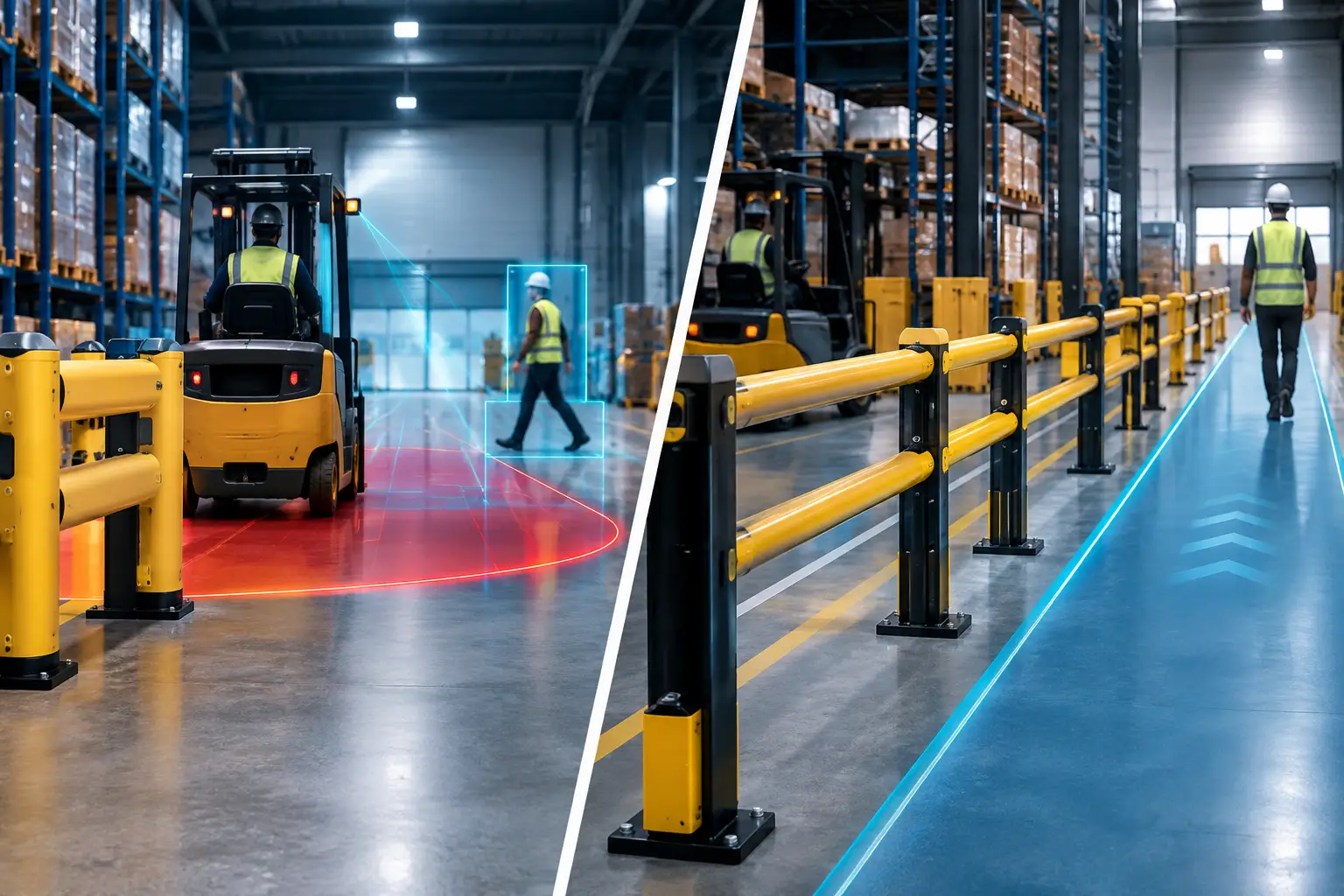
Physical separation is the most dependable way to reduce forklift-pedestrian collision exposure. Administrative rules have a role, but a rule depends on consistent human attention. Barriers, designated walkways, controlled gates, and protected crossings remain in place when workloads rise and visibility drops.
Start by assigning clear travel zones. Pedestrian walkways should be continuous where possible, wide enough for the expected foot traffic, and protected from vehicle encroachment in higher-risk areas. Heavy-duty safety barriers, guardrails, or bollards can provide meaningful protection where forklifts operate close to people, workstations, offices, charging stations, or packing areas.
Not every facility can completely segregate traffic. Older buildings, narrow-aisle storage, and mixed-use production spaces often require shared areas. In these locations, reduce the duration and frequency of interaction. Create defined crossings rather than allowing pedestrians to cross wherever convenient, and position those crossings where operators have the best possible sightlines.
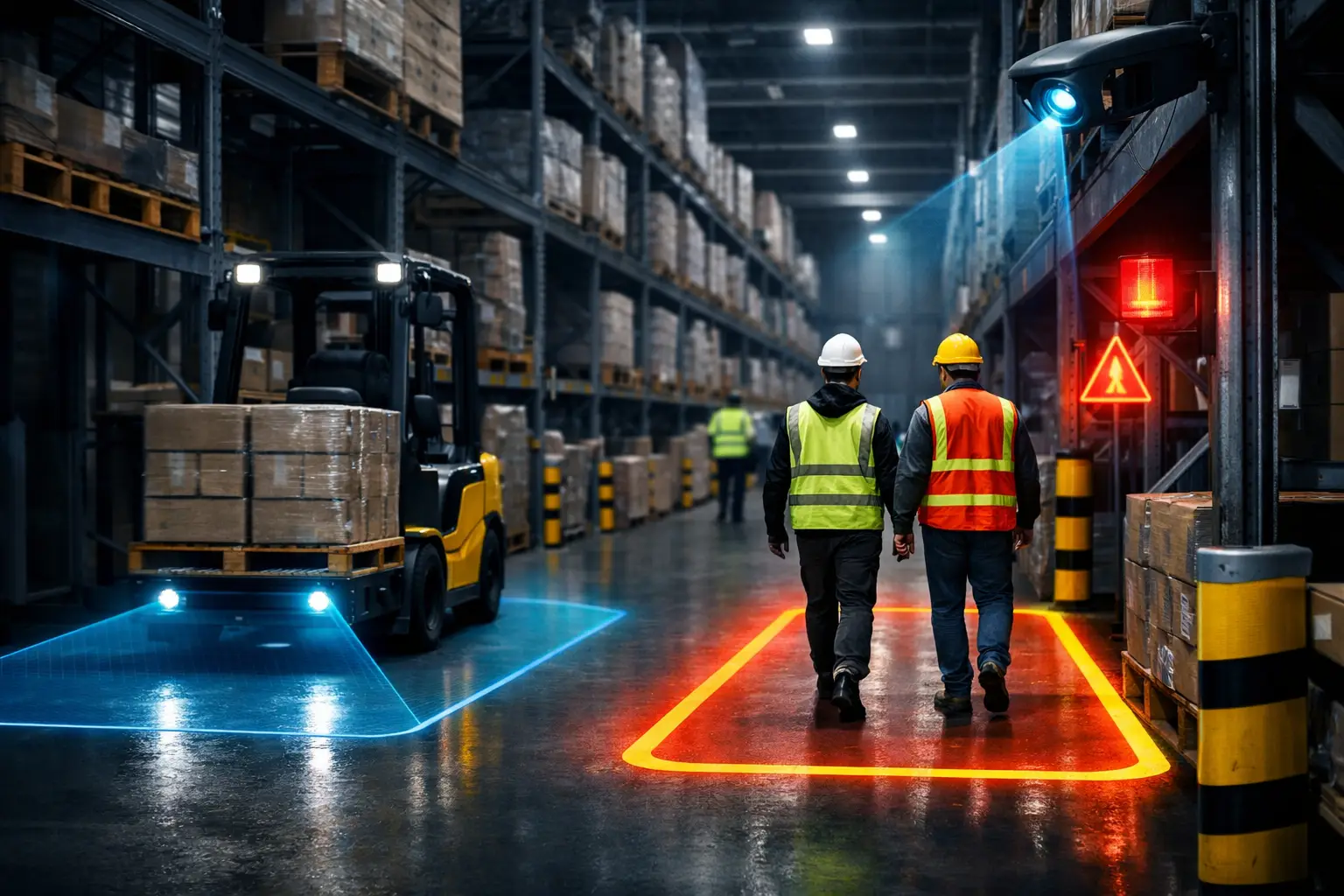
A well-designed crossing is visible before the forklift reaches it. Floor markings, high-visibility signs, projected warning symbols, and pedestrian-controlled alert systems can reinforce the crossing’s purpose. Where traffic is frequent or views are obstructed, consider sensors or intelligent warning systems that alert both the vehicle operator and pedestrian when a conflict is developing.
Control Blind Corners, Intersections, and Reversing
Most aisle hazards are concentrated at transition points: the end of a rack run, an intersection between main and secondary travel paths, a doorway, or the edge of a staging zone. These locations deserve more than a convex mirror and a generic warning sign.
First, improve the physical layout. Keep loads and temporary storage clear of sightlines. Use one-way travel where aisle width, turning activity, and operational flow support it. Where two-way traffic is unavoidable, ensure the aisle can accommodate equipment and loads without forcing operators to travel too close to racking, pedestrians, or parked vehicles.
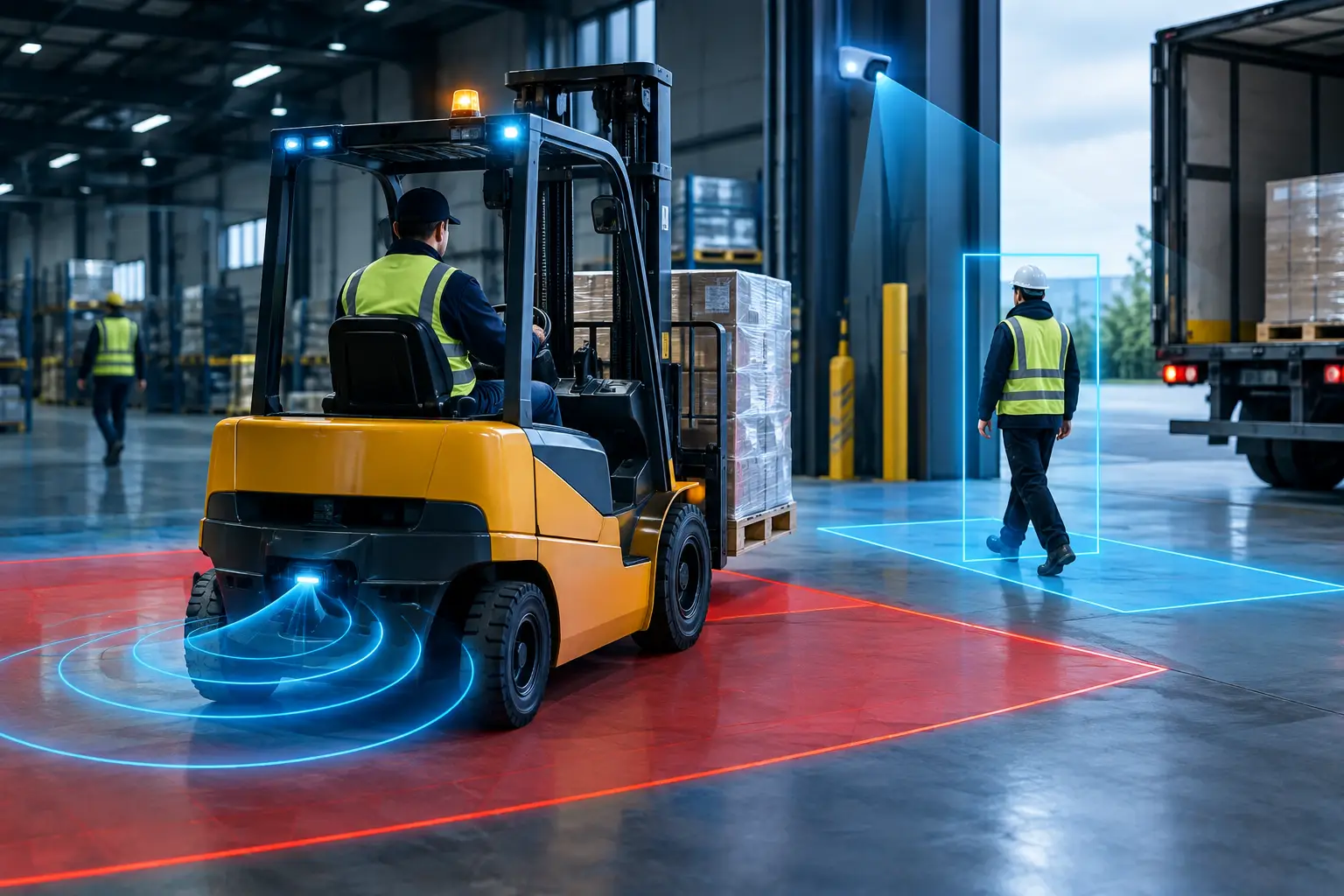
Next, make approaching traffic visible and audible. Blue spot lights, red-zone warnings, projected floor alerts, and audible alarms can increase awareness, particularly in noisy or visually busy facilities. However, these measures should support a controlled traffic design, not compensate for an unsafe layout. Too many alarms can become background noise, while poorly positioned lights may be hidden by loads or washed out by ambient lighting.
Reversing deserves particular attention. It introduces blind zones even for skilled operators, especially with high or bulky loads. Where possible, redesign routes to reduce reverse travel. When reversing cannot be eliminated, use designated maneuvering areas, speed control, clear right-of-way rules, and proximity warning technology appropriate to the operating environment.
Set Rules That Workers Can Apply in Seconds
The strongest traffic rules are specific, visible, and easy to follow under pressure. “Use caution” does not tell a pedestrian where to walk or an operator who has priority at a crossing. A usable plan defines the route, the action, and the exception process.
For example, it should state which aisles are one-way, where pedestrians must cross, where forklifts may stage, what speed is appropriate in different zones, and how drivers should respond when a route is blocked. It should also clarify who can authorize temporary route changes during maintenance, stocktaking, or unusual inbound volumes.
Training should use the actual facility rather than relying only on classroom instruction. Walk operators and pedestrians through critical intersections, show them where sightlines are restricted, and explain why a barrier or crossing has been placed in a particular location. Contractors and visitors need the same clarity before entering operational areas.
Supervisors must reinforce the system consistently. If pallets are allowed to sit in pedestrian routes or vehicles routinely bypass designated lanes to save a few seconds, the written plan will quickly lose credibility. Operational discipline is a safety control, not an administrative detail.
Use Technology Where It Addresses a Defined Risk
Safety technology is most effective when selected for a specific failure point. A proximity warning system may be appropriate where pedestrians must occasionally enter a shared zone. Vision AI monitoring can help identify unsafe interactions, blocked walkways, speeding patterns, or repeated noncompliance that supervisors cannot observe continuously. Forklift impact monitoring can reveal where collisions and harsh events are occurring, helping teams investigate the cause rather than simply repairing the damage.
The right solution depends on the site. A high-throughput distribution center may benefit from automated alerts and data-driven monitoring across multiple intersections. A smaller factory may achieve substantial improvement through better route marking, barriers at key pinch points, and a controlled pedestrian gate. Technology should be tested in the real environment for line-of-sight performance, false alerts, noise levels, worker acceptance, and maintenance requirements.
Do not overlook asset protection. Rack-end barriers, column guards, and bollards can reduce the consequences of minor vehicle deviations. They do not replace good traffic management, but they can prevent a routine operating error from becoming expensive structural damage or a disruption to storage capacity.
Roll Out Changes Without Disrupting Operations
A traffic plan often fails when it is installed once and treated as finished. Warehouses change. SKU profiles shift, new equipment arrives, seasonal volumes increase, and staging areas migrate. Build the plan in phases, beginning with the highest-risk conflict points identified during the assessment.
Before implementation, communicate what will change and why. Mark routes clearly, remove obsolete signs, and avoid creating competing visual messages. Conduct supervised trials if a one-way system, new crossing, or revised staging location will alter established work patterns. Worker feedback is valuable here because operators often identify practical pinch points that are not apparent on drawings.
After rollout, measure whether controls are working. Track pedestrian-vehicle near misses, impacts, rack damage, route obstructions, speeding observations, and unplanned downtime linked to traffic incidents. Review these indicators alongside productivity data. A safer route that creates major congestion may need adjustment, while a slightly longer route may be worthwhile if it removes repeated conflict at a busy intersection.
Keep the Plan Active
Review aisle traffic controls after any incident, layout change, new vehicle introduction, or significant change in throughput. Routine inspections should confirm that barriers are intact, floor markings remain visible, signs are relevant, and designated walkways are not being used for storage. The goal is not to preserve a diagram. It is to preserve safe movement as operations evolve.
Every worker deserves a clear path through the facility and a work area that does not depend on perfect timing or perfect visibility. When traffic routes, physical controls, operating rules, and safety technology work together, accident prevention becomes part of the way the operation moves.