Forklift routes rarely fail because workers do not know the rules. They fail when a person steps into a blind corner, a vehicle reverses from a rack aisle, or loading activity changes faster than people can react. The best industrial warning light systems make these hazards visible at the moment they matter, giving pedestrians, drivers, and supervisors a clearer signal to act before a near miss becomes an injury.
A warning light is not a substitute for traffic segregation, trained operators, or disciplined operating procedures. It is a practical engineering control that strengthens those measures where sightlines, noise, vehicle movement, and changing workflows create residual risk. For warehouses, factories, distribution centers, and loading bays, the right system can reduce collision exposure, protect assets, and prevent the disruption that follows an incident.
Why Industrial Warning Lights Must Match the Hazard
A flashing beacon placed without regard to the actual risk can become background noise. Workers see it repeatedly, learn that it does not require a response, and eventually tune it out. Effective visual warning systems are tied to a defined event: a forklift approaching an intersection, a pedestrian entering a shared zone, a dock door opening, or a vehicle reversing into a restricted area.
Start with the movement pattern, not the product. Review where pedestrians and mobile equipment cross paths, where racks or stored goods obstruct views, and where ambient noise makes audible alerts less reliable. Also consider changes by shift. A route that is clear during daytime replenishment may become congested during outbound dispatch, cleaning, or maintenance activity.
The strongest installations give people enough notice to respond without creating unnecessary alarms. That requires selecting the right warning method, mounting location, activation logic, color, and light output for the operating environment.
Best Industrial Warning Light Systems by Application
There is no single best system for every facility. A compact warehouse with frequent forklift-pedestrian crossings needs a different control than a busy loading bay with truck movement and dock operations. The following systems address common high-risk applications.
Forklift blue spot and red zone lights
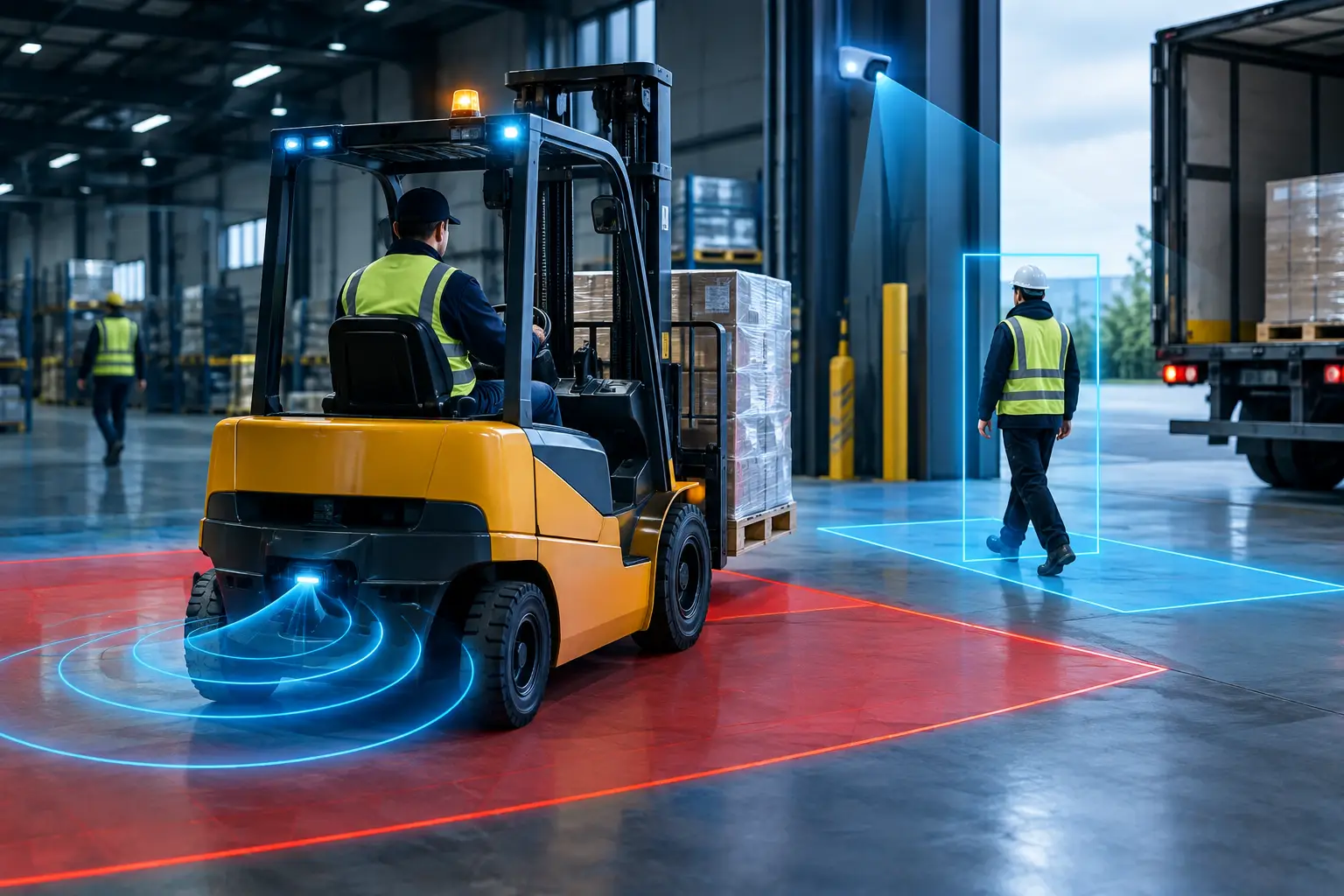
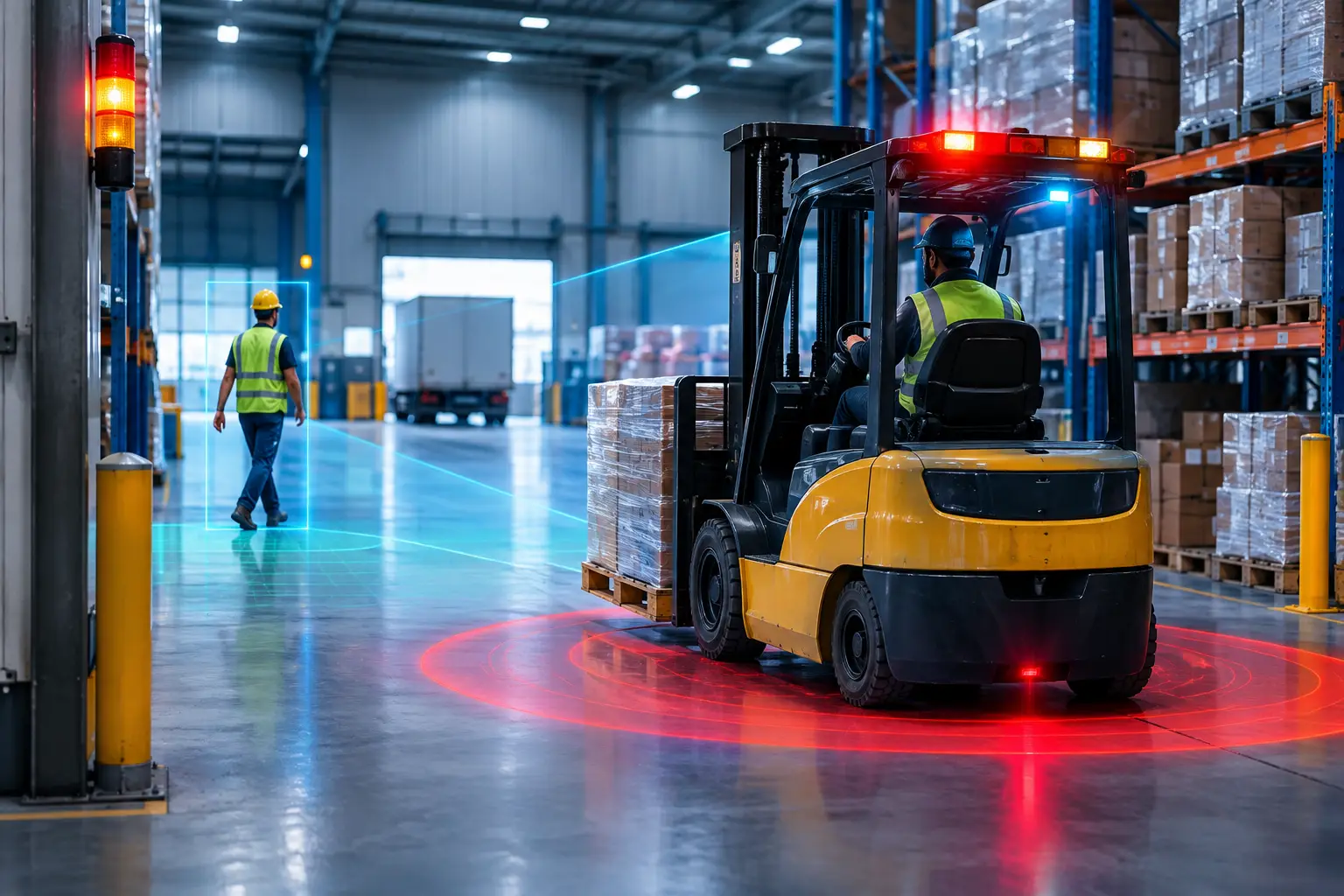
Forklift-mounted blue spot lights project a visible blue warning point ahead of or behind a moving vehicle. They are especially useful at blind corners, cross aisles, doorways, and areas with high background noise. The projected spot gives pedestrians an early indication that a forklift may emerge before the vehicle itself is visible.
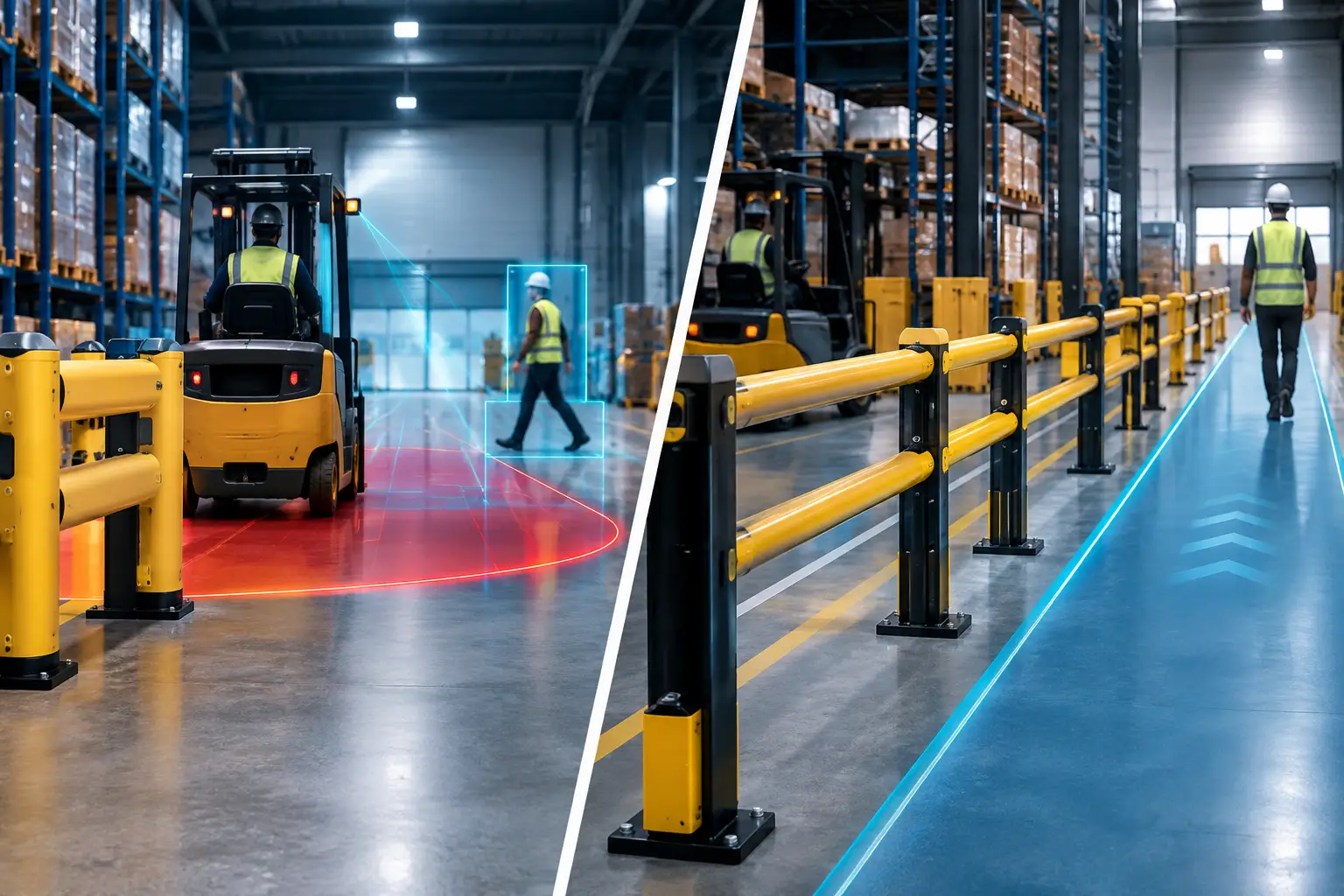
Red zone lights project a line on the floor alongside a forklift to indicate a safer exclusion distance. This can reinforce pedestrian separation during picking, staging, and material handling tasks. Red zone lights work best when workers understand that the line identifies a vehicle operating envelope, not merely a visual feature to step around casually.
These systems are straightforward to deploy, but their effectiveness depends on floor condition and lighting. Highly reflective floors, direct sunlight, or bright outdoor transition areas can reduce projection contrast. Field testing during actual operating hours is essential.
Intersection and blind-corner warning systems
At racking intersections and building corners, visibility is often the central problem. Motion-activated warning lights can alert approaching pedestrians and forklift operators when activity is detected from the opposite side. More advanced systems use sensors to trigger directional lights only for the relevant approach, reducing unnecessary activation.
A well-designed corner system should be positioned where it can be seen before someone commits to the crossing. If the warning only becomes visible at the corner itself, it offers little time for a driver to slow down or for a pedestrian to stop. In high-traffic locations, combining a visual signal with a targeted audible alert may be appropriate, provided the sound does not add to alarm fatigue.
Floor projection warning systems
Projected safety signage places visual instructions directly on the floor: STOP, LOOK OUT FOR FORKLIFTS, KEEP CLEAR, pedestrian crossing symbols, or restricted-zone boundaries. Unlike painted markings, projection remains visible when floor layouts need to change and can be updated without closing an area for repainting.
Floor projection is particularly valuable at crossing points, charging areas, conveyor interfaces, and loading zones where conventional signs are easily blocked by pallets, equipment, or open doors. It can also create a more immediate cue because the message appears in the worker’s natural line of sight.
The trade-off is that projected messages require appropriate contrast and surface conditions. They should support physical barriers and traffic controls, not attempt to compensate for a poorly designed route.
Dock door and loading bay status lights
Loading bays concentrate multiple hazards: trailers arriving and departing, forklifts entering trailers, pedestrians moving around staging lanes, and dock doors opening and closing. External and internal status lights can communicate whether a bay is safe for entry, whether a restraint is engaged, or whether a door is in an unsafe condition.
The value comes from connecting the light state to the actual dock process. A red signal that remains active until a vehicle restraint, dock equipment, or operating sequence reaches the correct condition gives teams a clear visual control. A manually switched light can still help, but it relies more heavily on consistent human action.
Proximity-triggered visual alerts
Proximity warning systems use sensors, tags, or detection technologies to identify when pedestrians and vehicles enter a defined risk zone. When the system detects a potential interaction, it can activate warning lights on the vehicle, in the surrounding area, or at a fixed location.
This approach is useful in mixed-traffic operations where fixed signs cannot account for changing movements. However, detection settings need careful commissioning. Excessive triggering can reduce trust in the system, while overly narrow detection zones may not provide sufficient warning time. Facilities should validate performance with real vehicle speeds, pedestrian behavior, aisle widths, and load configurations.
Vision AI-enabled warning systems
For complex areas, Vision AI safety monitoring can identify people, vehicles, unsafe entry into restricted zones, or other defined behaviors. It can then trigger visual alerts based on what is actually happening rather than simple motion alone. This makes it well suited to high-value risk areas with variable traffic patterns, such as loading interfaces, busy crosswalks, and production-to-warehouse transfer points.
Vision AI requires sound camera placement, clear operational objectives, and thoughtful alert design. It is not a plug-and-play answer to every hazard. Used correctly, it can provide more relevant warnings and help safety teams understand recurring exposure points that need layout or process improvements.
How to Select a System That Workers Will Respond To
A productive selection process begins with a site risk assessment. Observe the area during peak operation, not only when traffic is light. Map routes, identify blind spots, measure approach distances, and note where people take shortcuts. Review near-miss reports, equipment damage, and recurring congestion because these often reveal hazards not captured in a static floor plan.
Then define the response required from each warning. Should a pedestrian stop? Should a forklift operator slow down? Should a dock worker wait for an all-clear signal? A warning that does not communicate a clear action will deliver inconsistent results.
Consider these practical selection factors:
- Visibility in the actual environment, including sunlight, dust, reflective surfaces, and high-bay lighting.
- Activation logic that reflects the hazard rather than triggering continuously.
- Mounting positions that remain visible despite racking, loads, doors, and equipment movement.
- Durability suited to vibration, washdown exposure, temperature, and impact risk.
- Integration with forklift systems, dock equipment, barriers, sensors, or monitoring platforms where this improves control.
Color should be consistent across the facility. If red means stop at one loading bay, it should not mean vehicle approaching in another area. Standardizing visual language helps temporary staff, contractors, and employees moving between departments recognize the intended response quickly.
Installation Is Part of the Safety Control
Even high-quality warning technology can underperform when installation is treated as an afterthought. Before rollout, test the system in one representative risk area. Observe whether people notice it, whether it changes their behavior, and whether drivers can see it in time. Adjust the angle, height, detection range, or light pattern before replicating the design elsewhere.
Training should be brief, specific, and connected to normal work. Explain what triggers the alert, what the signal means, and the action each person must take. Supervisors should reinforce the control during shift observations and address workarounds early, especially if teams start relying on the warning system instead of maintaining safe travel practices.
Maintenance matters as well. Dirty lenses, misaligned projectors, damaged cables, depleted vehicle power connections, and sensor drift can quietly reduce performance. Include visual warning devices in planned inspection routines and investigate repeated activations or failures as operational data, not just maintenance issues.
Build Visibility Into the Areas Where Risk Changes Fast
The best industrial warning light systems are the ones that fit the facility’s real movements and prompt a clear response before people and equipment occupy the same space. Start with the locations where visibility is limited, traffic is unpredictable, or the consequence of a mistake is high.
Every worker deserves to return home safely every day. A properly designed warning system helps turn that responsibility into a visible, repeatable part of daily operations.