A forklift reversing out of an aisle, a picker stepping around a pallet, and a truck arriving at a loading bay can create a serious exposure in seconds. Warehouse incident reduction is not achieved by asking people to be more careful after a near miss. It requires the operation to identify where people, vehicles, loads, and fixed infrastructure come into conflict – then change the conditions that allow an incident to happen.
For warehouse, plant, and logistics leaders, this is both a worker protection issue and an operational continuity issue. A collision can injure someone, damage stock or racking, take a vehicle out of service, block a dispatch lane, and trigger an investigation that disrupts the entire shift. Every worker deserves to return home safely every day. A well-designed safety program helps make that outcome less dependent on luck.
Why Warehouse Incidents Keep Repeating
Many incidents are treated as isolated behavioral failures: a driver traveled too fast, a pedestrian entered a vehicle zone, or an operator did not check a blind corner. Those actions matter, but they are often the final link in a longer chain of operational conditions.
Congested aisles, poor sightlines, changing inventory layouts, rushed loading schedules, mixed pedestrian and forklift routes, and unclear right-of-way rules all increase exposure. The risk is especially high at intersections, dock doors, staging areas, battery charging zones, and rack end locations. These are places where normal work requires people and mobile equipment to occupy the same limited space.
Training remains necessary, but training alone cannot compensate for a layout that puts pedestrians in a forklift’s blind spot or a loading bay process that depends on verbal coordination. The more a safety control relies on perfect attention under pressure, the less reliable it becomes over time. Effective prevention combines competent people with engineered controls, clear processes, and visible feedback.
Start Warehouse Incident Reduction With Exposure Mapping
Before selecting equipment, map the actual movement of the facility. This is not the same as reviewing a floor plan from an office. Observe how forklifts travel during peak receiving, replenishment, picking, and dispatch periods. Watch where pedestrians cross routes because it is faster, where pallets accumulate, and where drivers reverse because turning space is limited.
A useful assessment focuses on the interaction points rather than the individual hazards in isolation. A pedestrian walkway may look adequate until it meets a blind intersection. A dock approach may appear controlled until a truck driver departs before loading equipment has cleared the trailer. A marked aisle may work during normal volume but fail when overflow stock narrows the route.
Record near misses as seriously as damage events. A near miss is often the clearest signal that a control is weak but has not yet failed at the worst possible moment. Look for repeat patterns by location, time of day, activity, vehicle type, and shift. If several reports involve the same crossing point, the issue is unlikely to be solved by another reminder poster.
Questions that reveal the real risk
Ask practical questions on the floor: Can a forklift operator see a pedestrian before entering an intersection? Can a pedestrian reach their work area without crossing a vehicle route? Is there a physical boundary between people and moving equipment? What happens when the normal process is disrupted by a late truck, a blocked dock, or a rush order?
The answers show whether the operation is controlling risk at its source or simply reacting to it after people are exposed.
Separate People and Vehicles Wherever Possible
The strongest forklift-pedestrian safety measure is separation. Dedicated pedestrian walkways, protected crossings, guarded workstations, and controlled access points reduce the chance that people and vehicles must negotiate the same space at the same time.
Physical barriers are more dependable than painted lines alone in high-traffic areas. Floor markings can define intent, but they do not stop a forklift from drifting into a walkway or prevent a pedestrian from taking a shortcut. Warehouse safety barriers, guardrails, and impact-resistant protection can create a clear boundary while also protecting racking, machinery, and building infrastructure from vehicle strikes.
Full separation is not always possible, particularly in existing facilities with constrained layouts. In those cases, control the interaction deliberately. Limit crossings to defined points, improve visibility, reduce vehicle speed at conflict zones, and use active alerts where they provide a clear additional layer of protection. The right solution depends on traffic volume, sightlines, vehicle types, pedestrian frequency, and the consequences of a collision.
Make Blind Spots Visible Before They Become Collisions
Blind corners and reversing movements deserve special attention because both parties may be unaware of the other until it is too late. Convex mirrors and signs can help in low-complexity areas, but they rely on users seeing, interpreting, and acting on the information at exactly the right time.
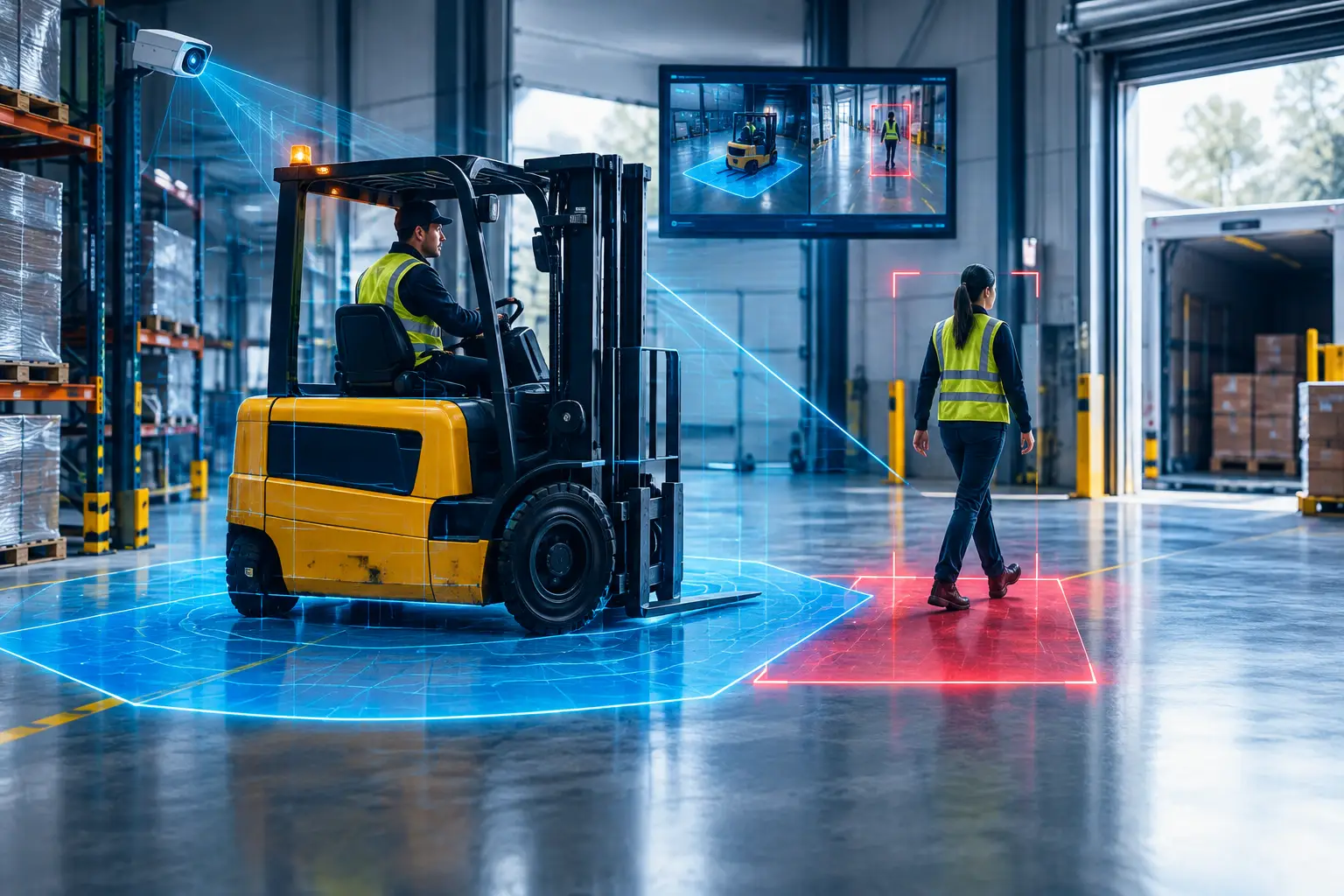
Active warning technologies add another level of control. Safety floor projection can project a visible warning zone ahead of an approaching vehicle or around a blind corner. Audible and visual alert systems can warn people of vehicle movement at intersections, doorways, and restricted areas. Proximity warning systems can alert operators and pedestrians when they enter a defined risk zone.
These controls should be selected carefully. Too many alarms can create noise fatigue, particularly in a busy distribution environment. Alerts work best when they are targeted, easy to understand, and tied to a specific action: stop, wait, or stay clear. During commissioning, test the system under normal operating noise, lighting, and traffic conditions rather than assuming a warning that works in an empty facility will work during peak activity.
Use Vision AI to identify recurring unsafe interactions
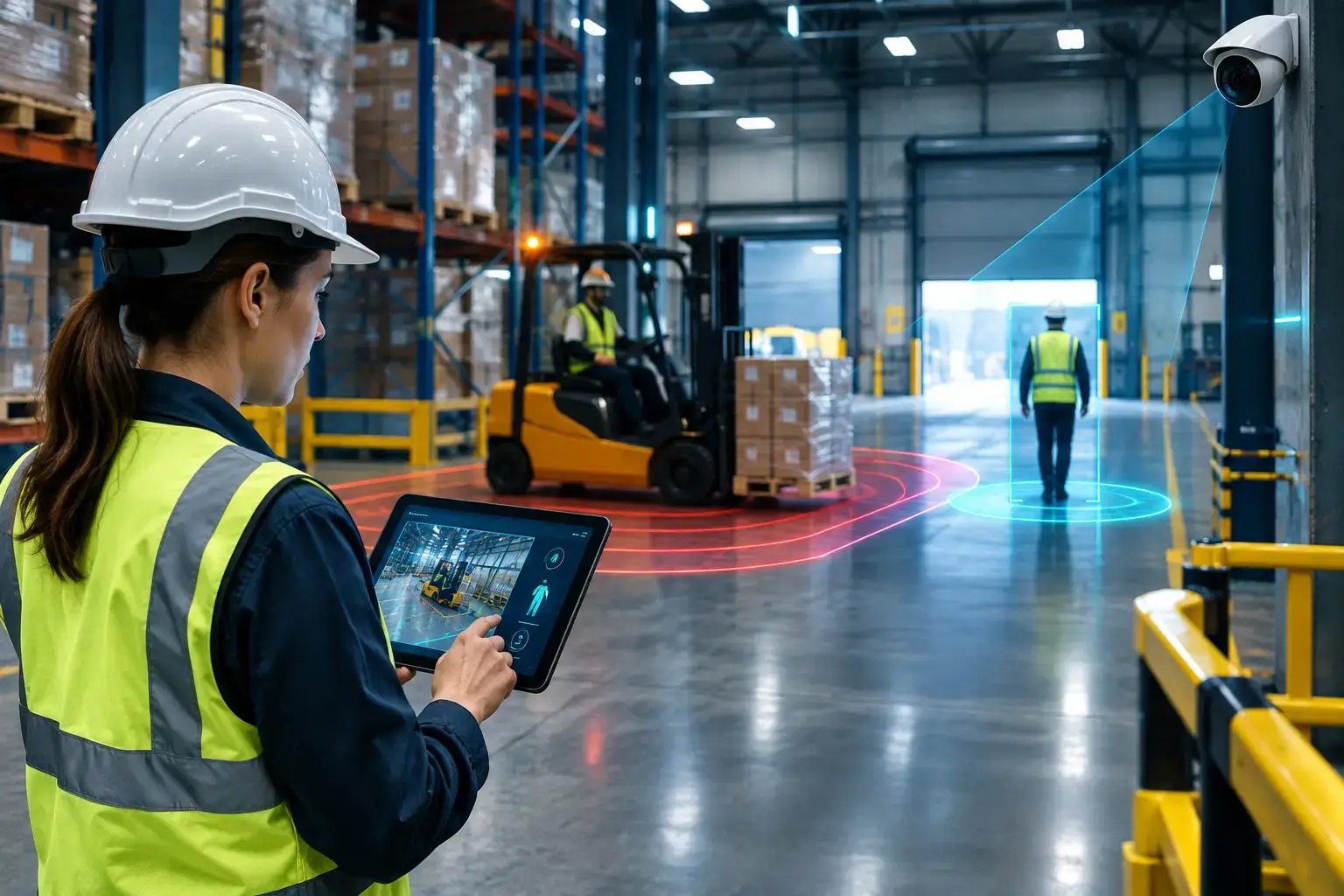
Vision AI safety monitoring can help operations move beyond incident counts. Instead of waiting for contact, managers can identify unsafe proximity events, repeated encroachment into pedestrian zones, missing separation at crossings, or behaviors that occur at particular times and locations.
The value is not simply in collecting more footage or more notifications. It is in using operational data to identify where controls need adjustment. If a system repeatedly detects close interactions at one aisle end, the response may involve changing the travel route, relocating a staging area, adding a barrier, or adjusting replenishment timing. Technology should support corrective action, not become a substitute for it.
Treat Loading Bays as High-Consequence Work Zones
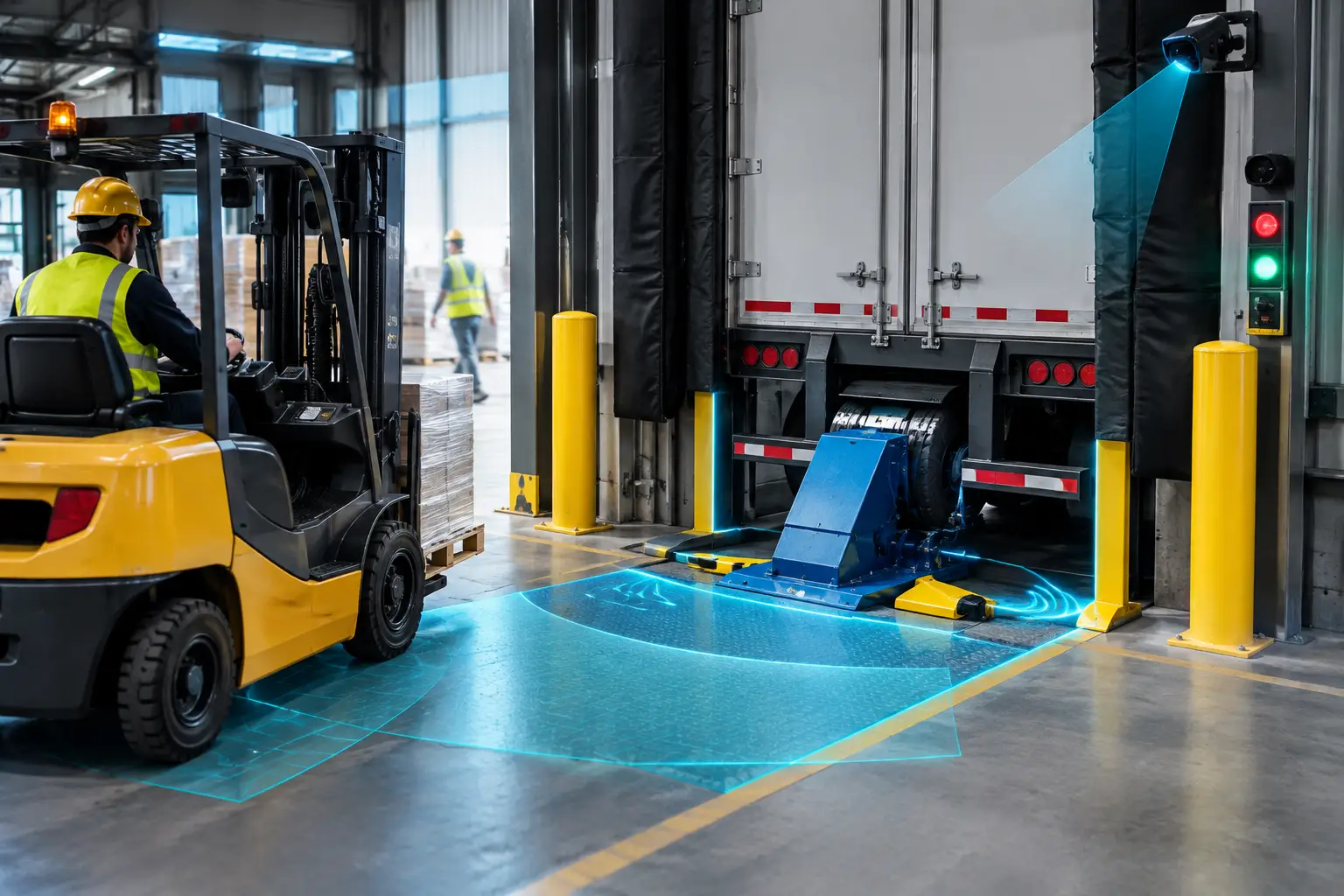
Loading bays combine vehicle movement, uneven schedules, external drivers, changing trailer conditions, and time pressure. A small coordination failure can lead to premature vehicle departure, trailer movement, falls between dock and trailer, or impacts involving material handling equipment.
A reliable loading bay safety process establishes who controls the vehicle’s status, when loading or unloading may begin, and how the dock team knows it is safe to proceed. Vehicle restraint systems, dock communication signals, wheel-based controls where appropriate, and physical dock protection can reduce reliance on assumptions between drivers and warehouse staff.
The most effective approach considers the entire sequence from vehicle arrival to departure. Controls must remain clear during shift changes, peak arrivals, and exceptions such as damaged trailers or delayed paperwork. If the process only works when a particular supervisor is present, it is not yet a dependable process.
Protect the Assets That Protect Your Operation
Rack strikes, damaged columns, broken guardrails, and repeated contact with dock infrastructure are not merely maintenance issues. They are evidence of uncontrolled vehicle movement and can create secondary hazards if left unaddressed.
Rack protection and column guards help limit the consequences of low-speed impacts, but they should not normalize repeated strikes. Track damage by location and frequency. A rack end that is hit repeatedly may need better segregation, a wider turning area, a revised travel path, or additional visual guidance. The objective is to eliminate the conditions causing contact while protecting critical assets during the transition.
This is where safety and efficiency often support each other. Clear routes, protected infrastructure, and fewer blocked aisles reduce unplanned work, equipment downtime, product loss, and delays in material flow.
Build Controls Into Daily Operations
Warehouse incident reduction cannot remain a one-time project completed after new signs or barriers are installed. Layouts change, throughput rises, seasonal staff arrive, and new equipment is introduced. Controls must be reviewed against the way work is actually being done.
Assign ownership for checking safety-critical areas, including crossings, pedestrian routes, loading bays, and rack protection. Inspect whether barriers remain intact, whether floor markings are still visible, and whether warning systems are functioning as intended. When changes are proposed to storage density, travel routes, or dock processes, evaluate their safety impact before implementation.
Workers and supervisors should also have a straightforward way to report hazards and near misses. The goal is not to create blame or paperwork. It is to capture early warning signs while there is still time to fix a route, adjust a process, or repair a damaged safeguard.
A practical partner can support this work by connecting site assessment, engineering recommendations, installation, training, and ongoing maintenance. SysGuard approaches safety technology as part of the operating environment, not as an isolated product purchase.
The safest warehouse is not the one with the most warning signs. It is the one where workers can predict how vehicles will move, where people are protected from moving equipment, and where the operation learns from close calls before someone is harmed. Start with the highest-exposure interaction in your facility, make one meaningful control improvement, and use what you learn to strengthen the next one.